
If the U.S. government places tariffs on imports from countries that have been accused
of deliberately undervaluing their currencies, the price of these imports will ________
and the demand for the undervalued currency will ________.
A) rise; rise
B) rise; fall
C) fall; rise
D) fall; fall
If a brewery wants to raise funds to purchase a new fermenting vat, it does so in the
A) factor market.
B) output market.
C) product market.
D) alcoholic beverages market.
Suppose Bill Gates deposits $20 million into his checking account at Wells Fargo Bank.
If the required reserve ratio is 10 percent, what is the maximum change in money
supply?
A) -$200 million

B) -$180 million
C) $2 million
D) $180 million
E) $200 million
Purchasing power parity is the theory that, in the long run, exchange rates should be at a
level such that equivalent amounts of any country’s currency
A) will equalize nominal interest rates across countries.
B) are valued inversely relative to the size of its GDP.
C) should earn the same real rate of return.
D) allow one to buy the same amount of goods and services.
The United States abandoned the ________ because the government wanted to rapidly
expand the money supply in response to the Great Depression.
A) gold standard
B) Bretton Woods system
C) managed float
D) floating exchange rate system

Labor productivity is
A) the quantity of output produced in one hour by several workers.
B) the quantity of capital one worker can produce in one day.
C) the quantity of output produced by one worker or by one hour of work.
D) the quantity of output produced in one hour by one machine.
If one U.S. dollar could be exchanged for one Canadian dollar in 1970, and one U.S.
dollar can now be exchanged for 1.13 Canadian dollars, which of the following is true?
A) The U.S. dollar lost value against the Canadian dollar.
B) The Canadian dollar lost value against the U.S. dollar.
C) The Canadian dollar gained value against the U.S. dollar.
D) Both A and C are true.
The Mass Rapid Transit (MRT) System in Hong Kong has been running significant
losses. Transport Ministry officials have argued over whether to raise fares to combat
the losses. One argument against a fare increase is that it will aggravate traffic
congestion on the streets during peak commuter hours. Suppose that the current fare is
$4 and the government is considering raising it to $6. Officials estimate that this
reduces the number of rides purchased from 10,000 to 8,000 per day.
a. What is the estimated elasticity of demand for MRT rides?
b. What does this elasticity of demand suggest to you about what will happen to total
revenue earned by the transit system?
c. Last year, the MRT system incurred a loss of $50,000 per day. Do you think the fare
increase will resolve the deficit problem as well as Ministry officials anticipate?
Explain.
Dividing the dividend payment by the stock’s closing market price determines the
A) coupon payment.
B) dividend yield.
C) price-earnings ratio.
D) selling price of the stock.
The price elasticity of supply of hot dog buns is estimated to be 1.5. Holding everything
else constant, this means that a 10 percent decrease in the price of hot dog buns will
cause the quantity of hot dog buns supplied to decrease by
A) 1.5 percent.
B) 15 percent.
C) approximately 25 percent.
D) approximately 5 percent.
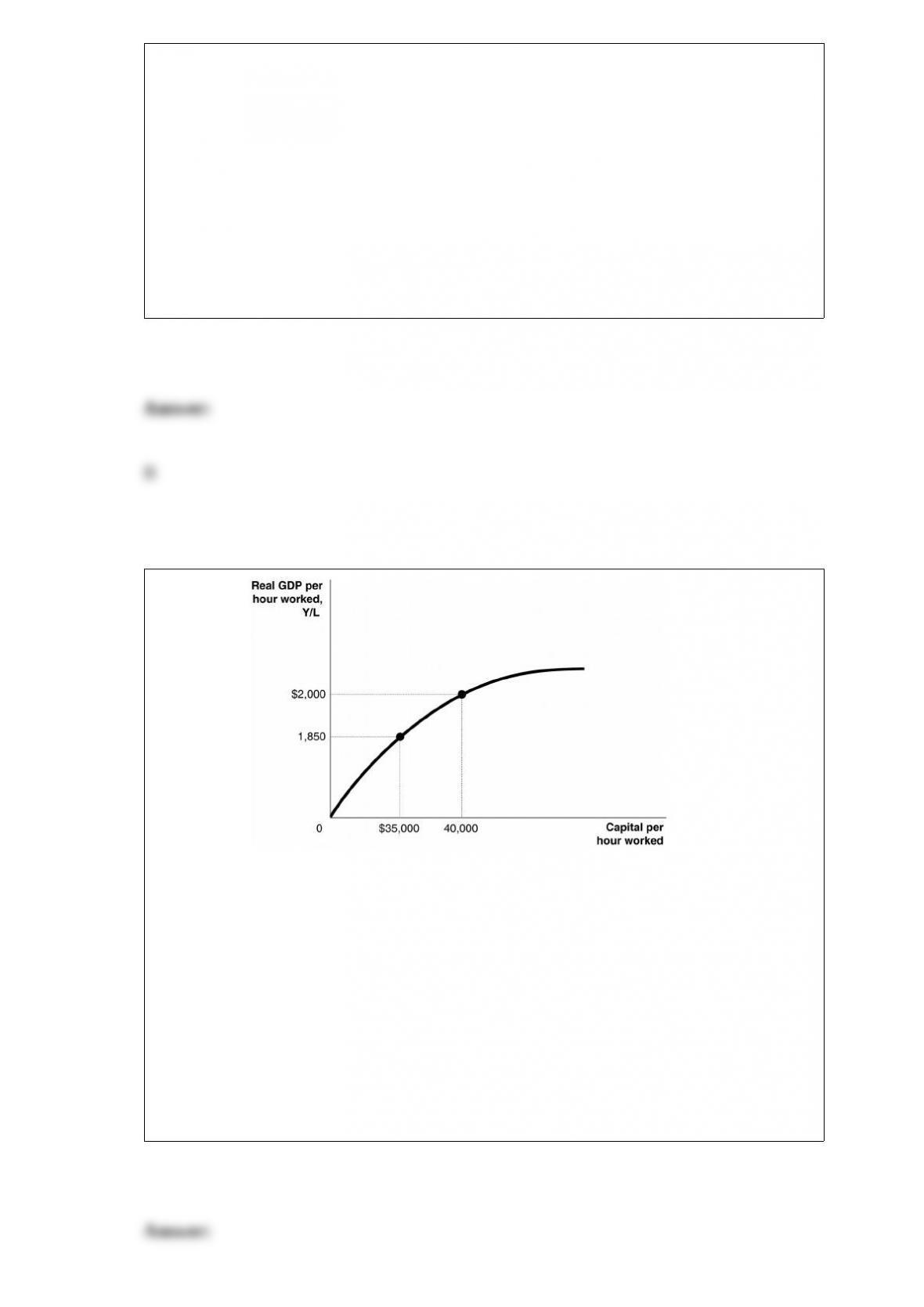
Figure 22-2
Based on the per-worker production function above, if the economy raises capital per
hour worked from $35,000 to $40,000, by how much will real GDP per hour worked
increase?
A) $150
B) $1,850
C) $2,000
D) $5,000

Soo Jin shares a one-bedroom apartment with her classmate. Her share of the rent is
$700 per month. She is considering moving to a studio apartment which she will not
have to share with anyone. The studio apartment rents for $950 per month. Recently,
you ran into Soo Jin on campus and she tells you that she has moved into the studio
apartment. Soo Jin is as rational as any other person. As an economics major, you
rightly conclude that
A) Soo Jin did not have a choice; her roommate was a slob.
B) Soo Jin figures that the additional benefit of having her own place (as opposed to
sharing) is at least $250.
C) Soo Jin figures that the benefit of having her own place (as opposed to sharing) is at
least $950.
D) the cost of having one’s own space outweighs the benefits.
Consider the following statements:
a. Consumers rent more DVDs from a video store that rents DVDs at a lower price than
other rival video stores in the area.
b. Department stores take steps to increase security since they believe it is more costly
to allow shoplifting than to install expensive security monitoring equipment.
c. Farmers produce more cotton when its selling price falls. Which of the above
statements demonstrates that economic agents respond to incentives?
A) a only.
B) b only.
C) c only.

D) a and b.
E) a, b, and c.
Absolute poverty measures vary from country to country. For example, in 2013, the
poverty line in the United States for a family of four with two children was an annual
income of $23,550 but economists often use a much lower threshold income of $1 per
day when calculating the rate of poverty in poor countries. How is this absolute poverty
measured?
A) by comparing the percentage of households living below the poverty line to the total
population
B) by comparing a household’s income to the income required to maintain the average
standard of living in a society at a particular time
C) by comparing the amount of goods and services that a household’s income can
purchase to an objective measure of the amount of income needed to sustain a certain
predetermined standard of living
D) by comparing the amount of goods and services that a household’s income can
purchase in one country to the amount of goods and services that a household’s income
can purchase in another country of comparable living standard
Which of the following is an example of an activity undertaken by an entrepreneur?
A) choosing the color scheme for your renovated kitchen
B) being promoted to the position of Chief of Police

C) being appointed to the U.S. Supreme Court
D) starting your own snow cone business
Scenario 8-1 CANOES-R-US makes canoes. It buys the shell of the canoe from
another firm for $300 and uses its labor and intermediate goods to make the canoe. It
sells the finished canoe to a retail canoe store for $800. The retail canoe store then sells
the canoe to a consumer for $1,200.
The value of each canoe in gross domestic product equals
A) $1,200.
B) $800.
C) $500.
D) $400.