
Which of the following shifts short-run, but not long-run aggregate supply to the right?
a. a decrease in the actual rate of inflation
b. a decrease in the expected rate of inflation
c. a decrease in the capital stock
d. a drought in the Midwest agricultural areas.
If there is an unanticipated increase in aggregate demand, which of the following is
most likely to occur?
a. a reduction in the price level
b. an increase in the rate of unemployment
c. an increase in employment
d. an expansion in the federal budget deficit
Use the figure to answer the following question(s).
Figure 11-12
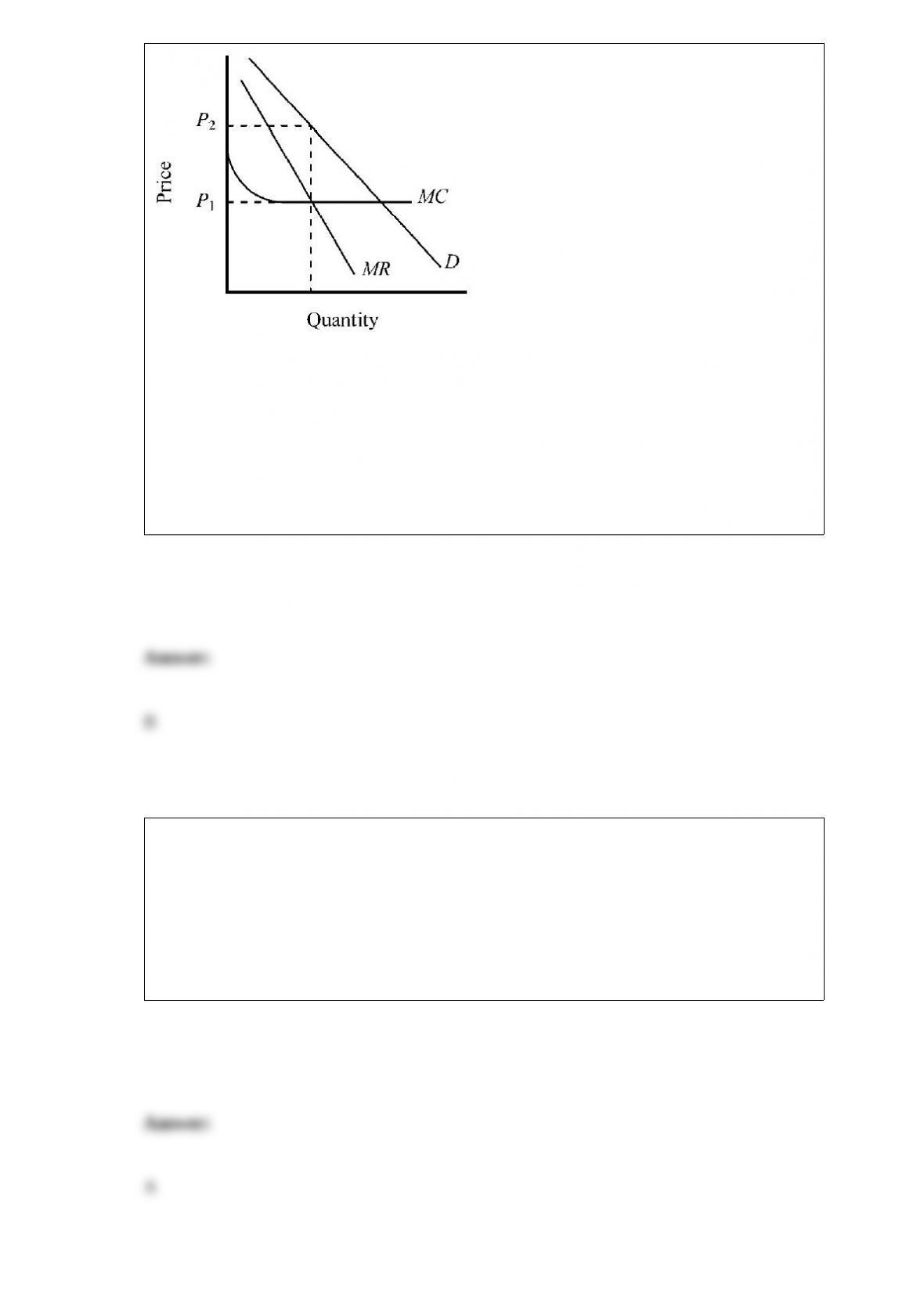
If the firms in this oligopolistic industry depicted in Figure 11-12 can collude
effectively and restrict the entry of potential competitors, the price of their product will
tend to be
a. greater than P2.
b. close to P2.
c. approximately equal to P1.
d. less than P1.
What impact would a severe drought that destroys the wheat crop in several areas of the
United States have on the market for wheat?
a. The supply of wheat would fall.
b. The supply of wheat would rise.
c. The demand for wheat would fall.
d. The demand for wheat would rise.

Which of the following would be most indicative of a shift to a more expansionary
monetary policy?
a. Rapid expansion in the monetary base, higher short-term interest rates, and a decline
in the growth rate of the M1 money supply
b. Rapid expansion in the monetary base, declining short-term interest rates, and an
increase in the growth rate of the M2 money supply
c. A reduction in the monetary base, higher short-term interest rates, and a decline in the
growth rate of the M1 money supply
d. A reduction in the monetary base, lower short-term interest rates, and a decline in the
growth rate of the M2 money supply
The price elasticity of demand for a commodity is determined primarily by the
a. size of the consumer surplus.
b. availability of good substitutes for the good.
c. incomes of consumers.
d. availability of complementary goods.
Which of the following statements is true about the demand for and/or the supply of
natural resources?
a. The supply curve for natural resources is more elastic in the long run than in the short
run.
b. The elasticity of demand for electricity, natural gas, and gasoline equals
approximately 0.1 in both the short run and the long run.
c. Natural resources are demanded by consumers and producers in steadily growing
amounts, so future shortages are inevitable.
d. The supply of many natural resources is finite; thus the long-run elasticity of supply
must be zero.
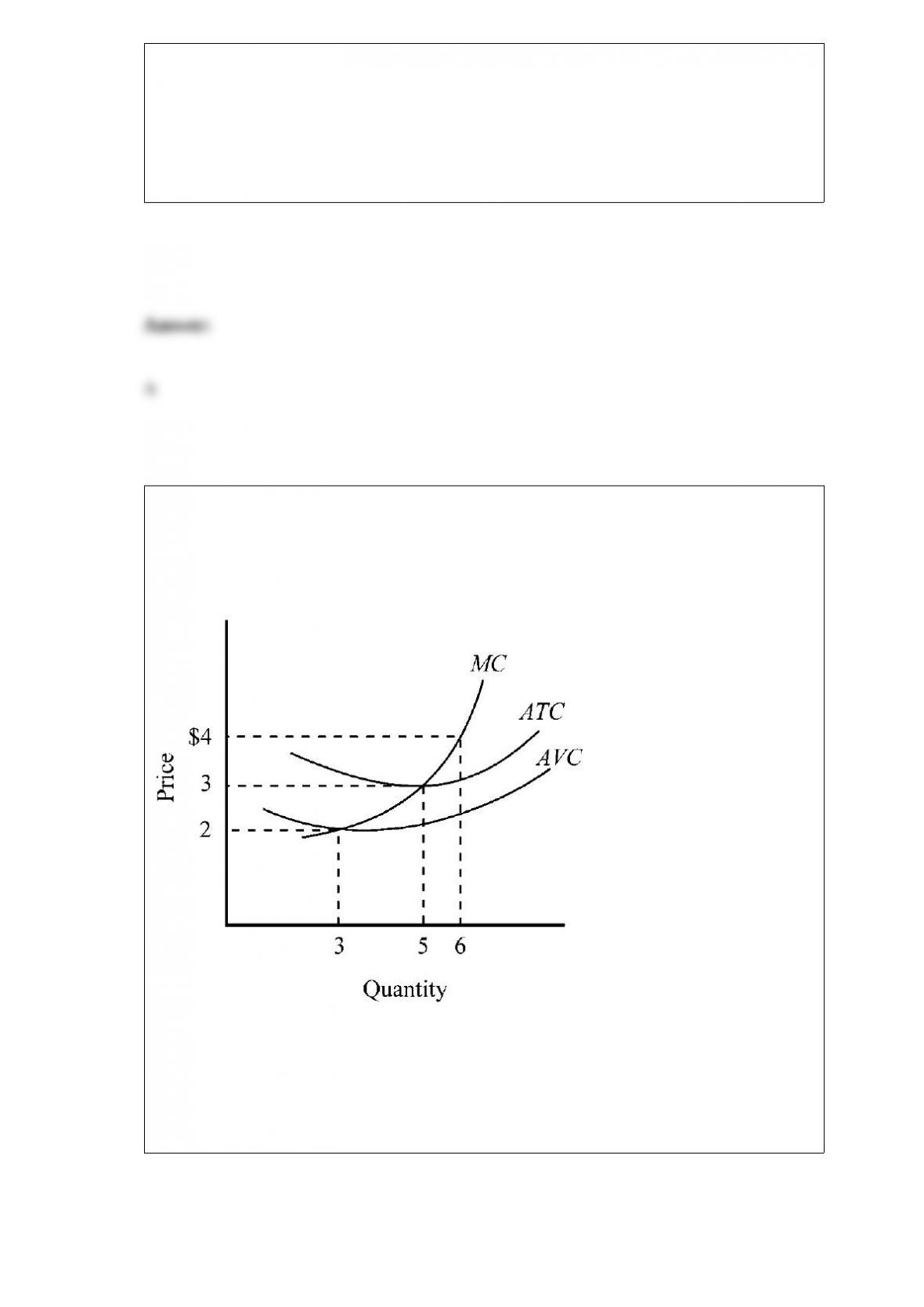
Use the figure to answer the following question(s).
Figure 9-5
If the market price in Figure 9-5 increases to $4, what output should the firm produce,
and what would be the firm’s maximum profit?
a. output, 3; maximum profit, $3 loss
b. output, 5; maximum profit, zero
c. output, 5; maximum profit, slightly less than $5
d. output, 6; maximum profit, slightly less than $6

According to Friedrich Hayek and his followers, the booms and busts of the business
cycle are primarily the result of
a. fluctuations in aggregate demand.
b. the “animal spirits” of private investors.
c. excessive credit expansion and artificially low interest rates that trigger
malinvestment.
d. the unwillingness of political decision-makers to follow the advice of
macroeconomists who know how to alter fiscal policy in a manner that would virtually
eliminate the ups and downs of the business cycle.
Suppose the nominal interest rate was 5 percent and the inflation rate was 3.5 percent.
a. The dollar value of savings increased at 1.5 percent, and the value of savings
measured in goods increased at 3.5 percent.
b. The dollar value of savings increased at 3.5 percent, and the value of savings
measured in goods increased at 1.5 percent.
c. The dollar value of savings increased at 3.5 percent, and the value of savings
measured in goods increased at 5 percent.
d. The dollar value of savings increased at 5 percent, and the value of savings measured
in goods increased at 1.5 percent.

The consumer price index (CPI) is calculated
a. using a fixed basket of goods and, therefore, will tend to understate inflation.
b. using a fixed basket of goods and, therefore, will tend to overstate inflation.
c. using a constantly changing basket of goods and, therefore, will tend to understate
inflation.
d. using a constantly changing basket of goods and, therefore, will tend to overstate
inflation.
Regarding the issue of economic stability, nonactivists believe that
a. consumption is highly unstable over the business cycle.
b. the highest possible level of investment must be maintained over all phases of the
business cycle.
c. minor economic disturbances often feed on themselves, leading to severe swings in
the business cycle.
d. the self-correcting properties of a market economy work reasonably well.
When institutions and policies provide secure property rights, a fair and balanced

judicial system, monetary stability, and effective limits on the power of government,
which of the following is most likely to be encouraged?
a. rent-seeking
b. actions that reduce the value of resources
c. productive activities
d. destructive activities
Prior to the time of John Maynard Keynes, most economists stressed that
a. low levels of aggregate demand would lead to prolonged periods of unemployment.
b. market economies were inherently unstable because of fluctuating aggregate demand.
c. market adjustments would automatically direct an economy to full employment
within a relatively brief period of time.
d. budget deficits and surpluses were necessary for the control of economic
fluctuations.
Jayden runs a company that sells its product for $250 each. When he employs 10
workers, they can sell 60 products per week, while only 54 products are sold when 9
workers are employed. What is the weekly marginal revenue product of the tenth
worker?

a. $250
b. $1,250
c. $1,500
d. $15,000
As the period for firms to expand output is lengthened, the elasticity of the market
supply curve will
a. approach zero.
b. increase.
c. decrease.
d. remain the same since time does not affect the elasticity of market supply.
Externalities cause the market mechanism to allocate goods and resources inefficiently
because
a. nonconsenting third parties are generally not hurt by externalities.
b. producers and consumers ignore signals given by the competitive market.
c. prices are always higher than they should be.
d. competitive markets fail to give producers and consumers correct price signals.

Diego’s annual income increased from $20,000 to $25,000. If Diego faces a 40 percent
effective marginal tax rate, the $5,000 increase in income will expand his disposable
income by
a. $2,000.
b. $3,000.
c. $3,600.
d. $5,000.
Why are the bonds held by the Fed and government agencies excluded from the
privately held debt figures?
a. The U.S. Treasury does not have to pay off these bonds.
b. These bonds were not issued by the U.S. Treasury.
c. These bonds do not create a net-interest obligation for the federal government.
d. These bonds are not interest-bearing bonds.

If businesses found that changing economic conditions made it attractive for them to
hire a larger number of economics majors, we would expect
a. economics majors to receive a greater return on their human capital investment.
b. a decrease in the employment opportunities for economics majors.
c. lower wages for economics majors.
d. fewer students to major in economics.
Suppose an airline ticket from Portland to Orlando costs $760. A bus ticket costs $360.
Traveling by plane will take 6 hours, compared with 26 hours by bus. Other things
constant, the minimum value of one’s time that would induce a rational individual to fly
rather than drive would be
a. $18 per hour.
b. $20 per hour.
c. $38 per hour.
d. $44 per hour.

Which of the following contributed to the severity of the Great Depression?
a. the substantial budget surpluses run during the Hoover administration
b. a sharp increase in tariff rates in 1930
c. the large reduction in tax rates under the Hoover administration
d. a highly expansionary monetary policy followed by the Fed in the late 1920s and
early 1930s
The exchange rate is
a. another term for “interest rate.”
b. another term for “growth rate.”
c. the rate at which goods trade for one another across international borders.
d. the price of one currency in terms of another currency.
When voters pay taxes in proportion to the benefits they receive from government
projects,
a. efficient projects will tend to be opposed by a majority of voters.
b. inefficient projects will often be favored by a majority of voters.

c. projects that are efficient will tend to be favored by an overwhelming majority of
voters.
d. democratic political decision making can be expected to work poorly.
Which of the following statements is true?
a. In both black markets and legal markets, supply and demand determine price.
b. The quality of products sold in black markets and legal markets are similar.
c. The price of products in black markets tends to be the same as those in legal markets
for otherwise identical products.
d. The rate of violence is similar in black markets and legal markets.
The period of growth in real GDP between the trough of the business cycle and the next
peak is called the
a. recessionary phase.
b. expansionary phase.
c. contractionary phase.
d. cyclical phase.

Economic analysis suggests that countercyclical macro-policy will
a. be difficult to time properly because of uncertainty about the future direction of the
economy.
b. be difficult to implement because we do not know whether monetary policy is
transmitted through the interest rate, or whether it affects aggregate demand directly.
c. reduce the natural rate of unemployment when macro-policy is persistently
expansionary.
d. help reduce economic instability if, and only if, we are willing to tolerate
double-digit inflation.
If the Federal Reserve lowered the reserve requirements imposed on the banking
industry, which of the following will most likely happen in the short run?
a. an increase in the demand for loanable funds, which will exert upward pressure on
the interest rate
b. an increase in the supply of loanable funds, which will exert downward pressure on
the interest rate
c. an increase in the unemployment rate
d. a decrease in the rate of inflation
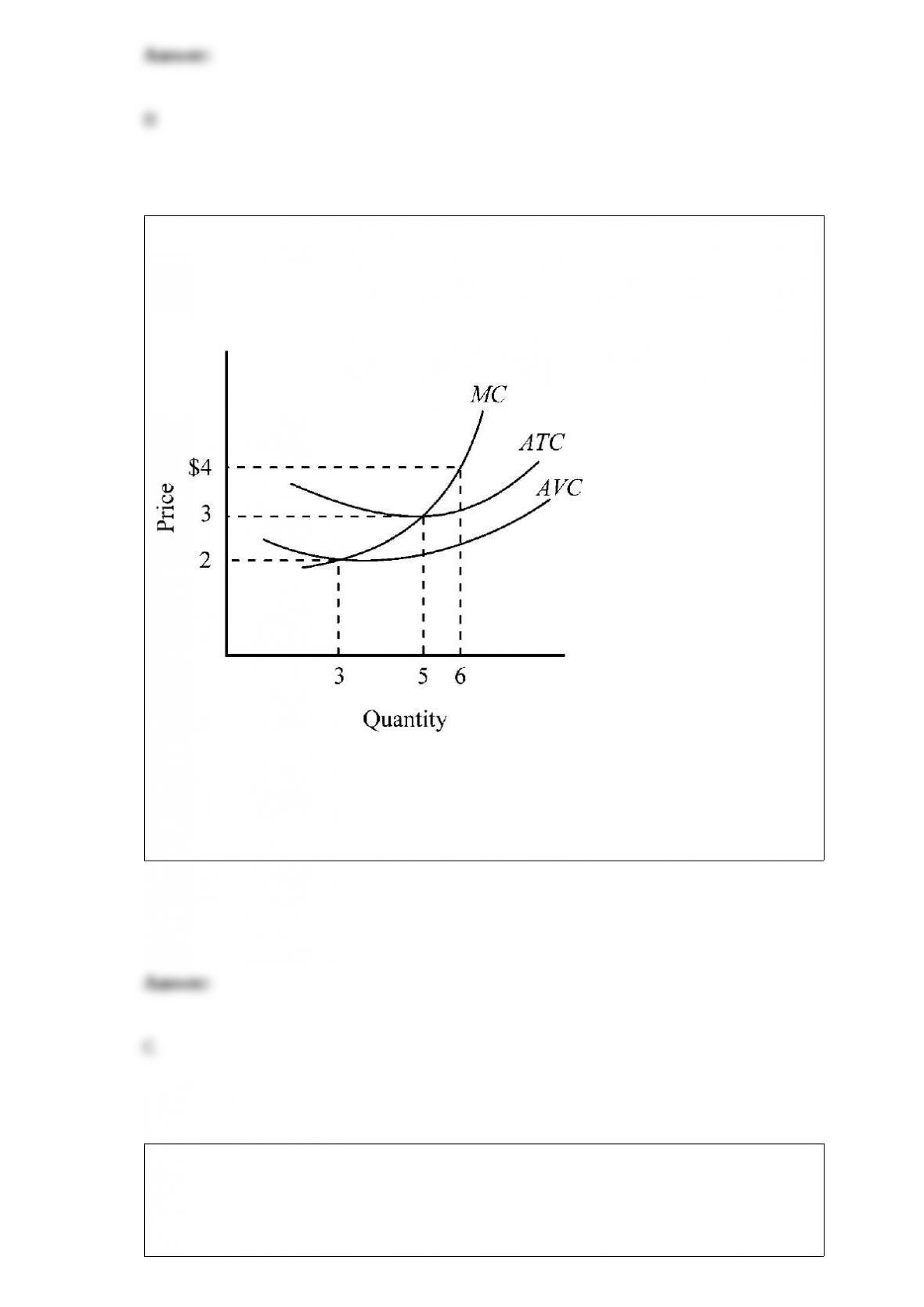
Use the figure to answer the following question(s).
Figure 9-5
If the market price in Figure 9-5 fell to $2.50, what should the firm do?
a. raise its price
b. shut down and wait for conditions to improve
c. continue operating in the short run if it expects conditions to improve
d. go out of business immediately
As debit cards become more popular, individuals will reduce their holdings of currency.
Other things constant, how will this impact the money supply?
a. Because more money is held as deposits at banks, the money supply will fall.

b. Because more money is held as deposits at banks, the money supply will expand.
c. Because debit card expenditures are counted in M2 but not M1, the M1 money
supply will fall.
d. Because debit card expenditures are counted in M1 but not M2, the M2 money
supply will fall.
The historical record indicates that foreign aid has
a. played a major role in helping formerly poor countries grow rapidly and achieve high
income levels.
b. re-enforced corrupt governments and policies that stifle productive activities.
c. helped poor countries escape counterproductive policies imposed by authoritarian
political leaders.
d. promoted economic growth, but slowed the movement toward political democracy.