
Expansionary policies are government stabilization policy actions intended to increase:
A. population.
B. unemployment.
C. average labor productivity.
D. planned spending.
In a certain economy, the components of planned spending are given by:
C = 500 + 0.8(Y – T) – 300r
Ip = 200 – 400r
G = 200
NX = 10
T = 150
Given the information about the economy above, what would be the impact on induced
expenditures of a one-percentage-point increase in the real interest rate?
A. Induced expenditures would increase by 35 units.
B. Induced expenditures would not change.
C. Induced expenditures would decrease by 35 units.
D. Induced expenditures would decrease by 7 units.

When firms engage in outsourcing, ________ benefit and ______ are harmed.
A. the firms; consumers
B. consumers; the firms
C. consumers; the firm’s domestic employees
D. the firms; the firms’ foreign employees
Quick Buck and Pushy Sales produce and sell identical products and face zero marginal
and average cost. Below is the market demand and marginal revenue curves for the
product.
Refer to the figure above. If Quick Buck and Pushy Sales decide to collude and work as
a pure monopolist so that each firm will produce half the quantity demanded by the
market, what will be the economic profit for Quick Buck?
A. $1,000
B. $1,500
C. $2,000
D. $3,000
Written contracts are more common for transactions that take place over a long period
of time than they are for transactions that are instantaneous because as time passes
A. buyers and sellers tend to forget what they agreed upon.
B. conditions may change giving one party an incentive to renege.
C. the object to be bought or sold loses value.
D. laws involving contract enforcement become more stringent.
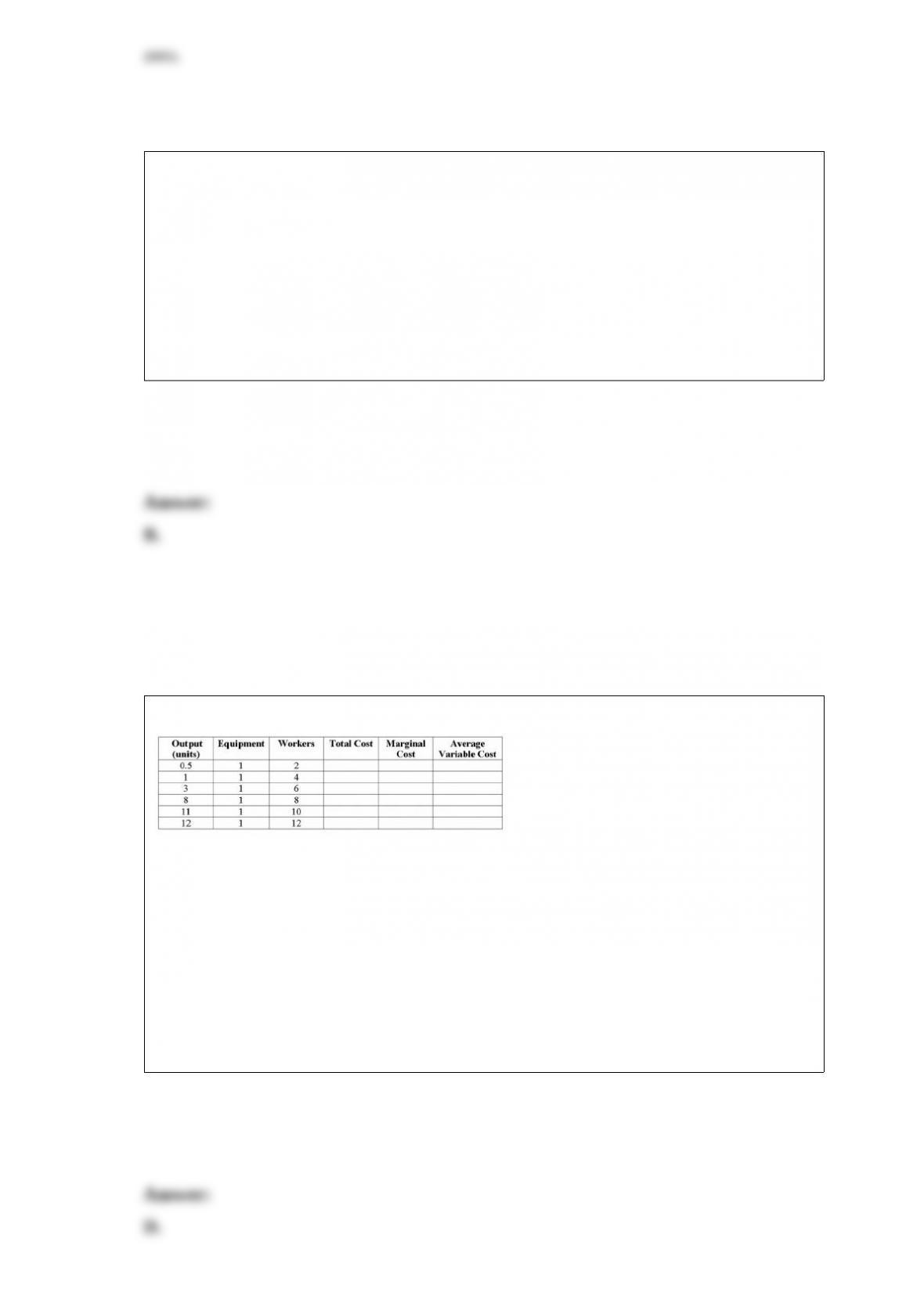
This phone center uses only equipment and workers to provide service.
Suppose that one unit of equipment costs $10 and each worker earns $5. What is the
total cost of producing 3 units of output?
A. $25
B. $30
C. $35
D. $40

School districts in which relatively more parents choose to not have their children
immunized
A. tend to be in poorer neighborhoods.
B. have higher rates of the diseases for which immunization is normally required.
C. have lower rates of the diseases for which immunization is normally required.
D. are in violation of federal health care regulations.
Holding other factors constant, if oil prices rise relative to the prices of other products,
then the real wages of oil workers will ______ and employment of oil workers will
_____.
A. increase; increase
B. increase; decrease
C. decrease; not change
D. decrease; increase
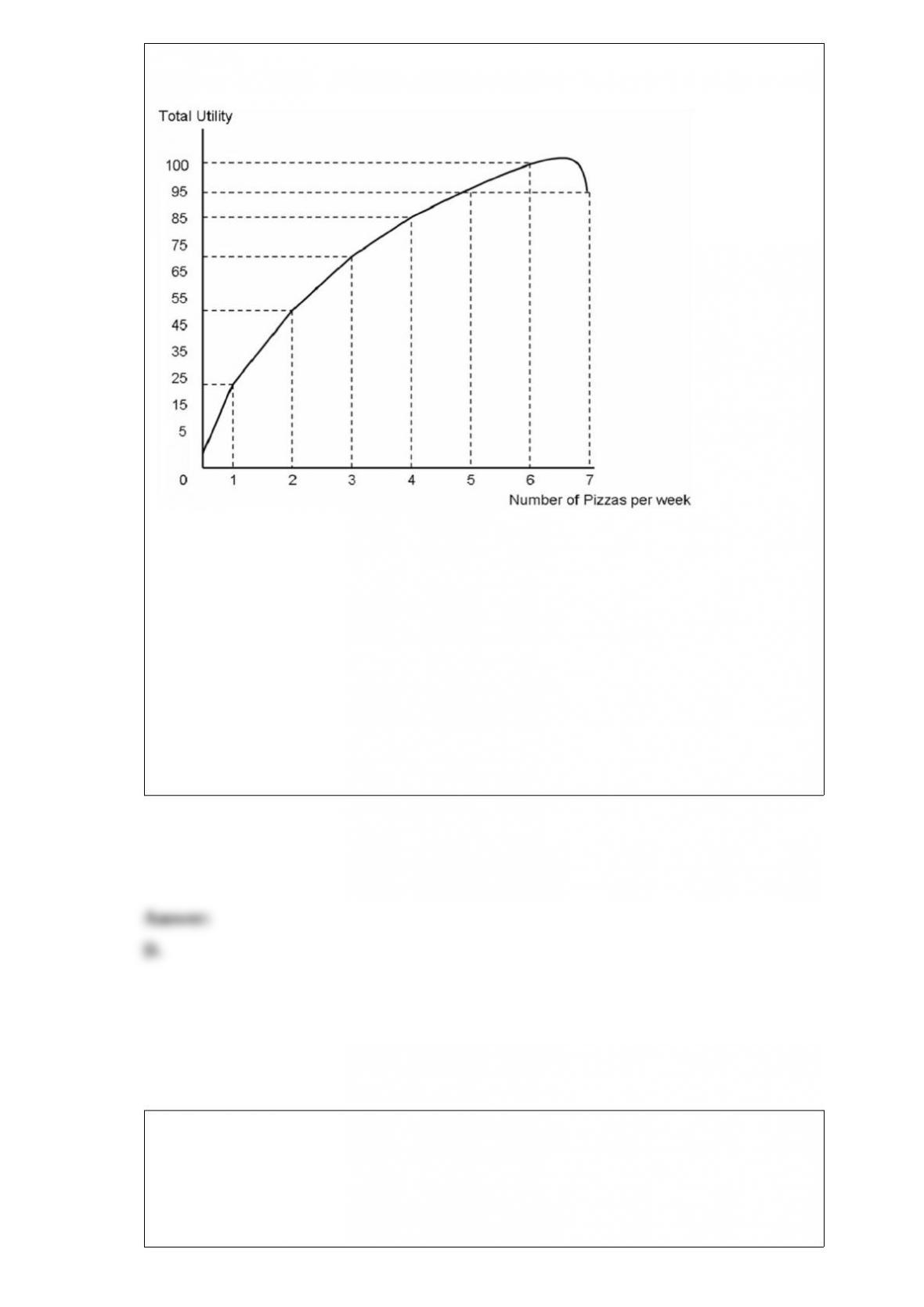
Refer to the figure above. Total utility increases with each additional pizza consumed
up to the _____ and then declines, but marginal utility _______ with each additional
pizza consumed each week.
A. 7th pizza, increases
B. 6th pizza, increases
C. 5th pizza, stays the same
D. 6th pizza, decreases
During times of high unemployment, colleges often observe an increase in enrollment
even if tuition remains unchanged. Why?
A. Students do not know about the decision pitfalls and go to college even though the
net benefit is negative.
B. The opportunity cost of attending college is lower because students are less likely to
have good full-time jobs.
C. The opportunity cost of attending college is higher because good jobs are harder to
find.
D. The benefit of attending college is lower because college graduates are less likely to
find jobs upon graduation.
Pat earns $25,000 per year (after taxes), and Pat’s spouse, Chris, earns $35,000 (after
taxes). They have two pre-school children. Childcare for their children costs $12,000
per year. Pat has decided to stay home and take care of the children. Pat must:
A. value spending time with the children by more than $25,000.
B. value spending time with the children by more than $12,000.
C. value spending time with the children by more than $13,000.
D. value spending time with the children as much as does Chris.
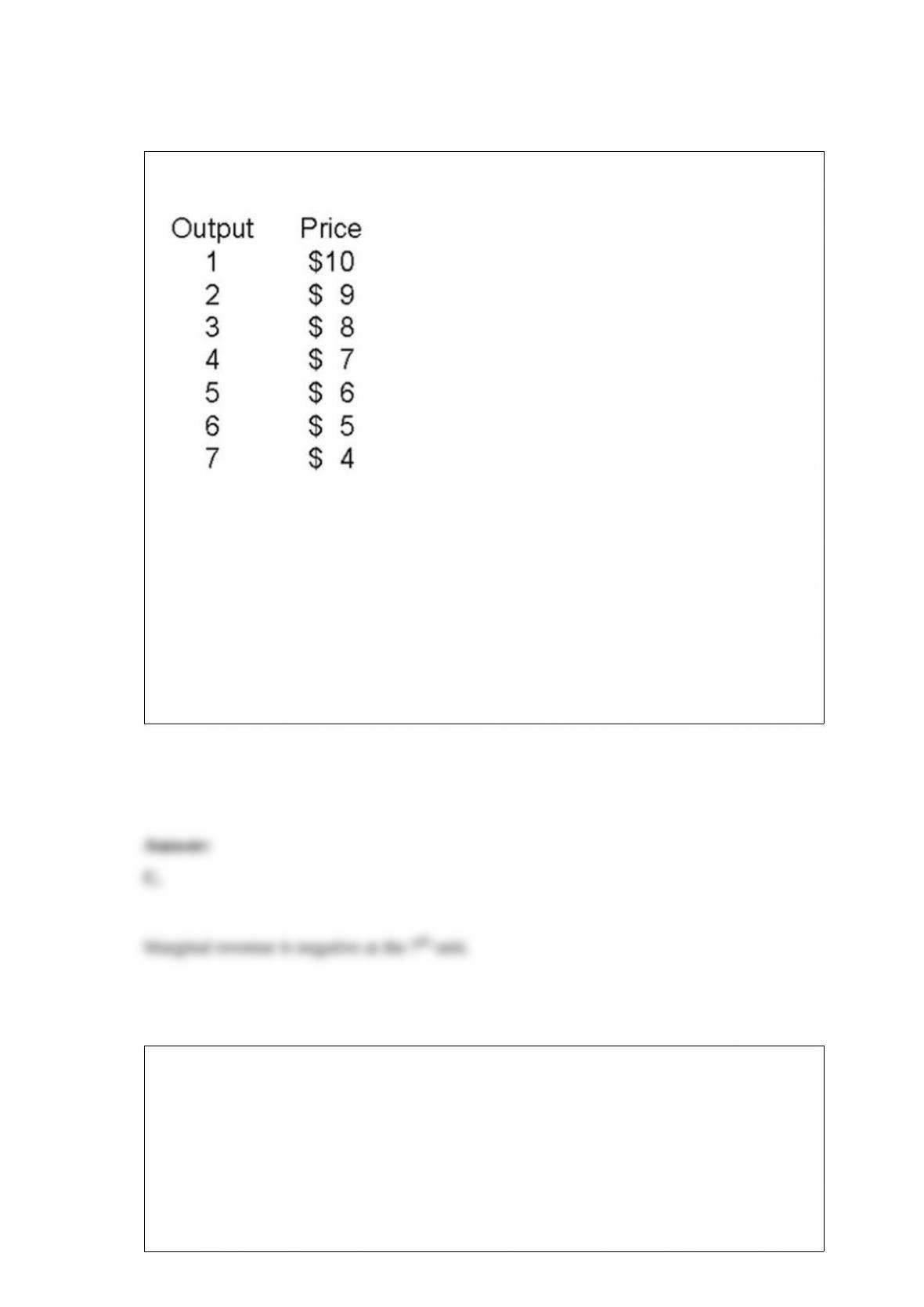
Refer to the figure above. Based on the data in the table, you would predict the firm
will:
A. earn a profit.
B. produce more than 7 units.
C. never produce the seventh unit.
D. never produce the fifth unit.
Tight monetary policy will ______ net exports as a result of a ______ currency.
A. increase; stronger
B. increase; weaker
C. decrease; weaker
D. decrease; stronger

The inside lag is relatively shorter for _____ policy and the outside lag is relatively
shorter for _____ policy.
A. monetary; fiscal
B. monetary; monetary
C. fiscal; monetary
D. fiscal; fiscal
Which of the following describes a surplus-enhancing transaction?
A. The Federal government taxes wealthy individuals to pay for income support
payments to poor people.
B. The public television station cancels Sesame Street because nobody pledged during
that show even though many kids were watching it.
C. I pay $5.00 for one scoop of ice cream at the ballgame even though I have a whole
gallon at home in my freezer that cost me less than $5.00.
D. Your state government imposes a higher minimum wage law than the one set by
federal law.

An economic expansion in the U.S. ______ the demand for exports from Mexico
resulting in an increase in Mexican autonomous expenditures and a(n) ______ output
gap in Mexico.
A. reduces; expansionary
B. increases; expansionary
C. reduces; recessionary
D. increases; recessionary
In the Soviet Union, firm managers had ______ incentive to reduce costs and produce
better products because of ______.
A. little; the absence of private property rights
B. little; the absence of free markets
C. great; government threats
D. great; the complexity of coordinating economic activity
Total spending on final goods and services in an economy must equal total:
A. profits.
B. production.
C. revenues from all transactions.
D. investment.
This graph shows one consumer’s demand for ice cream at the student union:

Joe is one of the students whose demand is shown. Joe buys more ice cream when the
price is $2.00 than when the price is $3.00 because
A. Joe cannot afford $3.00 for a scoop of ice cream.
B. Joe has more consumer surplus when price is $3.00.
C. the marginal utility Joe gets from his fifth scoop of ice cream is less than the
marginal utility Joe gets from other things that cost $3.00.
D. Joe does not experience diminishing marginal utility for ice cream consumption
when it is only $2.00 per scoop but does when it is $3.00.
Suppose there are ten people playing cards in a room. One of them wants to smoke a
cigar; nine of them dislike the smell of cigar smoke. The smoker values the privilege of
smoking at $5, and each of the other nine occupants of the room would be willing to
pay fifty cents for clean air in the room. The rules governing use of the room state that
smoking is not allowed unless everyone agrees to allow smoking.
Refer to the information given above. Declaring the card room a non-smoking area with
no opportunity to negotiate would:
A. decrease total economic surplus.
B. increase total economic surplus.
C. leave total economic surplus unchanged, but redistribute benefits.
D. efficiently solve the externality problem.

Gross domestic product (GDP) equals the ______ of final ______ produced within a
country during a given period of time.
A. market value; goods
B. market value; services
C. market value; goods and services
D. quantity; goods and services
The prediction that workers obtain additional training only when the rewards from the
training are expected to exceed the costs of the training (including the opportunity
costs) is based on the:
A. principle of comparative advantage.
B. principle of diminishing returns to capital.
C. scarcity principle.
D. cost-benefit principle.

Suppose that you notice that relationships that are formalized by marriage or other
contractual arrangement tend to be more stable than relationships that are not
formalized. A search-theory based explanation for this observation is that
A. formalization increases the cost of continuing to search for a better partner.
B. formal relationships are entered into only after a complete search of alternatives.
C. formal arrangements are a necessary part of any optimal search strategy.
D. remaining in long-term relationships is generally a dominant strategy.
At the very least, Joe Average and Bill Gates are both identically limited by:
A. their wealth.
B. the 24 hours that comprise a day.
C. their knowledge.
D. their influence.
Private incentives in markets with external benefits lead to _____; private incentives in
markets with external costs lead to _____.
A. maximum total economic surplus; deadweight loss
B. deadweight loss; deadweight loss
C. excess total economic surplus; efficiency
D. excess total economic surplus; deadweight loss
If total output is calculated by adding up the market value of goods and services
produced, then more expensive items:
A. receive the same weight as cheaper items.
B. receive a greater weight than cheaper items.
C. receive a smaller weight than cheaper items.
D. are double counted.
The ______ is the rate of change of the _______.

A. base year price index; current year price index
B. current year price index; base year price index
C. CPI; rate of inflation
D. rate of inflation; CPI
The table below shows the payoff matrix in the form of short term profits for two firms,
A and B, for two different strategies, investing in new capital or not investing in new
capital. Payoffs are in millions of dollars.
Refer to the figure above. An industrial spy comes to firm B and claims to know what
firm A has decided. How much would this information be worth to firm B?
A. $0.
B. $50 million.
C. $30 million.
D. $70 million.
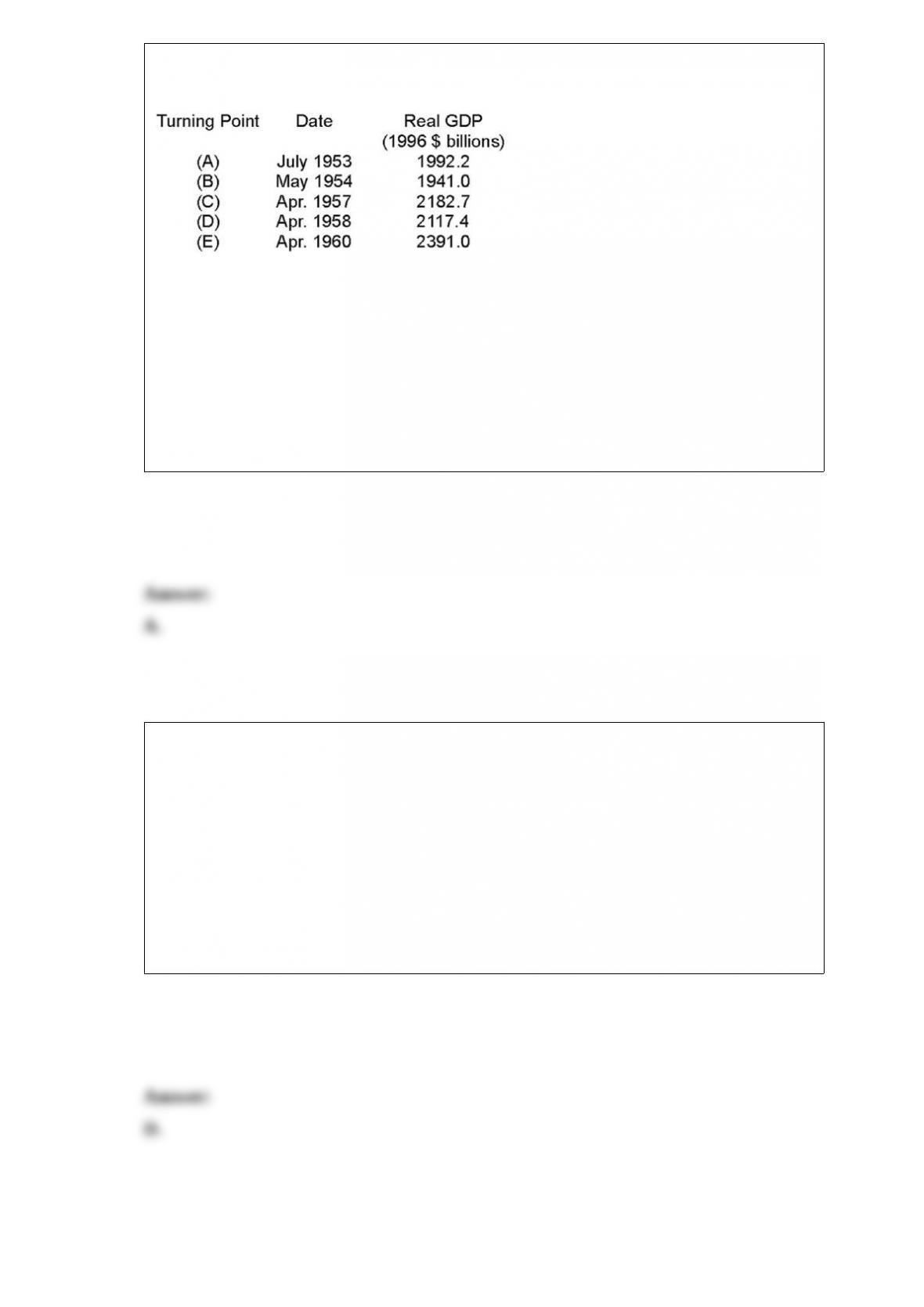
The following data give the dates of successive turning points in U.S. economic activity
and the corresponding levels of real GDP at the time.
Which of the following periods was a recession?
A. July 1953 through May 1954
B. May 1954 through April 1957
C. July 1953 through April 1957
D. May 1954 through April 1958
Shoe leather costs include the ______ due to the more frequent trips to the bank, the
new cash management systems and the expanded employment in banks that inflation
causes.
A. bracket creep and redistribution that occur
B. deflating and indexing that are necessary
C. substitution and price adjustment biases that arise
D. time and effort that are used up
This graph shows the cost functions of Moe’s mushroom gathering business, which is
perfectly competitive.
When mushrooms sell for $10 per bushel, if Moe chooses the profit maximizing
quantity Moe will gather
A. 10 bushels
B. 20 bushels
C. 30 bushels
D. zero bushels
For most people, baking cinnamon rolls generates _____ externality, and burning tires
generates _______ externality.
A. a positive; a negative
B. a negative; a positive
C. a positive, no
D. no; a negative

Suppose that Josh pays $6,000 in income taxes and Maggie pays $4,000. If they are
subject to a progressive tax structure, we can say that
A. Josh pays a smaller percentage of his income in taxes.
B. Josh has a higher income than Maggie.
C. Maggie has a higher income than Josh.
D. Josh and Maggie pay the same percentage of their income in taxes.