
Real GDP is not a perfect measure of economic well-being because it excludes the
value of all of the following except:
A. leisure time.
B. goods and services available in the market economy.
C. nonmarket economic activity.
D. goods and services produced in the underground economy.
Suppose a firm uses workers and office space to produce output. The firm is locked into
a year-long lease on its office space, but it can easily vary the number of
employee-hours it uses each day. The table below describes the relationship between
the number of employee-hours the firm uses each day and the firm’s daily output. Each
unit of output sells for $2, the hourly wage rate is $14, and the rent on the office space
is $50 per day.
When the firm uses 9 employee-hours, it’s total variable cost each day is:
A. $30
B. $56
C. $84
D. $126
Monopolists use the hurdle method of price discrimination in order to:
A. separate consumers on the basis of their reservation prices.
B. lower their marginal cost.
C. increase the demand for their good.
D. produce the socially optimal level of output.
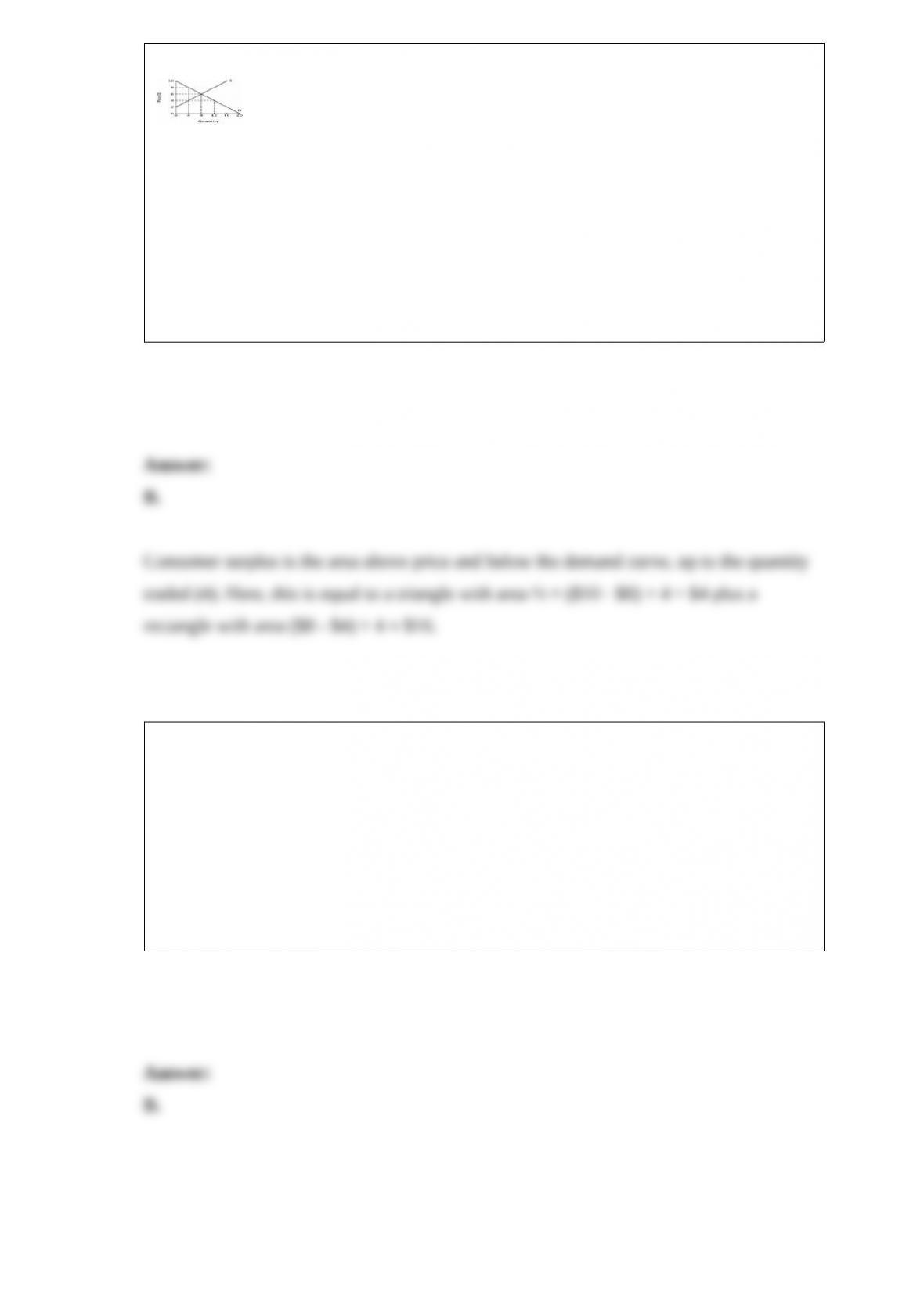
Refer to the figure above. If the price is $4 today, and if there are no other changes in
this market, one would expect the price in the future to be:
A. $4.
B. less than $4.
C. greater than $6.
D. greater than $4.
Refer to the figure below.
If a price ceiling were imposed at $4, consumer surplus would be:
A. $36.
B. $20.
C. $24.
D. $28.
Under a first-dollar health insurance plan, the patient’s marginal cost of treating a
covered illness is:
A. positive.
B. zero.
C. negative.
D. a percentage of the total cost.
Suppose that Coke and Sprite each sell for $2 a can. Each month Joe buys 6 cans of
Sprite and 30 cans of Coke. From this we can infer that:
A. Joe is buying too many cans of Sprite.
B. Joe is buying too many cans of Coke.
C. Joe is maximizing his utility if his marginal utility from the 6th can of Sprite he buys
is less than his marginal utility from the 30th can of Coke he buys.
D. Joe is maximizing his utility if his marginal utility from the 6th can of Sprite he buys
is equal to his marginal utility from the 30th can of Coke he buys.
You can spend $5 for lunch and you would like to have two double cheeseburgers.
When you get to the restaurant, you find out the price for double cheeseburger has
increased from $2.50 to $2.99. You decide to have just one double cheeseburger for
lunch. This is best described as a(n):
A. substitution effect.
B. income effect.
C. buyer’s reservation price effect.
D. seller’s reservation price effect.
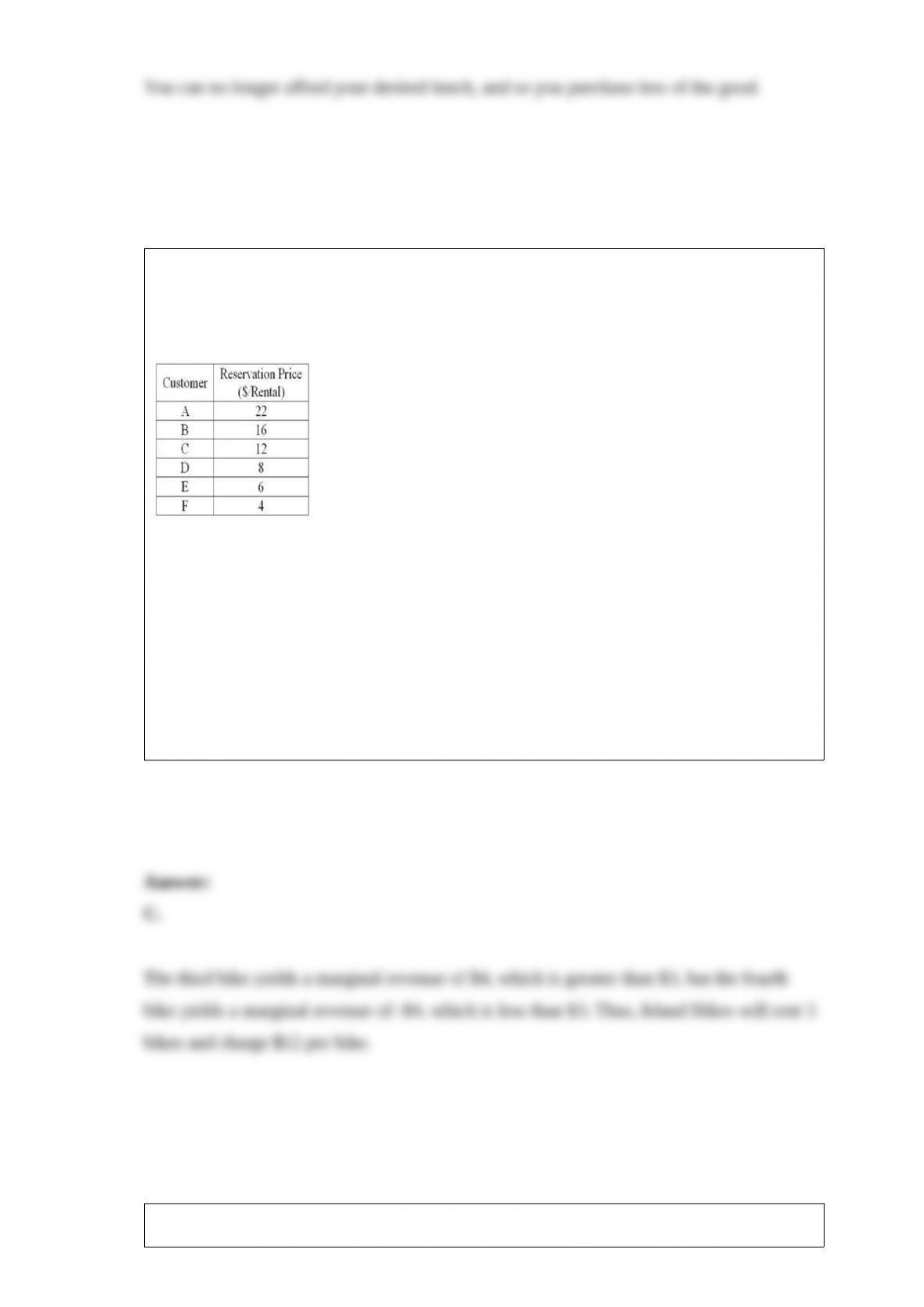
Suppose Island Bikes, a profit-maximizing firm, is the only bike rental company in a
small resort town. The marginal cost to Island Bikes of renting out a bike is $3, and
Island Bikes has no fixed costs. Each day Island Bikes has six potential customers,
whose reservations prices are listed below.
If Island Bikes charges a single price to all of its customers, then what price will it
charge?
A. $4
B. $8
C. $12
D. $16
Globalization and skill-biased technological change have contributed to:

A. the long-term growth in real wages.
B. the slowdown in productivity since 1973.
C. increasing wage inequality.
D. high rates of employment in Western Europe.
Which of the following will cause an increase market supply?
A. A decrease in the number of firms in the market.
B. An increase in demand for the good.
C. A technological innovation that lowers the marginal cost of producing the good.
D. An increase in the price of the good.
Refer to the figure below. What is total consumer surplus at the market equilibrium?
A. $6 per day
B. $80 per day
C. $160 per day
D. $240 per day
Paper Pushers Inc. hires workers in a competitive labor market. Apart from labor, the
company has no other variable inputs. The company’s hourly output varies with the
number of workers hired, as shown in the table below.
The VMP of the sixth worker is ______ than the VMP of the fourth worker because
______.
A. less; the firm experiences economies of scale.
B. more; of the law of increasing returns.
C. less; of the law of diminishing returns.
D. more; workers can specialize and exploit their comparative advantage.
One problem with using monetary policy to address “bubbles” in asset markets is that:
A. doing so presupposes that the Federal Reserve is better than financial-market

professionals at identifying bubbles.
B. monetary policy is well-suited for addressing the problem of inappropriately high
asset prices.
C. reducing the real interest rate to deal with the bubble could lead to inflation.
D. the Federal Reserve is not interested in stabilizing output.
Suppose there are ten people playing cards in a room. One of them wants to smoke a
cigar; nine of them dislike the smell of cigar smoke. The smoker values the privilege of
smoking at $5, and each of the other nine people of the room would be willing to pay
fifty cents for clean air in the room. The rules governing use of the room state that
smoking is not allowed unless everyone agrees to allow smoking. If all ten people can
negotiate with each other at no cost, then the Coase theorem predicts that if the cigar
smoker has the right to determine whether smoking is allowed, then there ______ be
smoking, and if the other nine people in the room have the right to determine whether
smoking is allowed, then there ______ be smoking.
A. will; will
B. will; will not
C. will not; will not
D. will not; will

As the U.S. dollar appreciates relative to other currencies, the dollar price of goods
imported to the U.S. _____, causing net exports and GDP to ______.
A. rises; rise
B. rises; fall
C. falls; rise
D. falls; fall
The extra benefit that results from carrying out one additional unit of an activity is the
______ of the activity.
A. marginal benefit
B. total benefit
C. average benefit
D. economic benefit
Globalization ______ the wages of workers in the exporting industries and ______ the

wages of workers in the import-competing industries.
A. raises; raises
B. raises; lowers
C. raises; does not change
D. lowers; raises
Suppose that the EPA has proposed strict controls on the amount of sulfur that diesel
fuel contains. These controls were designed to fully offset the cost of pollution
generated by diesel fuel vehicles. The effect of the regulation is estimated to increase
the equilibrium price of a gallon of diesel fuel by 10 cents. Suppose that demand for
diesel fuel is perfectly inelastic and supply has a positive slope. The effect of the
regulation will _______ than if demand were not perfectly inelastic.
A. increase price and quantity by more
B. increase price by less and reduce quantity by more
C. decrease price and quantity by more
D. increase price by more and reduce quantity by less
Joe’s Taco Hut can purchase a delivery truck for $20,000 and Joe estimates it will

generate a net income (after taxes, maintenance and operating costs) of $2,000 per year.
He has no other opportunities. He should:
A. purchase the truck only if the real interest rate is less than 2%.
B. not purchase the truck if the real interest rate is greater than 2%.
C. purchase the truck if the real interest rate is greater than 10%.
D. purchase the truck if the real interest rate is less than 10%.
Refer to the figure above. Moving from demand curve D1 to demand curve D2 could be
caused by a(n):
A. decrease in consumers’ incomes.
B. increase in quantity supplied.
C. increase in the price of a close substitute.
D. increase in the price of a complement.
Which of the following statements is true for both Microsoft and a locally owned
restaurant?
A. Both are perfect competitors.
B. Both confront perfectly elastic demand for their products.
C. Neither firm is able to influence the price of their products.
D. Both seek to maximize profits.
If the consumer price index increased from 1.52 to 1.65, then it must be the case that
______ relative to prices in the base year.
A. all prices rose
B. the weighted average level of prices rose
C. all prices fell
D. some prices rose and some prices fell

The expenditure line in the Keynesian cross diagram represents the:
A. equilibrium condition that Y = PAE.
B. relationship between planned expenditure and output.
C. relationship between consumption and after-tax disposable income.
D. equilibrium condition that Y = Y*.
The existence of a negative externality will result in:
A. a less than optimal level of production.
B. a greater than optimal level of production.
C. prices that are artificially high.
D. elimination of deadweight loss.
If planned aggregate expenditure (PAE) in an economy equals 2,000 + 0.8Y and
potential output (Y*) equals 11,000, then this economy has:
A. an expansionary gap.
B. a recessionary gap.

C. no output gap.
D. no autonomous expenditure.
Gamma has $30,000 of capital per worker, while Omega has $7,500 of capital per
worker. In all other respects, the two countries are the same. According to the principle
of diminishing returns to capital, an additional unit of capital will increase output
______ in Gamma compared to Omega, holding other factors constant.
A. more
B. less
C. not at all
D. by the same amount
All else equal, the price elasticity of demand for small-budget items such as soap tends
to be ______ than the price elasticity of demand for big-ticket items such as flat-screen
TVs.
A. higher
B. lower
C. very high
D. the same
A monopoly that results from economies of scale is called a(n):
A. antitrust violator.
B. large-scale monopolist.
C. natural monopoly.
D. cost-plus firm.
When government runs a budget deficit, it makes up the difference by:
A. issuing government bonds.
B. paying down outstanding debt.

C. increasing transfer payments.
D. increasing public saving.