
Economists believe the most persuasive argument for protectionism is to
A) save jobs.
B) protect high wages.
C) protect national security.
D) protect infant industries.
Which of the following willshift the demand curve for a good?
A) a change in the technology used to produce the good
B) an increase in the price of the good
C) a decrease in the price of a complementary good
D) a decrease in the price of the good
The consumer price index is the
A) cost of a market basket of goods and services typically consumed in the base year.
B) cost of a market basket of goods and services typically consumed in the current
period.
C) average of the prices of the goods and services purchased by a typical urban family
of four.

D) average of the prices of new final goods and services produced in the economy over
a period of time.
Which of the following is the best example of a tariff?
A) a limit imposed on the number of sports utility vehicles that the United States can
import from Japan
B) a subsidy granted by the U.S. government to domestic garment manufacturers so
they can compete more effectively with foreign garment manufacturers
C) a tax placed on all sports utility vehicles sold in the domestic market
D) a $5,000 per-car fee imposed on all sports utility vehicles imported into the United
States
Cassie’s Quilts alters, reconstructs and restores heirloom quilts. Cassie has just spent
$800 purchasing, cleaning and reconstructing an antique quilt which she expects to sell
for $1,500 once she is finished. After having spent $800, Cassie discovers that she
would need some special period fabric that would cost her $200 in material and time in
order to complete the task. Alternatively, she can sell the quilt “as is” now for $900.
What should she do?
A) She should cut her losses and sell the quilt now.
B) It does not matter what she does; she is going to take a loss on her project.
C) She should purchase the period fabric, complete the task and then sell the quilt.
D) She should not do anymore work on the quilt because she has already spent too
much time on it and has not been paid for that time.
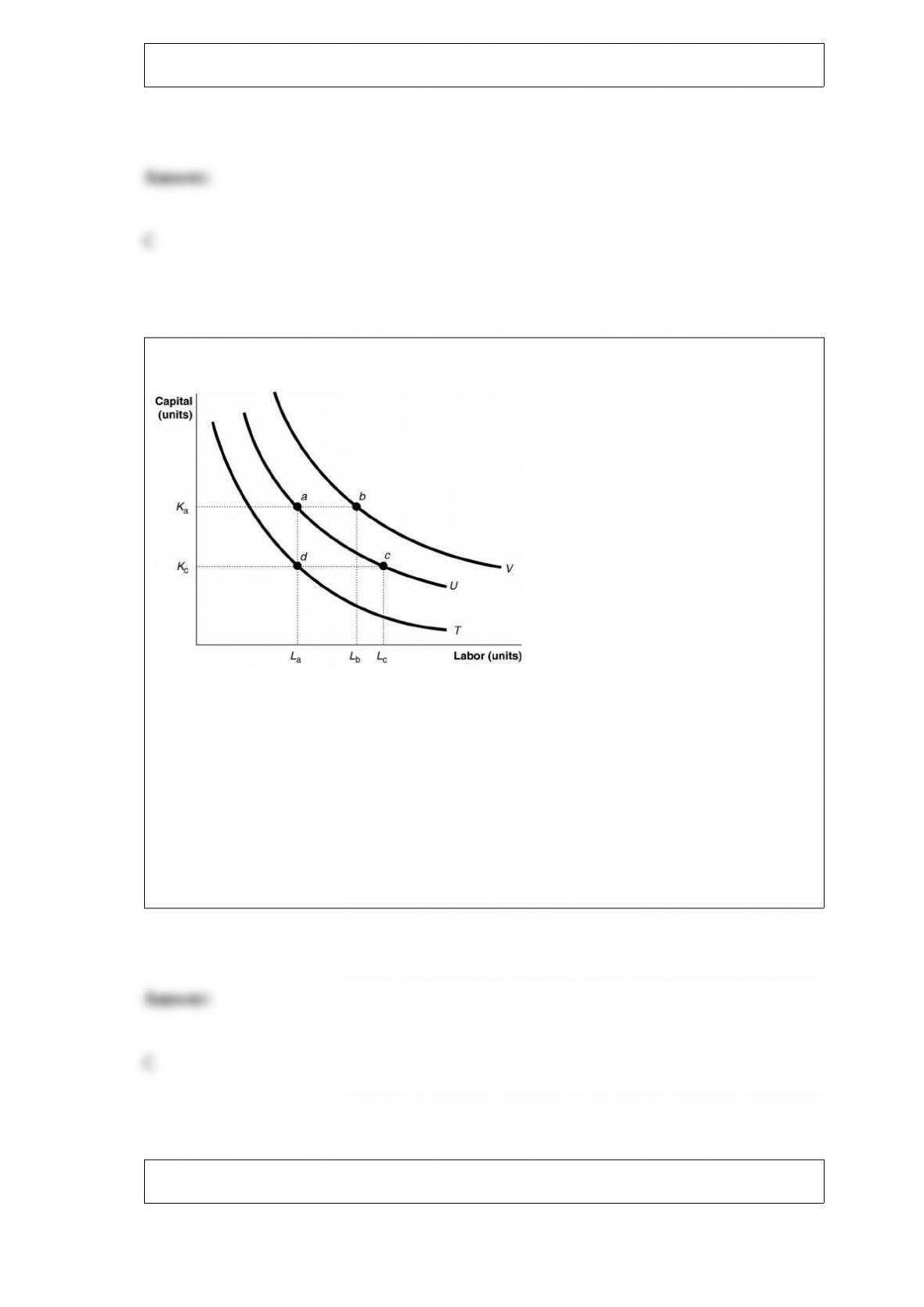
Figure 11-12
The movement from isoquant T to isoquant U depicts
A) a change in preferences with regards to input usage.
B) an increase in the cost of production.
C) an increase in output.
D) an increase in labor usage holding capital and output constant.
Table 8-17
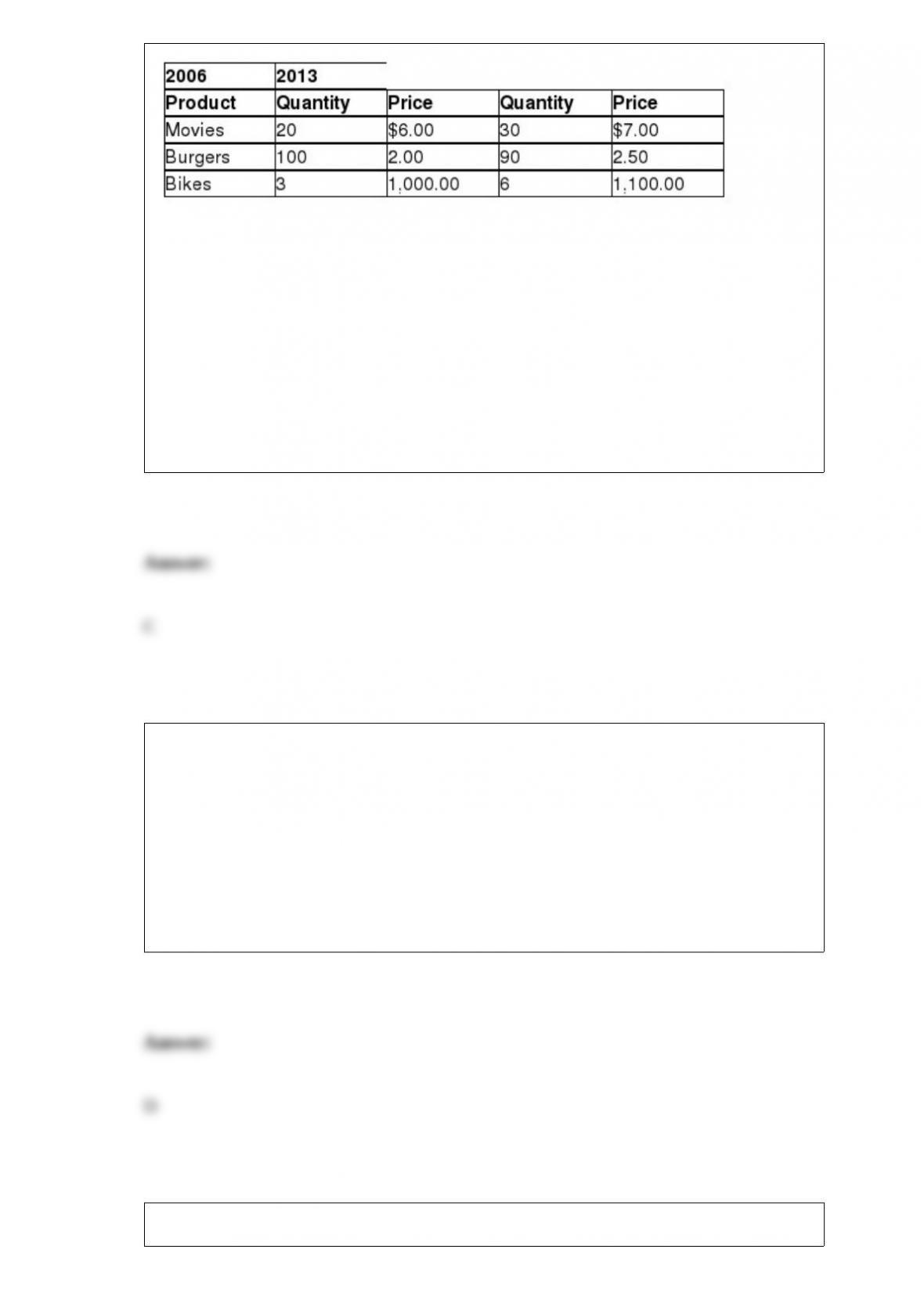
A very simple economy produces three goods: movies, burgers, and bikes. The
quantities produced and their corresponding prices for 2006 and 2013 are shown in the
table above. What is real GDP in 2013, using 2006 as the base year?
A) $3,320
B) $3,690
C) $6,360
D) $7,035
Whenever a buyer and a seller agree to trade,
A) the agreement is made based on absolute advantage.
B) they must have identical opportunity costs in producing their respective products.
C) one party will always be worse off.
D) both must believe they will be made better off.
Table 10-1
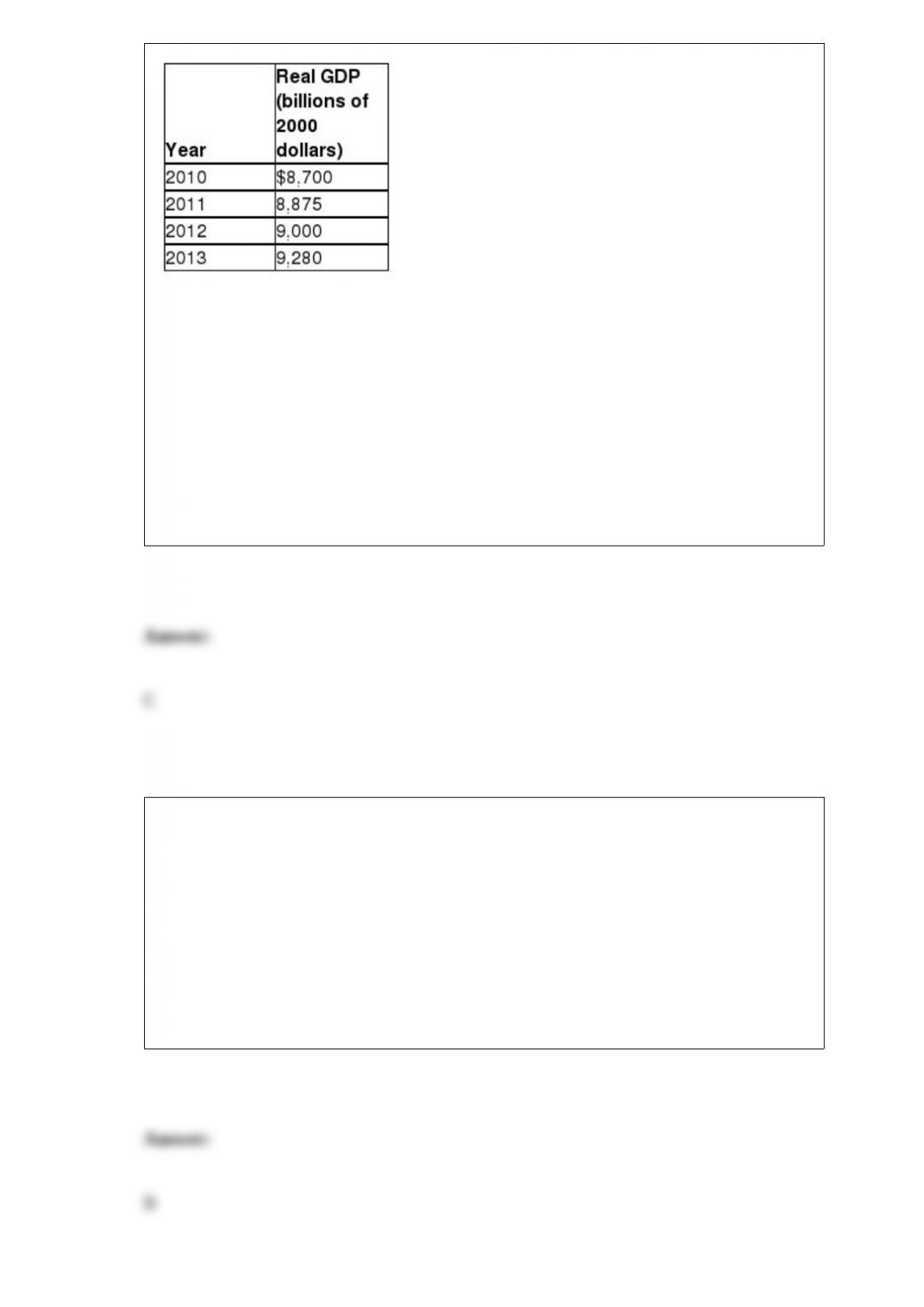
Using the table above, what is the approximate average annual growth rate from 2010
to 2013?
A) 1%
B) 1.5%
C) 2%
D) 3%
A decrease in United States net foreign direct investment would occur if
A) U.S. citizens have decreased the value of foreign stocks and bonds they own.
B) U.S. citizens have decreased their building or purchasing of facilities in foreign
countries.
C) net foreign investment decreases.
D) net capital flows increase.

The fastest growing category of government expenditure is
A) grants to state and local governments.
B) defense spending.
C) transfer payments.
D) government purchases.