
________ involves undertaking an activity until its marginal benefits equal marginal
costs.
A) Scarcity reduction
B) Central planning
C) Marginal analysis
D) Market intervention
Scarcity
A) stems from the incompatibility between limited resources and unlimited wants.
B) can be overcome by discovering new resources.
C) can be eliminated by rationing products.
D) is a bigger problem in market economies than in socialist economies.
Which type of businesses earns the majority of profits in the United States?
A) corporations
B) partnerships
C) sole proprietorships
D) none of these

Which of the following is a true statement regarding the economic growth model’s
predictions and how it actually affects the real world?
A) The growth model predicts that poor countries should catch up with rich countries,
but developing countries are not catching up to lower-income industrialized countries as
a group.
B) The growth model predicts that poor countries will never catch up with rich
countries, but lower-income industrialized countries are catching up to higher-income
industrialized countries as a group.
C) The growth model predicts that poor countries will catch up with rich countries, but
lower-income industrialized countries are not catching up to higher-income
industrialized countries as a group.
D) The growth model predicts that poor countries will catch up with rich countries, and
this is what we observe across all developmental categories of countries.
Which of the following statements about capital markets is true?
A) The U.S. capital market is currently larger than all other capital markets combined.
B) At one time, the U.S. capital market was larger than all other capital markets
combined, but that is no longer the case.
C) There are currently large capital markets in Europe, but none in Asia.
D) The largest capital markets in the world today are in East Asia and Latin America.
Hurricane Katrina damaged a large portion of refining and pipeline capacity when it
swept through the Gulf coast states in August 2005. As a result of this, many gasoline
distributors were not able to maintain normal deliveries. At the pre-hurricane
equilibrium price (i.e., at the initial equilibrium price), we would expect to see
A) a surplus of gasoline.
B) the quantity demanded equal to the quantity supplied.
C) a shortage of gasoline.
D) an increase in the demand for gasoline.
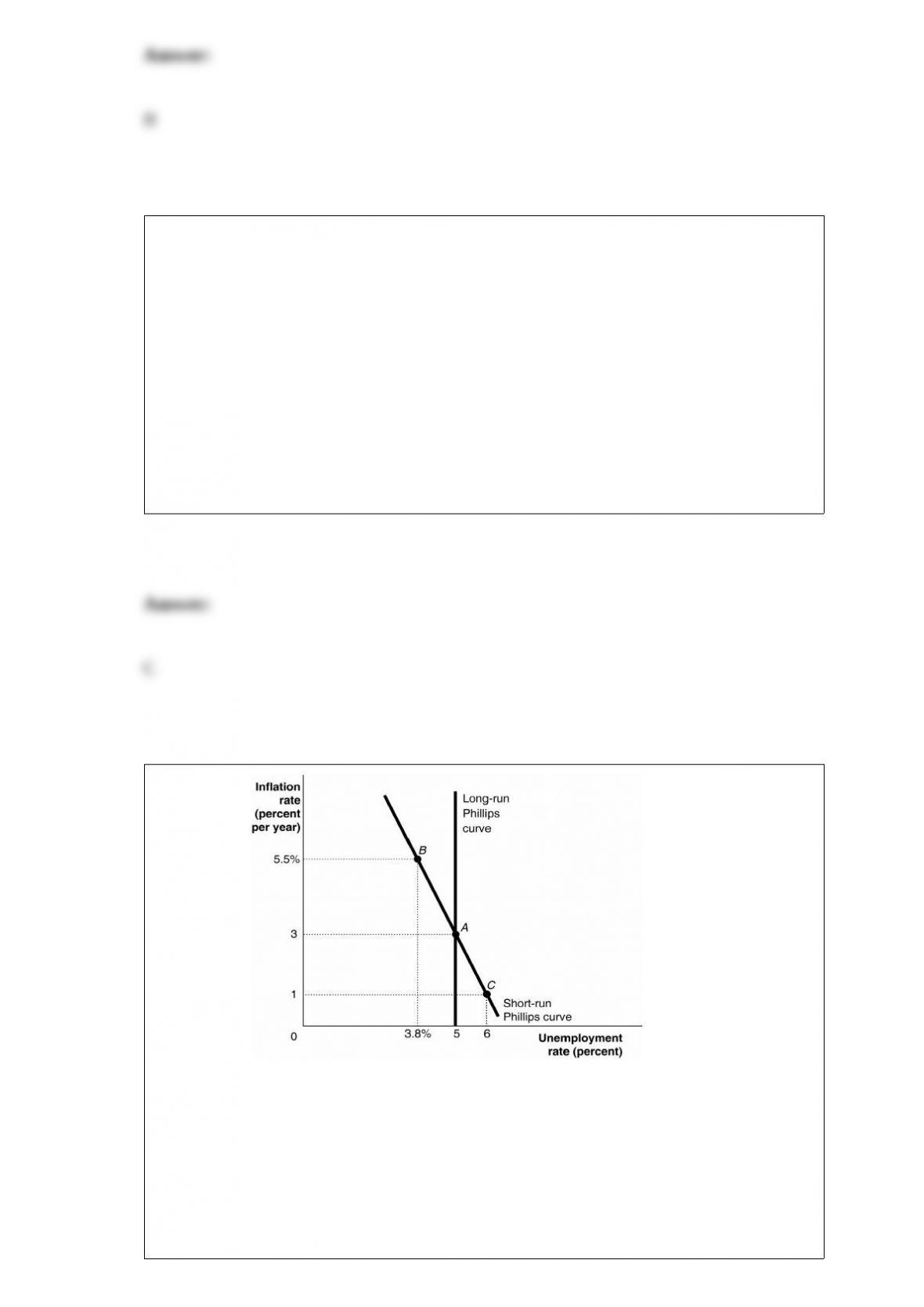
Figure 28-2
At which point are inflation expectations equal to the actual inflation rate?
A) A
B) B
C) C

D) all of the above
Nominal GDP is another term for
A) inflation-adjusted GDP.
B) real GDP.
C) constant-dollar GDP.
D) current-dollar GDP.
Which of the following transactions represents the purchase of a final good?
A) Starbucks purchases coffee beans.
B) Delta buys a new European-made jetliner.
C) Apple computer buys computer processors from Intel.
D) Your father buys a new John Deere riding lawn mower.

To affect the market outcome, a price floor
A) must be set above the black market price.
B) must be set above the legal price.
C) must be set above the price ceiling.
D) must be set above the equilibrium price.
If disposable income increases by $500 million, and consumption increases by $400
million, then the marginal propensity to consume is
A) 1.25.
B) 0.8.
C) 0.6.
D) 0.4.
The Latvian currency, the lat, is pegged to the euro at a rate of 0.71 lats to the euro. At
the pegged exchange rate, how many euros would be exchanged for one lat?
A) 0.29
B) 0.71
C) 1.41
D) 1.71
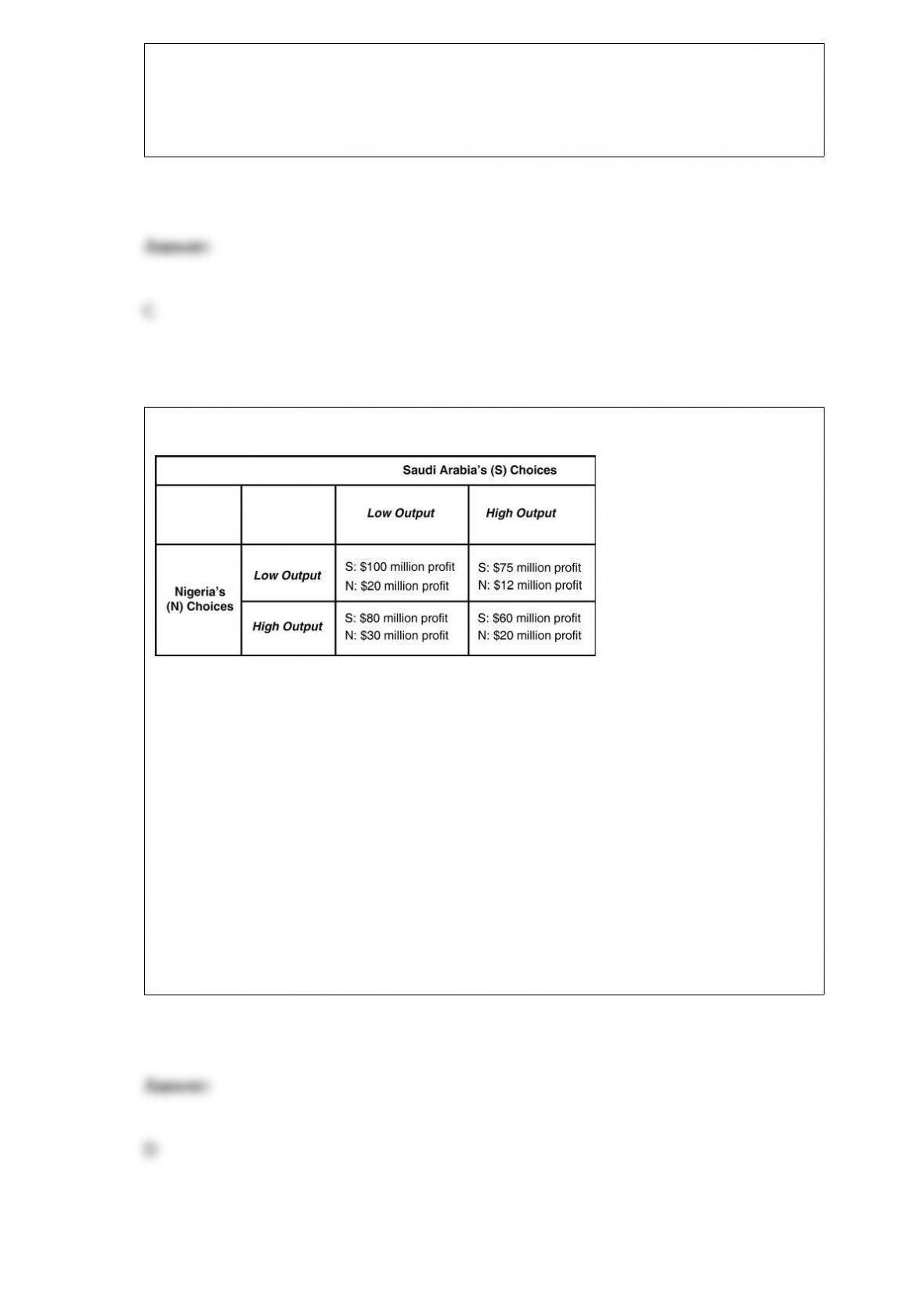
Table 14-3
Suppose OPEC has only
two producers, Saudi Arabia and Nigeria. Saudi Arabia has far more oil reserves and is
the lower cost producer compared to Nigeria. The payoff matrix in Table 14-3 shows
the profits earned per day by each country. “Low output” corresponds to producing the
OPEC assigned quota and “high output” corresponds to producing the maximum
capacity beyond the assigned quota. Is there a dominant strategy for Nigeria and, if so,
what is it?
A) Yes, it has a dominant strategy depending on what Saudi Arabia does.
B) No, there is no dominant strategy.
C) Yes, the dominant strategy is to produce a low output.
D) Yes, the dominant strategy is to produce a high output.

How will an interest rate decrease in the United States affect equilibrium in the foreign
exchange market?
A) The equilibrium exchange rate will increase, and the equilibrium quantity of dollars
traded cannot be determined.
B) The equilibrium exchange rate will decrease, and the equilibrium quantity of dollars
traded cannot be determined.
C) The equilibrium exchange rate cannot be determined, and the equilibrium quantity of
dollars traded will increase.
D) The equilibrium exchange rate will increase, and the equilibrium quantity of dollars
traded will increase.
Article Summary. A growing number of U.S. citizens are going to other countries
for elective surgery procedures. Improved quality and significant cost savings
abroad have attracted an increasing number of what are being referred to as
American medical tourists, especially those who either do not have insurance or
whose insurance does not cover the desired procedure. As few as five years ago,
Americans tended to travel to countries such as Thailand or Mexico for the
procedures, but many are now choosing to go to Europe, where governments and
hospitals are now publicizing these services. Many of the procedures being done
overseas are joint replacement, and partly in response to the number of patients
going abroad for these procedures, programs are being developed to reduce the
cost of these surgeries in the United States. Source: Elizabeth Rosenthal, “The
Growing Popularity of Having Surgery Overseas,” New York Times, August 6,
2013.
If more European governments and hospitals begin to offer and publicize their services
to American medical tourists and, due to the growing number of aging baby boomers,
more Americans desire joint-replacement surgery, what will happen in the market for
joint-replacement surgery as a result of these two factors?
A) Demand will increase, but these two factors will not shift the supply curve.
B) Supply will increase, but these two factors will not shift the demand curve.
C) Demand and supply will both increase.
D) Demand will increase and supply will decrease.