1) marginal utility is total utility divided by the number of units consumed.
2)
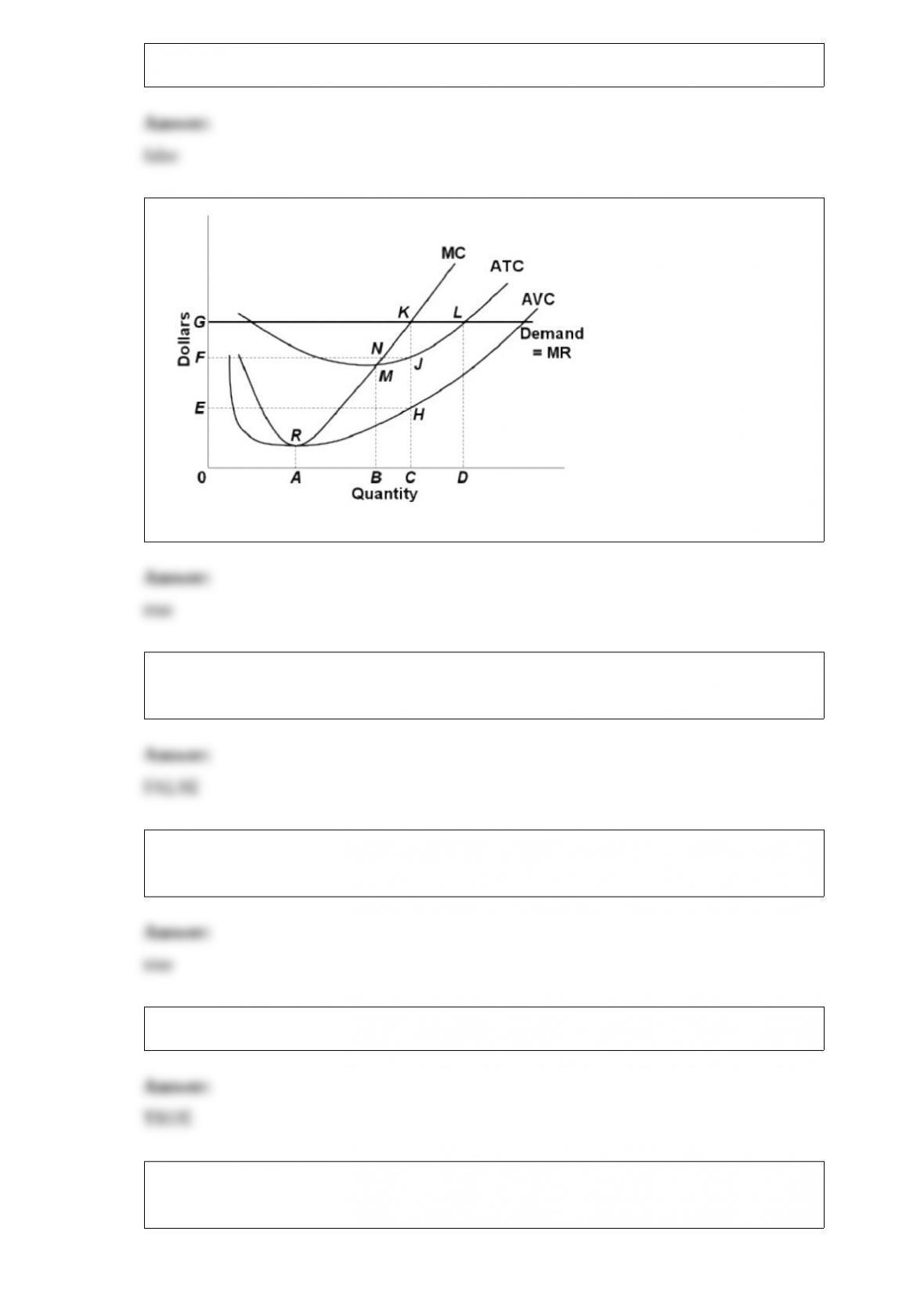
refer to the above diagram. at output c production will result in an economic profit.
3) A lump-sum tax causes the after-tax consumption schedule to be flatter than the
before-tax consumption schedule.
4) marginal revenue is the addition to total revenue resulting from the sale of one more
unit of output.
5) Checkable deposits are a liability on a bank’s balance sheet.
6) The higher a resource’s current price, the more extraction should be delayed to a later
period.

7) The percentage share of total U.S. financial assets held by commercial banks and
thrifts has increased since 1980.
8) A $10 billion decrease in taxes will increase the equilibrium GDP by more than
would a $10 billion increase in government expenditures.
9) when a consumer shifts purchases from x to y, the marginal utility of x falls and the
marginal utility of y rises.
10) the limited money income of consumers results in a so-called budget constraint.
11) Six of the 50 states account for approximately half of all union members in the
United States.
12)
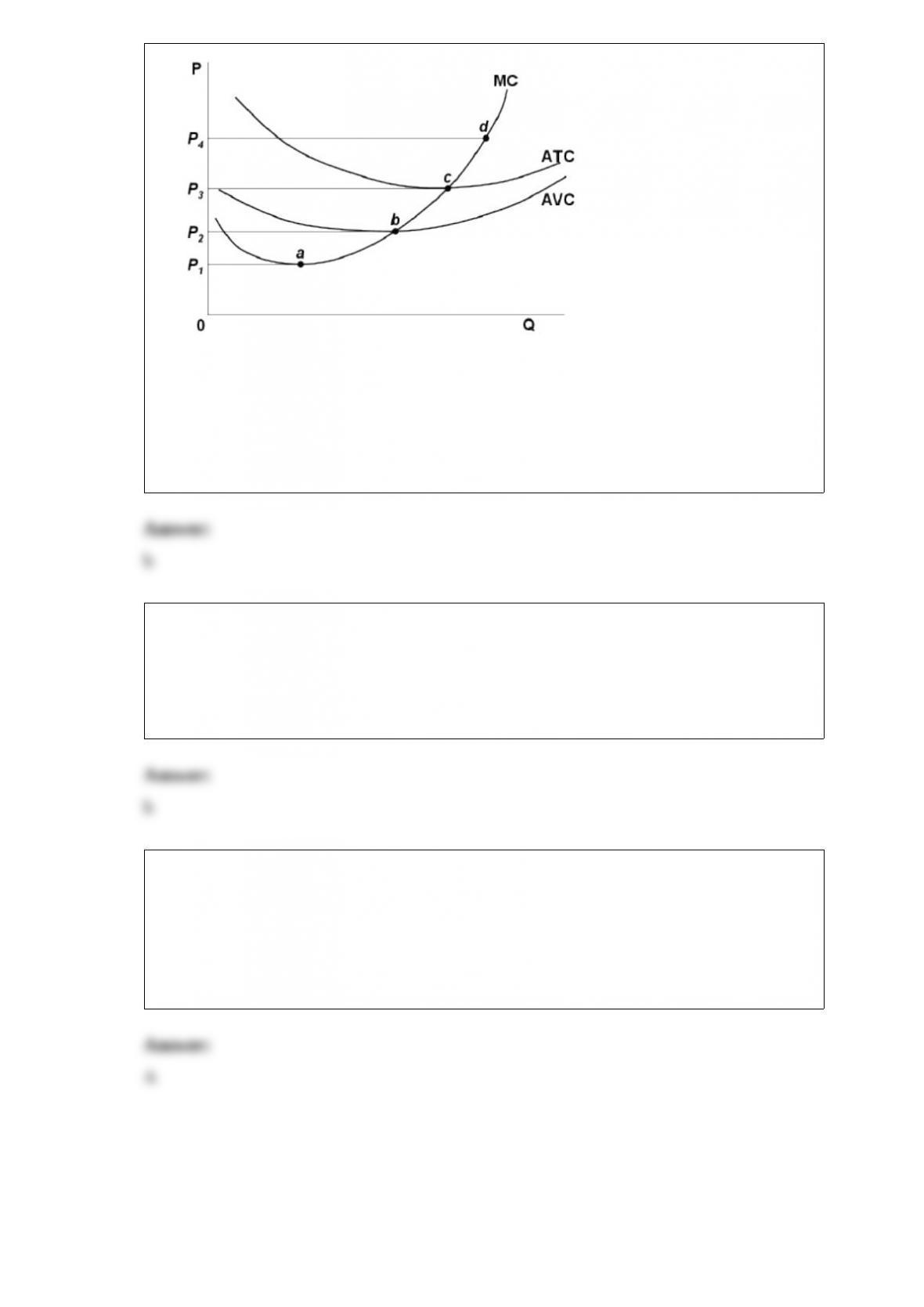
refer to the above diagram for a purely competitive producer. the firm’s short-run supply
curve is:
a.the abcd segment and above on the mc curve.
b.the bcd segment and above on the mc curve.
c.the cd segment and above on the mc curve.
d.not shown.
13) an increase in the quantity demanded means that:
a.given supply, the price of the product can be expected to decline.
b.price has declined and consumers therefore want to purchase more of the product.
c.the demand curve has shifted to the right.
d.the demand curve has shifted to the left.
14) Assuming no other changes, if balances in small time deposits increase by $30
billion and money market mutual funds held by individuals decrease by $30 billion, the:
A.M1 and M2 money supplies will not change.
B.M2 money supply will increase.
C.M1 money supply will decline.
D.M2 money supply will increase and the M1 money supply will decrease.
15)
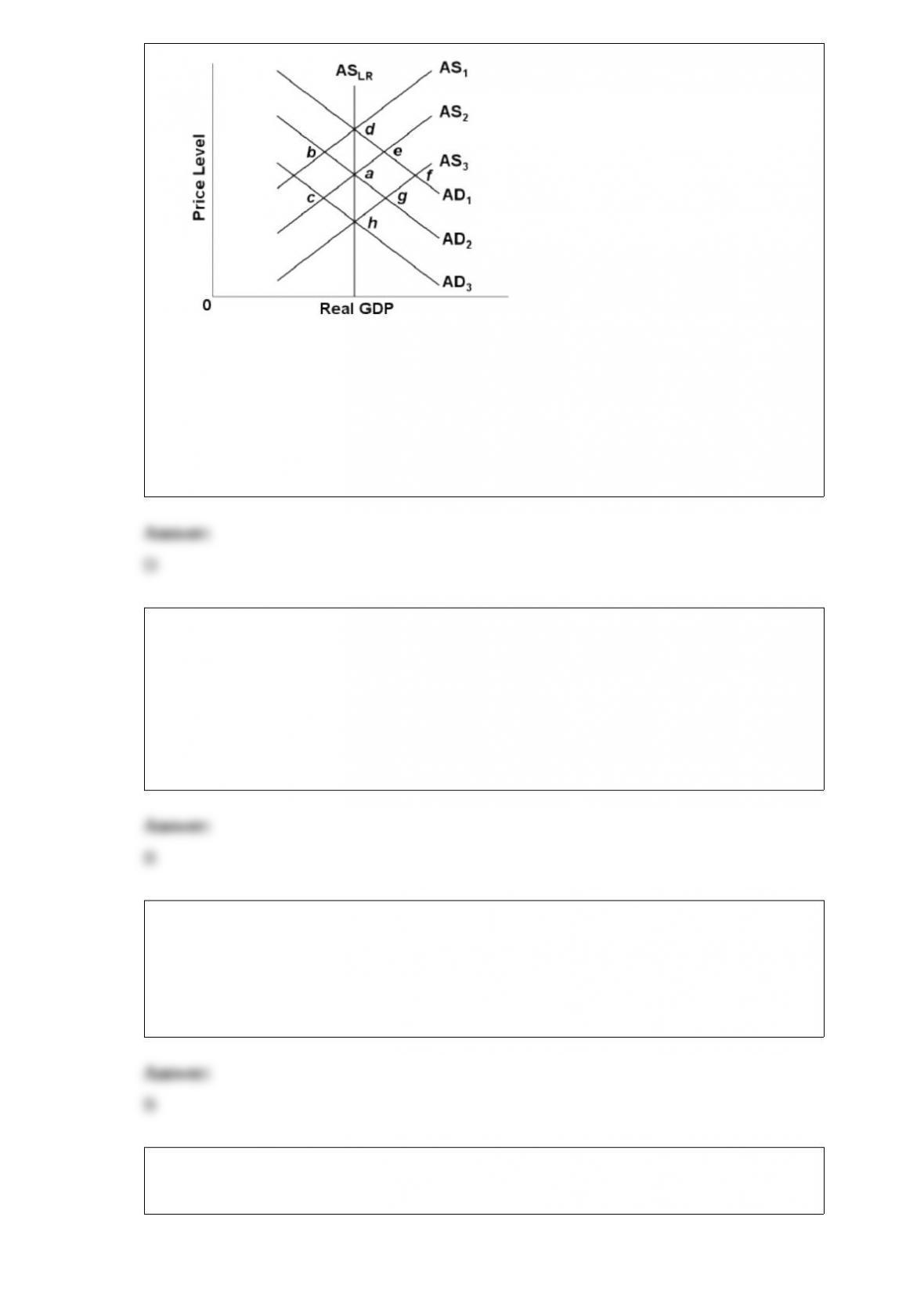
Refer to the above figure and assume the economy initially is in equilibrium at point a.
In the new classical theory, an unanticipated decrease in aggregate demand from AD2 to
AD3 would move the economy:
A.directly from a to h
B.from a to g to h
C.directly from a to d
D.from a to c to h
16) Which of the following is a feature of farm policy present in the Food,
Conservation, and Energy Act of 2008, that was not part of the Freedom to Farm Act of
1996?
A.direct payments (direct subsidies) based on crops currently grown
B.countercyclical payments
C.farm buyouts by government
D.acreage allotments (restrictions on planting)
17) Per-unit production cost is:
A.real output divided by inputs.
B.total input cost divided by units of output.
C.units of output divided by total input cost.
D.a determinant of aggregate demand.
18) the letters a, b, and c designate three successively larger plant sizes.

refer to the above data. in the long run the firm should use plant size “c” for:
a.all possible levels of output.
b.10 to 30 units of output.
c.40 to 70 units of output.
d.all units of output greater than 80.
19) According to climate change scientists, over the next 50 years the earth’s average
temperature is expected to:
A.rise anywhere from 2.2 to 10 degrees Fahrenheit.
B.rise anywhere from 1 to 4.5 degrees Fahrenheit.
C.fall anywhere from 2.2 to 4.5 degrees Fahrenheit.
D.remain constant overall, but with dramatic increases and decreases in certain regions.
20) Which of the following is correct?
A.Income is a stock and wealth is a flow concept.
B.Both income and wealth are flow concepts.
C.Both income and wealth are stock concepts.
D.Income is a flow and wealth is a stock concept.
21) The basic reason why the commercial banking system can increase its checkable
deposits by a multiple of its excess reserves is that:
A.reserves lost by any particular bank will be gained by some other bank.
B.the central banks follow policies that prevent reserves from falling below the level
required by law.
C.the MPC of borrowers is greater than zero, but less than 1.
D.the banking system must keep reserves equal to 100 percent of its checkable-deposit
liabilities.

22) In terms of individual nations, the largest U.S. trade deficit is with:
A.Japan.
B.Mexico.
C.China.
D.Canada.
23) what do the income effect, the substitution effect, and diminishing marginal utility
have in common?
a.all are required to explain the utility-maximizing position of a consumer.
b.they are all empirically measurable.
c.they all help explain the upsloping supply curve.
d.they all help explain the downsloping demand curve.
24) determine, other things equal, the effects of a given change in a determinant of
demand or supply for product x upon (1) the demand (d) for, or supply (s) of, x, (2) the
equilibrium price (p) of x and (3) the equilibrium quantity (q) of x.
refer to the above. consumer expectations that the price of x will rise sharply in the
future will:
a.increase s, increase p, and increase q.
b.increase d, increase p, and increase q.
c.decrease s, increase p, and increase q.
d.increase d, decrease p, and increase q.
25) The U.S. public debt:
A.refers to the debts of all units of governmentFederal, state, and local.
B.consists of the total debt of U.S. households, businesses, and government.
C.refers to the collective amount that U.S. citizens and businesses owe to foreigners.
D.consists of the historical accumulation of all Federal government deficits less
surpluses.

26) if unemployed workers leave a nation, the standard of living (national income per
capita) will rise in that nation.
27) which of the following do national income accountants consider to be investment?
a.the purchase of an automobile for private, nonbusiness use
b.the purchase of a new house
c.the purchase of corporate bonds
d.the purchase of gold coins
28) Economic rent is:
A.nonexistent in a static, purely competitive economy.
B.the price paid for a resource that has a perfectly inelastic supply.
C.the price paid for a resource that has a perfectly elastic supply.
D.equal to the pure rate of interest if all markets are competitive.
29) If a firm is a monopsonist in the hiring of both labor and capital, it will obtain the
profit-maximizing quantities of labor and capital when:
A.MRPL/PL = MRPC/PC = 1.
B.MRPL/MRCL = MRPC/MRCC = 1.
C.the MRP of labor equals the MRP of capital.
D.the MRC of labor equals the MRC of capital.
30) What are the major features of monopolistic competition compared to pure
competition and pure monopoly?
31) What are the three time horizons used to categorize aggregate supply? What is the
difference between the immediate short-run and the short-run aggregate supply?
32) What are the prospects for domestic capital formation in DVCs?

33) How do companies deal with unexpected shifts in quantity demanded when prices
are sticky?
34) How equal is the distribution of personal income by households in the United
States?
35) Which is more importantlabor quantity or labor productivityas a source of economic
growth in the United States? Explain.
36) What are political business cycles and how could they be created?
37) A witness told a congressional committee that if the United States doubled its real
GDP, it would be a much less livable society than it is today. Explain this view.
38) Explain the reasoning behind why employment could increase for domestic-born
workers if immigrant workers become complementary resources rather than substitute
resources.