
Propositions in positive economics
a. can be tested by comparisons with facts.
b. yield results that depend on individual values or preferences.
c. are rarely agreed to by both conservative and liberal economists.
d. make statements about what ought to be.
e. are generally identical to those of normative economics.
How did the proposed fiscal policies of President Eisenhower and President Nixon
differ?
a. Eisenhower felt unemployment was the most pressing economic problem of the time;
Nixon saw inflation as more serious.
b. Nixon favored a balanced budget; Eisenhower did not.
c. Nixon favored strong growth in the economy; Eisenhower wanted to create a budget
surplus.
d. Eisenhower was a strong believer in the use of fiscal policy to influence the
economy; Nixon had a laissez-faire attitude.
e. They both favored the same fiscal policies but differed on monetary policy.

Discretionary fiscal policy is
a. the responsibility of the Federal Reserve System.
b. designed to increase the size of recessionary and inflationary gaps.
c. focused on making the 45-degree line more vertical.
d. intended to ensure continuing corporate dividends under changing sales conditions.
e. implemented through changes in government expenditures and tax rates.
When individuals and firms base their expectations on the best use of whatever
information is available, they conform to the theory of ________ expectations.
a. great
b. passive
c. limited
d. systematic
e. rational
When actual output is below potential output
a. the economic costs of unemployment are zero.
b. everyone actively seeking a job can easily find one.
c. extreme inflationary pressure prevails.
d. less than 95 percent of the labor force is employed.
e. the economy is producing on its production possibilities curve.
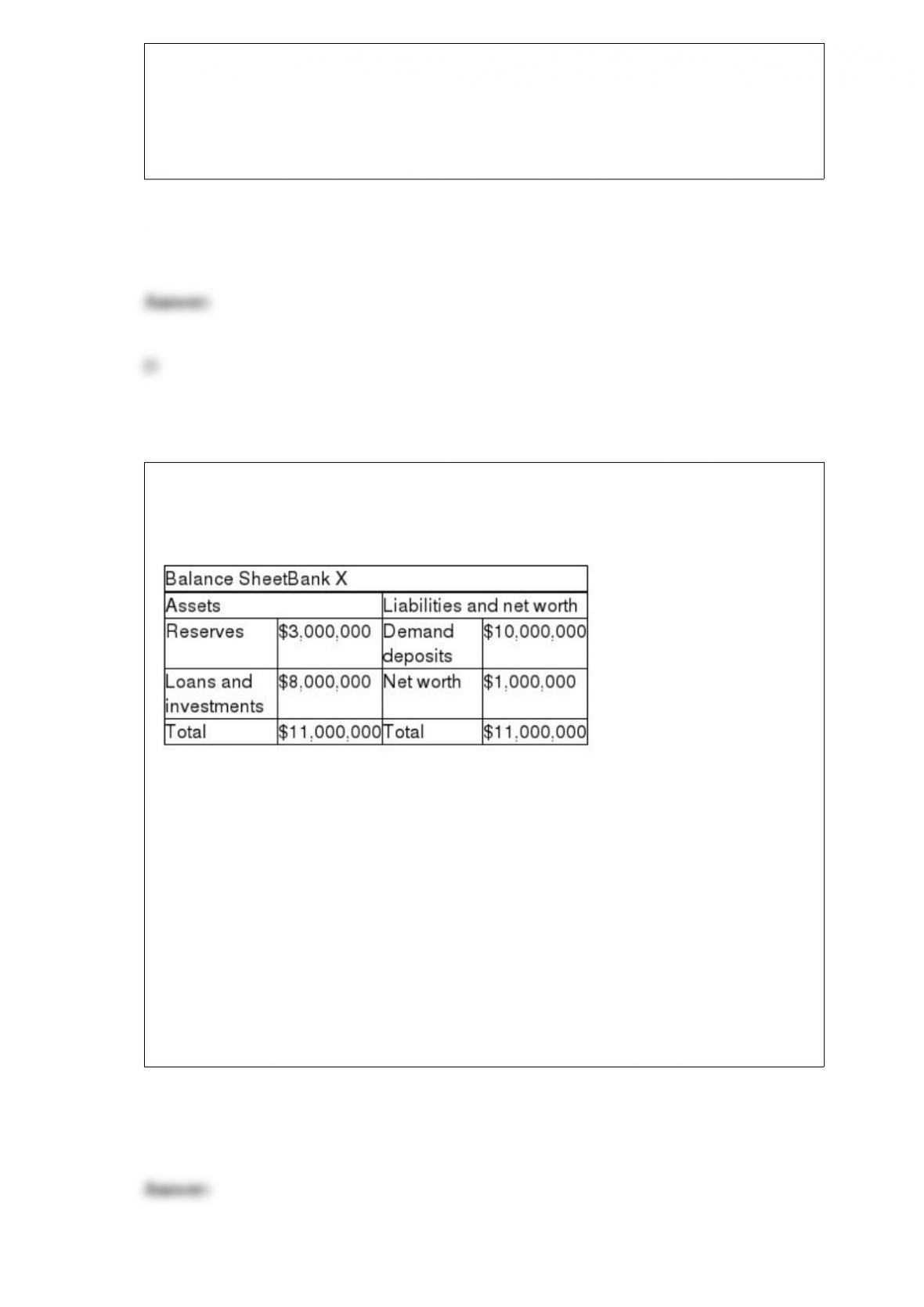
The following questions refer to the table that follows. Assume that there is a
fractional-reserve banking system, that the legal reserve requirements are 10 percent,
and that the balance sheet for Bank X is as follows:
If Bank X safely increases its loans
a. the country’s money supply is unaffected.
b. the bank’s net worth is immediately increased.
c. both its demand deposit liabilities and its assets will be temporarily increased by the
amount of the loan.
d. only its demand deposit liabilities will be increased.
e. its demand deposit liabilities will be increased by some multiple of the loan.
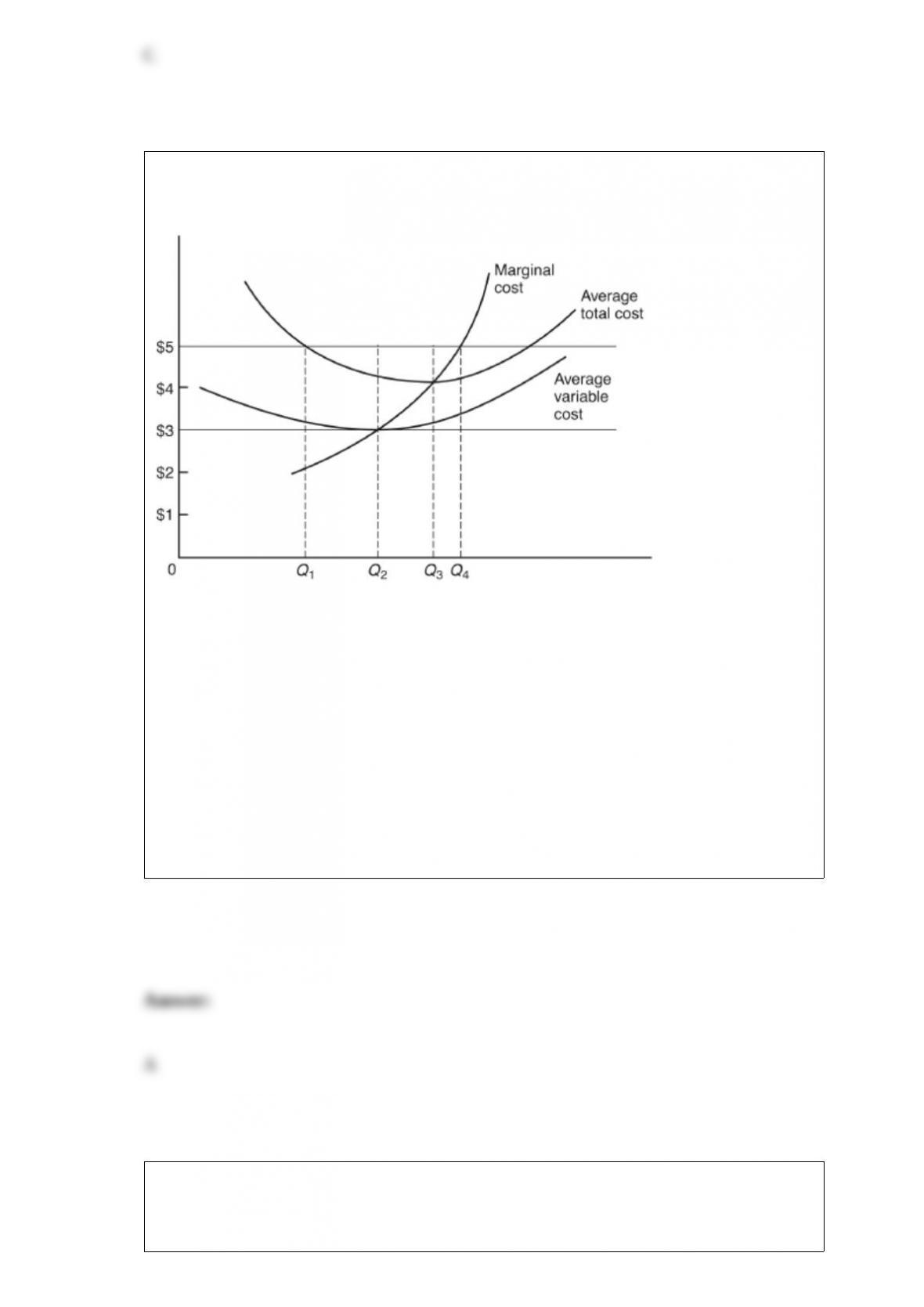
The following questions are based on the following diagram showing the short-run cost
curves for a perfectly competitive firm:
If the price is $2 per
unit, the profit-maximizing level of output is
a. zero.
b. 0Q1.
c. 0Q2.
d. 0Q3.
e. 0Q4.
The process of cumulative expansion of demand deposits assumes that no depositor
withdraws cash from the banking system. If some do, when the required reserve ratio is
25 percent and no bank keeps excess reserves, a deposit of $10,000 in newly printed

money will lead to an increase in the money supply of
a. less than $30,000.
b. $30,000.
c. $40,000.
d. $50,000.
e. $60,000.
The following questions are based on the following changes in the balance sheet of
Nowhere National Bank.
Assets Liabilities
a. Reserves No change Demand deposits $8,000
Loans and investments $8,000
Total $8,000 Total $8,000
b. Reserves $2,000 Demand deposits $10,000
Loans and investments $8,000
Total $10,000 Total $10,000
c. Reserves $10,000 Demand deposits $10,000
Loans and investments No change
Total $10,000 Total $10,000
d. Reserves “$8,000 Demand deposits “$8,000
Loans and investments No change

Total “$8,000 Total “$8,000
e. Reserves $10,000 Demand deposits No change
Loans and investments $10,000
Total $20,000 Total No change
Which letter best indicates the change in the balance sheet of this bank after completion
of a loan?
a. a
b. b
c. c
d. d
e. e
The effect of a tariff on a good in which the domestic industry does NOT have a
comparative advantage is
a. an increase in the exports of the good.
b. that the domestic industry’s gain is just offset by the consuming public’s loss.
c. a reduction in the nation’s standard of living.
d. fewer jobs and lower wages for domestic workers in the protected industry.
e. nonexistent if the domestic industry has an absolute advantage.

When firms do not have to pay the true social costs for resources
a. they have an incentive to reduce pollution voluntarily with their excess profits.
b. the net social benefits are increased.
c. they will use too little of them, from society’s perspective.
d. no external diseconomies are present.
e. the public is induced to buy more of that output than it would otherwise.
What percentage of the nation’s small businesses are proprietorships?
a. less than 10 percent
b. between 10 and 25 percent
c. between 26 and 50 percent
d. between 51 and 75 percent
e. more than 75 percent

Over the past 50 years, the prevailing national attitude toward the government budget
has been one
a. that consistently advocated surpluses.
b. that supported increasingly larger surpluses.
c. that paid increasing lip service to the desirability of growth deficits.
d. that changed from favoring annually balanced budgets to favoring a budget balanced
over the business cycle back to favoring annually balanced budgets.
e. of indifference, since it is clear that the government budget has no effect on economic
activity.
Expenditures on education and training that raise per capita output are viewed as
a. conspicuous consumption.
b. public and private transfer payments.
c. investments in human capital.
d. consumer surplus.
e. normative expenditures.

Suppose I am to receive $24,000 two years from now. I need the money immediately
and wish to sell the rights to the $24,000. If the interest rate is 12 percent, I can expect
to receive
a. $23,659.
b. $21,428.
c. $20,000.
d. $19,133.
e. $18,230.
In 1840, the country with the highest per capita output was
a. the United States.
b. Canada.
c. Germany.
d. Japan.
e. England.
The money supply, broadly defined, is distinguished from the money supply, narrowly

defined, in that the former includes
a. checking accounts.
b. some deposit accounts that are not as easy to use for purchases.
c. items of greater value.
d. U.S. government bonds.
e. precious metals.
Inflation
a. hurts people living on fixed incomes.
b. inevitably tends to die out.
c. has been the experience of this country since its founding.
d. does not tend to redistribute income.
e. inevitably leads to deflation.
If the demand curve for agricultural products is price inelastic, bumper crops would
cause farm prices

a. and incomes to rise.
b. and incomes to fall.
c. to fall and incomes to rise.
d. to rise and incomes to fall.
e. and incomes to remain unchanged.
Which of the following conditions would cause a country’s currency to depreciate
relative to another country’s currency?
a. a lower rate of economic growth
b. a lower rate of inflation
c. a lower rate of interest
d. lower costs of production
e. a higher unemployment rate
Schumpeter argues that the rate of technological change is likely to be greater in
imperfectly competitive industries because imperfectly competitive firms
a. earn profits that support expenditures on research and development.

b. lack the power necessary to keep rivals from imitating their innovations.
c. have a vested interest in maintaining demand for existing products.
d. use their power to keep out rivals who would be more inclined to use new
techniques.
e. are composed of a large number of independent decision-making units that are less
inclined to be conservative.
In the short run, the greater the level of output, the
a. greater the average fixed cost.
b. lower the total fixed cost.
c. greater the total fixed cost.
d. lower the total variable cost.
e. greater the total variable cost.
The actual rate of growth of GDP is directly related to the percent of GDP devoted to
investment if

a. the marginal product of labor equals one.
b. the stock of human capital expands at an exponential rate.
c. noninflationary full employment is sustained with a constant capital-output ratio.
d. consumption is an increasing percentage of GDP.
e. net inventory investment rises at an accelerating rate.
The price leadership model that applies when the firm that changes price is regarded as
an accurate interpreter of industry cost and demand conditions is the ________ model.
a. marginal firm
b. cartel
c. perceived interdependence
d. barometric firm
e. dominant firm
An important element of the Sarbanes”Oxley Act of 2002 is that it
a. sets limits on the market shares of large corporations.

b. enables the Fed to actively intervene in the stock market by buying corporate
securities during times of falling stock prices.
c. tightens the standards of accountability for the top corporate officers.
d. requires corporate boards of directors to have at least one elected public official as a
member.
e. prevents corporations from declaring profits that are higher than they originally
estimated.
If the marginal cost for a perfectly competitive, profit-maximizing firm currently
exceeds the price of its output, the firm should
a. expand its output and lower its price.
b. continue to produce at the same output rate and raise its price.
c. contract output.
d. increase its nonprice competition.
e. do nothing; it is currently maximizing profits.
Costs of owner-supplied resources are ________ costs.
a. fixed

b. related
c. functional
d. optimal
e. implicit
The greatest amount of consumer spending in the economy is on
a. durable goods.
b. nondurable goods.
c. services.
d. plants and equipment.
e. residential structures.
A government budget deficit has the greatest inflationary impact if it is financed by
a. increasing personal and corporate taxes.
b. creating new money.

c. borrowing from consumers and businesses.
d. impounding surplus funds.
e. reducing government expenditures.
Star athletes often receive incomes significantly above what they would be willing to
accept to continue playing. In the context of economic analysis, it would be reasonable
to consider this additional income a form of
a. wage.
b. profit.
c. rent.
d. interest.
e. merit pay.
In real business cycle models, a favorable supply shock
a. pushes the aggregate demand curve to the right.
b. causes real GDP to rise.
c. lowers the income of firms and individuals.

d. increases the price level.
e. pushes the aggregate supply curve to the left.