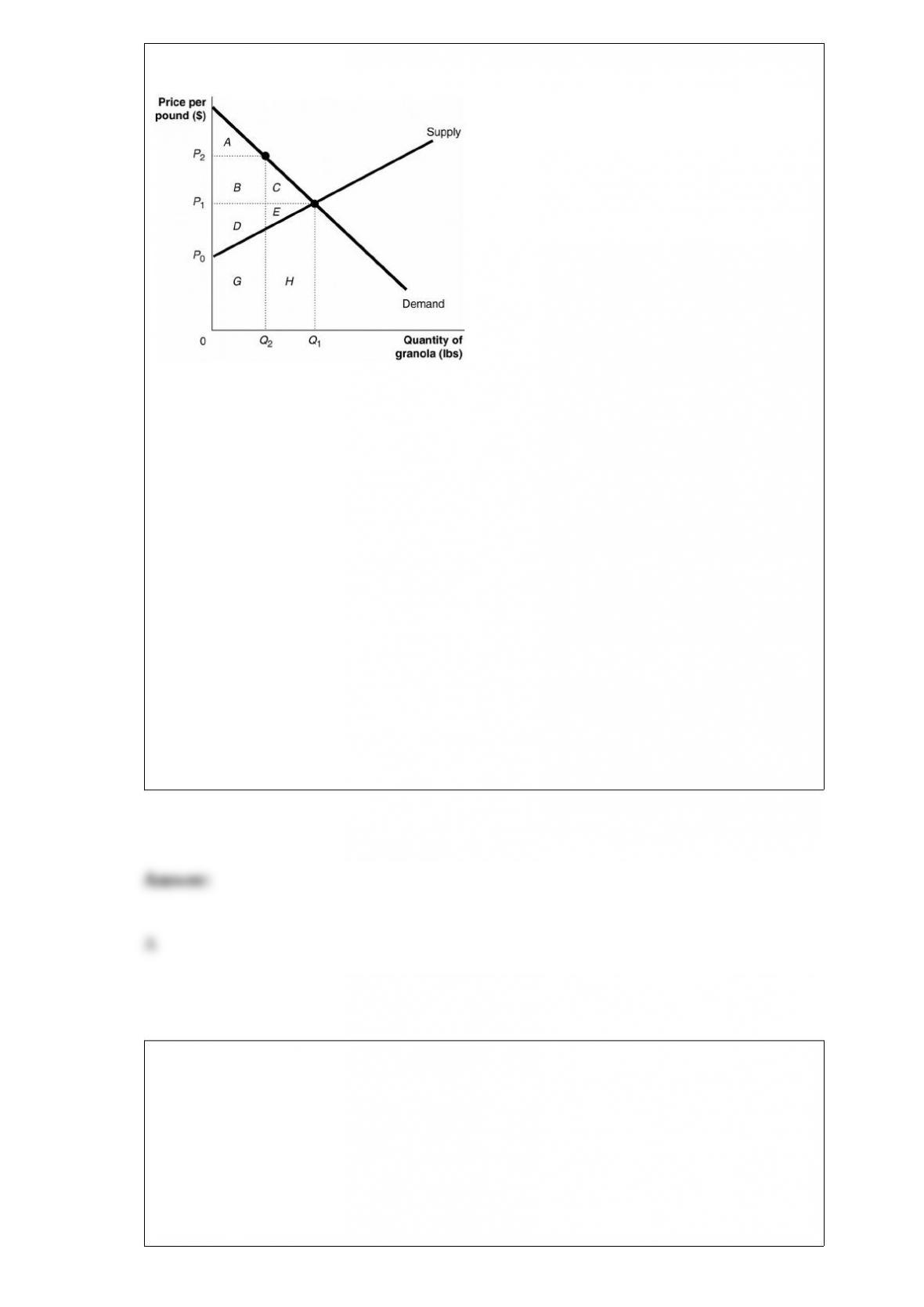
Figure 4-3
Figure 4-3 shows the market for granola. The market is initially in equilibrium at a price
of P1 and a quantity of Q1. Now suppose producers decide to cut output to Q2 in order
to raise the price to P2.
Refer to Figure 4-3. At the price P2, consumers are willing to buy the Q2pounds of
granola. Is this an economically efficient quantity?
A) No, the marginal benefit of the last unit (Q2) exceeds the marginal cost of that last
unit.
B) Yes, otherwise consumers would not buy Q2 units.
C) Yes, because the price P2 shows what consumers are willing to pay for the product.
D) No, the marginal cost of the last unit (Q2) exceeds the marginal benefit of the last
unit.
According to the quantity theory of money, if the money supply grows at 20 percent
and real GDP grows at 5 percent, then the inflation rate will be
A) 15 percent.
B) 20 percent.
C) 25 percent.

D) 100 percent.
The purchase of $1 million of Treasury securities by the Federal Reserve, if there is no
change in the quantity of currency, will cause reserves at banks to
A) increase by $1 million.
B) increase by less than $1 million.
C) decrease by $1 million.
D) decrease by less than $1 million.
If the price of beef jerky rises, the substitution effect due to the price change will cause
A) an increase in the demand for beef jerky.
B) an increase in the demand for hot sauce, a complement for beef jerky.
C) an increase in the quantity of beef jerky demanded.
D) a decrease in the quantity of beef jerky demanded.

Suppose an excise tax of $0.75 is imposed on every pack of cigarettes sold and sellers
are responsible for paying this tax. How would the imposition of the tax be illustrated in
a graph?
A) The supply curve for cigarettes would shift to the left by $0.75.
B) The supply curve for cigarettes would shift to the left by less than $0.75.
C) The supply curve for cigarettes would shift to the left by more than $0.75.
D) The supply curve for cigarettes would shift to the right by $0.75.
The minimum wage is an example of
A) a subsidy for low-skilled workers.
B) a price floor.
C) a price ceiling.
D) a black market.
Private saving is defined as
A) Y + TR – C – T.
B) T + G + TR.

C) T – G + TR.
D) Y + TR + C – T.
Parker Hannifin benefitted when the Federal Reserve slashed the federal funds rate to
near-zero levels in 2008. Lower interest rates increased demand for its machinery
components, which would allow Parker Hannifin to ________ employment and
________ prices.
A) increase; increase
B) increase; decrease
C) decrease; increase
D) decrease; decrease
If firms pay what are called “efficiency wages,” they pay wages that
A) motivate workers to increase their productivity.
B) are lower than average to ensure maximum profit.
C) will eventually lower the unemployment rate.
D) are mandated by the government.

If the Fed raises its target for the federal fund rate, this indicates that
A) the Fed is pursuing an expansionary monetary policy.
B) the Fed is pursuing a contractionary monetary policy.
C) the Fed is attempting to combat deflation.
D) The Fed is concerned that the growth in aggregate demand is too slow to keep up
with potential GDP.
Which of the following statements is false?
A) Corporations can issue stocks and bonds, while proprietorships cannot.
B) Corporations have one owner, while proprietorships have many owners.
C) Corporations face more taxes than do proprietorships.
D) Proprietorships have unlimited liability while corporations have limited liability.