Goodwill is listed as an asset on a firm’s balance sheet.
Answer:
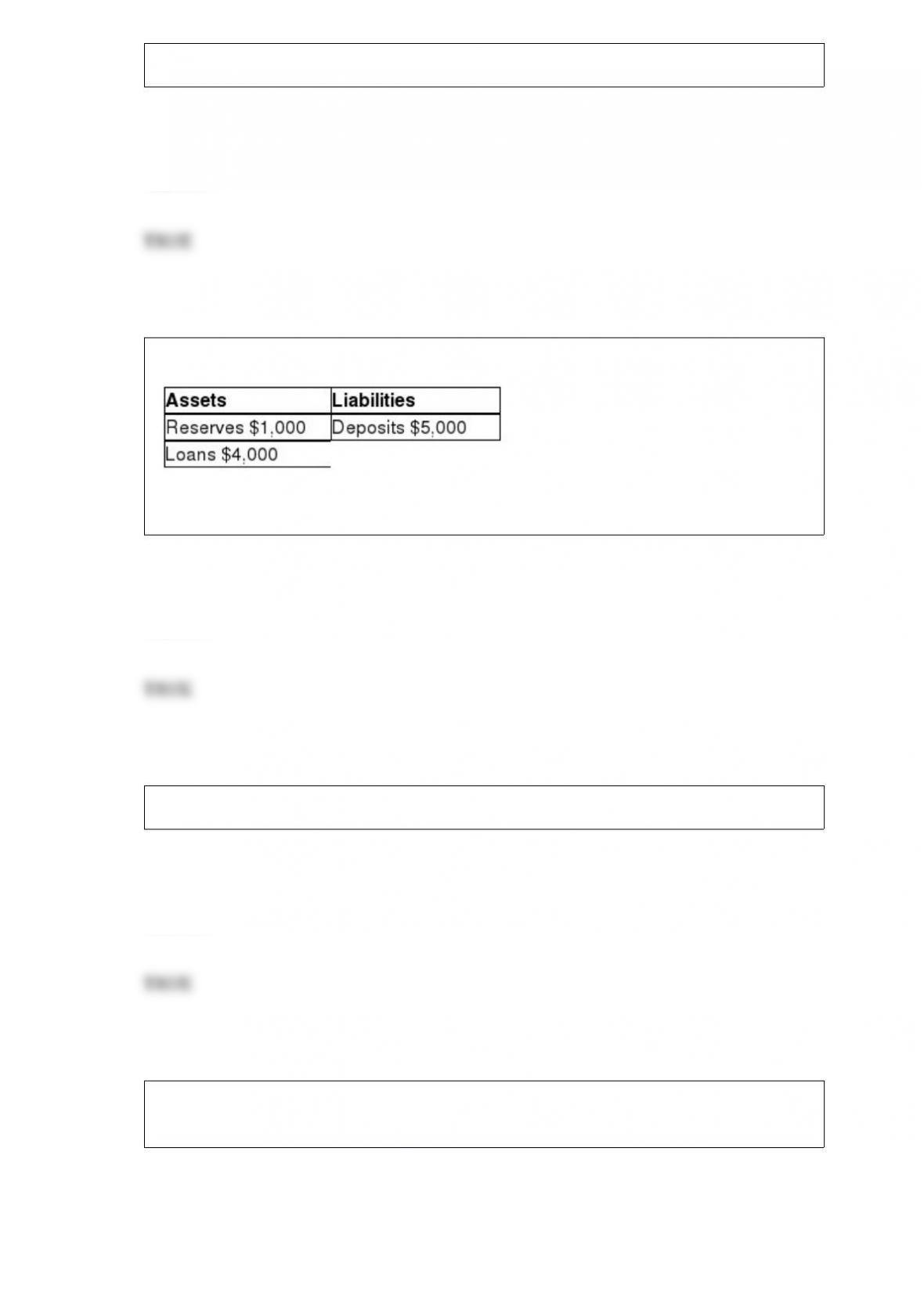
Consider the following T-account for a bank:
If the required reserve ratio is 20 percent and the bank is holding no excess reserves, the
bank at this point can make no more loans.
Answer:
In a perfectly competitive market, in the long run, arbitrage profits will be bid away.
Answer:
If transactions costs are low, private bargaining will always result in an efficient
solution to the problem of externalities.
Answer:

“The distribution of income should be determined by the government” is an example of
a normative economic statement.
Answer:
Rising nominal GDP will increase the demand for money and short-term interest rates.
Answer:
Accounting profit is the difference between a firm’s revenue and its opportunity costs.
Answer:
The price elasticity of supply is calculated as the change in supply divided by the
change in price.
Answer:

Long lags associated with the legislative process in implementing fiscal policy make it
more difficult to use than monetary policy.
Answer:
Behavioral economics is the study of situations in which people make rational choices.
Answer:
Indirect finance includes the sale by a corporation of stocks or bonds, but does not
include borrowing money from a bank.
Answer:
Accounting profit is the difference between a firm’s revenue and its opportunity costs.
Answer:

Corporations are legally owned by their shareholders.
Answer:
From 1970 to 2006, the poverty rate in East Asia rose slightly, but the level of poverty
in sub-Saharan Africa fell dramatically.
Answer:
Even if expectations of inflation are rational, sluggish adjustment of wages and prices
will still create a short-run trade-off between inflation and unemployment.
Answer:
Which of the following is a microeconomics question?
A) When will the government better secure the borders?
B) Why hasn’t the federal government raised the minimum wage?

C) How does Fiat decide on the price of the 500 Pop model?
D) What determines the level of U.S. imports and exports?
Answer:
The rapid growth of the Chinese economy should
A) benefit U.S. consumers as they have access to less expensive consumer goods.
B) make it more difficult for citizens of the United States to find a job.
C) not affect the mix of jobs available to citizens of the United States.
D) A and B
Answer:
The automatic mechanism ________ the price level in the case of ________ and
________ the price level in the case of ________.
A) raises; recession; lowers; expansion
B) lowers; expansion; lowers; recession
C) raises; expansion; raises; recession
D) lowers; recession; raises; expansion
Answer:

In 2008, the Fed and the Treasury began attempting to stabilize the commercial banking
system through the Troubled Asset Relief Program (TARP) by
A) allowing domestic banks to be taken over by foreign banks.
B) permitting banks to sell commercial bonds to the Federal Reserve Bank.
C) allowing banks to double any outstanding claims for federal deposit insurance
reimbursements.
D) providing funds to banks in exchange for stock.
Answer:
Suppose you are considering buying stock in the stock market, and your objective is to
maximize your net worth. Furthermore, your study of the market reveals that the
economy will be slowing down over the next several months. Under these conditions, it
would be best to purchase stock in companies that produce
A) normal goods.
B) luxury goods.
C) inferior goods.
D) price elastic goods.
Answer:

Table 14-8 Two rival oligopolists in the
athletic supplements industry, the Power Fuel Company and the Brawny Juice
Company, have to decide on their pricing strategy. Each can choose either a high price
or a low price. Table 14-8 shows the payoff matrix with the profits that each firm can
expect to earn depending on the pricing strategy it adopts.
If the firms act out of individual self-interest, which prices will they select?
A) Both firms will select a high price.
B) Brawny Juice will select a high price, Power Fuel will select a low price.
C) Brawny Juice will select a low price, Power Fuel will select a high price.
D) Both firms will select a low price.
Answer:
Destabilizing speculation refers to
A) actions taken by the International Monetary Fund that increase lending to countries
who have pegged their currencies against the dollar.
B) actions taken by currency traders to sell a currency that is undervalued.
C) actions taken by investors who sell a country’s currency in anticipation of buying it
back later at a lower price.
D) any depreciation of a country’s currency as a result of long-run adjustments to
purchasing power parity.
Answer:

Figure 24-2
Ceteris paribus, an increase in the capital stock would be represented by a movement
from
A) SRAS1 to SRAS2.
B) SRAS2 to SRAS1.
C) point A to point B.
D) point B to point A.
Answer:
If production displays economies of scale, the long-run average cost curve is
A) above the short-run average total cost curve.
B) downward-sloping.
C) upward sloping.
D) below the long-run marginal cost curve.
Answer:

If the number of unemployed workers is 200 million, the number of employed workers
is 300 million, and the working-age population is 800 million, what is the labor force
participation rate?
A) 12.5%
B) 37.5%
C) 40%
D) 62.5%
Answer:
Suppose that Congress allocates $5 billion to an “energy-efficient appliance rebate”
program. It also raises taxes by $5 billion to keep the deficit from growing. If the
marginal propensity to consume is 0.8, what is the effect on equilibrium GDP?
A) GDP does not change.
B) GDP increases by $25 billion.
C) GDP increases by $4 billion.
D) GDP increases by $5 billion.
Answer:
The Federal Open Market Committee consists of
A) the seven member Board of Governors of the Federal Reserve.

B) the 12 Federal Reserve Bank Presidents.
C) five of the Federal Reserve Bank Presidents.
D) the Board of Governors plus five of the Federal Reserve Bank Presidents.
Answer:
Which of the following can a firm do in the long run but not in the short run?
A) decrease the size of its physical plant
B) reduce its rate of output by laying off workers
C) increase its variable costs
D) increase its use of raw materials
Answer:
With perfect price discrimination there is
A) no deadweight loss.
B) no producer surplus.
C) one single price.
D) an increase in consumer surplus.
Answer:

Equations for C, I, G, and NX are given below. If the equilibrium level of GDP is
$32,000, what is the marginal propensity to consume? C = 5,000 + (MPC)Y
I = 1,500
G = 2,000
NX = -500 A) 0.67
B) 0.75
C) 0.8
D) 0.9
Answer:
What is a Pigovian tax? What happens to deadweight loss when a Pigovian tax is
implemented?
Answer:
Describe how Wal-Mart has used positive technological change to manage its inventory.
Answer:
What is the marginal productivity theory of income distribution?
Answer:
What are economies of scale? What are diseconomies of scale?
Answer:
Wally, Vijay, Sandra and Consuela make up a software development team at Javasoft.
The firm is considering implementing one of two incentive compensation schemes. In
scheme A, each programmer receives an annual bonus if he or she meets all individual
programming deadlines. In scheme B, members of the team share equally in a joint
bonus if the team meets all of its product delivery deadlines. All four employees are
equally talented but Wally is a slacker who does as little work as he can get away with.
Which scheme might team members prefer? Which scheme will management prefer?
Answer:
Using a supply and demand graph, illustrate the effect of an increase in the federal
cigarette tax of $1.00 per pack, where the entire tax burden falls on the consumer.
Assume the equilibrium price before the tax is $5.00 per pack and the equilibrium
quantity is 30 million packs. After the implementation of the tax, what are the
equilibrium price and equilibrium quantity?
Answer:
What is the difference between ‘straight-time pay,” “commission pay,” and “piece-rate
pay”?
Answer: