
Consider the labor market below.
The imposition of a $12 per hour minimum wage causes total economic surplus in this
labor market to ______ by ______.
A. rise; $800
B. fall; $800
C. rise; $400
D. fall; $1,600
All else equal, relative to a person who earns minimum wage, a person who earns $30
per hour has:
A. a higher opportunity cost of working an additional hour.
B. a higher opportunity cost of taking the day off work.
C. a lower opportunity cost of driving farther to work.
D. the same opportunity cost of spending time on leisure activities.
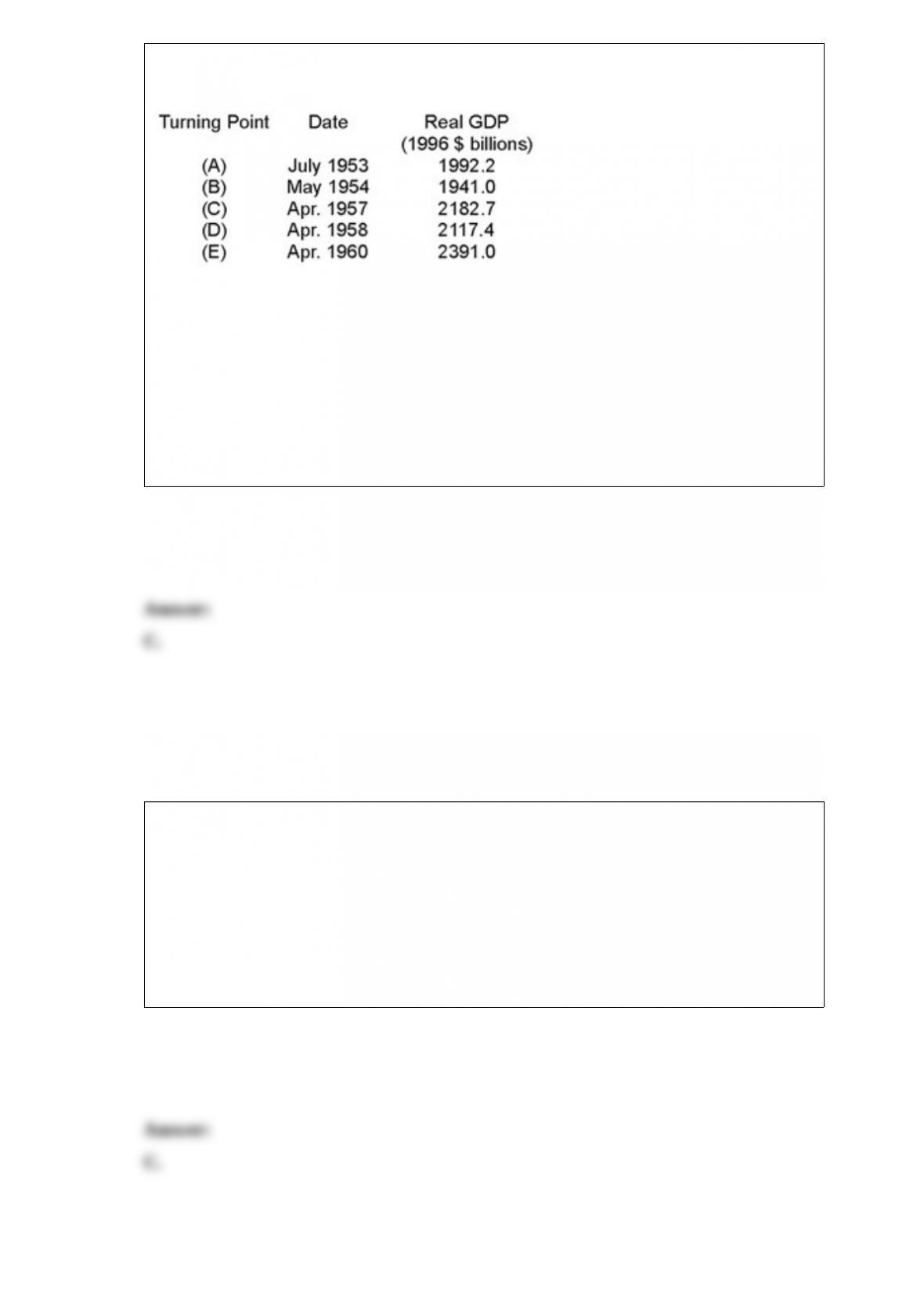
The following data give the dates of successive turning points in U.S. economic activity
and the corresponding levels of real GDP at the time.
Which of the turning points are peaks?
A. (A), (B), and (C)
B. (C), (D), and (E)
C. (A), (C), and (E)
D. (B) and (D)
Nominal GDP measures the ______ of production.
A. change in the volume
B. physical volume
C. current dollar value
D. base year value

The three functions of money are:
A. spending for consumption, investment, and government purchases.
B. measuring balance of payments, exchange rates, and interest rates.
C. implementing monetary policy, fiscal policy, and structural policy.
D. serving as a medium of exchange, unit of account, and store of value.
If Jane works for 6 hours she can rent out 9 apartments, and if she works for 7 hours she
can rent out 12 apartments. The marginal benefit of Jane’s 7th hour of work equals:
A. 12 apartments
B. 9 apartments
C. 3 apartments
D. 1 apartment

Mo’s current income is $100 more per month than his current consumption needs. He
decides to use the $100 to reduce his credit card debt. As a result, his:
A. liabilities will decrease and his wealth will increase.
B. liabilities and his wealth will decrease.
C. assets will decrease and his wealth will increase.
D. assets and his wealth will increase.
Curly told Larry about his new business venture: Curly pays Acme International $1,000
per month for supplies, works out of his apartment on his own computer and earns a
monthly revenue of $1,500. Should Larry quit his job and do what Curly is doing?
A. Yes, as long as Larry has at least $1,000 in savings to get started.
B. No, if Larry is earning more than $500 per month at his current job.
C. No, unless Larry can borrow the $1,000 monthly payment at no interest.
D. Yes, as long as Larry can work out if his apartment and owns a computer.

Assume that each day ten thousand children watch Sesame Street on public television
and that watching Sesame Street generates a benefit of $100 per child per year. Once a
year, public televisions hold a pledge drive asking viewers to make voluntary
contributions in order to keep the programming available to everyone.
If public television stations collect less than $100 per child during the pledge drive, then
this is evidence:
A. that the government should not subsidize public television.
B. that parents do not care about their children.
C. of the free-rider problem.
D. that head taxes are regressive.
Your classmates from the University of Chicago are planning to go to Miami for spring
break, and you are undecided about whether you should go with them. The round-trip
airfares are $600, but you have a frequent-flyer coupon worth $500 that you could use
to pay part of the airfare. All other costs for the vacation are exactly $900. The most
you would be willing to pay for the trip is $1400. Your only alternative use for your
frequent-flyer coupon is for your trip to Atlanta two weeks after the break to attend your
sister’s graduation, which your parents are forcing you to attend. The Chicago-Atlanta
round-trip airfares are $450. If the Chicago-Atlanta round-trip air fare were $350,
should you use the coupon to go to Miami?
A. No, your economic surplus would be -$50.
B. No, your economic surplus would be -$100.
C. Yes, your economic surplus would be $50.
D. Yes, your economic surplus would be $400.
Relative to a monopoly charging a single price to all consumers, perfect price
discrimination ______ producer surplus and ______ consumer surplus.
A. increases; decreases
B. increases; increases
C. decreases; decreases
D. decreases; increases
A depression is:
A. a particularly severe and protracted recession.
B. the high point of economic activity prior to a downturn.
C. the low point of economic activity prior to a recovery.
D. a particularly strong and protracted expansion.

Indexing is the process of:
A. dividing a real quantity by a price index.
B. dividing a nominal quantity by a price index.
C. increasing a nominal quantity by an amount equal to the percentage change in a price
index.
D. increasing a real quantity by an amount equal to the percentage change in a price
index.
A currency appreciation is a(n):
A. increase in the value of a currency relative to other currencies.
B. decrease in the value of a currency relative to other currencies.
C. reduction in the official value of a currency in a fixed-exchange-rate system.
D. increase in the official value of a currency in a fixed-exchange-rate system.
Stockholders receive returns on their financial investment in the form of ______ and
_____.

A. interest payments; dividends
B. capital gains; dividends
C. coupon payments; capital gains
D. capital gains; interest payments
Goods and services that are used up in the production of other goods and services are
called ______ goods and services.
A. intermediate
B. final
C. value added
D. nominal
From a macroeconomic perspective, the problem of low household saving has probably
been overstated because:
A. household saving is not related at all to an economy’s ability to accumulate new
capital.
B. household saving has been increasing steadily over the last three decades.

C. it is national saving, not household saving, that allows an economy to accumulate
new capital.
D. household saving represents a smaller share of national saving than does public
saving.
For a given seller, the figure below shows the relationship between the number of units
produced and the opportunity cost of producing an additional unit of output. If the
market price of this good is $6, how many units would this seller produce?
A. 50
B. 150
C. 250
D. 300
Some people oppose deficit spending because it:
A. promotes logrolling.
B. crowds out private investment.
C. leads to rent seeking.

D. violates the cost-benefit principle.
Refer to the figure below.
Based on the Keynesian cross diagram, at short-run equilibrium output,
A. there is a recessionary gap.
B. there is an expansionary gap.
C. output equals potential output.
D. firms will be producing more than they can sell.
Assume the minimum wage exceeds the market-clearing wage. If there is an increase in
the supply of labor then the number of workers who are unemployed will ______, and
the number of workers who are employed will _______.
A. increase; increase
B. increase; decrease
C. increase, not change
D. decrease; increase
When marginal revenue is zero:
A. profit is maximized.
B. total cost is minimized.
C. elasticity of demand is zero.
D. total revenue is maximized.
Suppose that Cathy spends all of her income on 20 units of good X and 25 units of good
Y. Cathy’s marginal utility from the 20th unit of good X is 9 utils, and her marginal
utility from the 25th unit of good Y is 19 utils. If the price of good X is $0.50 per unit
and the price of good Y is $1.00 per unit, then to comply with the rational spending
rule, Cathy should:
A. purchase more than 20 units of good X and less than 25 units of Y.
B. purchase less than 20 units of good X and more than 25 units of good Y.
C. purchase more than 20 units of good X and more than 25 units of good Y.
D. continue to purchase 20 units of good X and 25 units of good Y.

Suppose a small island nation imports sugar for its population at the world price of
$1,500 per ton. The domestic market for sugar is shown below.
If the government provides a subsidy of $500 per ton, then producer surplus will be
______ per day.
A. $0
B. $1,000
C. $4,000
D. $8,000

Autonomous expenditure is the portion of planned aggregate expenditure that:
A. equals aggregate output.
B. equals planned spending.
C. equals induced expenditure.
D. is independent of output.
Mel is thinking of going on a cruise. Mel values a cruise in nice weather at $2,000 and
values a cruise in bad weather at $50. The probability of nice weather is 60% and the
probability of bad weather is 40%. Trip insurance is sometimes available. If purchased,
it allows travelers to delay the cruise until the weather is nice. Suppose that the price of
the cruise is $1,200. If Mel is risk-neutral, then Mel should:
A. not buy trip insurance.
B. only buy trip insurance if it costs less than $780.
C. only buy trip insurance if it costs less than $20.
D. only buy trip insurance if it costs less than $50.

All of the following central banks have announced numerical targets for inflation
except the:
A. United States Federal Reserve System.
B. Bank of Canada.
C. Bank of England.
D. Central Bank of Brazil.
If the cost to firms of reducing workplace injuries by 1 percent is $1,000 a year for each
worker, then it is efficient for firms to reduce workplace injuries by 1 percent if:
A. the value workers place on the reduction in workplace injuries is less than $1,000 per
year.
B. the value workers place on the reduction in workplace injuries is at least $1,000 per
year.
C. firms are earning an economic profit of at least $1,000 per year.
D. firms are earning an economic profit of less than $1,000 per year.
Suppose Erie Textiles can dispose of its waste “for free” by dumping it into a nearby
river. While the firm benefits from dumping waste into the river, the waste reduces fish
and bird reproduction. This causes damage to local fishermen and bird watchers. At a
cost, Erie Textiles can filter out the toxins, in which case local fishermen and bird
watchers will not suffer any damage. The relevant gains and losses (in thousands of
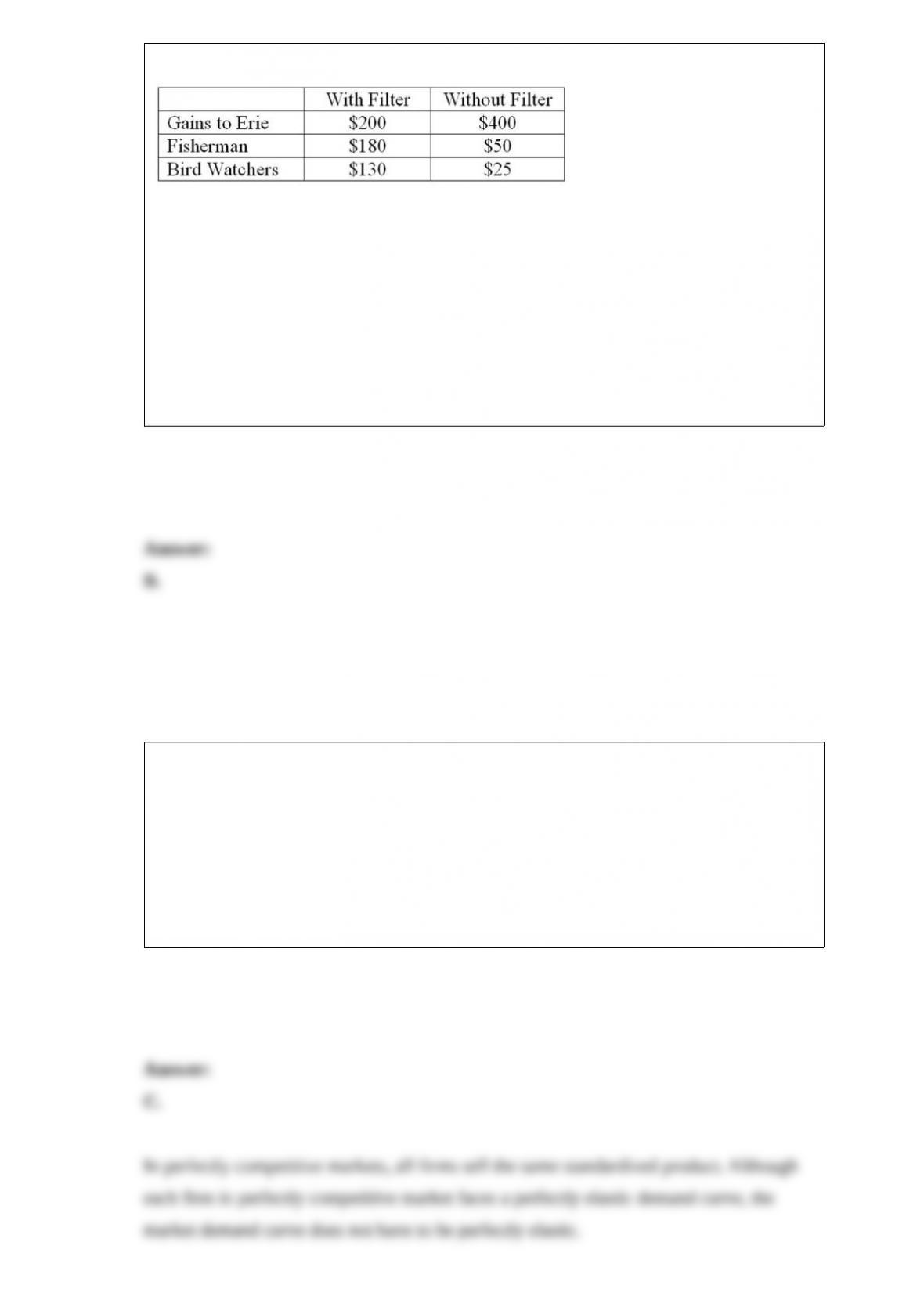
dollars) for the three parties are listed below.
Local fishermen and bird watchers would be willing to compensate Erie Textiles
______ for operating with a filter.
A. up to $310 thousand dollars
B. no more than $235 thousand dollars
C. no more than $75 thousand dollars
D. nothing
Which of the following is a defining characteristic of all perfectly competitive markets?
A. Each firm in the market faces a perfectly inelastic demand curve.
B. The market demand curve is perfectly elastic.
C. All firms sell the same standardized product.
D. Consumers display strong brand loyalty.

For a given nominal exchange rate and domestic price level, a decrease in the foreign
price level ______ the real exchange rate.
A. increases
B. decreases
C. may either increase or decrease
D. offsets any change in
Health and safety regulations in the labor market:
A. are always efficient because they improve working conditions.
B. should be evaluated by comparing their costs to their benefits.
C. are necessarily inefficient if they impose additional costs on employers.
D. can lead to an increase in frictional unemployment.

Consider the labor market below. Suppose the government passes a minimum wage
requiring employers to pay at least $8.00 per hour.
Prior to the imposition of the minimum wage, employer surplus is ______ per day, and
after the imposition of the minimum wage, employer surplus is ______ per day.
A. $9,000; $1,000
B. $9,000; $5,000
C. $18,000; $2,000
D. $18,000; $14,000