1) macroeconomics can best be described as the:
a.analysis of how a consumer tries to spend income.
b.study of the large aggregates of the economy or the economy as a whole.
c.analysis of how firms attempt to maximize their profits.
d.study of how supply and demand determine prices in individual markets.
2)
Refer to the above table. The equilibrium interest rate is:
A.2 percent.
B.4 percent.
C.6 percent.
D.8 percent.
3) in comparing the changes in tc and tvc associated with an additional unit of output,
we find that:
a.the change in tvc is equal to mc, while the change in tc is equal to tfc.
b.the change in tc exceeds the change in tvc.
c.the change in tvc exceeds the change in tc.
d.both are equal to mc.
4) The following consolidated balance sheet of the commercial banking system.
Assume that the reserve requirement is 20 percent. All figures are in billions and each
question should be answered independently of changes specified in all preceding ones.
Refer to the above data. Suppose the Fed wants to increase the money supply by $1000
billion to drive down interest rates and stimulate the economy. To accomplish this it
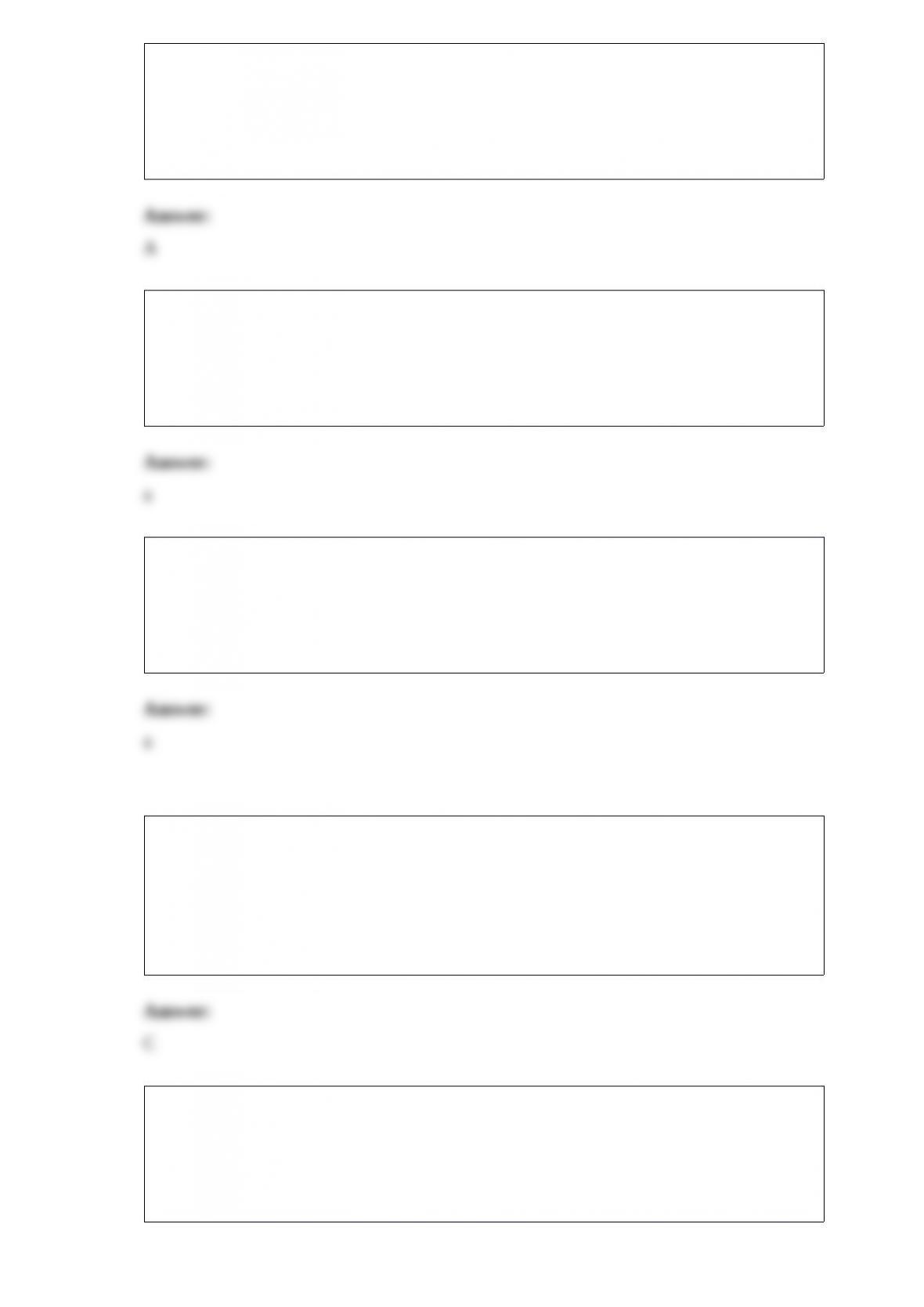
could lower the reserve requirement from 20 percent to:
A.10 percent.
B.12 percent.
C.14 percent.
D.16 percent.
5) the supply of product x is elastic if the price of x rises by:
a.5 percent and quantity supplied rises by 7 percent.
b.8 percent and quantity supplied rises by 8 percent.
c.10 percent and quantity supplied remains the same.
d.7 percent and quantity supplied rises by 5 percent.
6) the narrower the definition of a product:
a.the larger the number of substitutes and the greater the price elasticity of demand.
b.the smaller the number of substitutes and the greater the price elasticity of demand.
c.the larger the number of substitutes and the smaller the price elasticity of demand.
d.the smaller the number of substitutes and the smaller the price elasticity of demand.
7) If nominal GDP is $600 billion and, on the average, each dollar is spent three times
per year, then the amount of money demanded for transactions purposes will be:
A.$1800 billion.
B.$600 billion.
C.$200 billion.
D.$1200 billion.
8) Technological advance is shown as a(n):
A.movement from a point inside a production possibilities curve to a point on the curve.
B.movement along a production possibilities curve.
C.outward shift of a production possibilities curve.
D.inward shift of a production possibilities curve.
9) which of the following is not characteristic of indifference curves?
a.they are downsloping.
b.they are convex to the origin.
c.their slope diminishes as we move from northwest to southeast on a given curve.
d.curves closer to the origin reflect higher levels of total utility.
10) suppose that lenders want to receive a real rate of interest of 5 percent, and that they
expect inflation to remain steady at 2 percent in the coming years. based on this, lenders
should charge a nominal interest rate of:
a.2 percent.
b.3 percent.
c.5 percent.
d.7 percent.
11) A cap-and-trade program causes the:
A.supply of pollution rights to be perfectly inelastic.
B.supply of pollution rights to be perfectly elastic.
C.demand for pollution rights to be perfectly inelastic.
D.demand for pollution rights to be perfectly elastic.
12) “Present value” refers to the:
A.value today of some amount of money to be received in the future.
B.current value of money held in a bank account.
C.amount to which some current amount of money will grow over time.
D.interest rate specified when a loan contract is signed.
13) The pursuit through government of a transfer of wealth at someone else’s expense
refers to:
A.logrolling.
B.rent-seeking behavior.
C.the paradox of voting.
D.the median-voter model.
14)
refer to the above diagram and assume a single good. if the price of the good decreases
from $6.30 to $5.70, consumer spending would:
a.decrease if demand were d1only.
b.decrease if demand were d2only.
c.decrease if demand were either d1or d2.
d.increase if demand were either d1or d2.
15)
Refer to the above diagram for the Federal funds market. If the quantity of reserves
rises from $100 billion to $150 billion, we can expect:
A.the Federal funds rate to fall to 3.5 percent.
B.the discount rate to fall.
C.the prime interest rate to fall below 4.0 percent.

D.banks to become more cautious in lending.