
1) the quantity demanded of a product increases as its price declines because the:
a.lower price shifts the demand curve rightward.
b.lower price shifts the demand curve leftward.
c.lower price results in an increase in supply.
d.demand curve is downsloping.
2) A bank that has liabilities of $150 billion and a net worth of $20 billion must have:
A.excess reserves of $130 billion.
B.assets of $150 billion.
C.excess reserves of $150 billion.
D.assets of $170 billion.
3) In 2007, the capital account in the U.S. balance of payments was in:
A.deficit, and larger than the current account deficit.
B.surplus, and larger than the current account surplus.
C.balance, with no deficit or surplus.
D.deficit, and smaller than the current account deficit.
4) Investment in kind refers to the possibility that:
A.DVCs will invest for the purpose of becoming less dependent on world markets.
B.a DVC will overinvest in industries in which it has a comparative advantage,
disrupting its development program.
C.newly established manufacturing firms may expand by reinvesting their profits.
D.surplus labor in, say, agriculture can be diverted to the production of simple capital
goods such as earthen dams.
5) arthur sells $100 worth of cotton to bob. bob turns the cotton into cloth, which he
sells to camille for $300. camille uses the cloth to make prom dresses that she sells to
donita for $700. donita sells the dresses for $1200 to kids attending the prom. the total
contribution to gdp of this series of transactions is:
a.$1200
b.$500
c.$2300
d.$1100
6) suppose for a regulated monopoly that price equals minimum atc but price exceeds
mc. this means that:
a.both productive and allocative efficiency are being achieved.
b.productive efficiency is being achieved, but not allocative efficiency.
c.allocative efficiency is being achieved, but not productive efficiency.
d.neither productive nor allocative efficiency is being achieved.
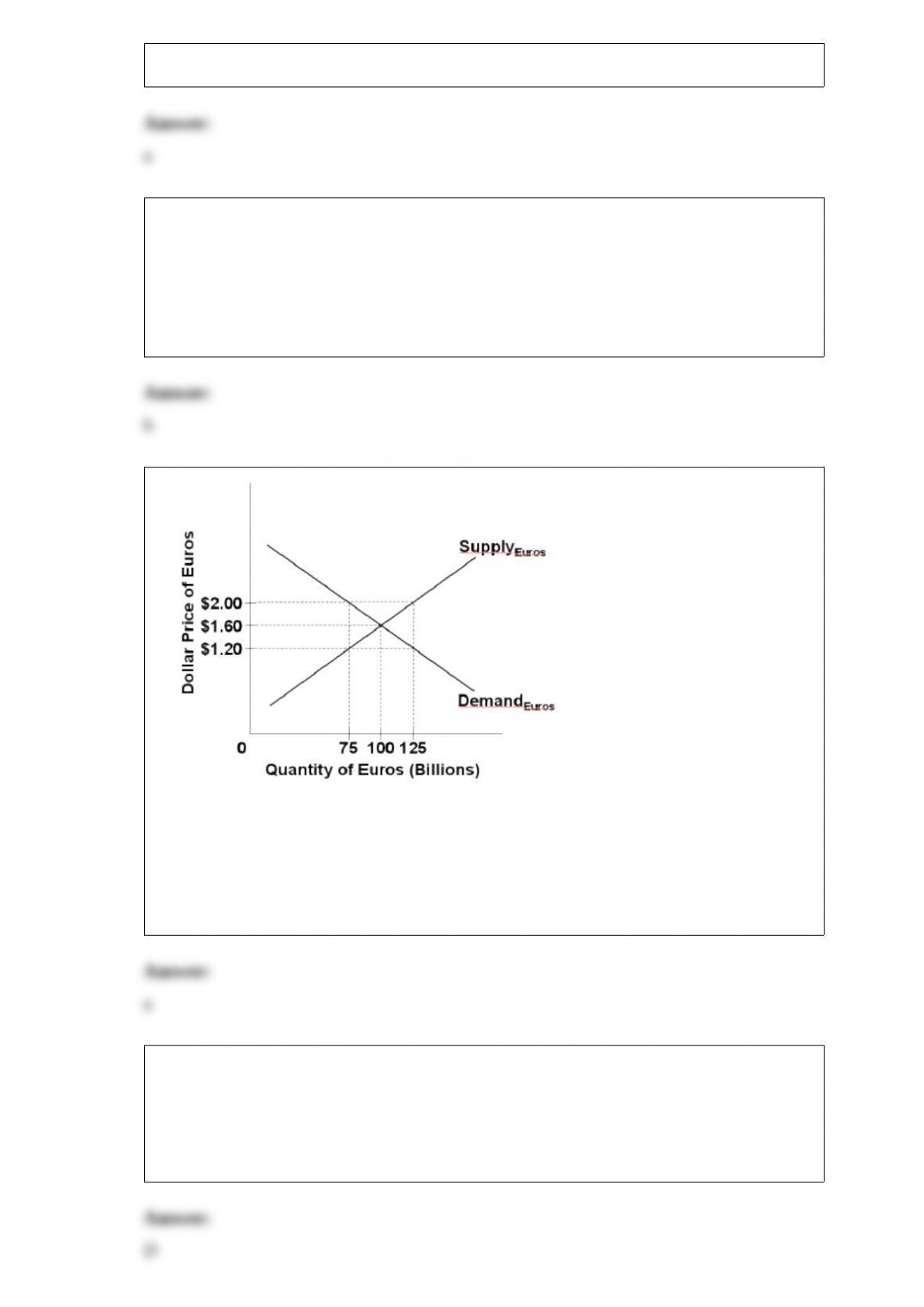
7)
refer to the above diagram. if u.s. consumers increase their travel to euro zone nations,
we would expect:
a.the demand for euros to increase, and the euro to appreciate.
b.the demand for euros to increase, and the dollar to appreciate.
c.the supply of euros to increase, and the euro to depreciate.
d.the supply of euros to decrease, and the dollar to depreciate.
8) The real interest rate can be estimated by:
A.subtracting the pure interest rate from the nominal interest rate.
B.dividing the nominal interest rate by the consumer price index.
C.subtracting the nominal interest rate from the rate of inflation.
D.subtracting the rate of inflation from the nominal interest rate.

9) a nondiscriminating pure monopolist finds that it can sell its fiftieth unit of output for
$50. we can surmise that the marginal:
a.cost of the fiftieth unit is also $50.
b.revenue of the fiftieth unit is also $50.
c.revenue of the fiftieth unit is less than $50.
d.revenue of the fiftieth unit is greater than $50.
10) Suppose the price of the product that labor is producing increases and
simultaneously the price of capital, which is substitutable for labor, decreases.
Assuming that the substitution effect is greater than the output effect, the demand for
labor:
A.will increase.
B.will decrease.
C.may either increase or decrease.
D.will not change.
11) Legal protections against direct copying of written material are called __________;
legal protections against using a product’s name are called __________.
A.patents; trademarks
B.trademarks; patents
C.copyrights; trademarks
D.copyrights; patents
12) diminishing marginal utility explains why:
a.the income effect exceeds the substitution effect.
b.the substitution effect exceeds the income effect.
c.supply curves are upsloping.
d.demand curves are downsloping.
13) Melanie and Oli are competing Pacific Halibut fishers. Both have been allocated
ITQs that limit their catch to 1,000 tons of Pacific Halibut each. Melanie’s cost per ton
is $20; Oli’s cost per ton is $28.
Refer to the information above and assume that the market price of Pacific Halibut is

$40 per ton. If Melanie pays Oli $10 per ton for his ITQs and then catches her new limit
of 2,000 tons, their combined profit would be:
A.$28,000.
B.$32,000.
C.$40,000.
D.$54,000.
14) Melanie and Oli are competing Pacific Halibut fishers. Both have been allocated
ITQs that limit their catch to 1,000 tons of Pacific Halibut each. Melanie’s cost per ton
is $20; Oli’s cost per ton is $28.
Refer to the information above. If the market price of Pacific Halibut is $40 per ton,
what is the maximum amount Melanie would be willing to pay per ton for Oli’s ITQs?
A.$20.
B.$28.
C.$40.
D.$12.
15) Which of the following statements is correct?
A.The actual reserves of a commercial bank equal its excess reserves minus its required
reserves.
B.A bank’s liabilities plus its net worth equal its assets.
C.When borrowers repay bank loans, the supply of money increases.
D.A single commercial bank can safely lend a multiple amount of its excess reserves.
16) which of the following is not a characteristic of pure competition?
a.price strategies by firms
b.a standardized product
c.no barriers to entry
d.a larger number of sellers