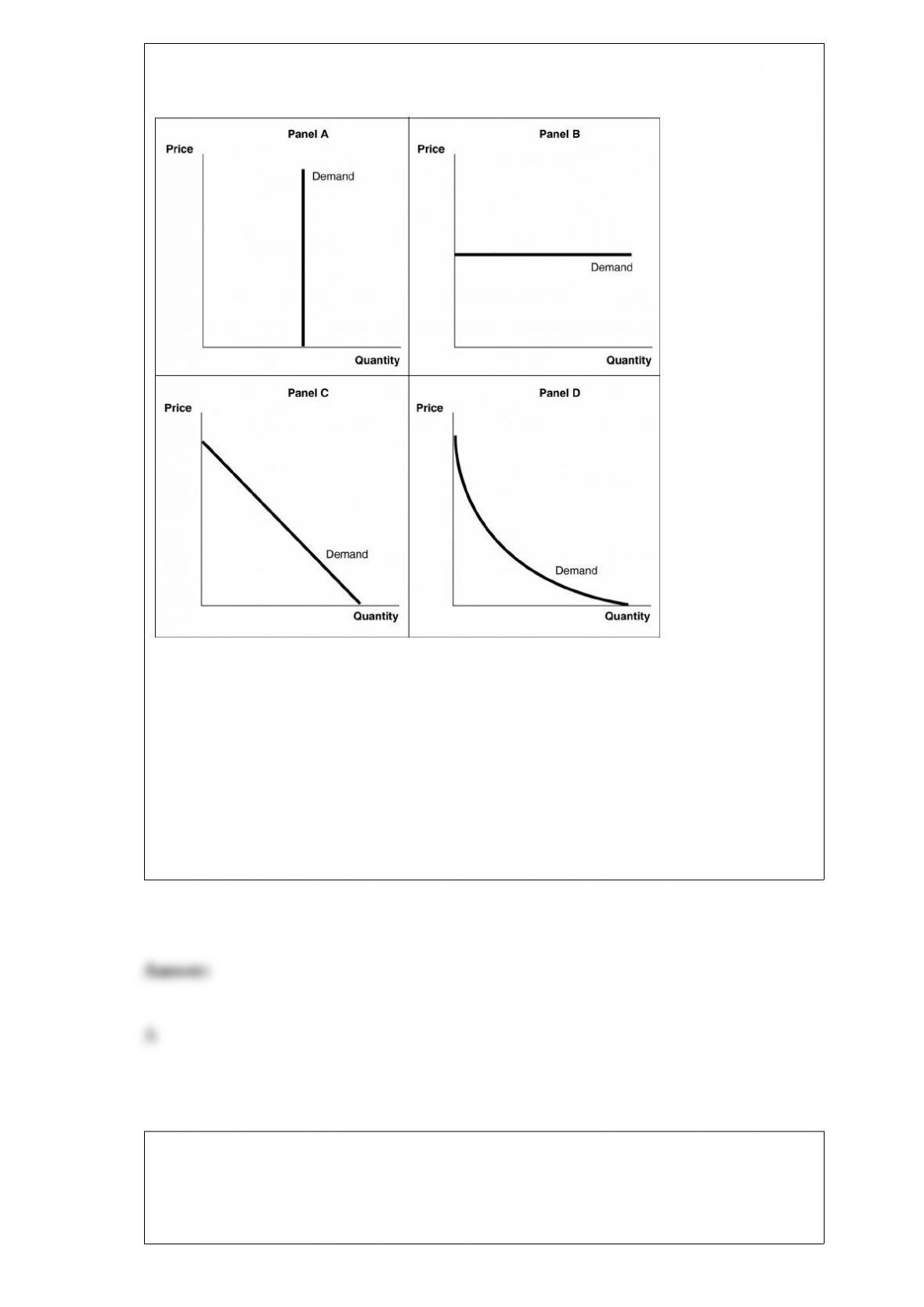
Figure 6-1
A perfectly inelastic demand curve is shown in
A) Panel A.
B) Panel B.
C) Panel C.
D) Panel D.
If, for the last unit of a good produced by a perfectly competitive firm, MR > MC, then
in producing it, the firm
A) added more to total costs than it added to total revenue.

B) added more to total revenue than it added to total cost.
C) is maximizing marginal profit.
D) has minimized its losses.
If the selling price of a firm’s product is $500 and the estimated average cost of
producing this product is $400, what is the firm’s markup?
A) 15 percent
B) 20 percent
C) 25 percent
D) 40 percent
The difference between technology and technological change is that
A) technology refers to the processes used by a firm to transform inputs into output
while technological change is a change in a firm’s ability to produce a given level of
output with a given quantity of inputs.
B) technology is carried out by firms producing physical goods but technological
change is an intellectual exercise into seeking ways to improve production.
C) technology is product-centered, that is, developing new products with our limited
resources while technological change is process-centered in that it focuses on
developing new production techniques.
D) technology involves the use of capital equipment while technological change
requires the use of brain power.
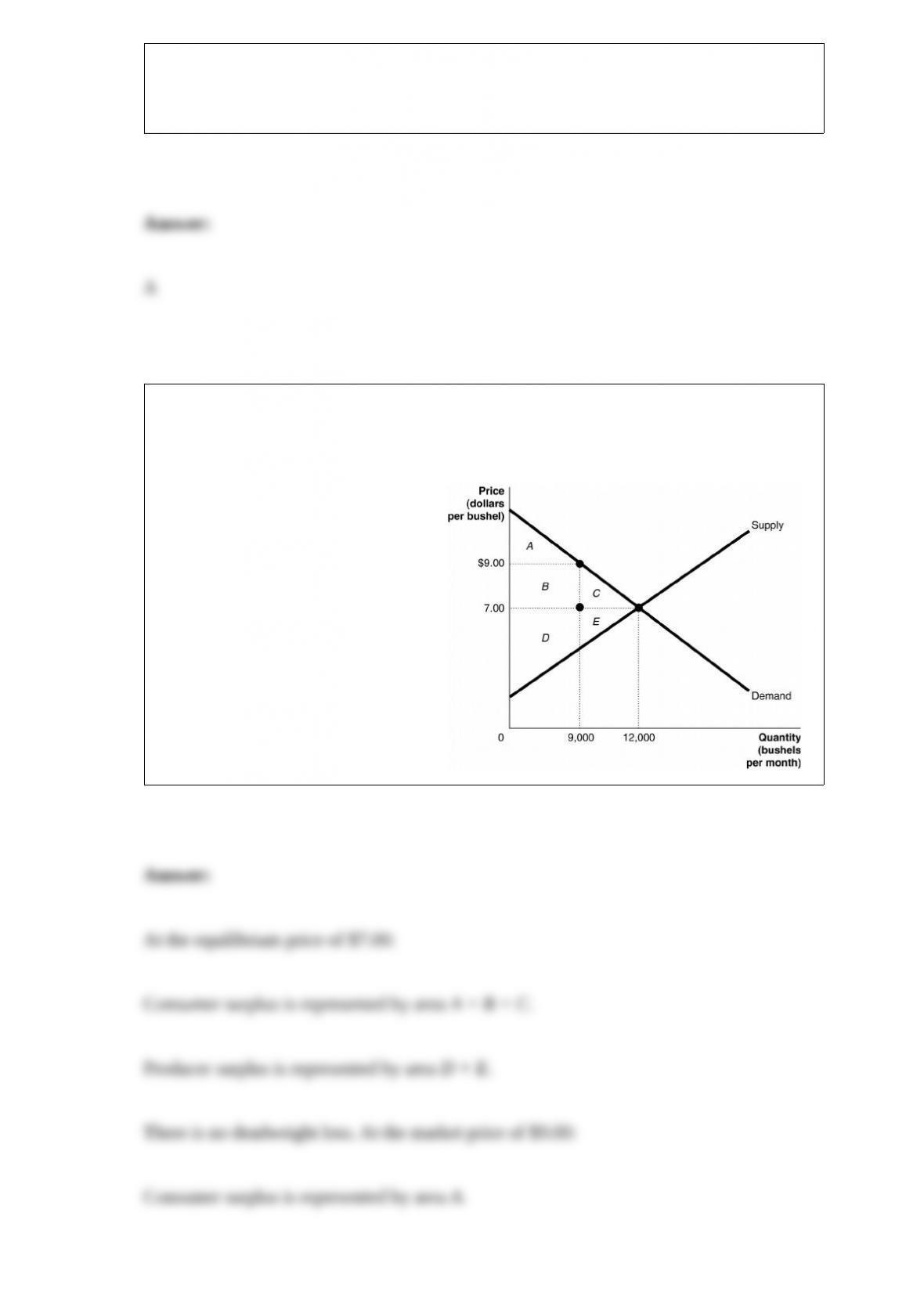
The graph below represents the market for alfalfa. The equilibrium price is $7.00 per
bushel, but the market price is $9.00 per bushel. Identify the areas representing
consumer surplus, producer surplus, and deadweight loss at the equilibrium price of
$7.00 and at the market price of $9.00.
Which of the following accurately describes an effect of hurricane Katrina on GDP?
A) GDP would decrease reflecting the costs of cleanup.
B) GDP would increase reflecting the costs of cleanup.
C) GDP would increase reflecting the decrease in production that occurred during the
storm and the productive capacity lost in the storm.
D) GDP would increase well-being.
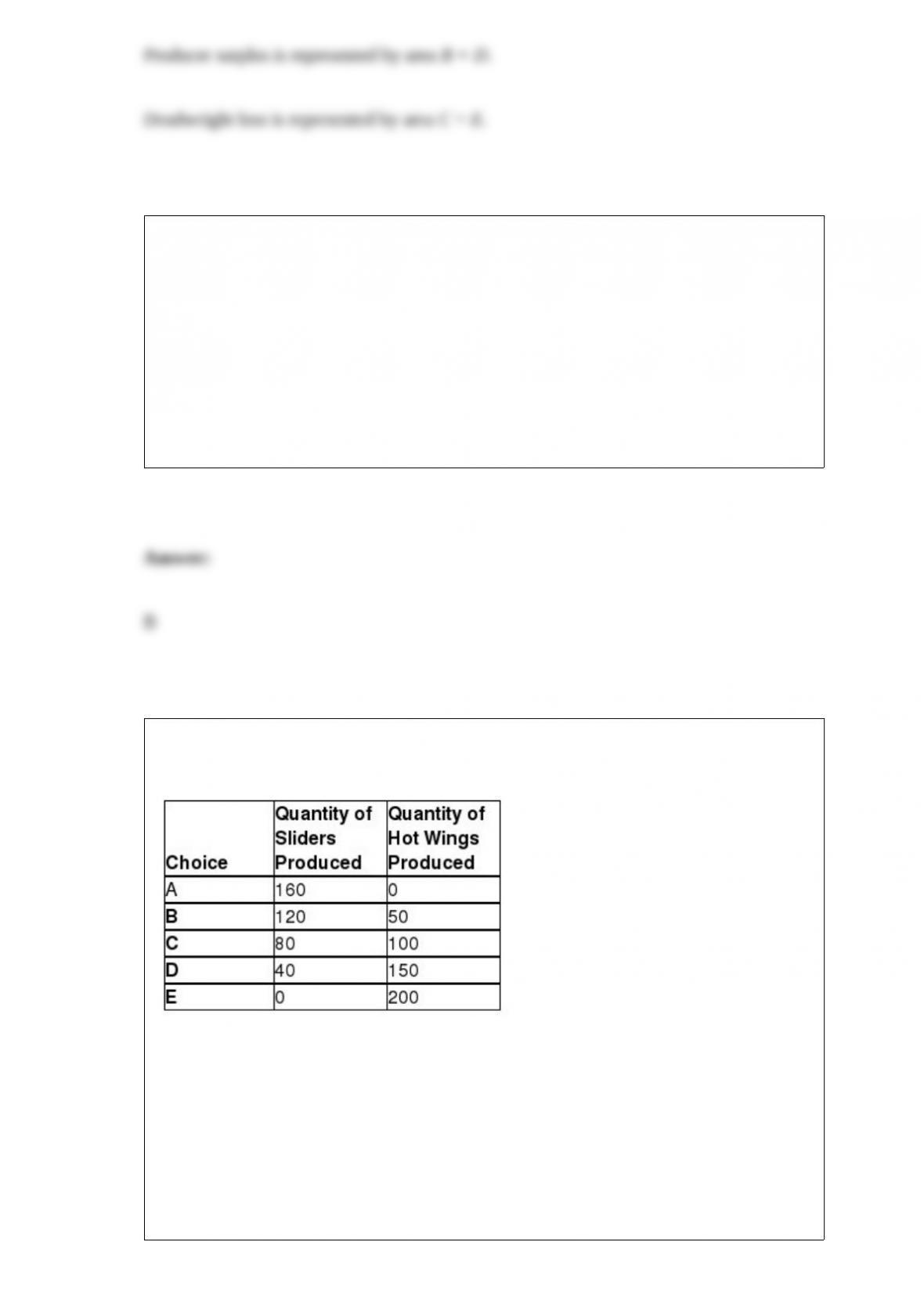
Table 2-3
Production Choices for Dina’s Diner
Dina faces ________ opportunity costs in the production of sliders and hot wings.
A) increasing
B) decreasing
C) constant

D) negative
Economists assume that the goal of consumers is to
A) do as little work as possible to survive.
B) make themselves as well off as possible.
C) expend all their income.
D) consume as much as possible.
The U.S. government’s focus on supply reduction efforts in its “war on drugs” has been
relatively unsuccessful at addressing illegal drug use. Some economists believe that a
successful anti-drug program must concentrate on reducing demand; for example,
through drug education and voluntary treatment programs for addicts.
a. Suppose the price elasticity of demand for cocaine is -0.5. What will happen to the
equilibrium price, quantity and total revenue from cocaine sales if the government
succeeds in its efforts to reduce demand? What is likely to happen to the incentive to
sell cocaine?
b. Suppose the government continues to concentrate its efforts on supply reduction and
is able to reduce the supply of cocaine. As a result of the reduction in supply the price
of cocaine increases by 25 percent. If the price elasticity of demand is -0.5, what is
likely to happen to the incentive to sell cocaine?
c. Based on your answers, explain why one approach might be preferred over the other.
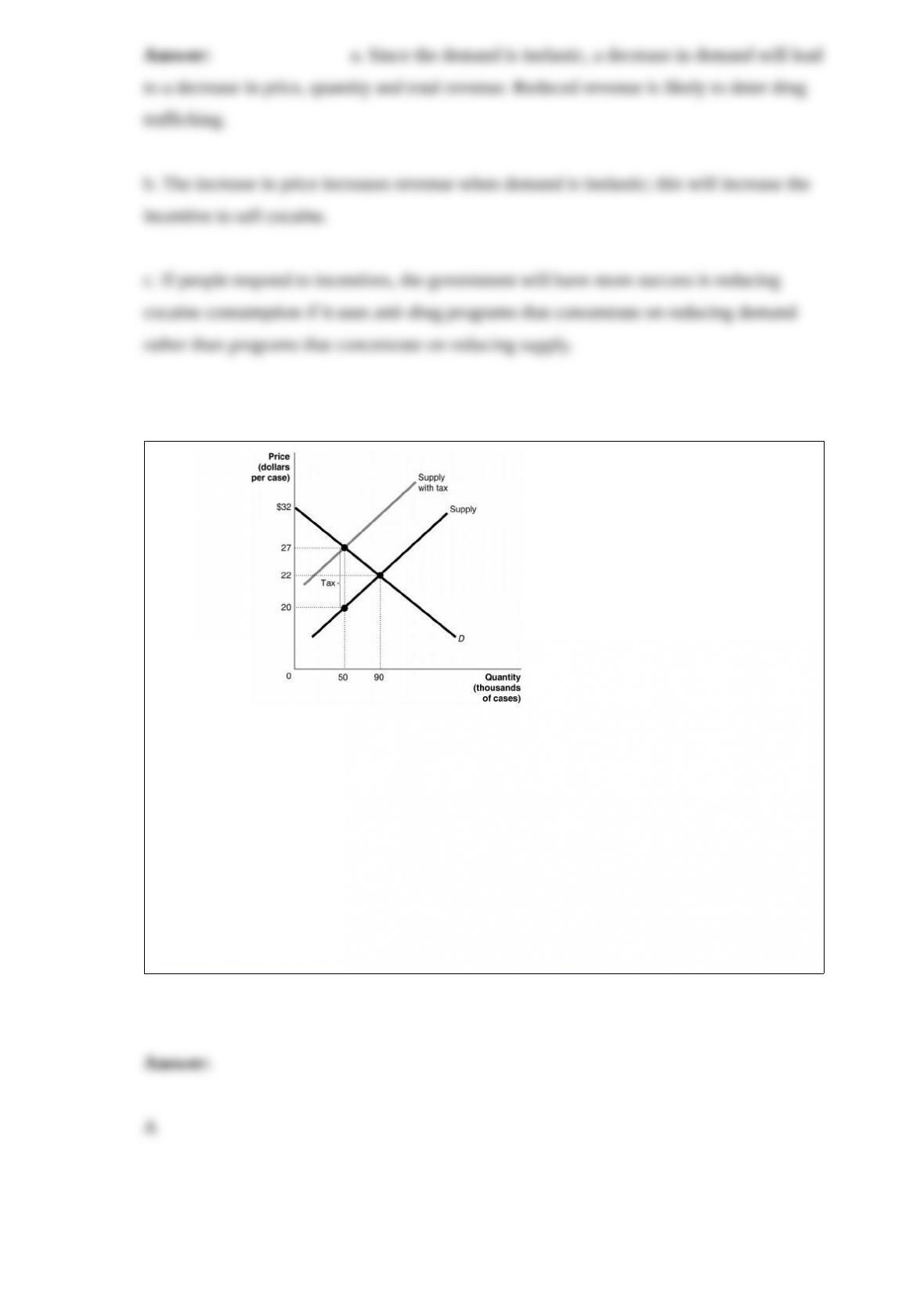
Figure 4-15 Figure 4-15 shows the market for
beer. The government plans to impose a unit tax in this market.
How much of the tax is paid by producers?
A) $2
B) $5
C) $7
D) $12

In the United States, currency includes
A) gold, silver, and paper money.
B) checking and savings account deposits.
C) paper money and coins in circulation.
D) traveler’s checks.
Price discrimination is the practice of
A) charging different prices for the same good when the price differences are not due to
differences in cost.
B) charging different prices for the same good when the price differences arise because
of differences in cost.
C) charging different prices for different qualities of a product.
D) charging higher prices for brand named goods and lower prices for generic versions
of the goods.
Which of the following are separate flows in the circular flow model?
A) the flow of goods and the flow of services
B) the flow of costs and the flow of revenue
C) the flow of income earned from the sale of resources and the flow of expenditures on

goods and services.
D) the flow of income received by households and the flow of tax revenues paid by
households
A(n) ________ comes to an end with a business cycle ________.
A) recession; peak
B) recession; trough
C) expansion; trough
D) expansion; bubble
An unemployment insurance program has which of the following effects?
A) It decreases the amount of personal income of the unemployed.
B) It contributes to the severity of a recession or economic downturn.
C) It increases the amount of time spent searching for a job.
D) It lowers the overall unemployment rate.