
Exhibit 5-5
In Exhibit 5-5, what is the total revenue at point a?
a. $4
b. $5
c. $10
d. $50
e. $100
Exhibit 8-13
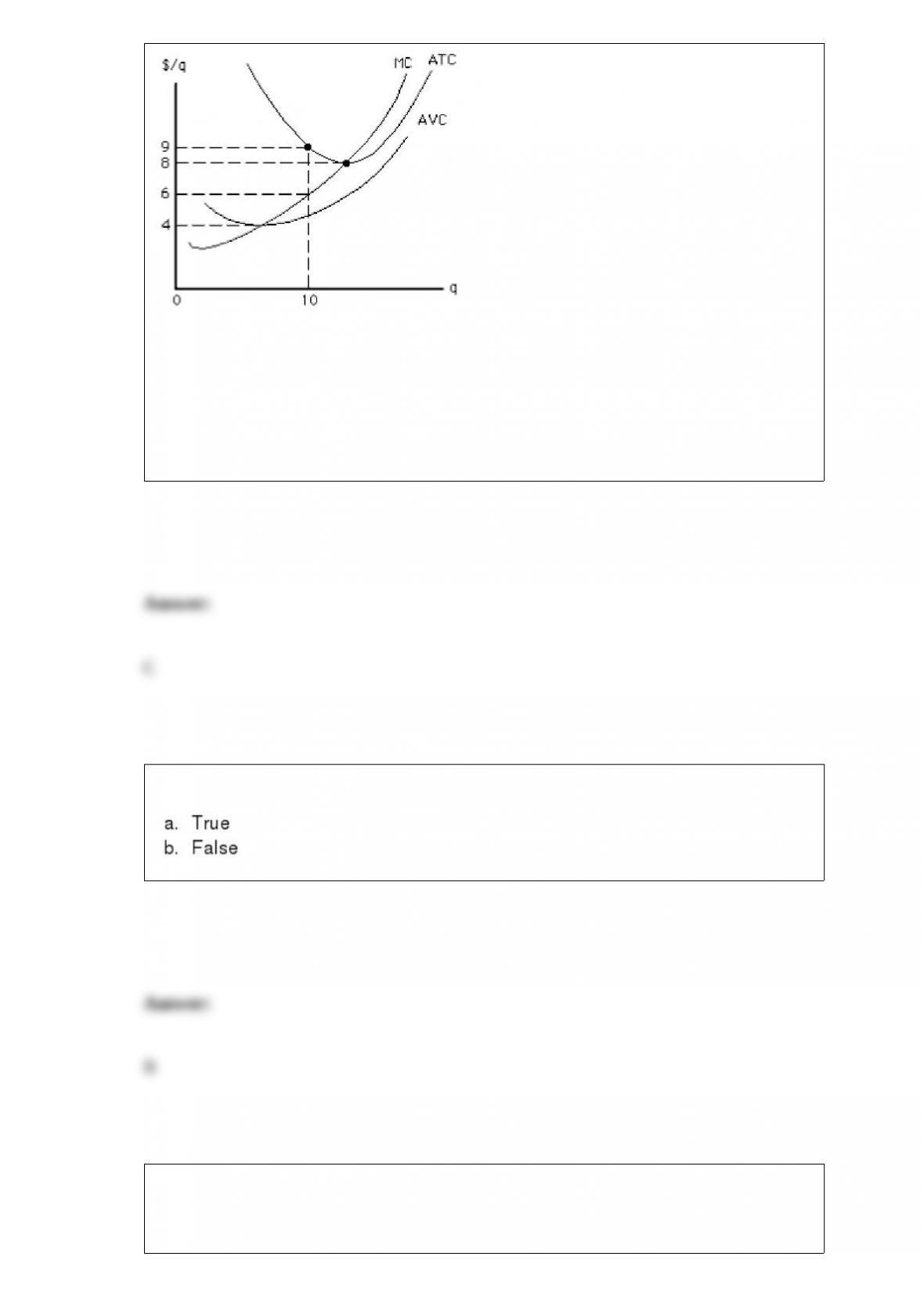
For the market shown in Exhibit 8-13, at what price will a perfectly competitive firm
earn zero profit?
a. $4
b. $6
c. $8
d. $9
e. more than $9
Only a change in income can affect a consumer’s budget line.
Exhibit 8-6
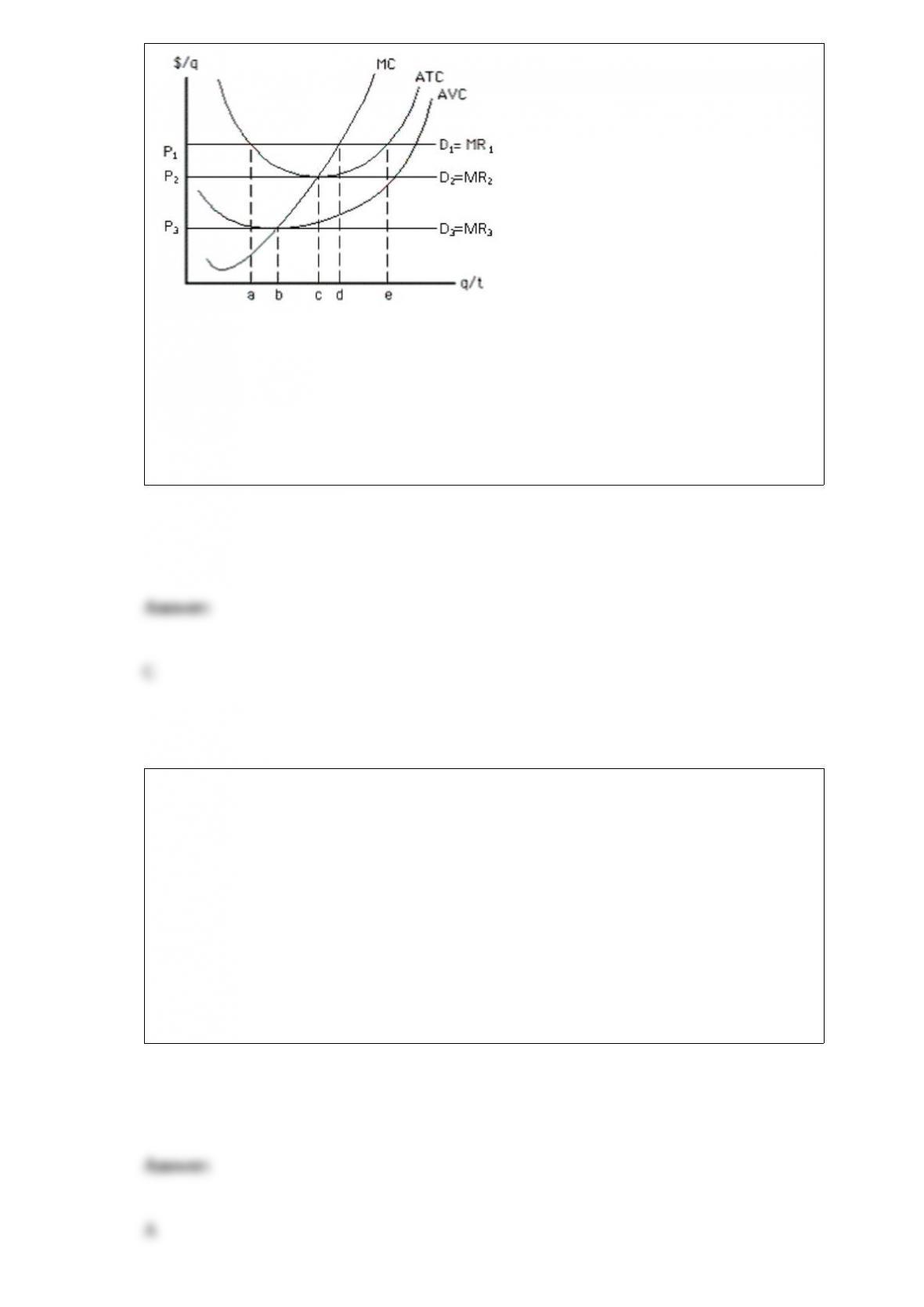
Consider Exhibit 8-6. At which price will this firm shut-down?
a. P1
b. P2
c. P3
d. P2or P3
e. will never shut-down
The reason that you don’t drink five cups of coffee at breakfast is that
a. the marginal utility of extra cups of coffee eventually diminishes
b. most people cannot afford five cups
c. the total utility of coffee rises as you consume more cups
d. the price of coffee rises as you buy more cups
e. the marginal satisfaction derived from cups of coffee remains constant

One explanation for the increased participation of married women in the U.S. labor
force is that
a. fewer women are being trained for household work by the public school system
b. rapid growth in the service sector has provided additional job opportunities for
women
c. the cost of professional day care has increased
d. couples are having more children
e. husbands earn more today than they did previously
Which of the following is true when regulators require a natural monopolist to set price
equal to marginal cost?
a. This policy results in a less than socially optimal allocation of resources.
b. The marginal cost of producing the last unit sold exceeds the consumers’ marginal
value for that last unit.
c. The monopolist will face recurring losses unless a subsidy is provided.
d. The monopolist will earn a normal profit.
e. The monopolist will earn more than a fair return.

People who are more productive in market work
a. produce less for themselves
b. spend more time engaged in nonmarket work
c. work fewer hours in market work and enjoy more leisure
d. are more likely to acquire skills and education through nonmarket work
e. are attracted to market employment at lower wages
Economic rent is defined as
a. the opportunity cost of a resource
b. the payment to a resource in excess of its opportunity cost
c. opportunity cost
d. total earnings
e. the part of a homeowner’s housing that is included in GDP accounts
Budget maximization results in a budget equal to that desired by the median voter.

a. True
b. False
There are three consumers in the market for playing cards: Don, John, and Ron. At a
price of $2 per pack, the quantities demanded by each are 3, 2, and 1, respectively. At a
price of $1.50 per pack, the quantities demanded by each are 4, 5, and 3, respectively.
Which of the following is true?
a. The market demand curve for playing cards does not obey the law of demand.
b. The price decrease causes the quantity demanded in this market to increase by 6.
c. The price decrease causes John’s demand curve to shift the most.
d. At a price of $1 per pack, the quantity demanded in this market must be 20.
e. Don’s behavior does not obey the law of demand.
If total cost at Q = 0 is $100 and total cost at Q = 10 is $500, then average variable cost
at Q = 10 is
a. $500
b. $400

c. $50
d. $40
e. $10
Innovation is the process of turning an invention into a marketable product.
a. True
b. False
The individual supply curve of labor is backward bending because the substitution
effect offsets the income effect at higher wage rates.
a. True
b. False
Both sugar and fructose can be used in the production of candy. If the price of sugar
increases,
a. the demand for sugar increases
b. sugar becomes relatively more expensive than fructose only if the price of fructose
falls
c. sugar becomes relatively more expensive than fructose, other things constant
d. the price of fructose immediately increases
e. the price of fructose immediately decreases
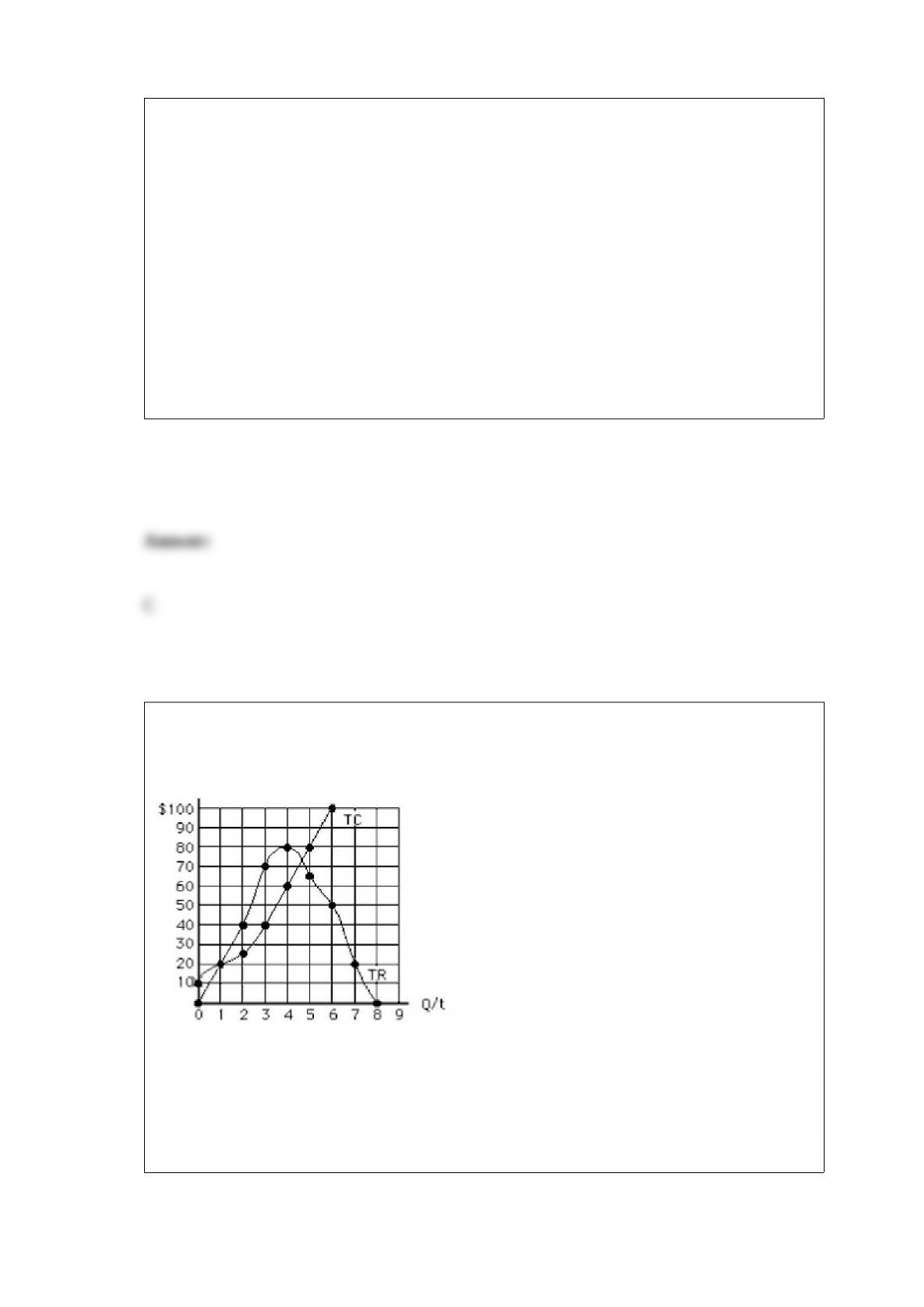
Exhibit 9-8
Consider Exhibit 9-8. What is the profit-maximizing price?
a. $70
b. $80
c. $23.33
d. $20
e. it is impossible to determine price because only information on total revenue is given

Upon opening a printing and copy shop, a firm budgets $30,000 for copy machines and
labor. If the price of labor is $30 per hour, what is the horizontal intercept of the isocost
line when labor is measured on the horizontal axis?
a. 75 hours
b. 1,000 hours
c. 90,000 hours
d. 300,000 hours
e. It is impossible to tell from the information given.
If Jeremy has an absolute advantage in cooking and Margaret has an absolute advantage
in cleaning, then
a. Jeremy has a comparative advantage in cooking, and Margaret has a comparative
advantage in cleaning
b. Jeremy has a comparative advantage in cleaning, and Margaret has a comparative
advantage in cooking
c. we can conclude nothing about comparative advantage
d. Jeremy has a comparative advantage in cooking, but we can conclude nothing about
Margaret
e. Margaret has a comparative advantage in cleaning, but we can conclude nothing
about Jeremy

Union wages in the United States are, on average,
a. equal to nonunion wages
b. twice as high as nonunion wages
c. half of nonunion wages
d. 15 percent higher than nonunion wages
e. 50 percent higher than nonunion wages
If the dependent variable Y is directly related to the independent variable X, this means
that changes in X cause changes in Y.
a. True
b. False
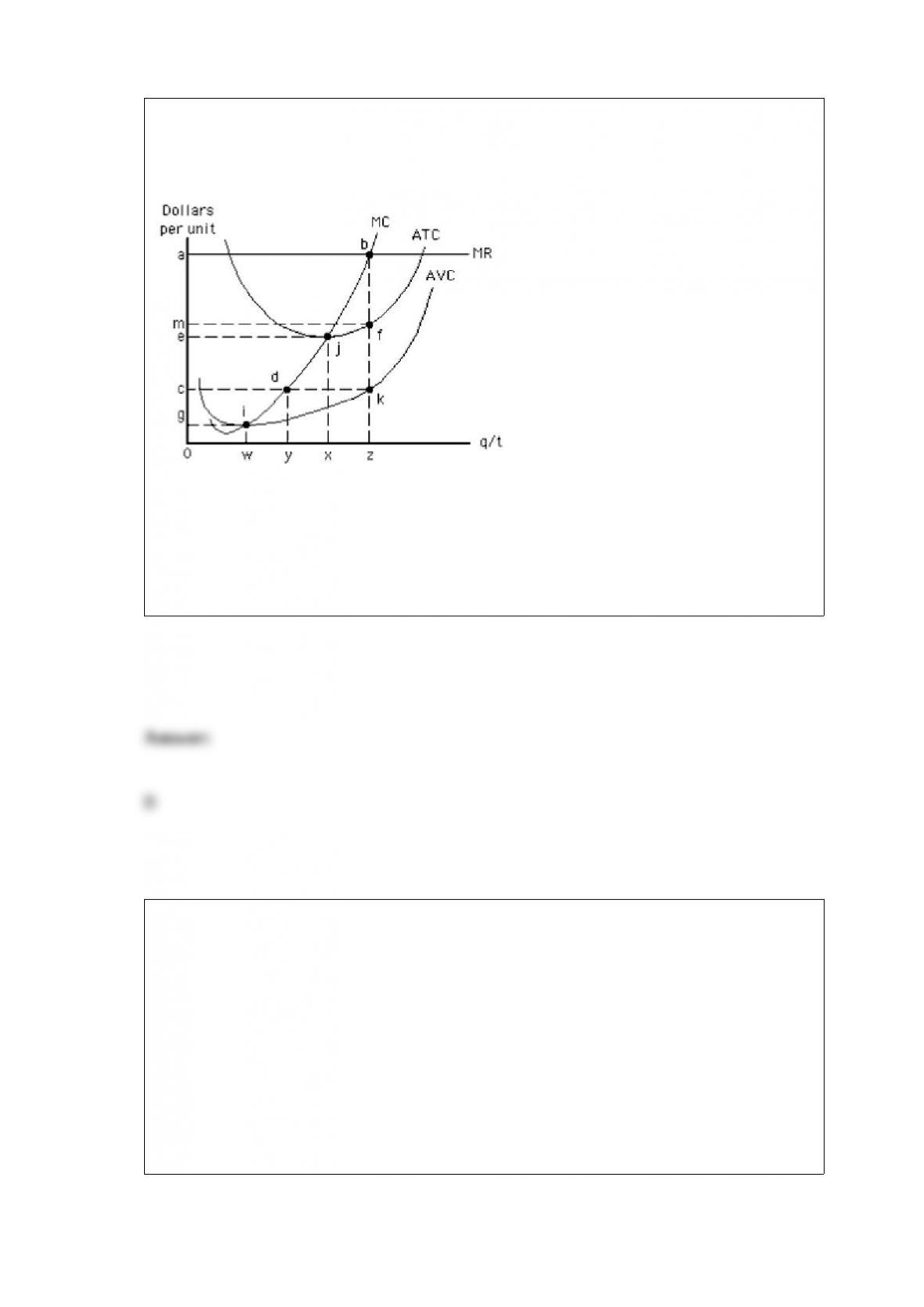
Exhibit 8-11
At the profit-maximizing output level, the firm represented in Exhibit 8-11 experiences
a. a loss of giw0
b. a profit of abfm
c. a profit of cdy0
d. zero profit or loss
e. a loss of mfkc
Which of the following is most likely to be a fixed cost for any firm?
a. the monthly electric bill
b. sales taxes
c. shipping and postage costs
d. rent on office space
e. charitable donations

As the price of milk increases, producers are normally willing to supply greater
quantities. This is known as the law of
a. demand
b. gravity
c. variable proportions
d. profitability
e. supply
Requiring Medicare participants to pay a small fraction of the cost of their medical care
a. reduces the quantity of health care they demand to zero
b. has no effect on the amount of health care they consume, but does generate revenue
for the government
c. reduces their utilization of health care without compromising their health
d. actually increases the amount of consumer surplus they receive
e. amounts to a significant burden for most of those participants
If a firm is producing at an output where the total revenue curve crosses the total cost
curve,
a. revenue is maximized
b. cost is maximized
c. cost is minimized
d. profit is maximized
e. profit is zero
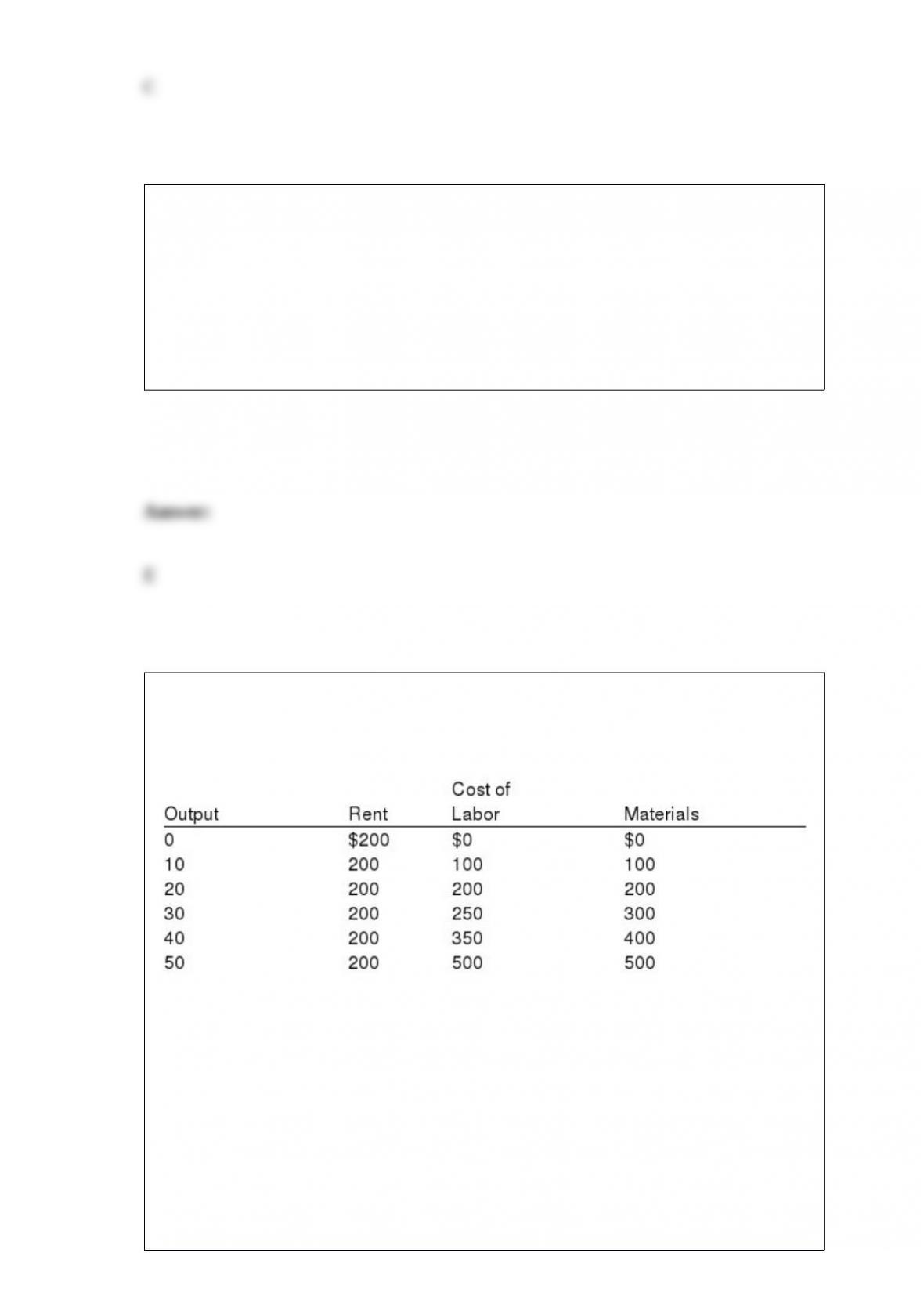
Exhibit 7-6
In Exhibit 7-6, the average total cost of producing 20 units is
a. $2
b. $20
c. $30
d. $100

e. $1,100
Exhibit 13-2
Given the data in Exhibit 13-2, the marginal product is
a. positive for all copy machines
b. positive for the first copy machine only
c. positive for the first four copy machines only
d. positive for the first five copy machines only
e. never positive
Suppose demand decreases and supply decreases. Which of the following will happen?
a. equilibrium price will increase

b. equilibrium price will decrease
c. equilibrium quantity will increase
d. equilibrium quantity will decrease
e. neither the equilibrium price nor the quantity will change
Which of the following is true of firms in both monopolistic competition and perfect
competition?
a. Firms face a horizontal demand curve.
b. Price exceeds marginal revenue.
c. Firms can enter and leave the industry with relative ease.
d. Price exceeds marginal cost.
e. Products are differentiated.
The slope of the total revenue curve equals
a. marginal revenue, which equals price for a perfectly competitive firm
b. marginal revenue, which is greater than price for a perfectly competitive firm
c. marginal revenue, which is less than price for a perfectly competitive firm
d. average revenue, which is greater than price for a perfectly competitive firm

e. average revenue, which is less than price for a perfectly competitive firm
Sjen Mavago, the economics minister of the country of X-Marks-the-Spot, has
concluded that entrepreneurs are unable to generate the kind of growth the country
needs. Her decision to create state enterprises might be motivated by the desire to
a. earn profit
b. provide jobs for friends and relatives of government officials
c. take risks
d. encourage a free market
e. limit government’s role in the economy
The movement in U.S. population from the farms to urban areas was caused primarily
by
a. each member of a farm family specializing in a particular set of tasks
b. a sharp increase in farm productivity
c. a decline in the demand for labor in urban areas
d. a sharp decline in the demand for agricultural products

e. increased education among married women