
If the price elasticity of supply of CDs is 0.8, then the supply is inelastic.
If the price elasticity of demand for peanuts is 0.4, then the demand is inelastic.
Recall Application 2, “The Market for Meteorites,” to answer the following
questions:
According to the Application, all meteorites are rare and expensive.
The marginal cost curve of a firm below AVC is also its short-run supply curve.

Price discrimination is best described as a firm charging different prices from other
firms selling the same product or service.
When applying the marginal principle, you should pick the level at which the activity’s
marginal benefit equals its marginal cost.
A burden of a tax on a good will not always be borne entirely by the seller.

An increase in the benefit from undertaking an activity will result in an increase in the
opportunity cost of that activity.
Economic cost is always less than accounting cost.
As the price of a product rises, the quantity supplied increases.
Inferior goods are substandard.

Another name for marketable pollution permits is a cap-and-trade system.
Economic profits are determined by subtracting total revenue and implicit costs.
The Clayton Act outlawed tying contracts.
Markets exist to facilitate exchange between people.

A merger is a process in which two or more firms combine their operations.
Utility is maximized when the chosen bundle of goods satisfies the equimarginal rule
and when the chosen bundle is on the budget line.
The increase in total cost that results from producing one more unit of output is the
fixed cost.

The decoy effect has important implications for consumer decision making, A savvy
consumer can use cognition to avoid being affected by the decoy effect.
If average cost is falling, marginal cost must also be falling.
A tie-in sale is when two firms merge together and are essentially tied together.
There is asymmetric information in the used car market because sellers cannot
distinguish between lemons (low-quality) and plums (high-quality) but buyers can.

When Jimmy produces one guitar his costs total $250. When he produces two guitars
his total costs are $400. This means that Jimmy’s marginal cost of producing the second
guitar is $200.
Entry of a second firm will result in a downward shift in the ATC curve.
Implicit cooperation among firms to maintain prices is illegal under antitrust laws.
A vertical supply curve is infinitely elastic.

In the short run, a firm that is incurring losses would always better off it keeps
producing.
A large blast furnace is an example of an indivisible input that cannot be scaled down to
reduce output.
When the U.S. banned tuna from Mexico because Mexico used nets that killed
dolphins, they acted in concordance with WTO rules.

Copayments and deductibles in insurance policies increase moral hazard.
An oligopoly is an industry with just one firm.
An increase in the market supply of clerks leads to an increase in the market wage rate
for clerks.
Marginal revenue product is the additional revenue for the firm when it hires one
additional unit of labor.

In a two-party democratic system, elected officials typically choose a view that is close
to the median voter to ensure their reelection.
One of the key economic questions is “who consumes the products?”
The opportunity cost of going to college:
A) is zero if your parents pay your tuition.
B) is equal to the cost of tuition, room and board, and other expenses.
C) includes wages you lose by going to school instead of working.
D) is the same for all students at a particular school who pay full tuition.

A market in which there are neither external benefits nor external costs is:
A) efficient.
B) inefficient.
C) efficient and equitable.
D) impossible.
Suppose that Helen has $50 to spend. Tacos cost $2 and burritos cost $5. Which of the
following combinations is NOT on her budget line?
A) 0 tacos and 10 burritos
B) 0 burritos and 25 tacos
C) 8 burritos and 5 tacos
D) 10 burritos and 3 tacos
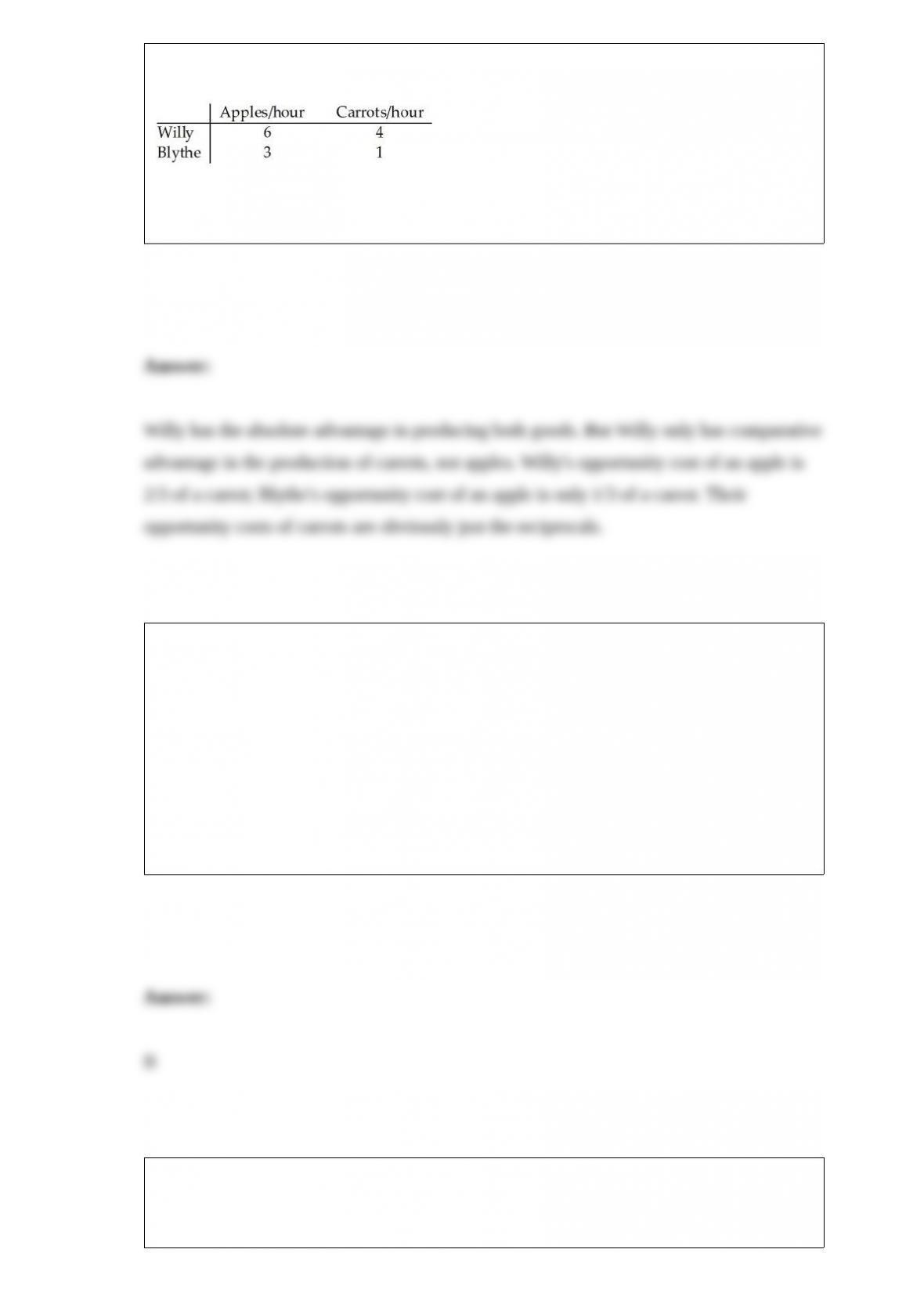
Consider two individuals, Willy and Blythe, who produce carrots and apples. Willy and
Blythe’s hourly productivity are as follows:
Who has the absolute advantage or comparative advantage in the production of apples
or carrots?
When supply decreases and the supply curve shifts to the left, equilibrium price
________ and equilibrium quantity ________.
A) increases; increases
B) increases; decreases
C) decreases; increases
D) decreases; decreases
Suppose Wave detergent is sold in a monopolistically competitive market. If the price of
Wave detergent is currently $6, and the average cost of producing Wave is $4, in the
long run we can expect:

A) firms to enter the detergent market and sell products similar to Wave, shifting the
demand curve for Wave to the left.
B) firms to enter the detergent market and sell product similar to Wave, shifting the
demand curve for Wave to the right.
C) the producers of Wave to go out of business.
D) the producers of Wave to earn economic profits greater than zero.
Suppose that steak is a normal good. When income decreases, the equilibrium quantity
of steak will ________ and the equilibrium price of steak will ________.
A) increase; increase
B) increase; decrease
C) decrease; increase
D) decrease; decrease
Under a system of marketable pollution permits, the ________ amount of permits
supplied, the ________ the equilibrium price charged for each permit:
A) higher; higher

B) higher; lower
C) lower; lower
D) It cannot be determined.
Suppose that the supply of gasoline decreases. Price will ________ and consumer
surplus will ________.
A) increase; increase
B) increase; decrease
C) decrease; increase
D) decrease; decrease
Suppose Mario is given a monthly income of $400 to spend on food while at college.
Further, suppose the price of a frozen meal is $8 and the price of a cup of soup is $4.
Which one of the following consumption combinations is possible given these prices
and income?
A) 40 frozen meals, 50 cups of soup
B) 15 frozen meals, 80 cups of soup
C) 20 frozen meals, 60 cups of soup

D) 10 frozen meals 100 cups of soup
If the marginal benefit of reducing water pollution is constant at $10 per ton, then it is
efficient to reduce water pollution:
A) to zero.
B) until marginal cost of reducing water pollution equals $10 per ton.
C) as long as the marginal cost of reducing water pollution is greater than $10 per ton.
D) to whatever level the market determines.
Figure 11.2 shows demand and costs for a monopolistically competitive firm. At the
profit maximizing output level, the firm’s profit is:
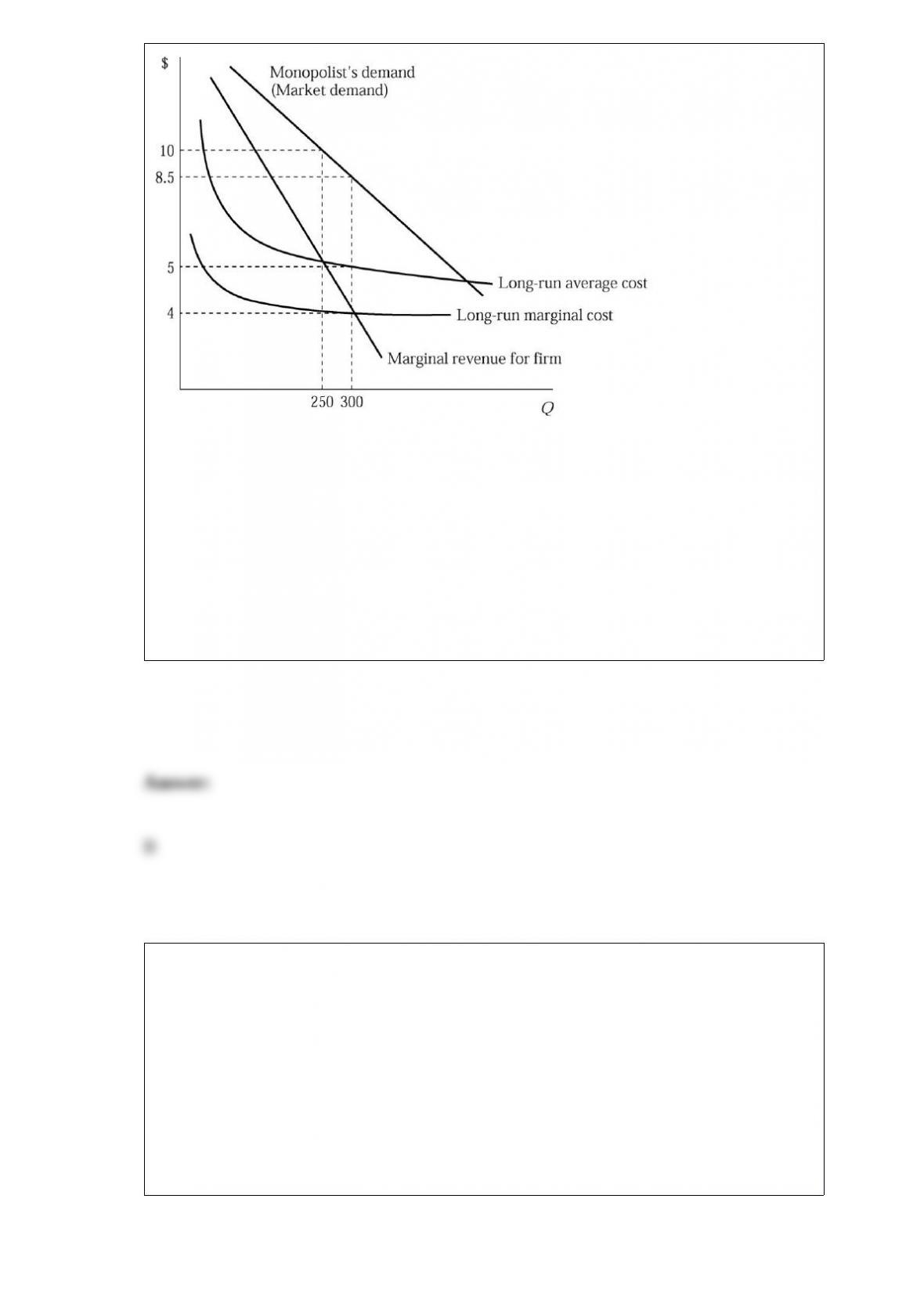
Figure 11.2
A) $1,200.
B) $1,050.
C) $750.
D) $375.
If the government imposes a maximum price on rental apartments that is below the
equilibrium price, we can expect to see all of the following EXCEPT:
A) landlords doing less maintenance to their rental units.
B) new apartment units being built.
C) renters spending more time searching for apartments.
D) some building owners converting their apartments to condominiums.

Refer to Scenario 9.1. 21st Century Pen Inc.’s fixed cost is:
Scenario 9.1: 21st Century Pen Inc. produces 2000 pens per day, and hires 20 workers
at a cost of $200 per day per worker. The price of each pen is $5 each. 21st Century Pen
Inc. pays a daily rental rate of $60 on its factory and a daily insurance rate of $20. 21st
Century Pen Inc. has a ten year lease on the factory and insurance contract for a year,
the company has no other expenses.
A) $4000 per day.
B) $4080 per day.
C) $80 per day.
D) $60 per day.
Which of the following is NOT a characteristic of a monopoly?
A) A monopolist faces a downward-sloping demand curve.
B) There are no close substitutes for a monopolist’s product.
C) After the first unit, the monopolist’s marginal revenue is always less than its price.
D) A monopolist is a price-taker.

For monopolistically competitive firms in long-run equilibrium:
A) the demand curve must intersect average total cost at its minimum.
B) the demand curve must be tangent to the average total cost curve at its minimum.
C) at the profit-maximizing quantity, the demand curve must intersect the average total
cost curve quantity.
D) at the profit-maximizing quantity, the demand curve must be tangent to the average
total cost curve.
Which of the following groups of countries are members of NAFTA?
A) Japan, Canada, and Mexico
B) the United States, Japan, and Mexico
C) the United States, France, and Germany
D) the United States, Canada, and Mexico
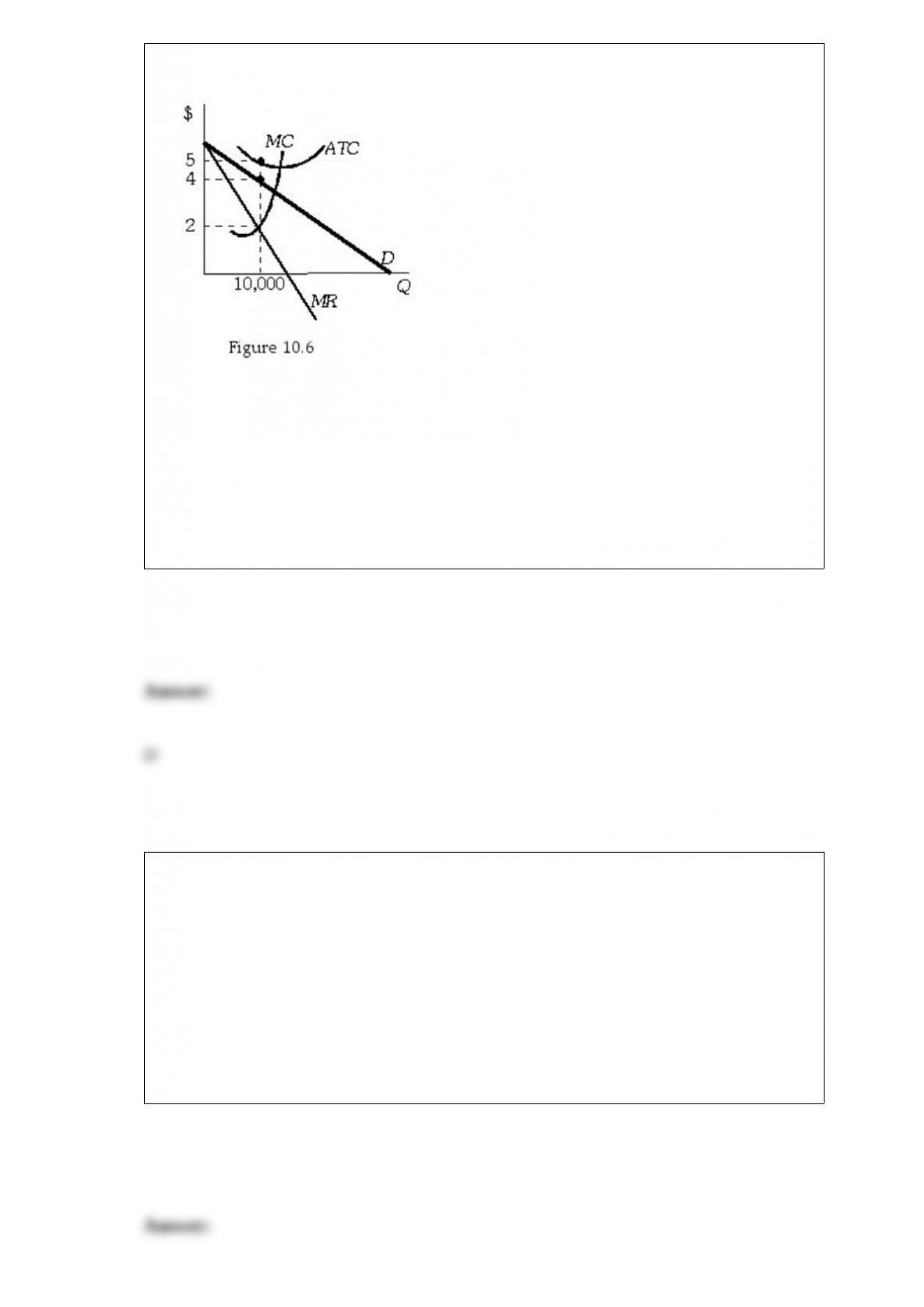
Refer to Figure 10.6. At the profit-maximizing level of output, total cost:
A) is $10,000.
B) is $20,000.
C) is $30,000.
D) is $50,000.
A ban on imports will ________ domestic producer surplus, and ________ domestic
consumer surplus.
A) increase; increase
B) increase; decrease
C) decrease; increase
D) decrease; decrease
Private goods are:
A) rival in consumption and their benefits are excludable.
B) nonrival in consumption and their benefits are excludable.
C) nonrival in consumption and their benefits are nonexcludable.
D) rival in consumption and their benefits are nonexcludable.
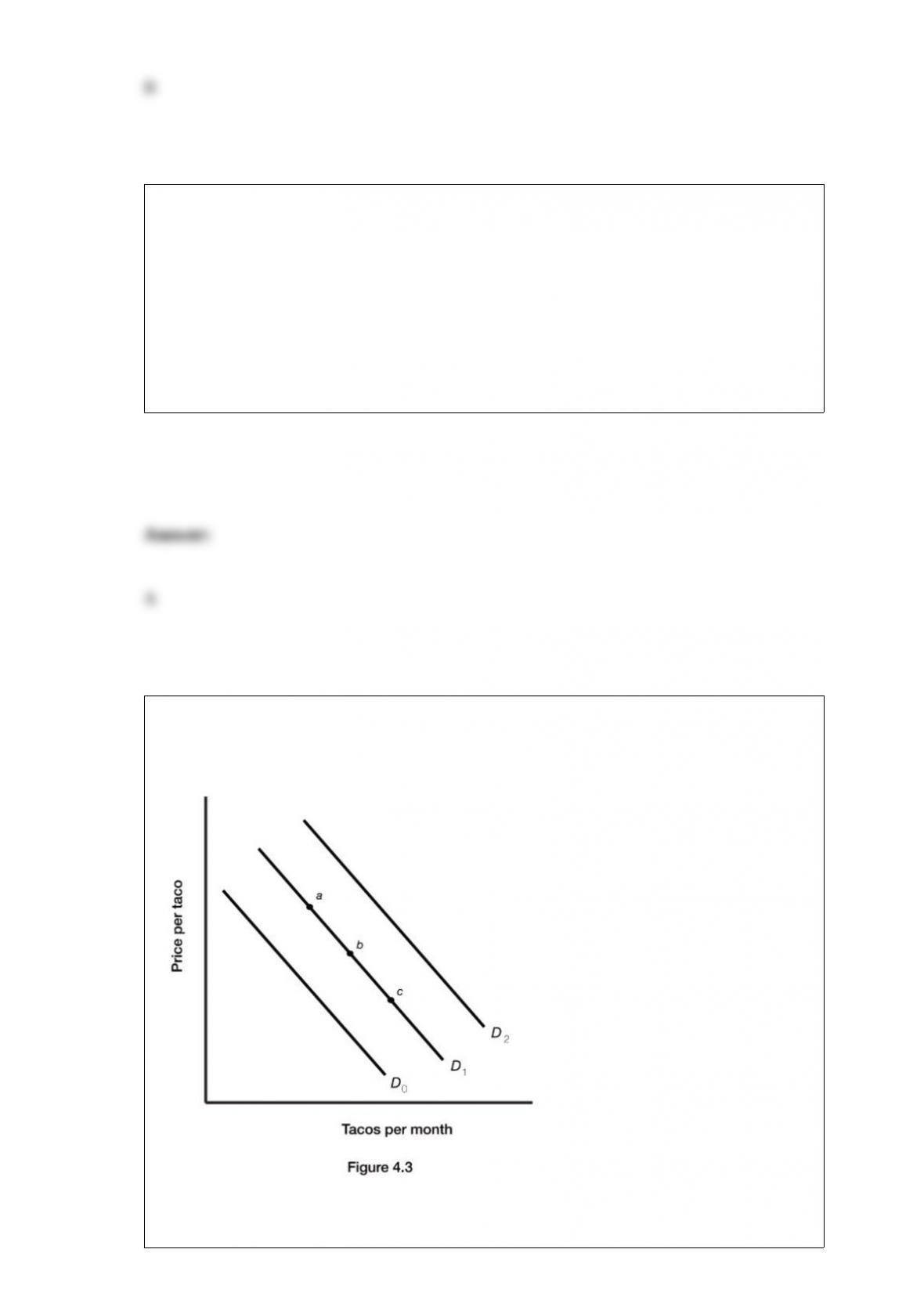
Figure 4.3 illustrates the demand for tacos. An increase in price of tacos would bring
about a movement from:
A) point a to point c.

B) point c to point a.
C) D2 to D0.
D) D0 to D1.
Natural monopoly occurs when:
A) the scale economies in production are so large that only a single firm can survive.
B) there are firms joining together to limit output and raise prices.
C) the government intervenes by putting barriers such as licenses or certifications.
D) there are patents.
Refer to Figure 9.5. This farmer would earn zero economic profit if price was:
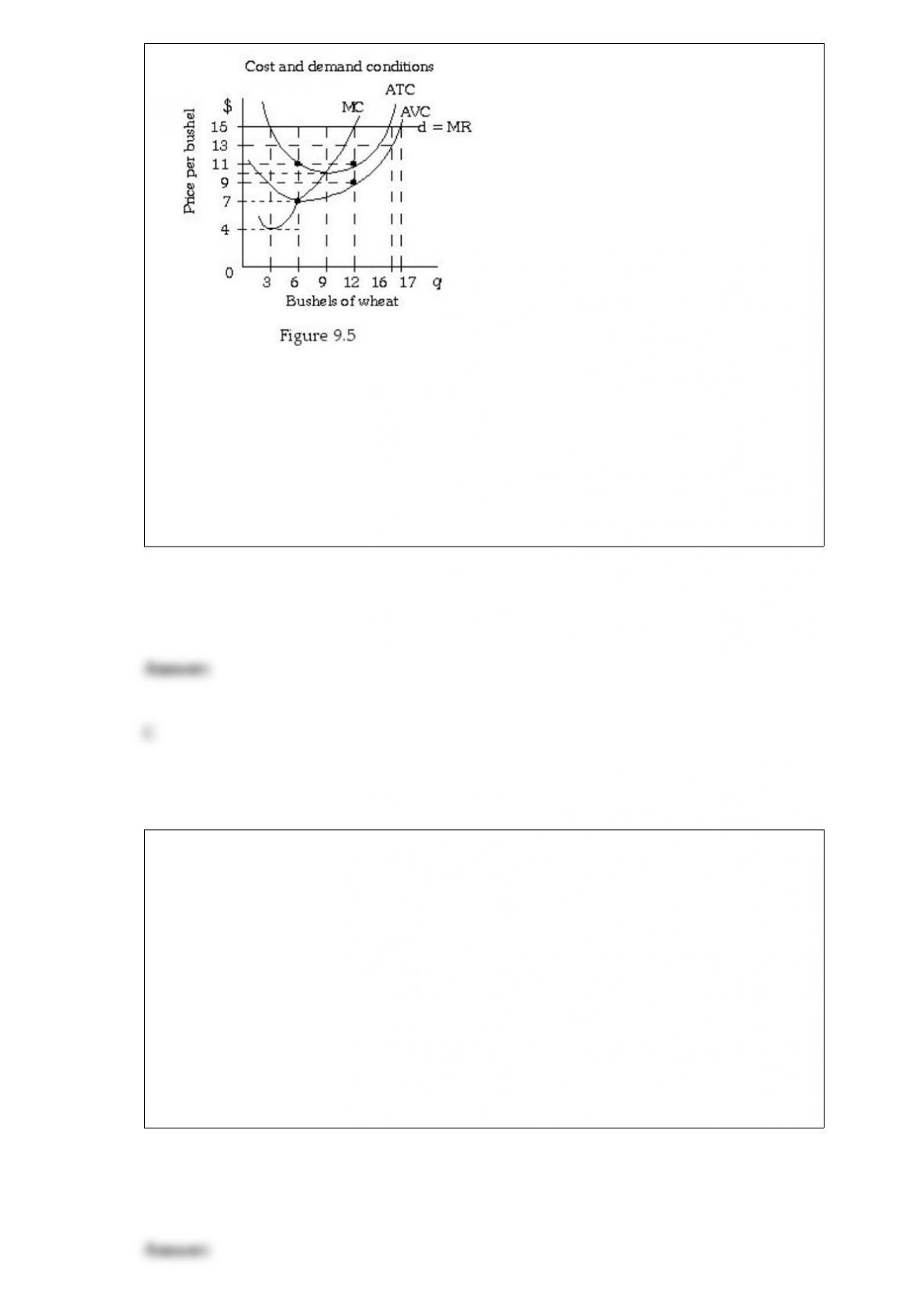
A) $7.
B) $9.
C) $10.
D) $11.
Recall the Application. The EPA has estimated the cost of methane recovery at different
recovery levels. Given those costs, the optimal level of methane recovery:
A) depends on the estimate of the marginal benefit of methane recovery.
B) is zero because the costs exceed the benefits.
C) will increase if scientists determine that methane is not as harmful as it is currently
thought to be.
D) will include only recovery from landfills and coal mines, but not from natural gas
distribution.
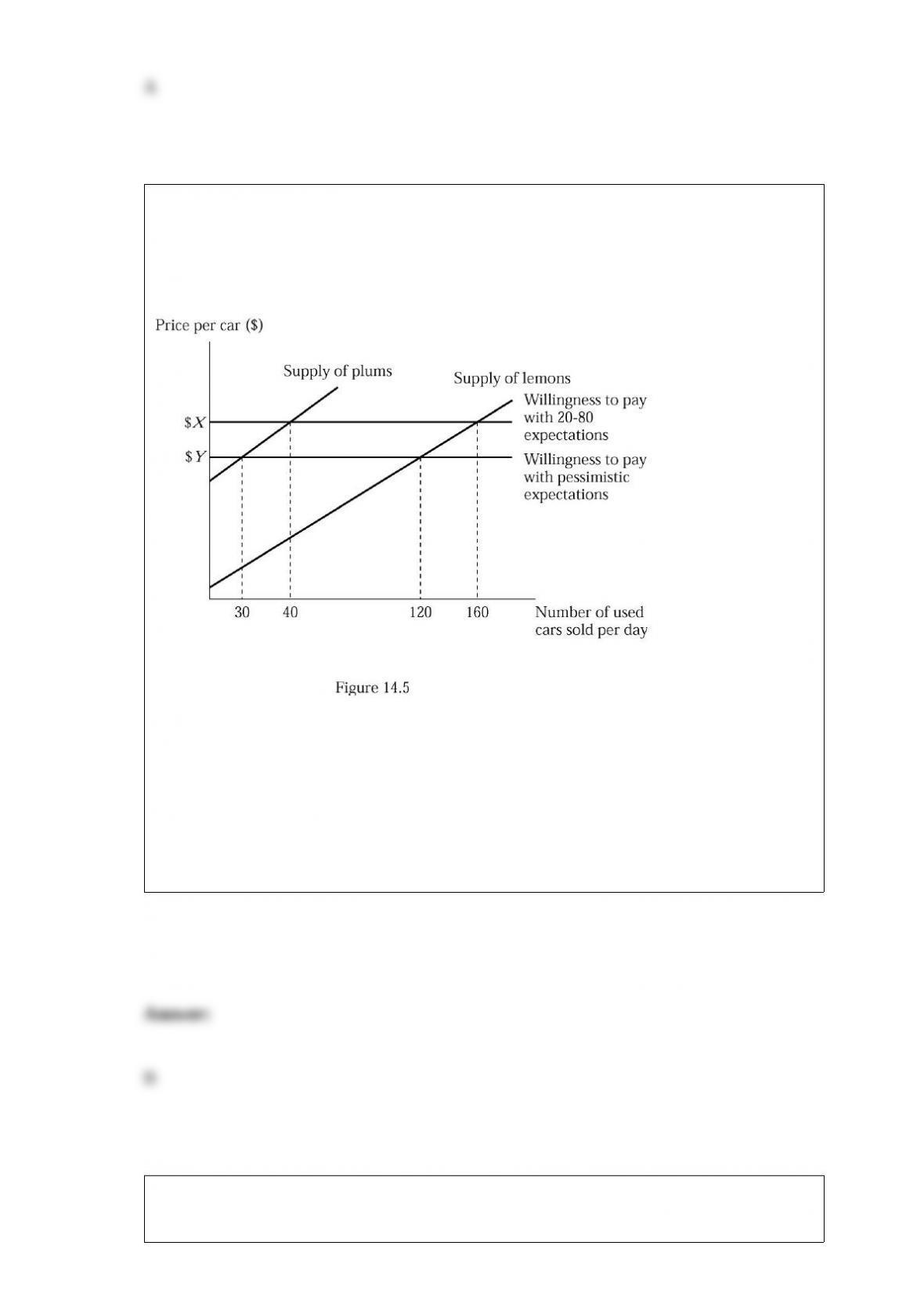
Figure 14.5 represents the market for used cars. Suppose buyers are willing to pay
$5,000 for a plum (high-quality) used car and $3,000 for a lemon (low-quality) used
car. If buyers believe that 80% of used cameras in the market are lemons (low quality),
what is consumers’ willingness to pay ($X)?
A) $5,000
B) $3,400
C) $3,000
D) $1,700
The input-substitution effect decreases the labor input per unit of output while the
output effect:

A) decreases the price of the output.
B) decreases the total output.
C) increases the price of the output.
D) increases the total output.
Suppose that the price elasticity of supply is 0.8 and the price increases by 10%. We
would predict:
A) an 8% increase in quantity supplied.
B) a 12.5% increase in quantity supplied.
C) a 0.8% increase in quantity supplied.
D) a 1.25% increase in quantity supplied.
Suppose that you lend $1,000 to a friend and he or she pays you back one year later.
What is the opportunity cost of lending the money?
A) There is no cost.
B) the real interest rate that would have been earned on the money

C) the nominal interest rate that would have been earned on the money
D) the implicit cost of the money
A constant cost industry is one in which:
A) demand is horizontal.
B) long-run supply is horizontal.
C) short-run supply is horizontal.
D) all of the above
The equimarginal rule:
A) equates the marginal utility per dollar spent on each good purchased.
B) states that in order to maximize utility the consumer should buy more of those goods
with a high marginal utility.
C) states that in order to maximize utility the consumer should buy more of those goods
that cost less.
D) none of the above
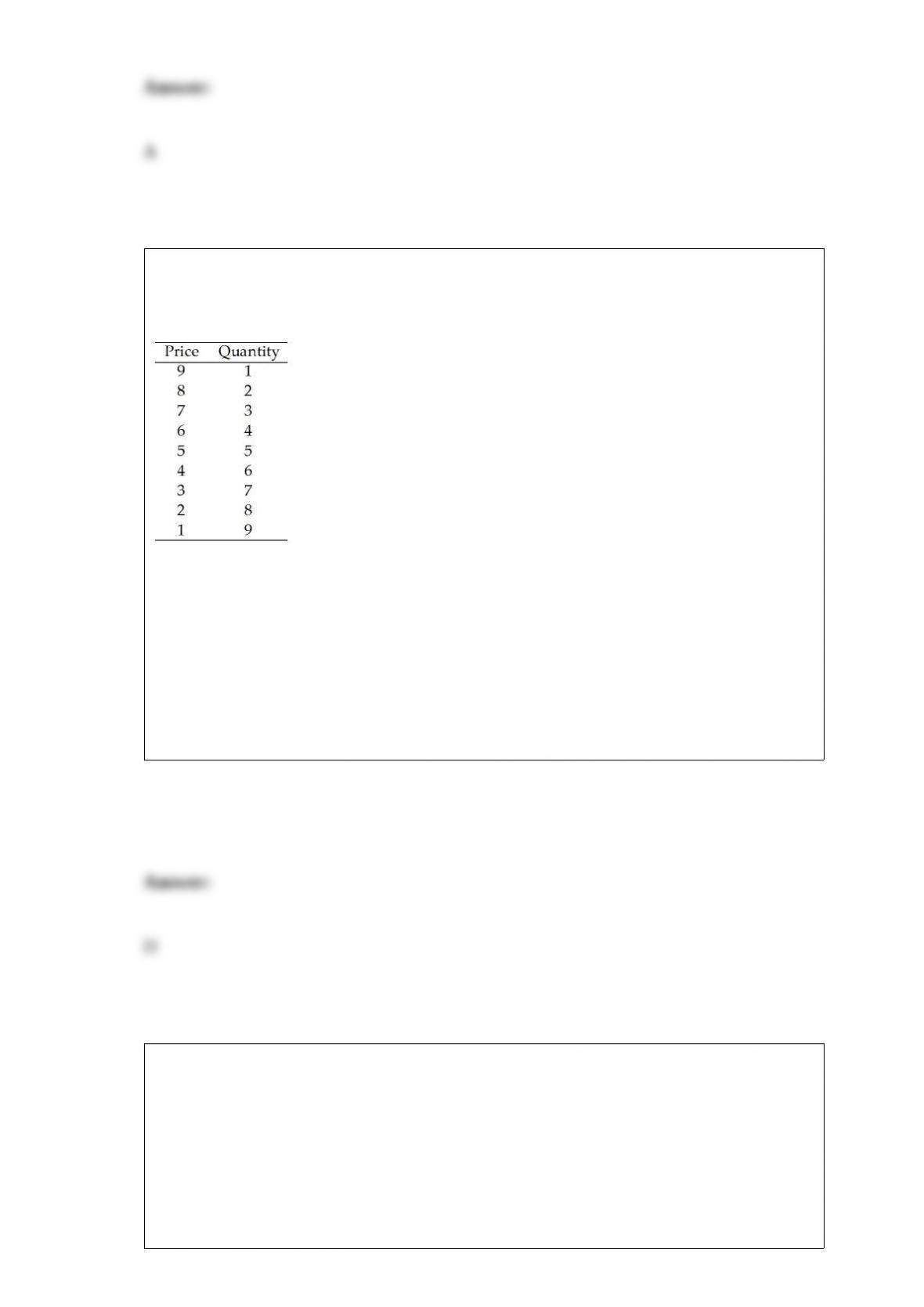
Refer to Table 10.1, which shows the relationship between the price that Gladys charges
for a product and the quantity of that product that Gladys sells. The total revenue that
Gladys receives from selling four units of output is:
Table 10.1
A) $4.
B) $6.
C) $10.
D) $24.
Firms like to know the price elasticity of demand because it determines how price
changes affect:
A) the supply curve.
B) costs.
C) revenues.
D) taxes.
If a firm shuts down in the short run, will the firm have zero costs? Why or why not?
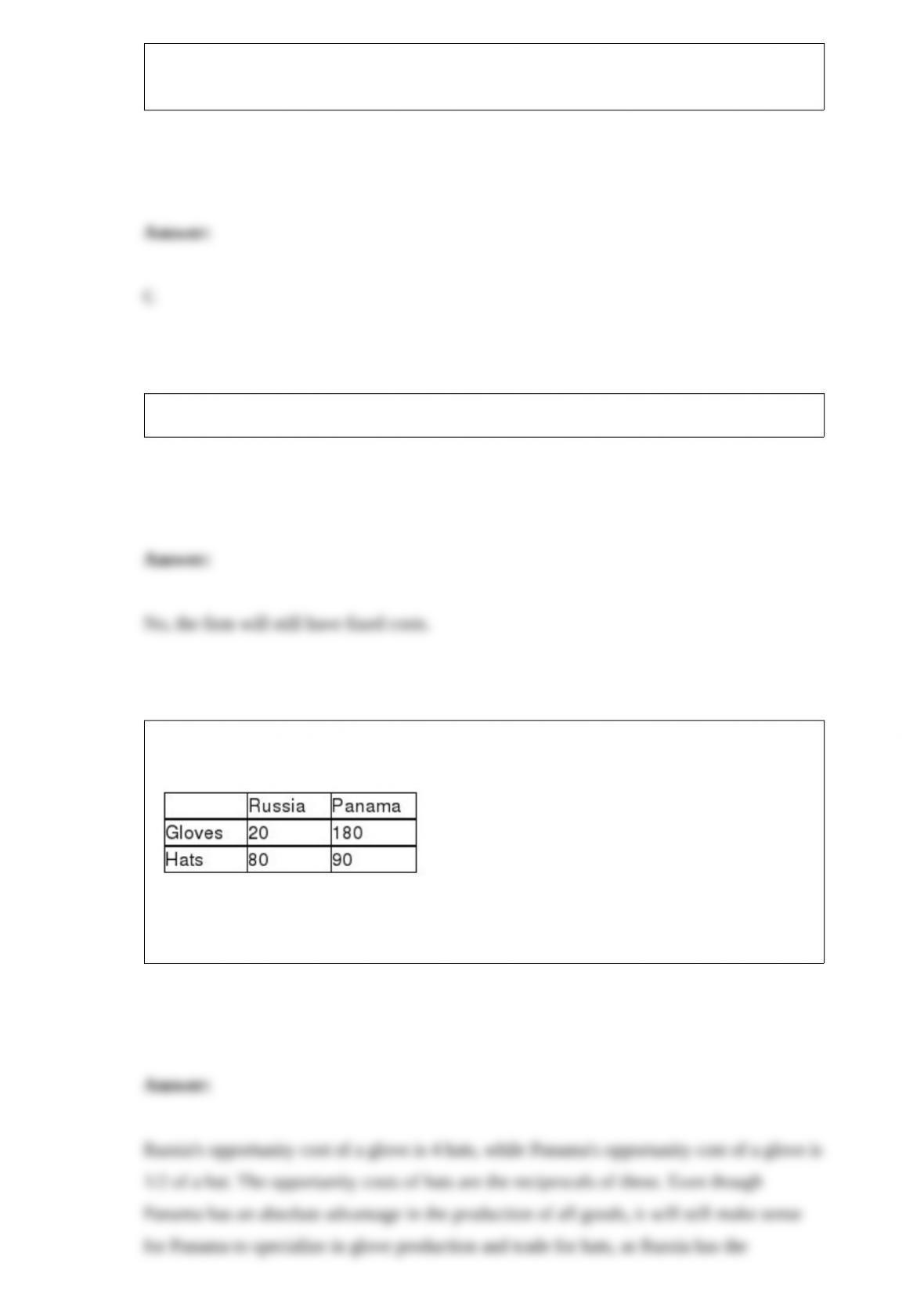
Consider the following weekly production possibilities of gloves and hats in Panama
and Russia:
What is each country’s opportunity cost of producing gloves and hats? If the countries
could, should they trade?
What is a public good?
Why does the vertical distance between the ATC curve and the AVC curve decrease as
output increases?
What is an opportunity cost?
Describe the market effects of a carbon tax.
Explain how a pollution tax on automobiles would work toward effectively
internalizing an external cost.
You are running a small yard maintenance business for the summer. What do you
expect to happen to the number of yards you can maintain in a day as you add workers
if you don’t purchase more capital equipment (like mowers and leaf blowers)?
How is the price of a marketable pollution permit determined?
Graphically illustrate and explain the effect of an increase in the marginal product of
labor on the demand curve for labor.
Marty has a collection of Beanie Babies that he is willing to sell for $850. Someone
offers him $1,000 for his collection. Calculate Marty’s producer surplus. What happens
to Marty’s producer surplus if someone offers him $1,200 instead?
What is meant by a dominant strategy?
Comment on the following statement: “In the short run, a firm’s total costs will be zero
if the firm chooses to produce nothing.”
Do firms in a perfectly contestable market earn positive economic profit in the long
run? Explain.
Is demand for electricity more price elastic when measured over a short period of time
or a long period of time? Explain.
What happens when a firm encounters diminishing returns? What causes diminishing
returns?
How is a long-run average cost curve different from a short-run average cost curve?
How are they related?
What is the signaling effect of a college education?