
The unemployment rate is
A) the percentage of the labor force that is employed.
B) the percentage of the number employed that is unemployed.
C) the percentage of the working-age population that is unemployed.
D) the percentage of the labor force that is unemployed.
E) the percentage of the working-age population that is employed.
A lumberjack loses his job because timber cutting restrictions were imposed by the EPA
to protect the spotted owl habitat. This lumberjack would be
A) frictionally unemployed.
B) cyclically unemployed.
C) structurally unemployed.
D) seasonally unemployed.
Structural unemployment is the result of
A) a persistent mismatch between the skills and characteristics of workers and the
requirements of the jobs.
B) the search process of matching workers with jobs.

C) the ups and downs in inflation.
D) a slowdown in the economy.
Some policymakers have argue that products like cigarettes, alcohol, and sweetened
soda generate negative externalities in consumption. If the government decided to
impose a tax on soda, the government will cause
A) consumers to internalize the externality.
B) producers to internalize the externality.
C) the external cost to drinking soda to become a private cost paid by the government.
D) the external cost to drinking soda to become a private cost paid by producers.
If an increase in income leads to a decrease in the demand for popcorn, then popcorn is
A) an inferior good.
B) a neutral good.
C) a necessity.
D) a normal good.
According to a recent study, “Stricter college alcohol policies, such as raising the price
of alcohol, or banning alcohol on campus, decrease the number of students who use
marijuana.” On the basis of this information, how would you describe alcohol and
marijuana?
A) The two goods are substitutes in consumption.
B) There is no relationship between the two goods.
C) The two goods are complements in consumption.
D) They are both luxury goods.
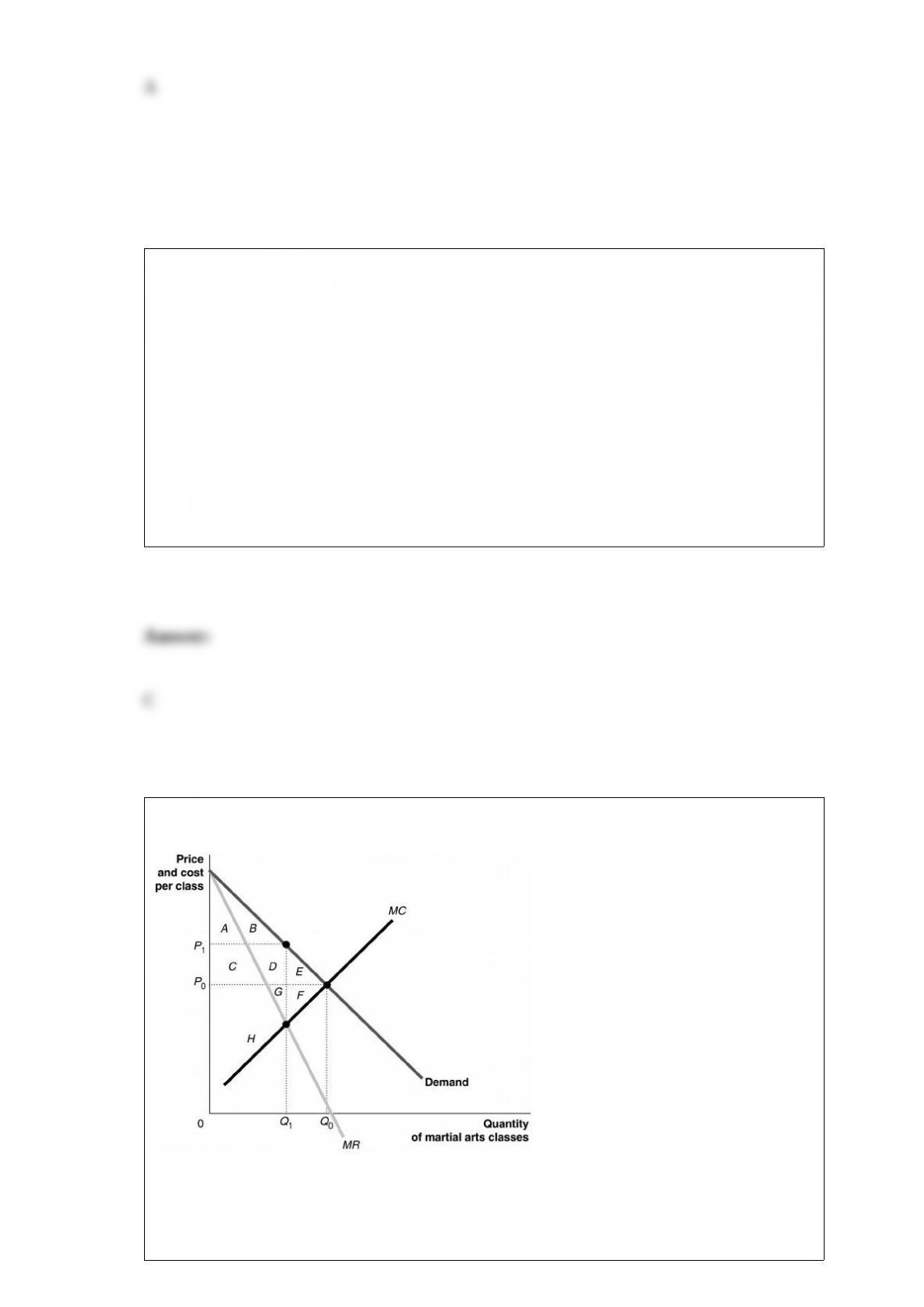
Figure 16-6
Watanabe Sensei operates the only
martial arts school in Hartfield. For simplicity, assume that consumers have identical
demand curves and that Sensei knows what this demand curve is. Figure 16-6 shows
this demand curve. With a two-part pricing scheme – a monopoly price for classes and a
one-time membership fee – what is the amount of producer surplus Sensei will earn?

A) an amount equal to the area A + B + C + D
B) an amount equal to the area E + F
C) an amount equal to the area A + C + H
D) an amount equal to the area A + B + C + D + H + G
An increase in interest rates
A) decreases investment spending on machinery, equipment and factories, but increases
consumption spending on durable goods and net exports.
B) decreases investment spending on machinery, equipment and factories, and
consumption spending on durable goods, but increases net exports.
C) decreases investment spending on machinery, equipment and factories, consumption
spending on durable goods, and net exports.
D) increases investment spending on machinery, equipment and factories, consumption
spending on durable goods, and net exports.
The new Keynesians emphasize the importance of
A) rational expectations.
B) the monetary growth rule.
C) real causes of the business cycle.
D) sticky wages and prices.
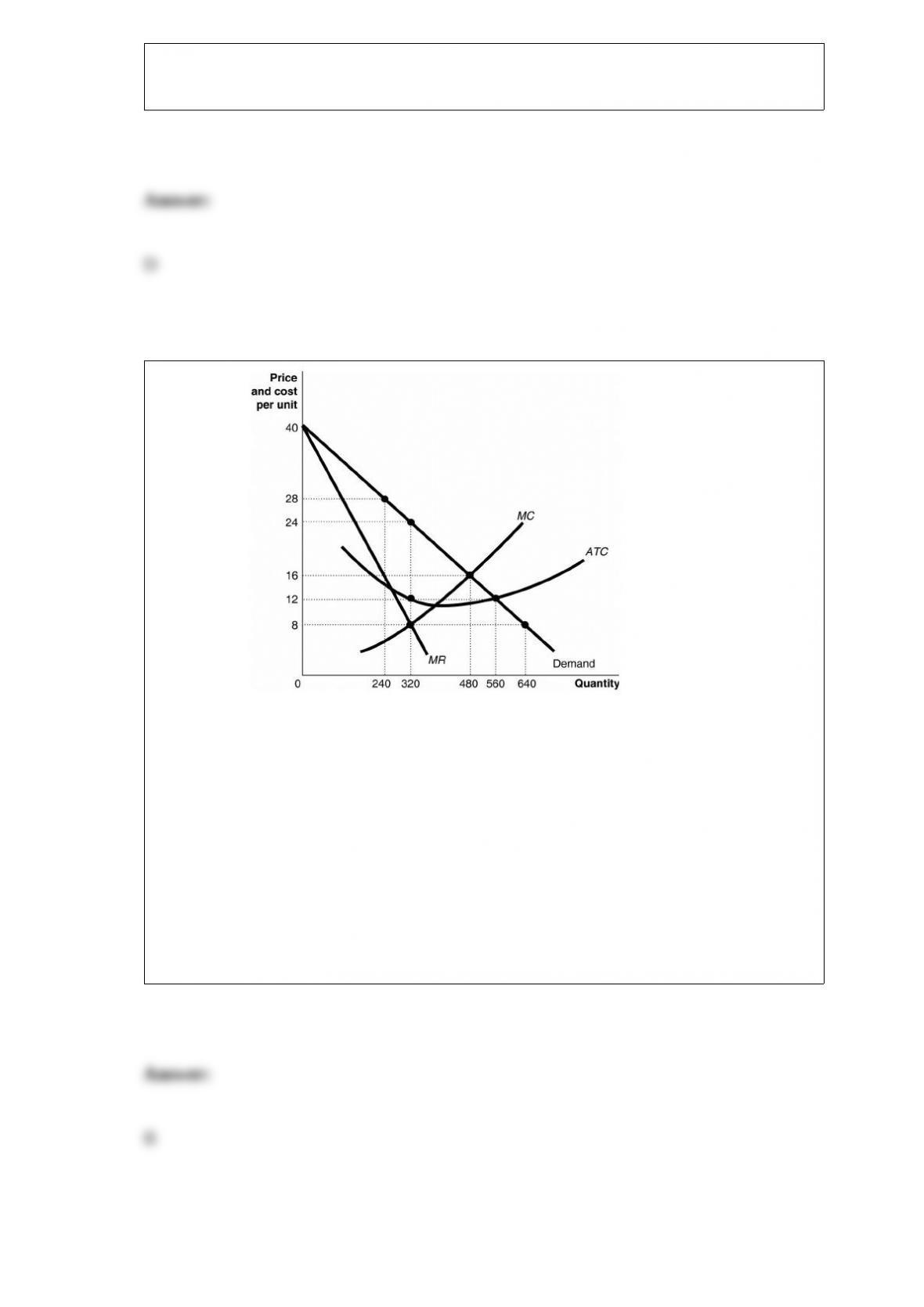
Figure 16-5
Suppose the firm represented in the diagram decides to use a two-part pricing strategy
such that it charges a fixed fee and a per-unit price equal to the monopoly price. What is
the quantity it should produce?
A) 240 units
B) 320 units
C) 480 units
D) 560 units

Marginal cost is equal to the
A) change in total cost divided by the change in output.
B) change in average total costs divided by the change in output.
C) change in total product divided by the change in output.
D) change in average product divided by the change in output.
Federal government purchases, as a percentage of GDP,
A) have risen since the early 1950s.
B) have fallen since the early 1950s.
C) have remained roughly the same since the early 1950s.
D) rose from the early 1950s until the mid 1980s, and then fell.
Table 4-3
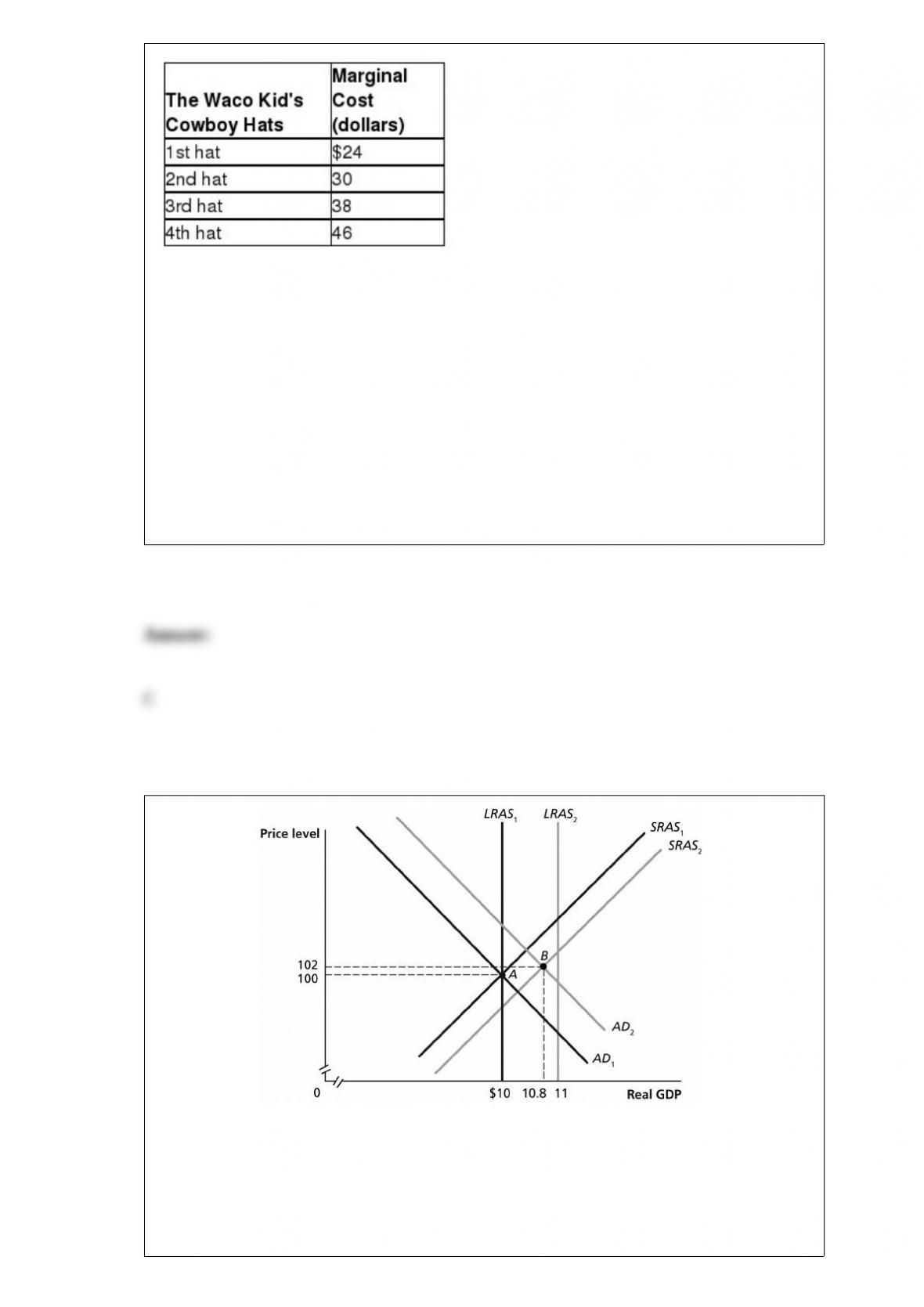
The table above lists the marginal cost of cowboy hats by The Waco Kid, a firm that
specializes in producing western wear. If the market price of cowboy hats is $50,
producer surplus is
A) $0.
B) $4.
C) $62.
D) $138.
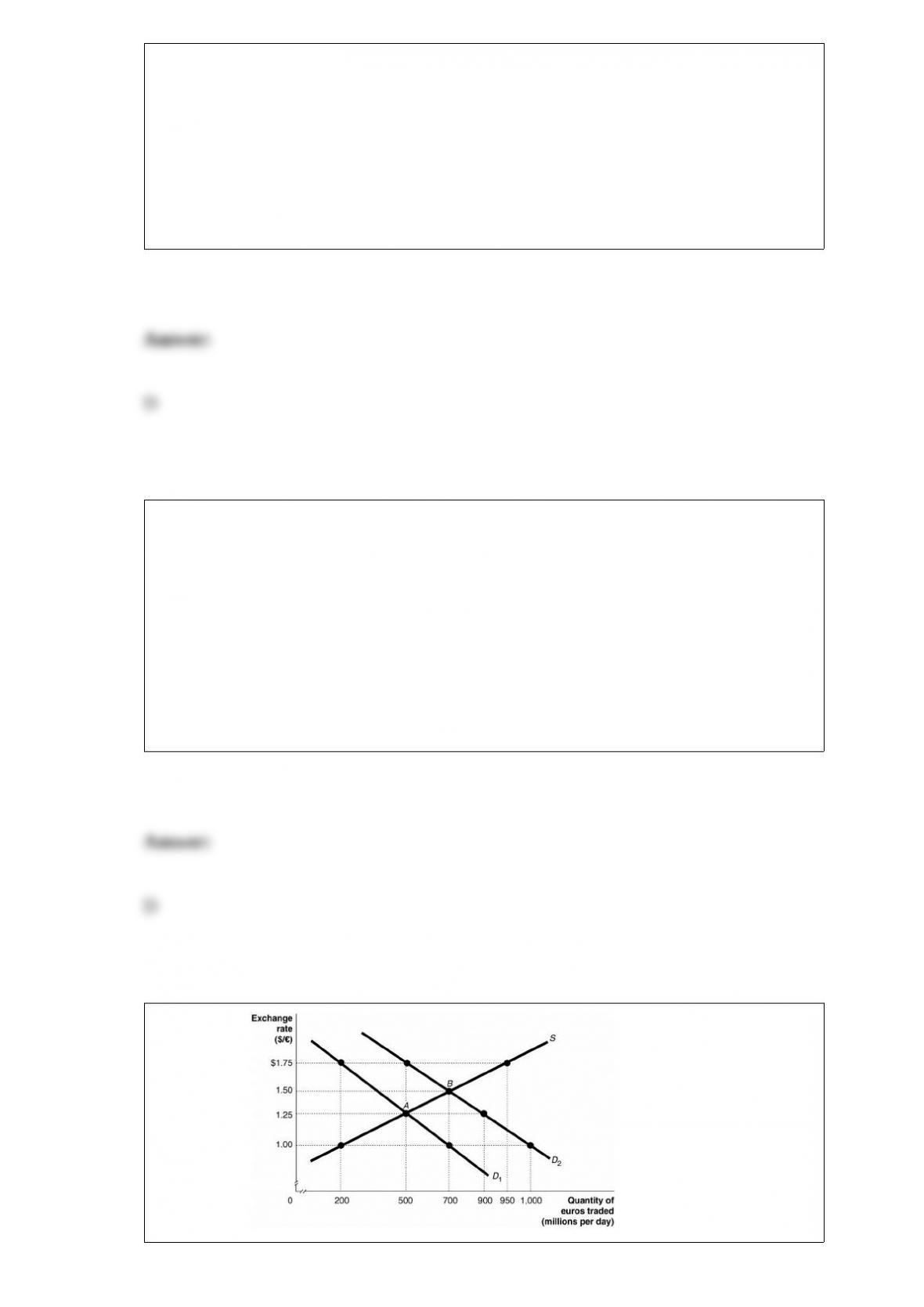
Figure 26-11
In the dynamic model of AD–AS in the figure above, if the economy is at point A in year
1 and is expected to go to point B in year 2, and the Federal Reserve pursues no policy,
then at point B
A) there is pressure on wages and prices to rise.
B) the unemployment rate is very, very low.
C) firms are operating above their normal capacity.
D) the economy is below full employment.
E) incomes and profits are rising.
Producing where marginal revenue equals marginal cost is equivalent to producing
where
A) average total cost equals average revenue.
B) average fixed cost is minimized.
C) total revenue is equal to total cost.
D) total profit is maximized.
Figure 19-8
The equilibrium exchange rate is at A, $1.25/euro. Suppose the European Central Bank
pegs its currency at $1.00/euro. Speculators expect that the value of the euro will rise
and this shifts the demand curve for euro to D2. After the shift,
A) there is a shortage of euro equal to 1,000 million.
B) there is a surplus of euro equal to 400 million.
C) there is a shortage of euro equal to 800 million.
D) there is a surplus of euro equal to 500 million.
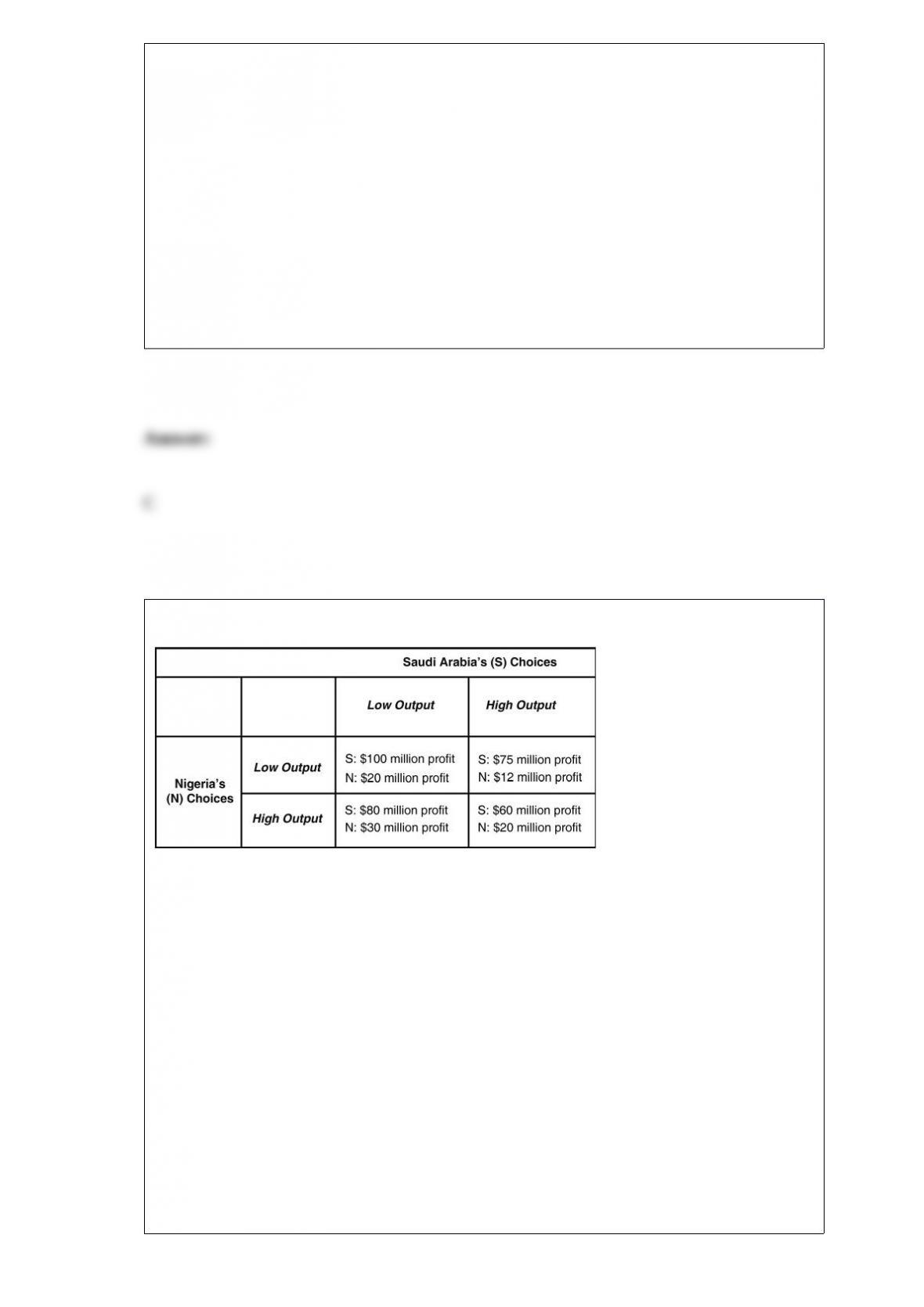
Table 14-3
Suppose OPEC has only
two producers, Saudi Arabia and Nigeria. Saudi Arabia has far more oil reserves and is
the lower cost producer compared to Nigeria. The payoff matrix in Table 14-3 shows
the profits earned per day by each country. “Low output” corresponds to producing the
OPEC assigned quota and “high output” corresponds to producing the maximum
capacity beyond the assigned quota. What is the Nash equilibrium in this game?
A) In the Nash equilibrium both Saudi Arabia and Nigeria produce a low output and
earn a profit of $100 million and $20 million respectively.
B) In the Nash equilibrium both Saudi Arabia and Nigeria produce a high output and
earn a profit of $60 million and $20 million respectively.
C) In the Nash equilibrium Saudi Arabia produces a low output and earns a profit of
$80 million and Nigeria produces a high output and $30 million respectively.
D) There is no Nash equilibrium.

If you have trouble finding a job because of a slowdown in the overall economy, we
would say that you are
A) frictionally unemployed.
B) structurally unemployed.
C) cyclically unemployed.
D) seasonally unemployed.
Total dividend payments plus retained earnings divided by outstanding stock shares
equals
A) the price-earnings ratio.
B) earnings per share.
C) the dividend yield.
D) the year-to-date percentage change.
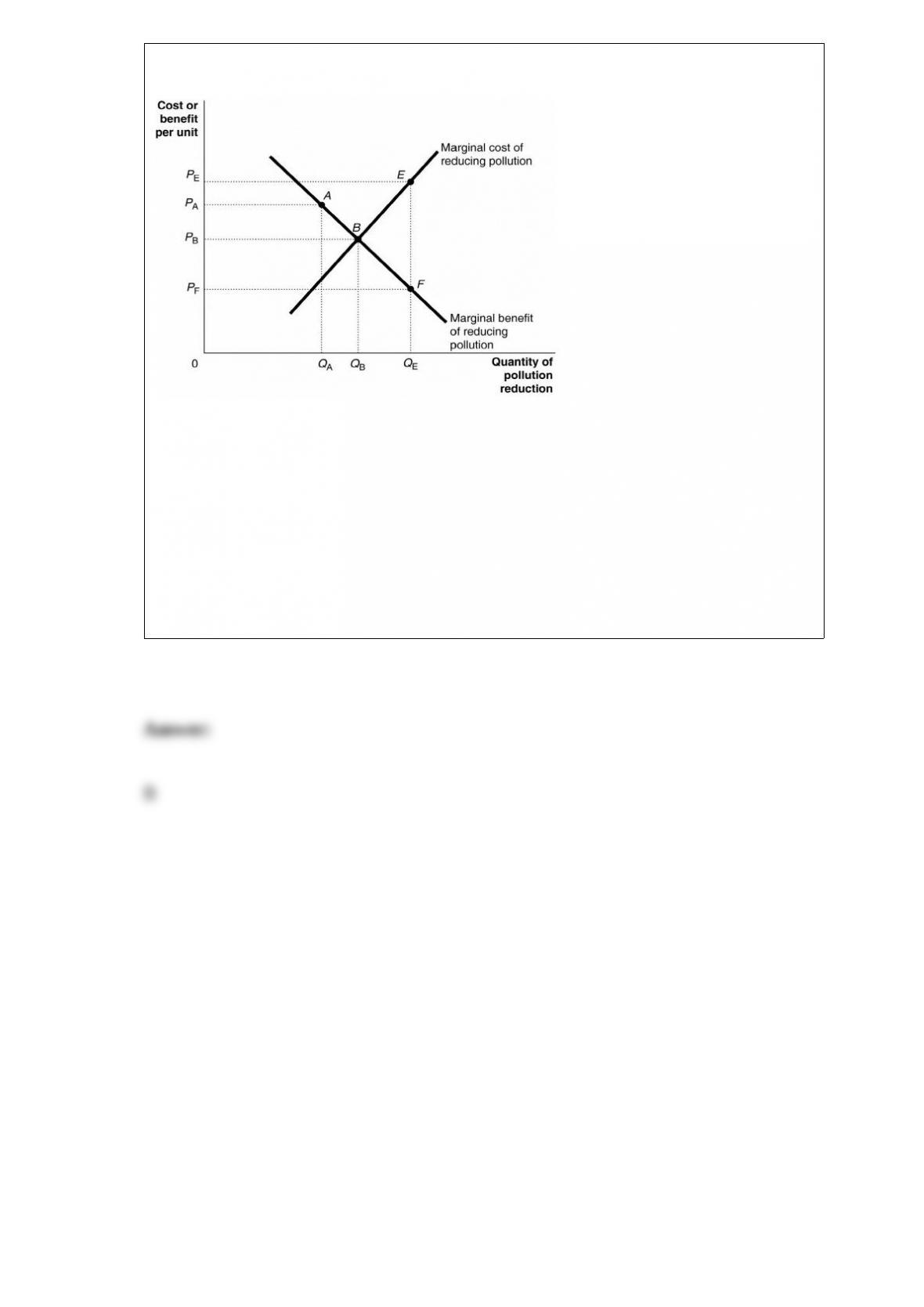
Figure 5-7
The marginal benefit of reducing pollution curve is the same curve as
A) the supply of pollution reduction curve.
B) the demand for pollution reduction curve.
C) the positive externality curve.
D) the external benefit curve.