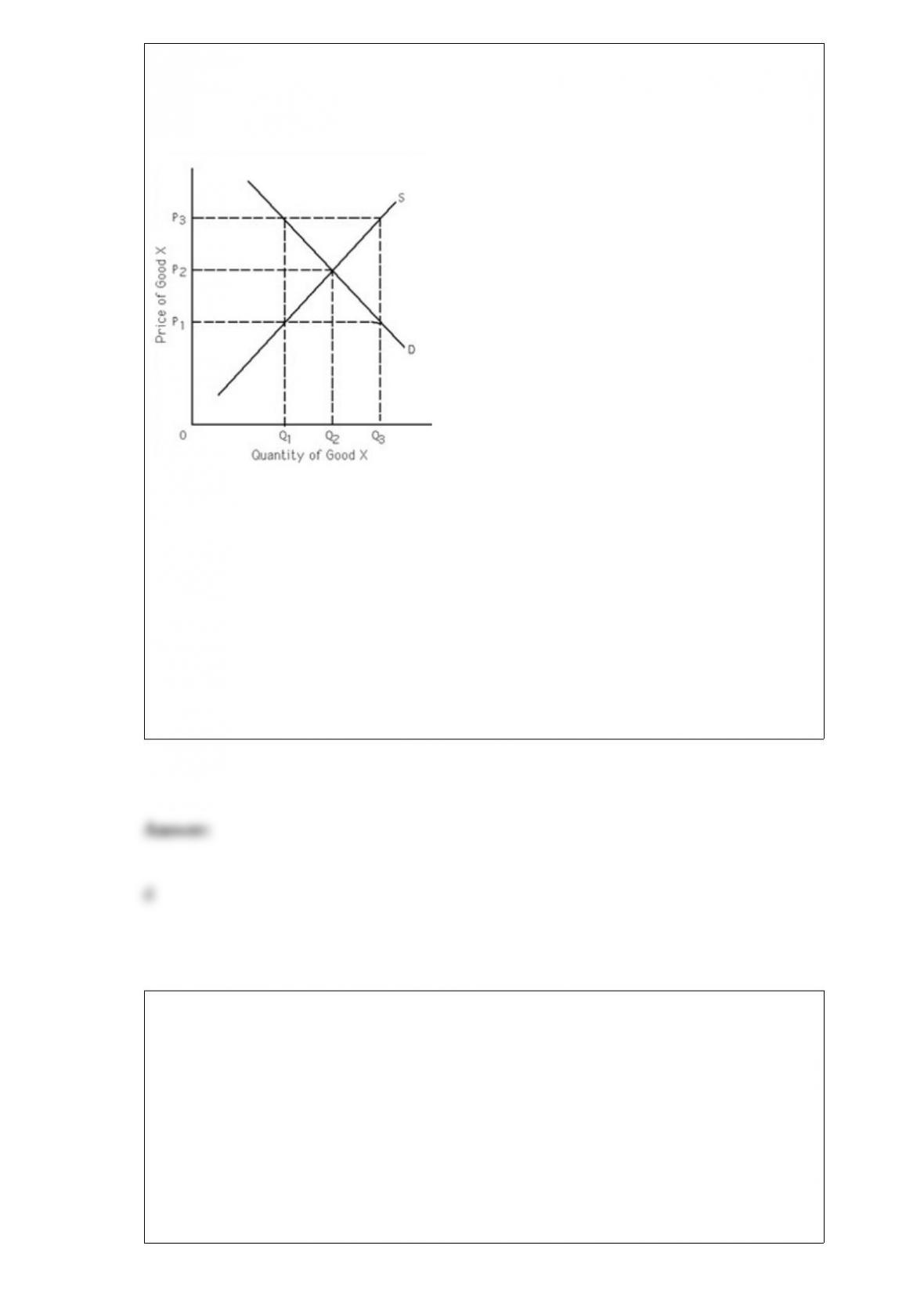
Refer to Exhibit 4-3. If P1 is a price ceiling, the highest price for good Y, which is tied
(a tie-in sale) to good X, is
Exhibit 4-3
a. P1.
b. P2.
c. P3.
d. P3 – P1.
e. P1 + P2.
A good is rivalrous in consumption if
a. its consumption by one person reduces its consumption by others.
b. it can be used to satisfy many needs (as compared to just one need).
c. it can be used to satisfy many wants (as compared to just one want).
d. its consumption by one person increases its consumption by others.

e. a and c
To economists, utility means
a. marginal value.
b. relative value.
c. satisfaction.
d. usefulness.
e. a, c, and d
Consumer equilibrium occurs at the point where the slope of the budget constraint is
equal to the slope of the indifference curve.
a. True
b. False

You turn to the bond market page of a newspaper and look under the column headed
“Bonds” and see that it says, “Gemco 5 3/4 13” this indicates that
a. the coupon rate on this bond is 5.75 percent.
b. this bond will mature 13 years from the date that it was first issued.
c. the current yield on this bond is 5.75 percent.
d. a and b
e. all of the above
Proponents of the fixed exchange rate system argue that
a. flexible exchange rates may promote international trade, but under a fixed exchange
rate system at least we know what the rates will be from day to day.
b. under a flexible exchange rate system, there is too great a chance that the exchange
rate will diverge from the equilibrium exchange rate.
c. under a flexible exchange rate system, there is no way of knowing what the exchange
rate is at any particular point in time.
d. under a fixed exchange rate system, there would be only one currency.
e. none of the above

Refer to Exhibit 2-8. Who has the comparative advantage in the production of good Y?
Exhibit 2-8
a. Maria
b. Maya
c. Both Maria and Maya
d. Neither Maria nor Maya
The capture theory of regulation holds that
a. regulators try to capture as much “profit” (for themselves) from the regulatory
process as possible.
b. the special interests that are being regulated will eventually capture and control the
regulatory body that “regulates” them.
c. the public usually captures the regulatory body and makes it do what it wants.
d. the courts usually capture the regulatory body and force it to do what is in the
public’s best interest.
e. none of the above
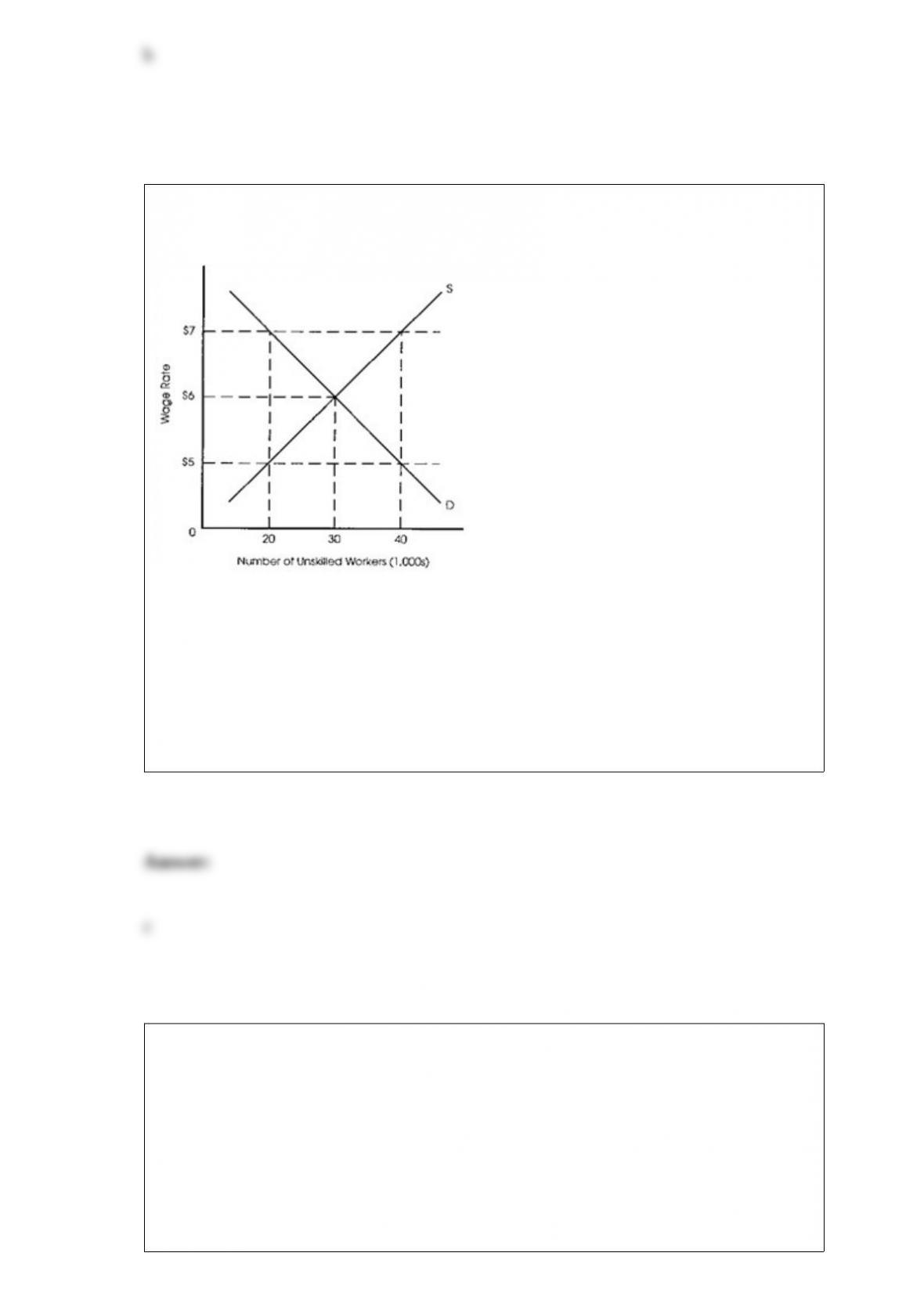
Refer to Exhibit 4-6. Suppose the minimum wage is set at $5. The result will be
Exhibit 4-6
a. unemployment.
b. a shortage of unskilled labor.
c. no impact on the unskilled labor market.
d. a prolonged surplus of unskilled labor.
e. none of the above
Suppose you could quantify the amount of satisfaction you receive from consuming ice
cream in money terms. You might say, “I expect to get $3 worth of satisfaction from this
ice cream cone.” According to traditional economic theory, if the price of this ice cream
cone were $3.25, would you buy one?
a. Ye, since the marginal benefit from consuming the ice cream cone is greater than the
marginal cost.
b. Yes, since the marginal cost of consuming the ice cream cone is greater than the

marginal benefit.
c. No, since the marginal cost of consuming the ice cream cone is greater than the
marginal benefit.
d. No, since the marginal benefit from consuming the ice cream cone is greater than the
marginal cost.
In a monopsony model of the labor market, the firm finds that (over a range) as more
workers are hired, the wage rate
a. increases.
b. decreases.
c. remains constant.
d. remains identical to the marginal factor cost per worker.
e. b and d
Keisha can produce the following combinations of X and Y: 100X and 20Y, 50X and
30Y, or 0X and 40Y. The opportunity cost of one unit of Y for Keisha is
a. 5 units of X.
b. 0.2 units of X.
c. 3 units of X.
d. 1/2 unit of X.
e. none of the above
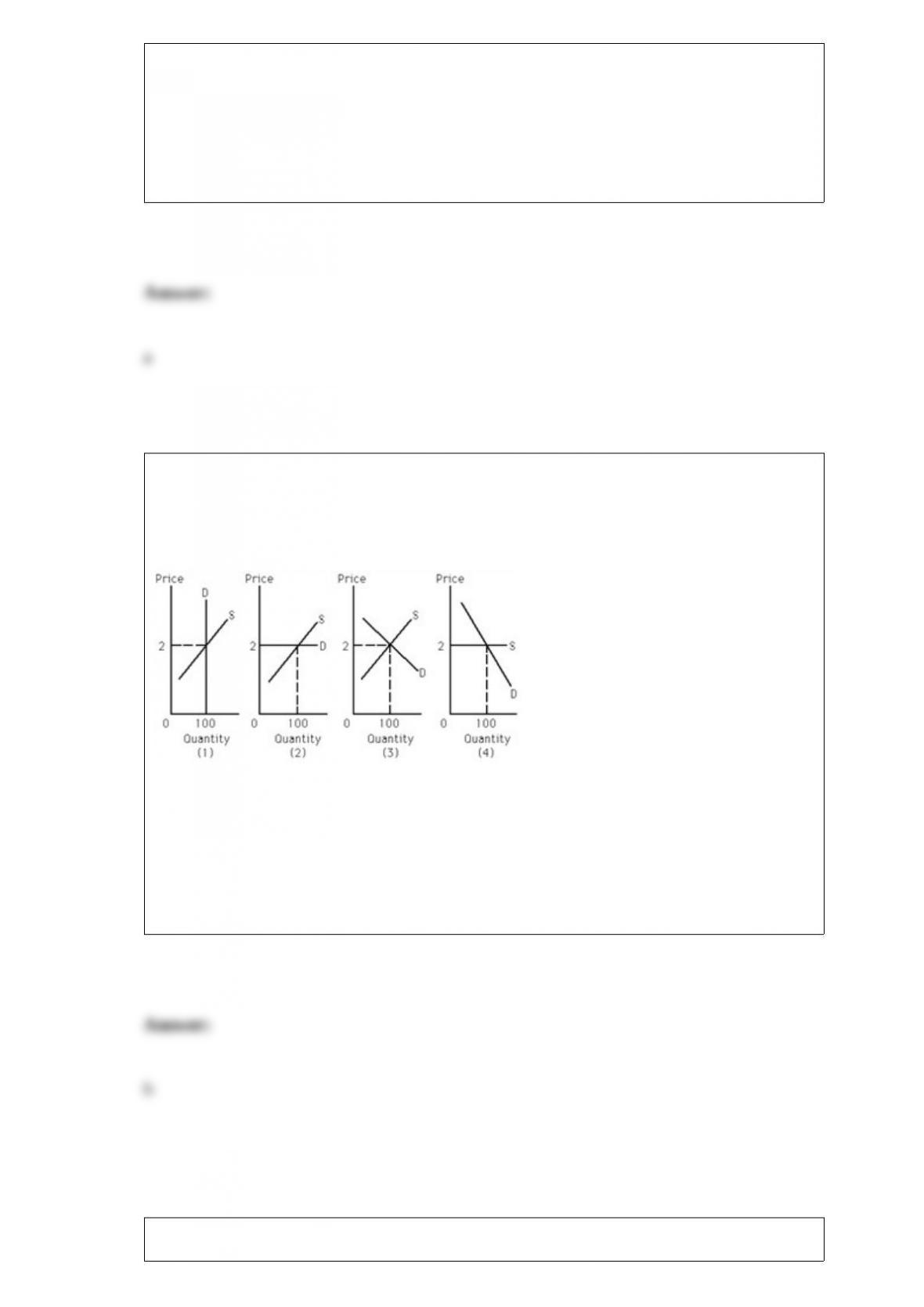
Refer to Exhibit 20-7. If the government is contemplating imposing a per-unit tax and it
wants the tax to have as small a negative effect on consumers as possible, it should
choose a good for which the market is depicted on graph
Exhibit 20-7
a. (1).
b. (2).
c. (3).
d. (4).
A fixed input, X, and a variable input, Y, are used to produce good A. If the marginal

physical product (MPP) of Y is constant, it follows that the
a. marginal cost curve is upward sloping.
b. total fixed cost curve is vertical.
c. total variable cost curve is downward sloping.
d. b and c
e. none of the above
If a monopoly firm produces the quantity of output at which MR = MC, and charges a
price greater than average total cost, it necessarily
a. minimizes the difference between total fixed cost and total variable.
b. maximizes the difference between total fixed cost and total variable cost.
c. maximizes total revenue.
d. earns profit.
e. a, b, and d
Which of the following statements about a political campaign is false?

a. Candidates often label their opponents as either “too far right” or “too far left.”
b. Candidates often call themselves “middle-of-the-roaders” rather than “right-wingers”
or “left-wingers.”
c. Candidates often tend to talk about ends rather than means.
d. Candidates often tend to talk in specific terms rather than general terms about what
needs to be done.
An option is a contract that always
a. gives the owner the right, but not the obligation, to buy shares of a stock at a
specified price within the time limits of the contract.
b. gives the owner the right, but not the obligation, to sell shares of a stock at a
specified price within the time limits of the contract.
c. states that the seller agrees to provide a particular good to the buyer on a specified
future date at an agreed-upon price.
d. gives the owner the right, but not the obligation, to buy or sell shares of a stock at a
specified price within the time limits of the contract.
Special interest groups are subsets of the general population that
a. attempt to influence government officials for the benefit of the general population.
b. choose to be rationally ignorant because they are interested only in things that the
government is not concerned with.

c. are on the fringes of the political spectrum.
d. a and c
e. none of the above
Public choice theorists assert that persons who change jobs from, say, a government
position to a business position, sometimes alter their work behavior and attitudes
because
a. they want to fit in and be liked by their fellow workers.
b. they are acting rationally by weighing the costs and benefits of certain behavior in
different work settings.
c. they feel that if they change jobs, they should also change their behavior.
d. their new boss tells them it is in their best interest.
A monopolist is a _______________ and a monopolistic competitor is
______________________.
a. price searcher; also a price searcher
b. price taker; a price searcher
c. price taker; also a price taker
d. price searcher; a price taker

The type of regulatory pricing (of a natural monopoly firm) that is consistent with
resource-allocative efficiency is __________ cost pricing.
a. average
b. sunk
c. marginal
d. fixed
e. none of the above
Suppose Alice receives 200 utils from consuming one hamburger and 80 utils from
consuming a second hamburger. What is the marginal utility of the second hamburger?
a. 280 utils
b. 120 utils
c. 80 utils
d. 0 utils
e. none of the above
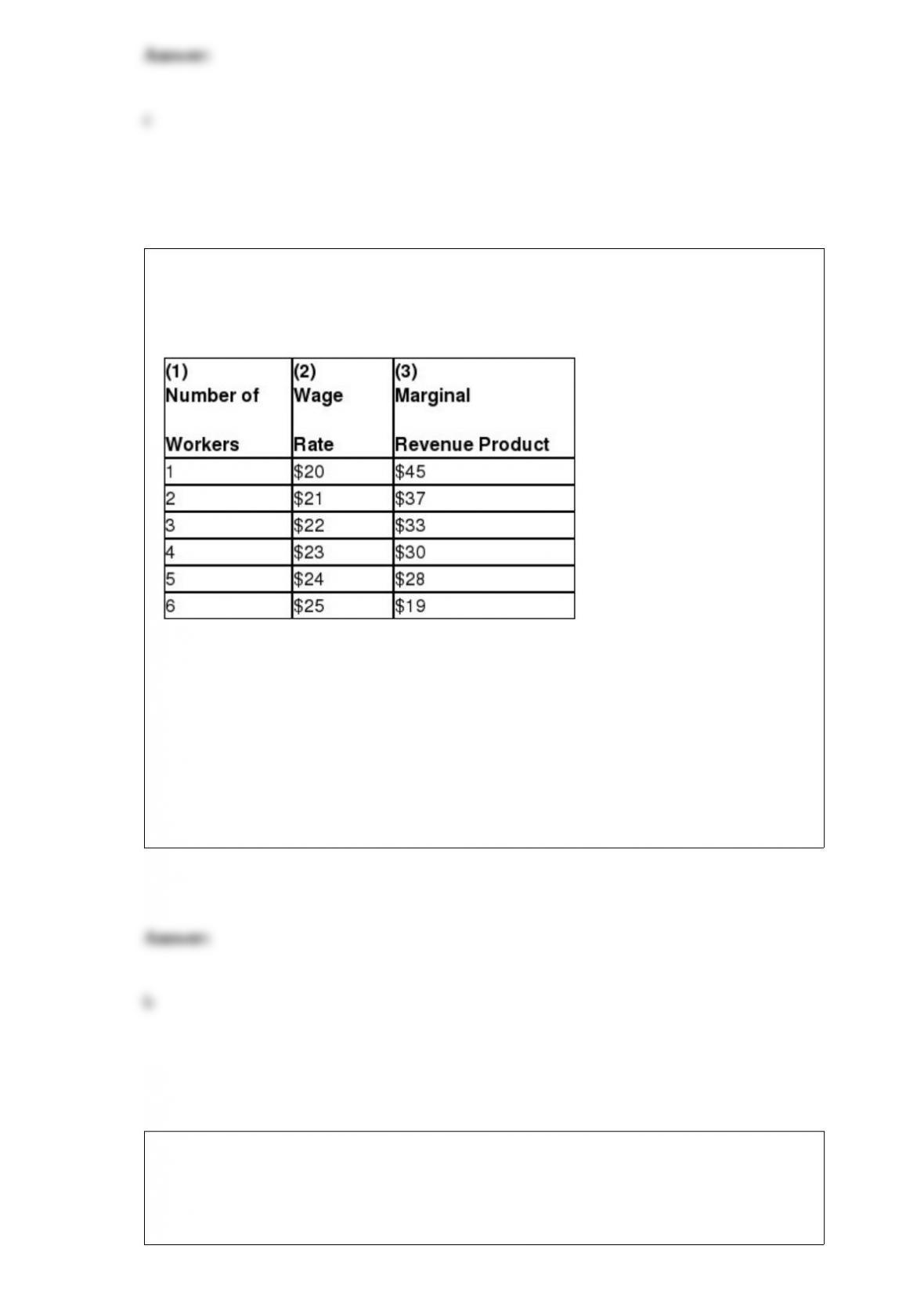
Refer to Exhibit 28-12. For each quantity of labor hired (after the first worker),
marginal factor cost will be
Exhibit 28-12
a. less than the corresponding amount in column (2).
b. greater than the corresponding amount in column (2).
c. less than the corresponding amount in column (3).
d. greater than the corresponding amount in column (3).
e. b and d
The cross elasticity of demand coefficient between Coca-Cola and Pepsi Cola would be
expected to be negative.
a. True

b. False