One reason why firms would choose a salary system rather than a commission
compensation system is that their employees might become less concerned about the
quality of their work.
Joe Santos owns the only pizza parlor in a small town that is also home to a
McDonald’s, a Taco Bell and a Kentucky Fried Chicken. Using a broad definition of a
monopoly, Joe has a monopoly.
A quasi-public good differs from a public good in that unlike a public good, it is
possible to keep out those who do not pay for the quasi-public good from enjoying the
benefits of the good.
The main goal of monetary policy for recent Fed Chairmen has been to maintain high
employment in labor markets.
If a country is producing efficiently and is on the production possibilities frontier, the
only way to produce more of one good is to produce less of the other.
The income effect of a wage decrease examines the effect of the decrease in wage
income on a worker’s ability to purchase goods and services.
Figure 27-6
In the dynamic model of AD–AS in the figure above, if the economy is at point A in year
1 and is expected to go to point B in year 2, and no fiscal or monetary policy is pursued,
then at point B
A) the unemployment rate is very low.
B) firms are operating at below capacity.
C) the economy is below full employment.
D) income and profits are falling.
E) there is pressure on wages and prices to fall.

Between 1980 and 2011, income inequality in the United States has increased in part
due to expanding international trade. How does expanding international trade contribute
to income inequality?
A) It increases the demand for a wide array of products which in turn increases prices
beyond the reach of average income individuals.
B) It allows producers to exploit workers and reduce the wages they are willing to pay
workers.
C) Domestic firms can now hire low-skilled workers anywhere in the world, putting
U.S. workers in competition with foreign workers. This has caused the wages of
unskilled workers to be depressed relative to the wages of other workers.
D) It reduces the cost of producing goods and therefore lowers the value of labor’s
services.
By offering training to workers whose firms laid them off because of competition from
foreign firms, the federal government is attempting to reduce
A) frictional unemployment.
B) structural unemployment.
C) cyclical unemployment.
D) seasonal unemployment.
E) unnatural unemployment.

The idea that because of scarcity, producing more of one good or service means
producing less of another good or service refers to the economic concept of
A) optimization.
B) efficiency.
C) trade-off.
D) equity.
Figure 16-5
Suppose the firm represented in the diagram decides to use a two-part pricing strategy
such that it charges a fixed fee and a per-unit price equal to the monopoly price. What is
the profitearned under this pricing scheme?
A) $5,760
B) $6,400
C) $7,680
D) $7,870

Maurice Allais, Reinhard Selten and Vernon Smith all were awarded the Nobel Prize in
Economics in part because
A) of their work with experimental economics.
B) they discovered the first example of a Giffen good.
C) of their work on the substitution and income effects of price changes.
D) they proved that external economies would lead to market failure.
An increase in capital inflows will
A) increase net foreign investment.
B) increase capital outflows.
C) decrease capital outflows.
D) increase the value of the domestic currency.
Health problems prevent people from working harder, which can lower a country’s total
income. This indicates that in effect, health problems
A) are a primary cause of price decreases.
B) increase the incentive to work.
C) shift country’s production possibilities frontier inward.
D) decrease consumer surplus.
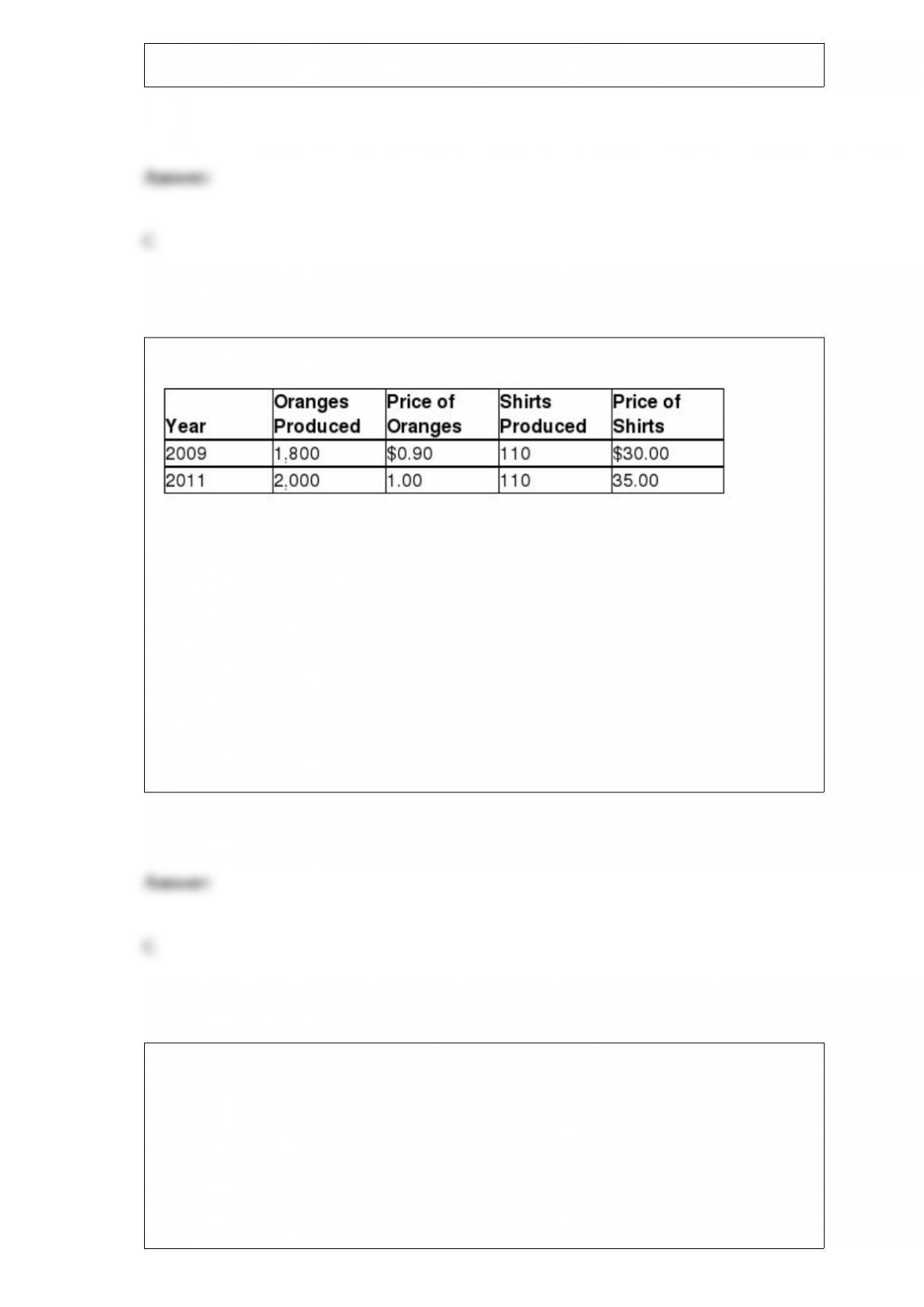
Table 8-13
Consider the data shown above for Vicuna, a country that produces only two products:
oranges and shirts.
Real GDP for Vicuna for 2009 using 2011 as the base year equals
A) $4,620.
B) $5,100.
C) $5,650.
D) $5,850.
Which of the following is part of an economic model?
A) preferences of economic agents
B) data
C) norms

D) opinions
The nominal GDP of the U.S. in 2012 was approximately $16.2 trillion. This means that
A) the value of output in 2012 was around $16.2 trillion.
B) total income in 2012 was around $16.2 trillion.
C) total spending in 2012 was around $16.2 trillion.
D) all of the above are true.
If the economy is growing beyond potential real GDP, which of the following would be
an appropriate fiscal policy to bring the economy back to long-run aggregate supply?
An increase in
A) the money supply and a decrease in interest rates.
B) government purchases.
C) oil prices.
D) taxes.
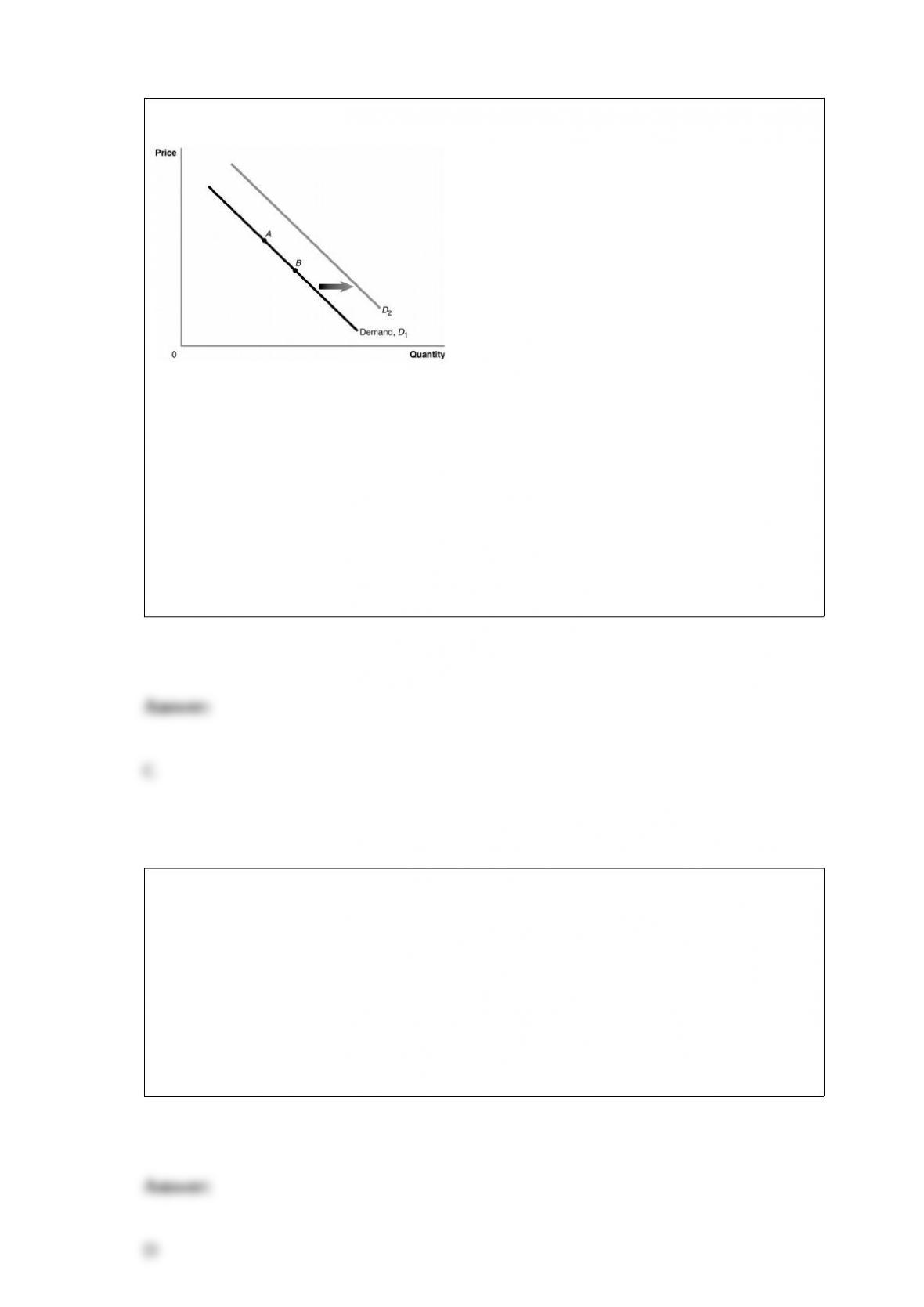
Figure 3-1
An increase in population would be represented by a movement from
A) A to B.
B) B to A.
C) D1 to D2.
D) D2 to D1.
Which of the following firms is not able to practice price discrimination?
A) movie theaters
B) commercial airlines
C) land-line telephone companies
D) the largest wheat farmer in Nebraska

Which of the following correctly describes how an increase in the price level affects
consumption spending?
A) An increase in the price level raises real wealth, which causes consumption to
increase.
B) An increase in the price level decreases the amount of money a household needs to
buy goods and raises the interest rate, which causes consumption to increase.
C) An increase in the price level increases the amount of money a household needs to
buy goods and raises the interest rate, which causes consumption to increase.
D) An increase in the price level lowers real wealth, which causes consumption to
decrease.
The ________ production points on a production possibility curve are the points along
and inside the production possibility frontier.
A) attainable
B) unattainable
C) productively efficient
D) allocatively efficient
Explain the difference between Gross Domestic Product and Gross National Product.
Give an example of each.
Does expansionary fiscal policy directly increase the money supply? Isn’t it true that the
president and Congress fight recessions by spending more money?
What is marginal benefit? Which curve is also referred to as a marginal benefit curve?
When the price of Starbucks coffee increased by 8 percent, the quantity demanded of
Peets coffee increased by 10 percent. Calculate the cross price elasticity of demand
between Starbucks coffee and Peets coffee. What is the relationship between the two
products?
If the exchange rate between the Mexican peso and the U.S. dollar expressed in terms
of pesos per dollar is 13.5 pesos = 1 dollar, what is the exchange rate when expresses in
terms of dollars per peso?
What are the key factors that determine the profitability of a firm in a monopolistically
competitive market?
Is nominal GDP measured in terms of quantity or in terms of dollars? If dollars, the
value of the dollar from what period? Is real GDP measured in terms of quantity or in
terms of dollars? If dollars, the value of the dollar from what period?
What is the difference between explicit costs and implicit costs? List three examples
each of explicit costs and implicit costs that may be experienced by a small business.