A Bank has excess reserves if the actual reserves that the bank holds is less than the
required reserves.
A decrease in population would shift the demand curve to the left.
Money solves the problem of double coincidence of wants that would regularly occur
under a system of credit.
If a central bank is not credible in its task of fighting inflation, private expectations of
higher inflation will likely develop.
The larger the market, the higher the costs of technological progress.
When developing classical models, there is an assumption that wages and prices will
remain fixed relative to changes in supply and demand.
The federal government ran a budget deficit of approximately $1.3 trillion in 2010.
If the Fed wants to decrease the supply of money, it can reduce the required reserve
ratio.

The multiplier-accelerator model ultimately shows that:
A) a decrease in investment will cause not cause a drop in GDP.
B) a decrease in investment will cause GDP to rise by a larger proportion than what the
multiplier will suggest.
C) a decrease in investment will cause a drop in GDP by a larger proportion than what
the multiplier will suggest.
D) a decrease in investment will cause a drop in GDP by a smaller proportion than what
the multiplier will suggest.
In addition to lowering the discount rate to increase the money supply, the Fed could
also
A) purchase bonds on the open market and raise reserve requirements.
B) sell bonds on the open market and raise reserve requirements.
C) purchase bonds on the open market and lower reserve requirements.
D) sell bonds on the open market and lower reserve requirements.
Recall the Application about the government of Mexico City repainting highway
lane lines to transform a 4-lane highway into a 6-lane highway to answer the
following question. When the government converted the highway from 4 lanes into 6
lanes, they claimed the capacity had increased by 50 percent. When the government
switched the highway back from 6 lanes to 4 lanes, they claimed the capacity had been
decreased by 33 percent. Had the government used the midpoint method, the percentage

increase would have been ________ percent and the percentage decrease would have
been ________ percent.
A) 33; 50
B) 33; 33
C) 40; 40
D) 50; 50
If a country uses trade deficits to finance consumption, then the country will
experience:
A) no capital deepening.
B) a smaller portion of GDP in the future used for capital deepening.
C) a decline in real GDP per capita in the future.
D) All of the above are correct.
Which of the following is not included in the current account?
A) exports of goods
B) export of services
C) investment income from abroad

D) statistical discrepancy
The economic reason why some individuals choose keep their tuition money and not to
go to school is:
A) they believe the value of education is higher than the tuition costs.
B) the marginal cost of education is zero.
C) the marginal benefit of money is zero.
D) they believe the value of education is lower than the tuition costs.
Suppose that a technological advancement substantially reduces the cost of laser eye
surgery. This would cause the equilibrium
A) price of technology to increase.
B) quantity of technology to decrease.
C) quantity of laser eye surgery to increase.
D) quantity of laser eye surgery to decrease.

The rule in investing is that you should invest in a project as long as:
A) the inflation rate is lower than the real interest rate.
B) the future payments for the project is less than or equal to the present value of the
cost you incur today.
C) the economic cost you incur today is less than or equal to the present value of the
future payments for the project.
D) the real interest rate is higher than the nominal interest rate.
As compared to the estimates of the natural rate of unemployment for the United States,
those for Europe are
A) the same.
B) higher.
C) lower.
D) higher and more variable.
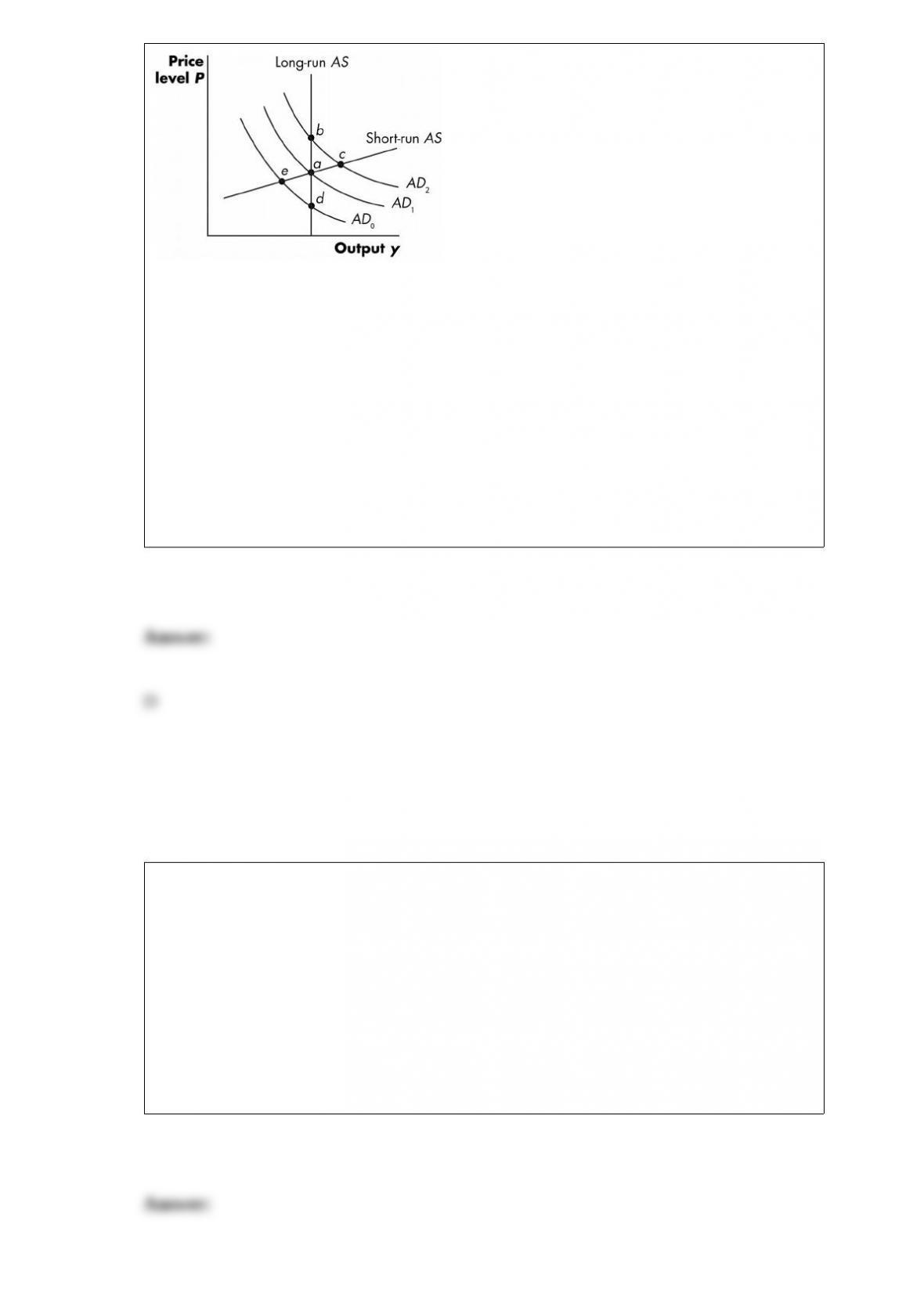
Figure 15.4
Refer to Figure 15.4. Suppose that the economy is originally in equilibrium at point a.
In the long run, as the supply of money decreases, the economy moves to point
A) a.
B) .
C) c.
D) d.
An individual or country that has a comparative advantage in the production of one
good
A) must have an absolute advantage in the good’s production.
B) must not have an absolute advantage in the good’s production.
C) may or may not have an absolute advantage in the good’s production.
D) must not have an absolute advantage in the production of the other good.

Recall Application 4, “Securitization: the Good, the Bad, and the Ugly,” to answer the
following questions:
According to the Application, most of the economy’s financial woes can be traced back
to a new innovation called:
A) securitization.
B) open market operations.
C) Fannie Mae.
D) Freddie Mac.
If the supply of labor ________, real wages fall and the amount of labor employed
________.
A) increases; increases
B) increases; decreases
C) decreases; increases
D) decreases; decreases

The largest cost associated with unanticipated inflation is:
A) the distortion of our tax system.
B) the menu cost.
C) the shoe-leather cost.
D) the arbitrary redistribution of income and wealth.
The multiplier for government spending can be calculated using which formula?
A) 1/(1-MPC)
B) -MPC/(1-MPC)
C) 1/MPC
D) (1-MPC)/MPC
The rate of interest charged to commercial banks by the Fed for loans is called the
________ rate.
A) federal funds
B) discount
C) prime
D) commercial paper

Suppose the exchange rate between the United States and Russia changed from $1 = 5
rubles to $1 = 4 rubles, which of the following statements is true?
A) The dollar depreciated.
B) The ruble depreciated.
C) The price of rubles in dollars decreased.
D) The dollar appreciated.
During World War II before there was trade among camps, items not consumed by the
majority of the camp (such as coffee in British camps and beef in Sikh camps) were:
A) more expensive than in other camps.
B) scarcer than in other camps.
C) cheaper than in other camps.
D) not provided to the prisoners.
An increase in consumer confidence will
A) not change autonomous consumption and rotate the consumption function upward.
B) not change autonomous consumption and rotate the consumption function
downward.
C) increase autonomous consumption and shift the consumption function upward.
D) decrease autonomous consumption and shift the consumption function downward.
To specify terms of exchange and facilitate exchange between strangers, a ________ is
often used.
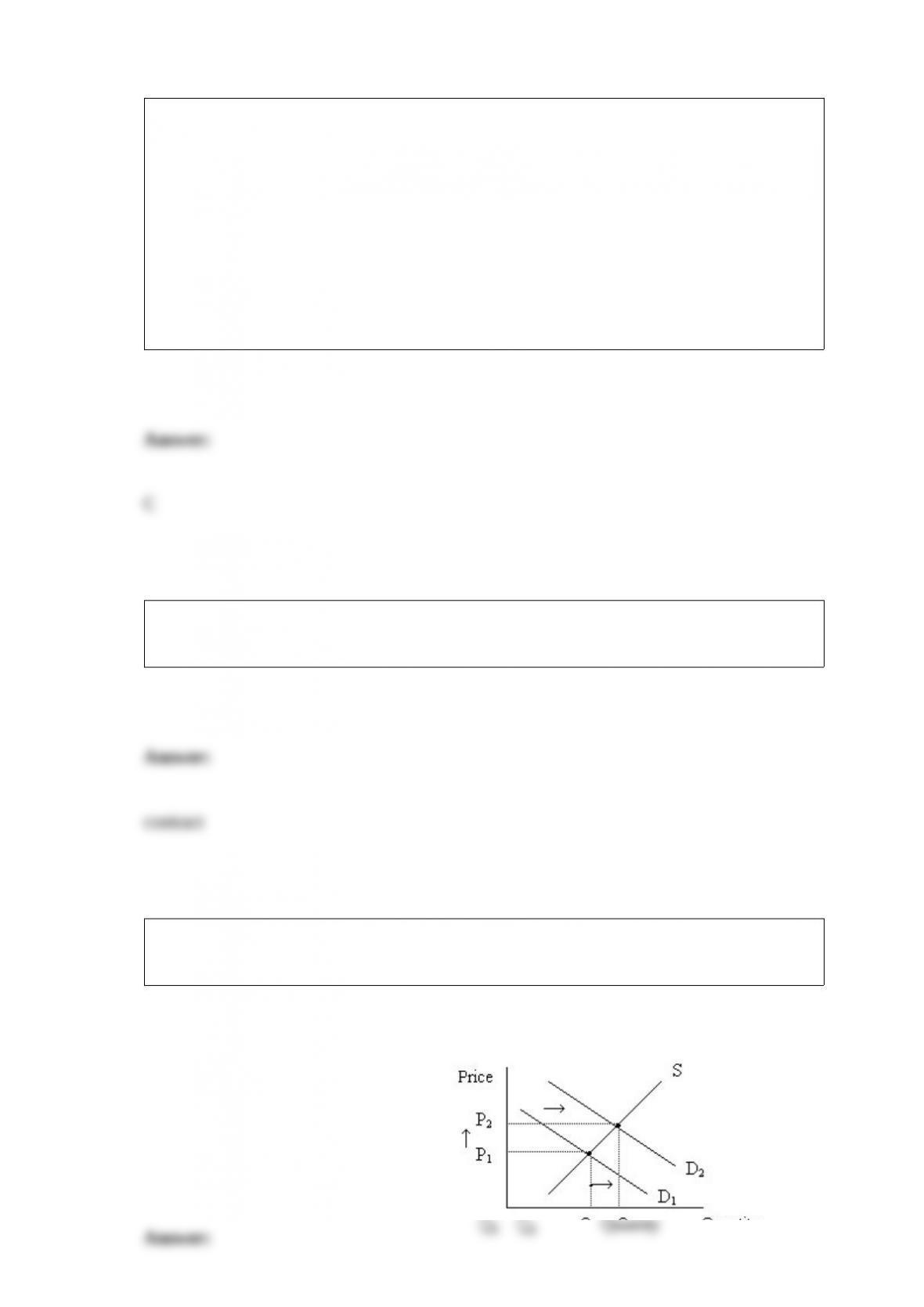
Draw a graph to illustrate the effect of an increase in demand on the price and quantity
in a market.
What are the three tools that the Federal Reserve uses to alter the money supply?
Explain how each can be used to increase the money supply.
In the Solow Model, will a country always enjoy economic growth through capital
deepening?
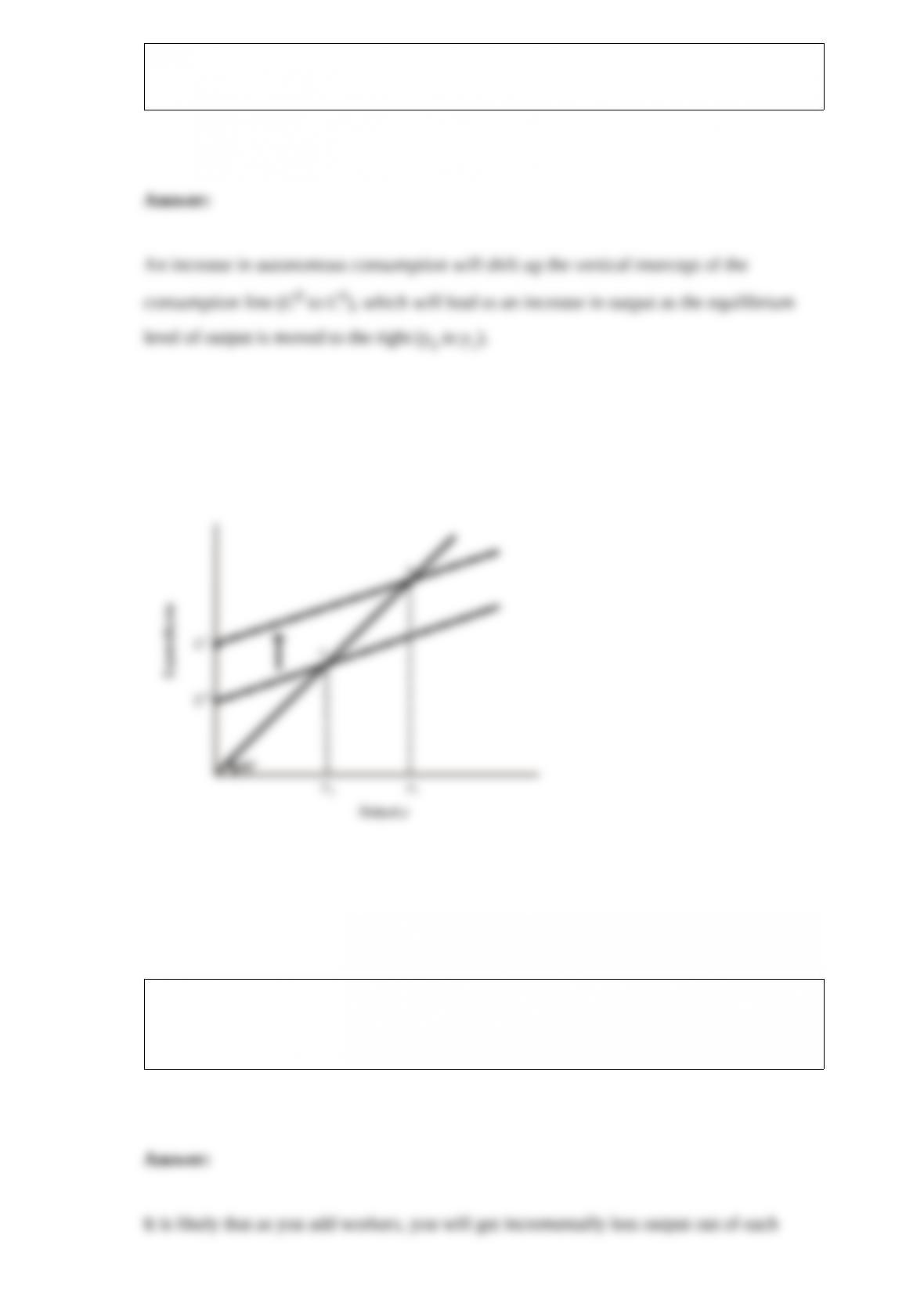
Suppose autonomous consumption increases. Explain how this event will lead to a rise
in equilibrium output, and illustrate using a graph of the income-expenditure model.
You are running a small yard maintenance business for the summer. What do you
expect to happen to the number of yards you can maintain in a day as you add workers
if you don’t purchase more capital equipment (like mowers and leaf blowers)?
Identify markets in which there is an exchange.