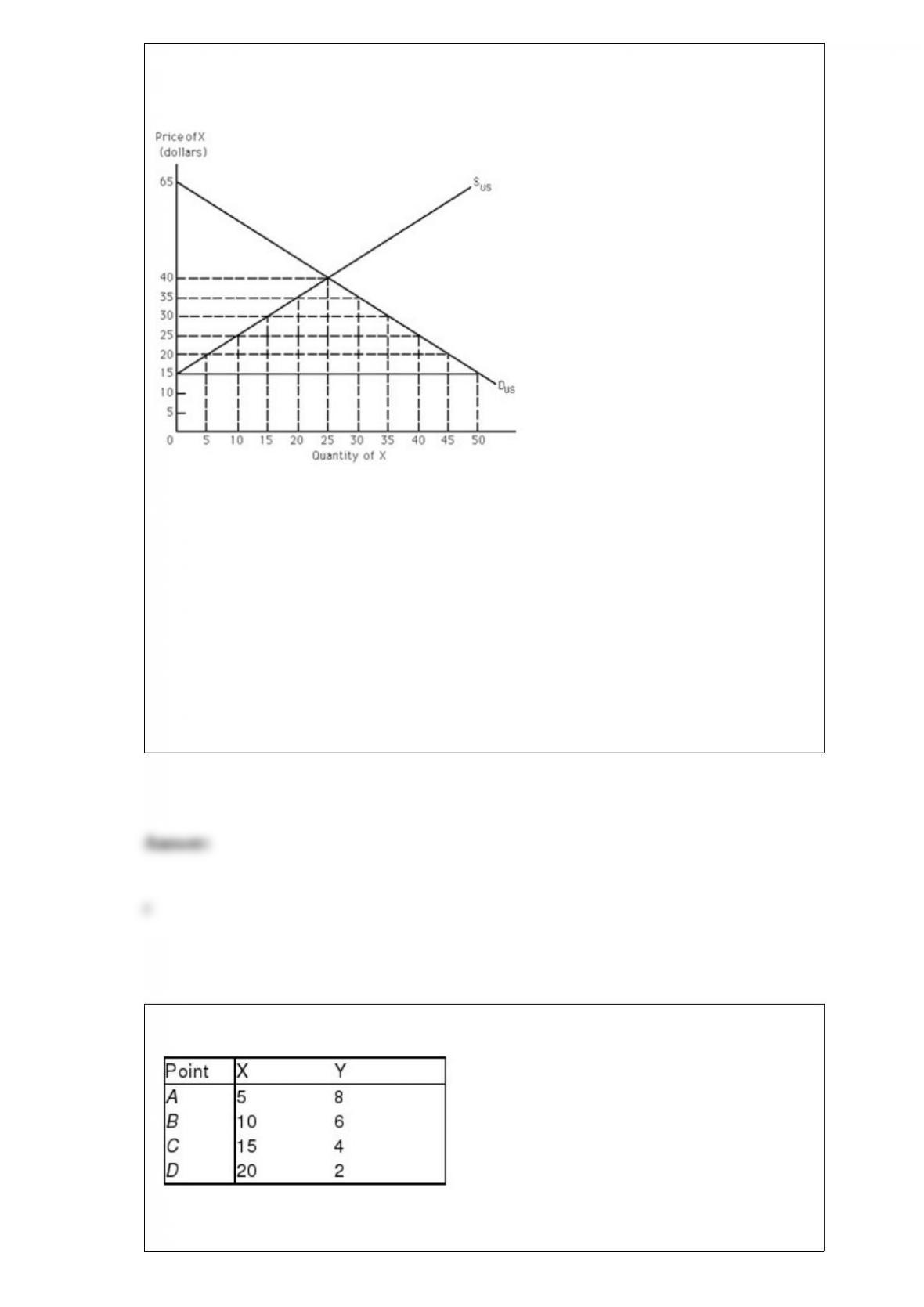
Exhibit 34-7
Assume that the current price of good X is $25 (which includes a $10 tariff on imports
of good X).Americans purchase ______ units of good X from U.S. producers and
import _______ units of good X from abroad.
a. 0; 50
b. 20; 25
c. 10; 30
d. 10; 40
Exhibit 1-3
According to the data provided in this table, what is the slope of the line between points
A and B, if these data were graphed with X on the horizontal axis and Y on the vertical

axis?
a. -0.40
b. -2.50
c. 0.40
d. 2.50
e. none of the above
The marginal cost curve passes through the __________ curve at its lowest point.
a. average variable cost
b. average total cost
c. average fixed cost
d. a and b
e. a, b, and c
Exhibit 4-7
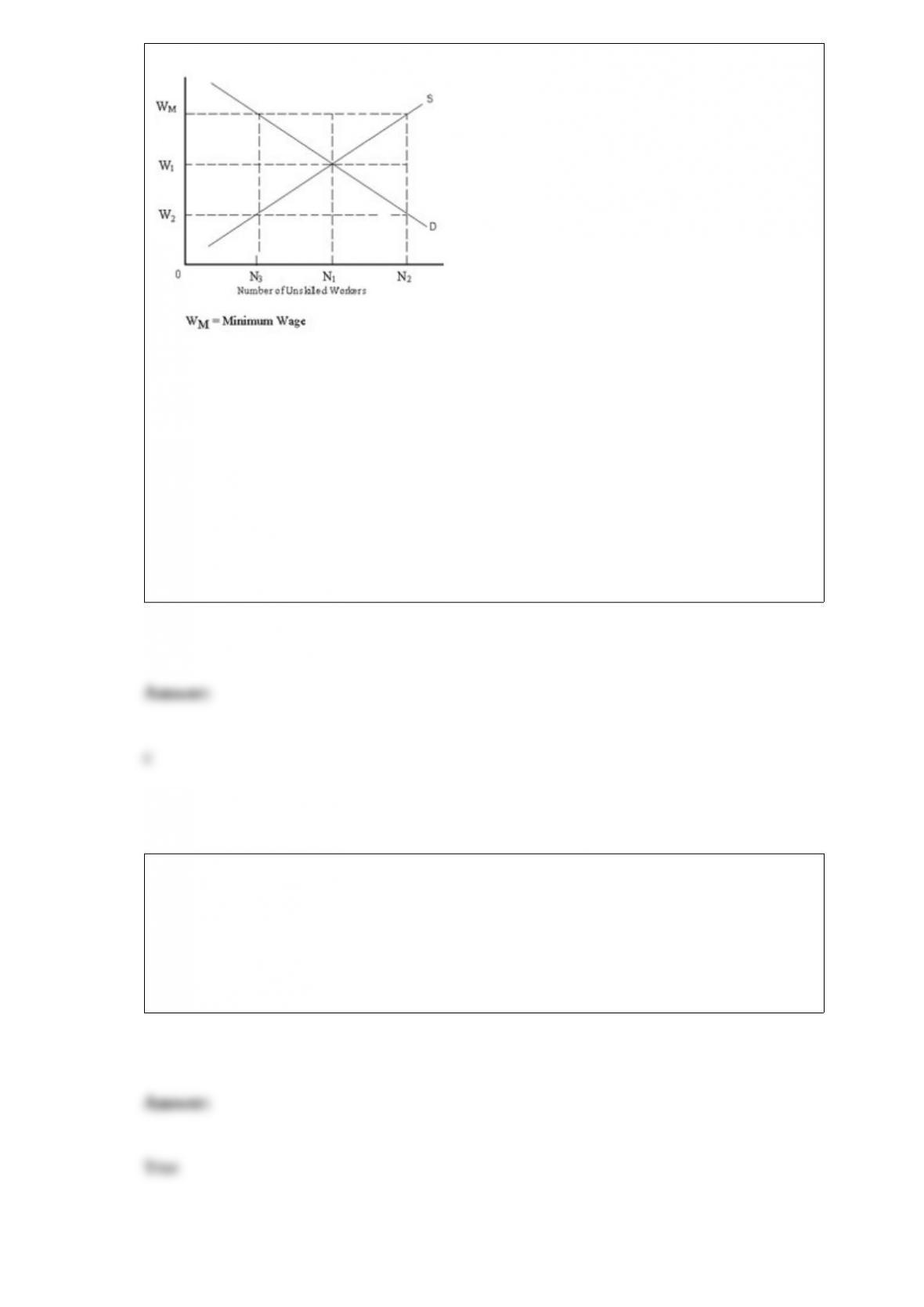
How many unskilled workers do firms want to employ at the minimum wage?
a. N2
b. N1
c. N3
d. N1 + N3
It is possible for everyone to be better off (in absolute terms) even though the income
distribution has become more unequal.
a. True
b. False
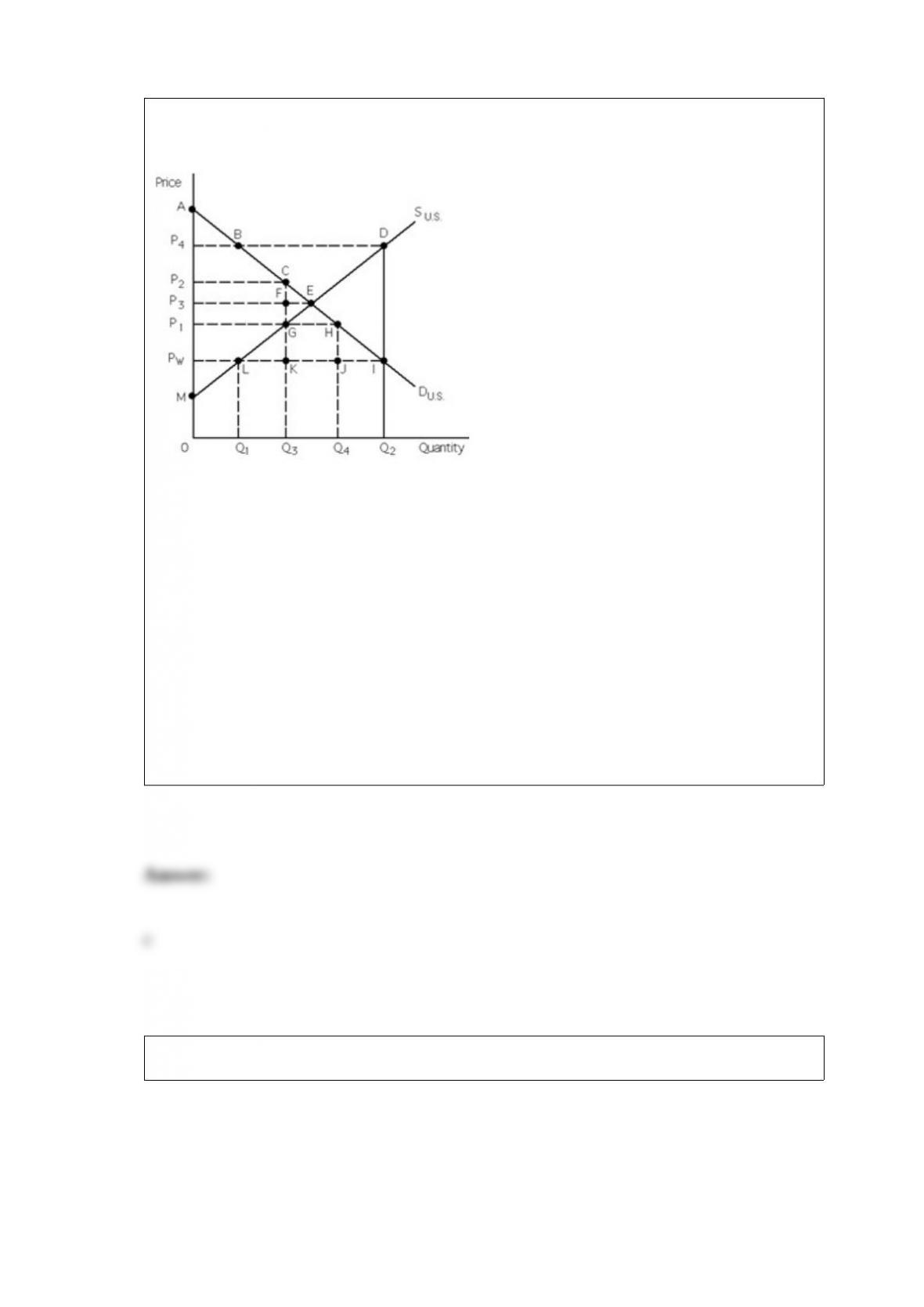
Exhibit 34-12
PW is the price that exists in a free world market. A quota is imposed and imports are
Q4 – Q3. Importers gain revenues equal to the area __________.
a. GKL + HIJ
b. GCE
c. GHJK
d. GFEH
e. none of the above
Exhibit 28-12
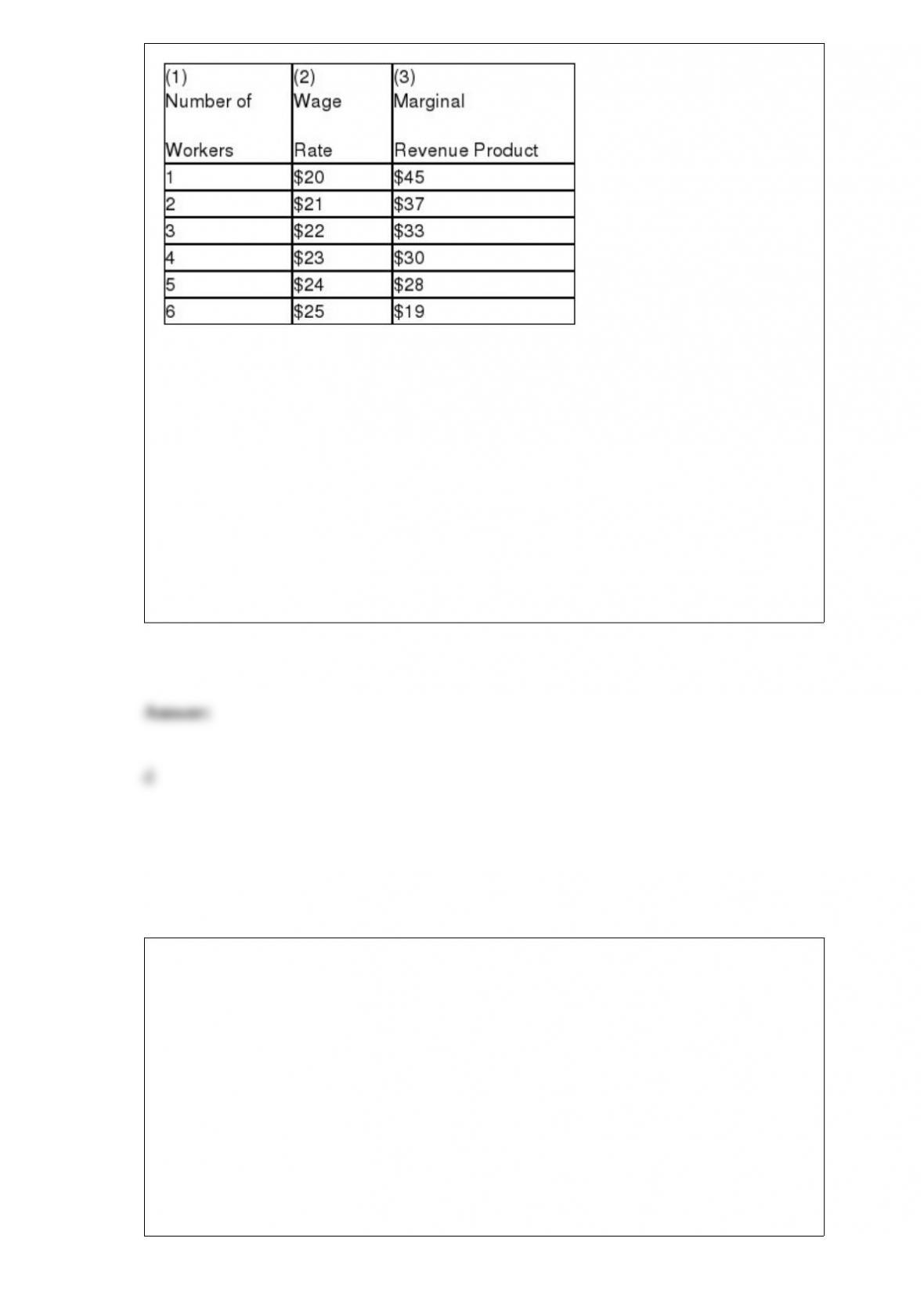
The profit-maximizing number of workers to hire for this firm is
a. 2.
b. 3.
c. 4.
d. 5.
e. 6.
The effect of a drought on the price of an agricultural product will be greater the more
__________ the demand for the agricultural product.
a. price inelastic
b. price elastic
c. income elastic
d. a and c
e. b and c

The English economist who said that grain prices weren’t high because rents were high,
but rents were high because grain prices were high was
a. Adam Smith.
b. Alfred Marshall.
c. David Ricardo.
d. John Maynard Keynes.
e. Joan Robinson.
Which of the following statements is true?
a. When rents are real, competing for them uses resources in a socially unproductive
way.
b. The competition for real rents often increases supply and lowers price.
c. If Firm A is receiving artificial rents and Firm B is receiving real rents, then Firm B is
larger than Firm A.
d. If Firm A is receiving artificial rents and Firm B is receiving real rents, then Firm B
is smaller than Firm A.

On a supply-and-demand diagram, consider a price for which the horizontal distance to
the supply curve is shorter than the horizontal distance to the demand curve. There is a
__________ at that price and the current price must be __________ the equilibrium
price.
a. shortage; above
b. shortage; below
c. surplus; above
d. surplus; below
In most societies, dollar price acts as the main rationing device. If dollar price weren’t
the main rationing device, would there still be a need for some rationing device to take
its place?
a. No, because with dollar price there would be no scarcity, although shortages would
still exist.
b. Yes, because there is a need for a rationing device as long as scarcity exists.
c. Yes, because there is a need for a rationing device as long as the world’s population is
so large.
d. No, because dollar price creates scarcity and without money price scarcity wouldn’t
exist.
e. none of the above

Which of the following statements does not invoke interpersonal utility comparisons?
a. The total utility a millionaire derives from $100 is less than the total utility a poor
person derives from $100.
b. The marginal utility a millionaire derives from the one-millionth dollar is less than
the marginal utility a poor person derives from the one-hundredth dollar.
c. For both the millionaire and the pauper, the marginal utility they derive from the
one-thousandth dollar is less than the marginal utility they derive from the
five-hundredth dollar.
d. None of the above, because all rely on interpersonal utility comparisons.
Which of the following statements is false?
a. If a perfectly competitive firm produces the quantity of output at which MR = MC, it
follows that the firm may or may not be earning a profit.
b. The firm’s supply curve is that portion of its AVC curve that lies above its MC curve.
c. If price is above ATC at the quantity of output at which MR = MC, the firm will be
earning a profit.
d. In long-run competitive equilibrium, price is equal to marginal cost.
The Gini coefficients for countries A and B are 0.25 and 0.30, respectively. We can

definitely conclude that
a. the lowest 20 percent family income groups in A and B receive 25 percent and 30
percent of total income, respectively.
b. the lowest 50 percent family income groups in A and B receive 25 percent and 30
percent of total income, respectively.
c. the lowest 20 percent family income group receives a greater share of total income in
country A than in country B.
d. the lowest 20 percent family income group receives a greater share of total income in
country B than in country A.
e. none of the above
Which of the following is not an assumption of the theory of monopoly?
a. There is one seller.
b. The single seller sells a product for which there are many close substitutes.
c. There are extremely high barriers to entry.
d. b and c
e. a and c
A firm that is a price taker in a factor market faces a(n) __________ supply curve of
factors.

a. upward-sloping
b. horizontal
c. downward-sloping
d. vertical
At a price of $9.99, Danielle buys 3 digital books per month. When the price decreases
to $7.99, Danielle buys 4 digital books per month. Jason says that Danielle’s demand for
digital books has increased. Is Jason correct?
a. Yes, Jason is correct.
b. No, Jason is incorrect. Danielle’s demand has decreased.
c. No, Jason is incorrect. Danielle’s quantity demanded has decreased, but her demand
has stayed the same.
d. No, Jason is incorrect. Danielle’s quantity demanded has increased, but her demand
has stayed the same.
e. No, Jason is incorrect. Danielle’s quantity demanded has increased and her demand
has decreased.