
Scarcity affects everyone, even billionaires.
a. True
b. False
Suppose the government provides peanut butter to everyone free of charge and
everyone consumes it to the point at which he receives no additional satisfaction from
another spoonful. Is this necessarily good?
a. Yes, because everyone is satisfied.
b. No, because there might be some cases where the resources used to produce peanut
butter could have been better used to produce more of other products.
c. Yes, because the law of diminishing marginal utility indicates that in order to get the
greatest amount of satisfaction from the use of resources, people should consume as
much of every good as they can.
d. none of the above
Comparative advantage is the ability to produce a good at a lower opportunity cost than
others.
a. True
b. False

The law of diminishing marginal returns helps to explain why the marginal cost curve
typically has a downward-sloping portion.
a. True
b. False
If Cassandra bought 16 cotton blouses last year when her income was $40,000 and she
buys 14 cotton blouses this year when her income is $35,000, then for Cassandra cotton
blouses are
a. an inferior good.
b. a normal good.
c. a substitute good.
d. a complementary good.
e. There is not enough information to answer this question.
The resource termed labor consists of the physical, but not the mental, talents that
people contribute to the production process.
a. True
b. False
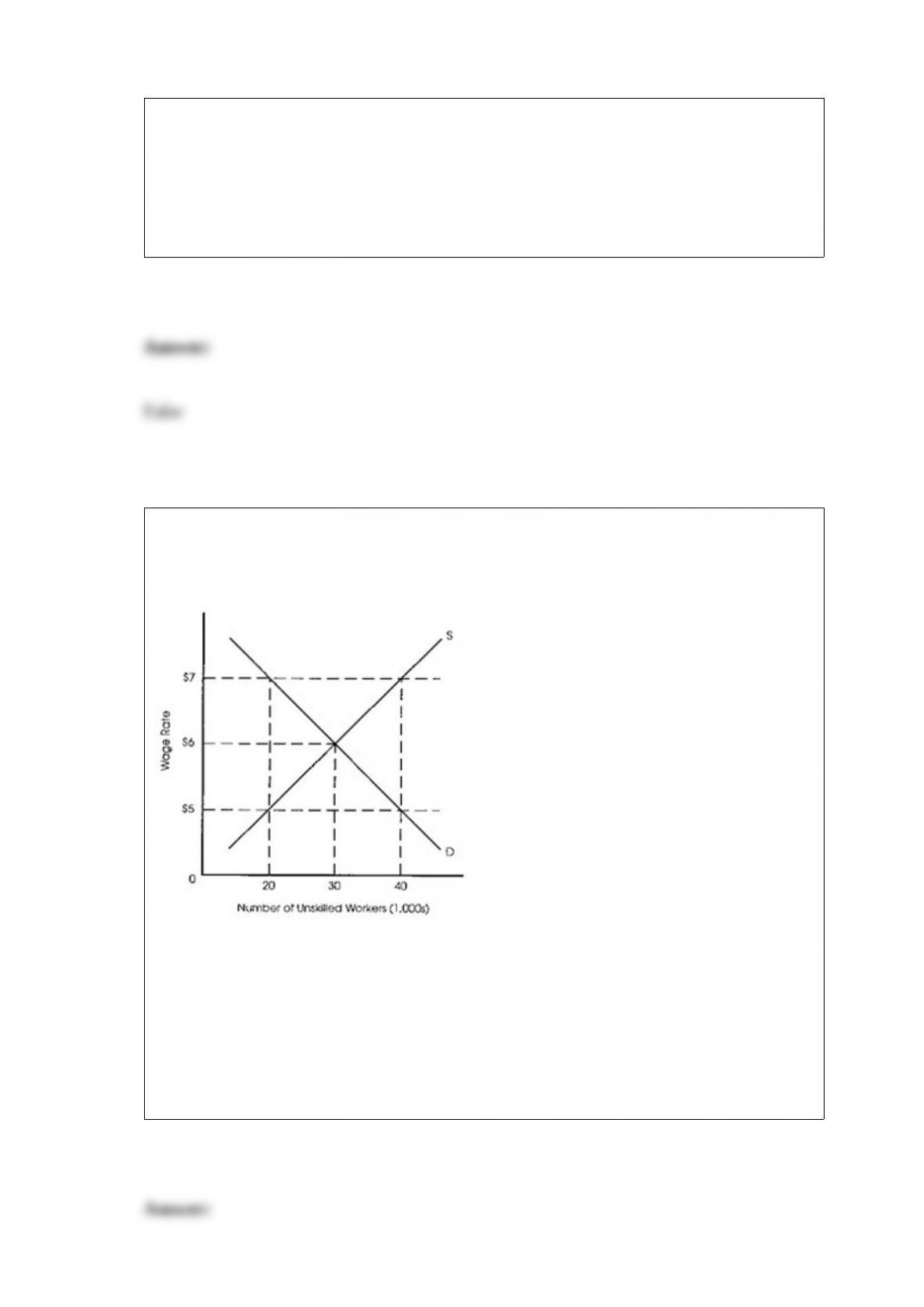
Refer to Exhibit 4-6. At a wage of $7, there will be a __________ of unskilled workers
equal to __________ thousand workers.
Exhibit 4-6
a. shortage; 10
b. surplus; 20
c. surplus; 10
d. shortage; 20
e. surplus; 15

When the equilibrium dollar price of a foreign currency decreases due to changes in
demand for or supply of the foreign currency, the foreign currency
a. has appreciated.
b. has depreciated.
c. is overvalued.
d. is undervalued.
e. is devalued.
The ability to produce a good at a lower opportunity cost than others is called a(n)
__________ advantage.
a. complementary
b. comparative
c. natural
d. indigenous
Suppose that the MU/P ratio for good X is the same as for good Y: 12 utils per dollar. If

the price of good X then rises to $2 from $1, a consumer who seeks to maintain
consumer equilibrium will buy more of good __________ until the marginal utility of
that good falls to __________ utils.
a. Y; 12
b. Y; 24
c. X; 12
d. Y; there is not enough information to answer this part of the question
e. X; there is not enough information to answer this part of the question
The answer is: “A reduction in consumers’ surplus.” What is the question?
a. What is an effect of a rise in price?
b. What is an effect of a tariff?
c. What is an effect of a quota?
d. a and b
e. a, b, and c
__________ is the number of units that individuals are __________ to buy at a
particular price during some time period.

a. Demand; willing and able
b. Supply; willing and able
c. Quantity demanded; willing and able
d. Demand; able
e. Quantity demanded; willing
If the demand for a good increases by more than the supply of the good increases, then
the good’s equilibrium price will __________ and its equilibrium quantity will
__________.
a. rise; fall
b. rise; rise
c. fall; fall
d. fall; rise
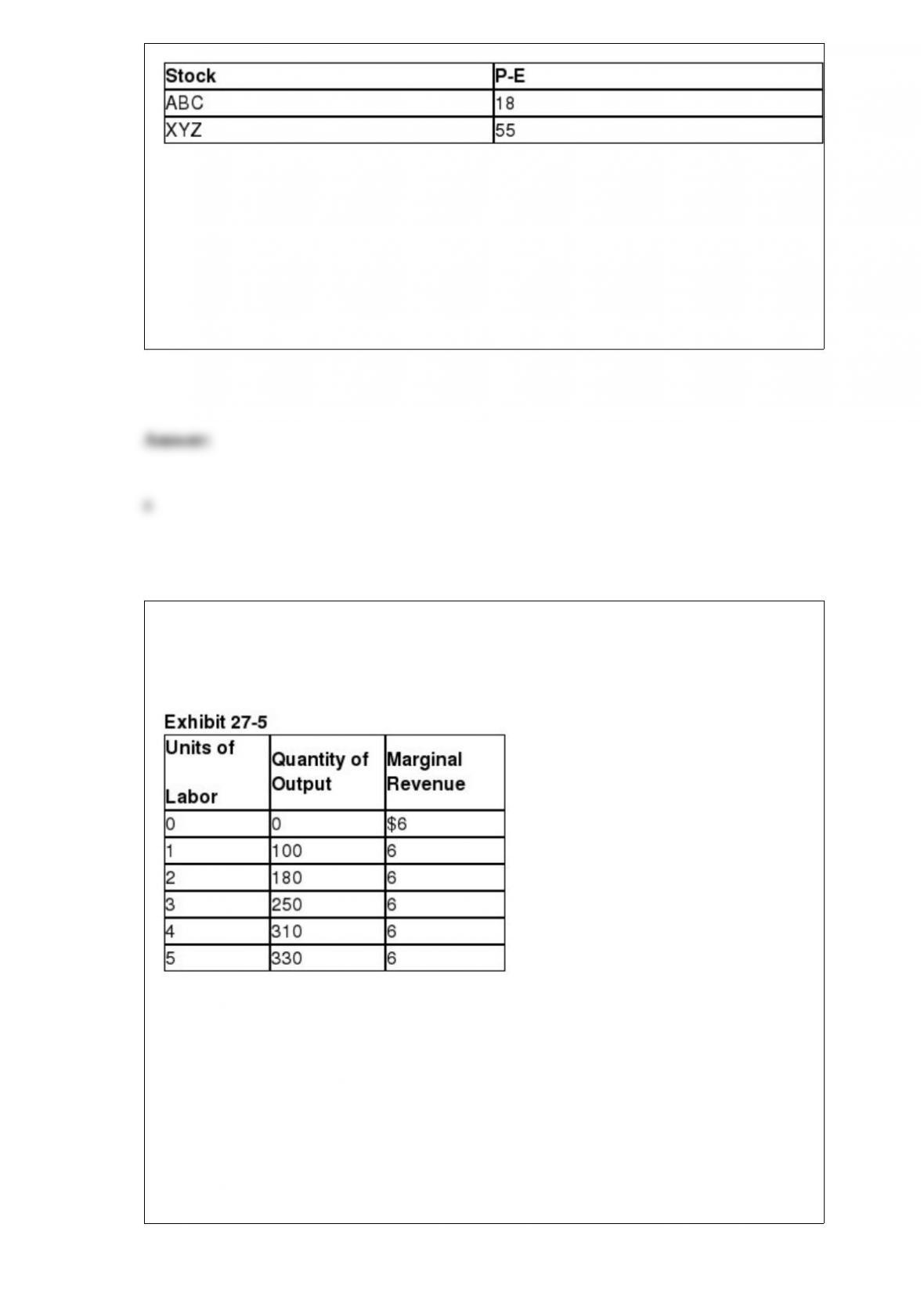
If you thought the share price of a stock was going to rise, would you be more likely to
buy a call option or a put option?
Exhibit 38-3
a. a call option
b. a put option
c. a call option and a put option
d. There is not enough information given to answer this question.
Refer to Exhibit 27-5. The value of marginal product (VMP) of the third unit of labor
equals
a. $70.
b. $420.
c. $300.
d. $700.
e. $105.

If the maximum price a person is willing and able to pay for a good is $50, and
consumers’ surplus is $20, then it follows that the price the buyer paid for the good is
a. $20
b. $70
c. $50
d. $30
e. There is not enough information to answer the question.
The Lorenz curve of perfect income equality is a
a. vertical line.
b. horizontal line.
c. 45-degree line.
d. downward-sloping line.
e. line with a slope of negative 1.
What is a cartel?Describe some of the problems inherent in forming and maintaining a
cartel.
Compare and contrast the following market structures: perfect competition and
monopolistic competition.
Explain why the government is often more responsive to producer interests than to
consumer interests when it comes to the imposition of tariffs and quotas.
Why is the production possibilities frontier (PPF) typically bowed-outward? Under
what circumstances would the PPF be a straight line?
What is the typical shape of the AFC curve?Explain why it is shaped this way.
List and describe three arguments that help to explain why nations sometimes restrict
trade. Does everyone agree with these arguments?
What does the elasticity of demand for labor measure?List and describe the three
determinants of this type of elasticity.