
Ariel is a Canadian citizen who works in Montreal, Canada and owns a winter home in
Palm Beach, Florida. When Ariel spends the winters in Palm Beach, an increase in the
value of the Canadian dollar relative to the U.S. dollar should
A) help Ariel as each Canadian dollar of her salary is now worth more U.S. dollars.
B) hurt Ariel as each Canadian dollar of her salary is now worth less U.S. dollars.
C) hurt Ariel as it is now more expensive to live in Palm Beach since the Canadian
dollar appreciation.
D) help Ariel as it is now less expensive to live in Canada since the Canadian dollar
appreciation.
In the long run, the Phillips curve is a ________ at ________.
A) horizontal line; 0% inflation
B) negatively sloped line; the intersection of aggregate demand and short-run aggregate
supply
C) vertical line; the natural rate of unemployment
D) None of the above is correct.
Economists ________ that price controls are desirable.
A) are in agreement
B) are reluctant to state

C) never believe
D) only recently agree
Which of the following are primarily macroeconomic topics and which are primarily
microeconomic topics?
a. gasoline prices
b. unemployment
c. inflation
d. health care costs
e. air pollution
f. economic growth
By the 2000s, an important market change occurred when investment banks became
significant participants in the secondary market for
A) mortgages.
B) Treasury securities.
C) corporate bonds.
D) currency.
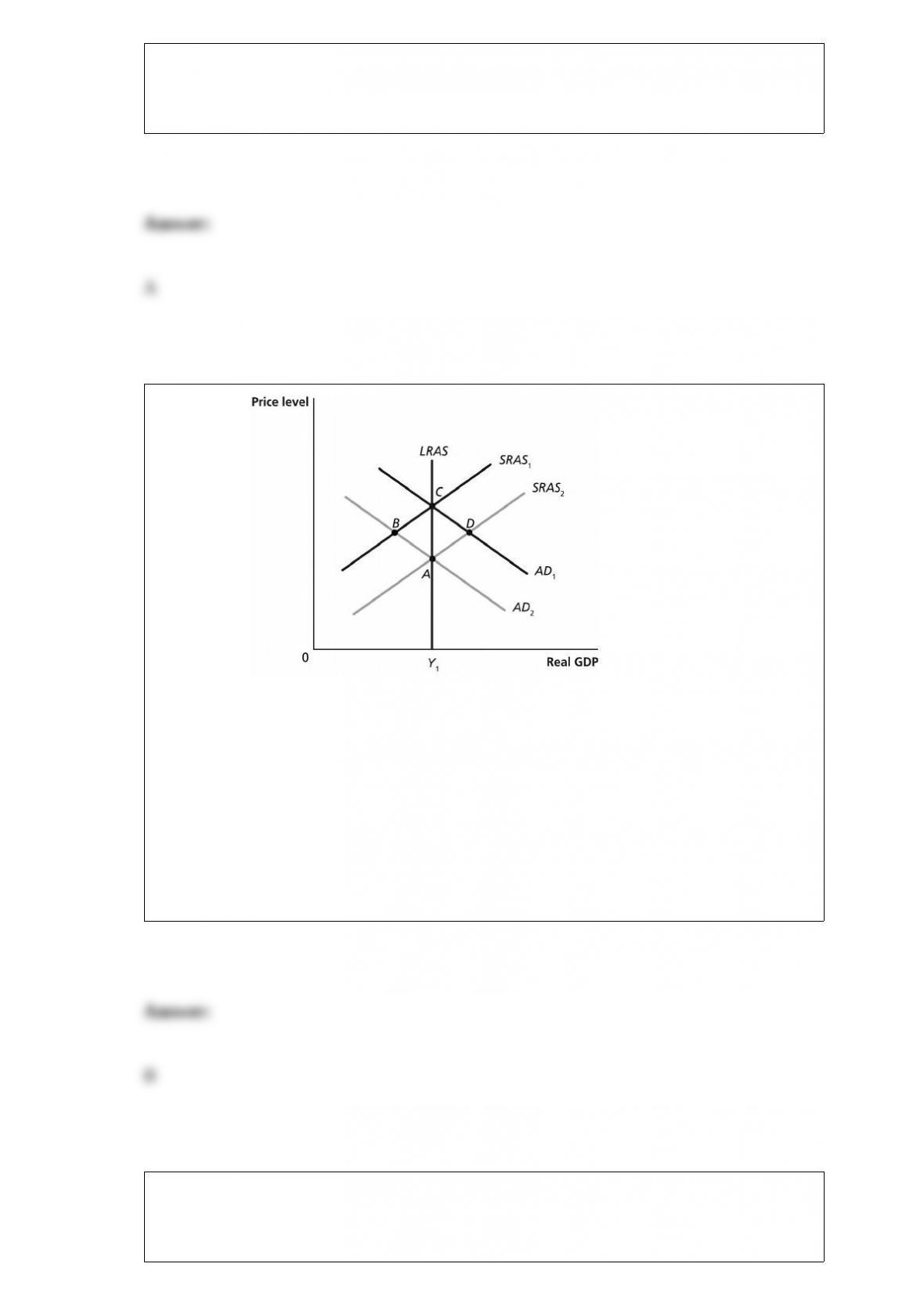
Figure 24-3
Which of the points in the above graph are possible long-run equilibria?
A) A and B
B) A and C
C) A and D
D) B and D
Consumer spending ________ and investment spending ________.
A) is very volatile and subject to fluctuations; follows a smooth trend
B) follows a smooth trend; is more volatile and subject to fluctuations
C) follows a smooth trend; is the most stable component of aggregate expenditure
D) is very erratic; is also erratic, but less erratic than consumer spending
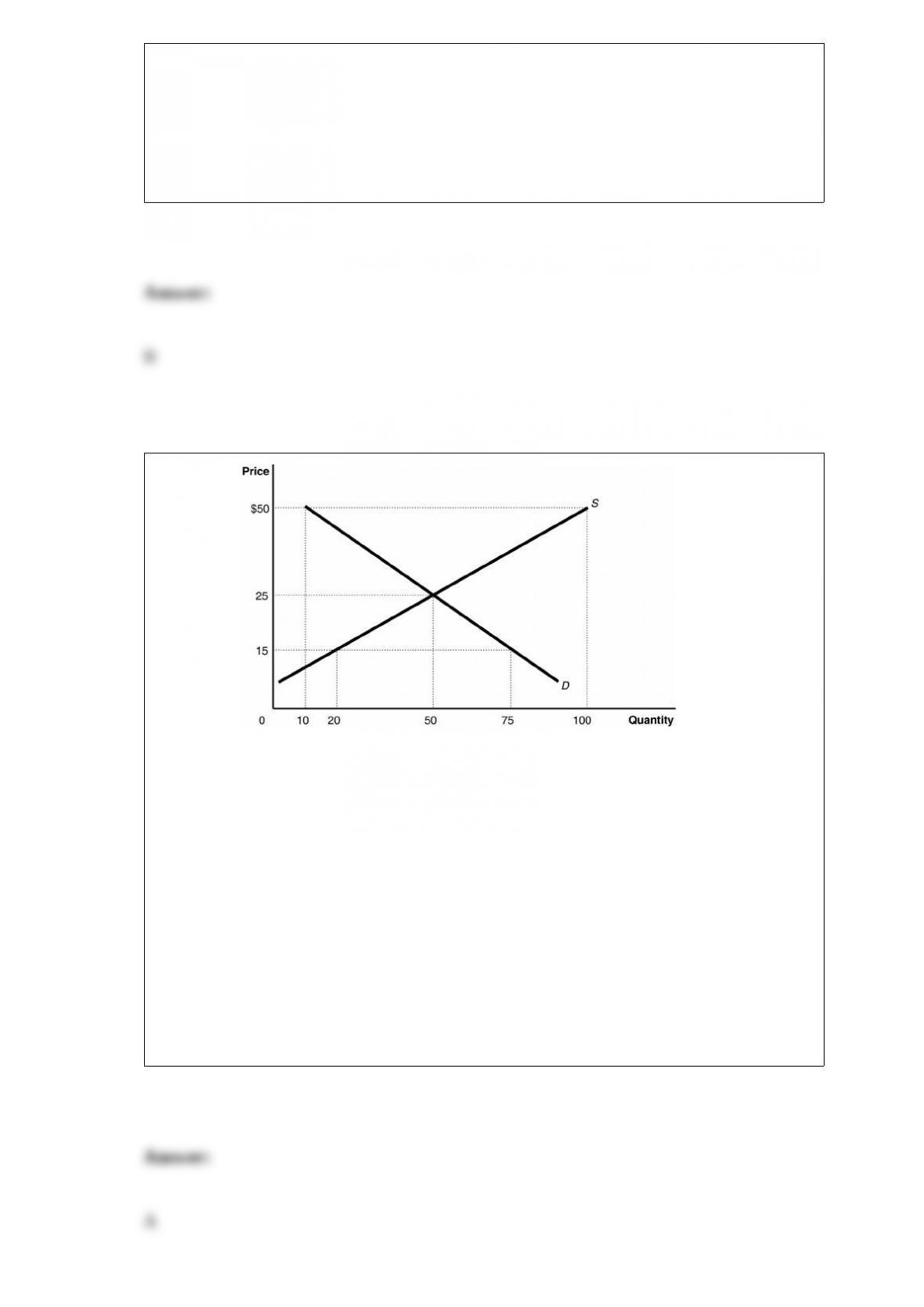
Figure 3-6
The figure above represents the market for coffee grinders. Compare the conditions in
the market when the price is $15 and when the price is $21. Which of the following
describes how the market Differs at these prices?
A) At each price there is a shortage; the shortage is greater at $15 than at $21.
B) The Difference between quantity supplied and quantity demanded is greater at $21
than at $15.
C) At each price there is a shortage; firms will raise the equilibrium price in order to
eliminate the shortage.
D) At each price the demand for coffee grinders exceeds the supply of coffee grinders.

In response to already low interest rates doing little to stimulate the economy, the Fed
announced a new program in September 2011 under which it would purchase long-term
Treasury securities while selling an equal amount of shorter-term Treasury securities.
This policy was known as
A) inflation targeting.
B) Operation Twist.
C) securities-bubble deflating.
D) quantitative easing.
A monopolistically competitive industry that earns economic profits in the short run
will
A) continue to earn economic profits in the long run.
B) experience the entry of new rival firms into the industry in the long run.
C) experience the exit of existing firms out of the industry in the long run.
D) experience a rise in demand in the long run.
If we have information about workers’ marginal products, then total and average
product can be found by

A) dividing marginal costs by the number of workers.
B) multiplying the average marginal product times the number of workers.
C) summing the marginal values to find the total and multiplying it times the number of
workers to get the average.
D) summing the marginal values to find the total and dividing it by the number of
workers to get the average.
Article Summary. Concerned about slow economic growth, the Fed announced in
September 2013 that it would postpone winding down its $85 billion a month bond
purchasing program which has been a key component of its monetary stimulus
package. Fed Chairman Ben Bernanke would not commit to a timeline for
reducing the bond purchases, stating that the program was “not on a preset
course.” The Fed’s forecasts of economic growth have been lowered for 2013 and
2014, and the Fed does not expect to raise interest rates until 2015. Since late 2008,
the Fed has held its benchmark interest rate near zero, while its balance sheet has
tripled to more than $3.6 trillion. The Fed also stated that so long as inflation did
not become a threat, it would not raise interest rates until the unemployment rate
dropped to 6.5 percent. At the time of the announcement, the unemployment rate
was 7.3 percent.
Source: Pedro da Costa and Alister Bull, “Fed Surprises, sticks to stimulus as it
cuts growth outlook,” Reuters, September 18, 2013.
The Fed announced that it would postpone winding down its $85 billion per month
bond purchasing program. The Fed’s purchasing of long-term treasury bonds and other
government-backed securities in an effort to keep long-term interest rates low is a
strategy known as
A) securitization.
B) contractionary spending.
C) indirect finance.
D) quantitative easing.
Which of the following statements is true?
A) Economic efficiency would be increased if the United States eliminated all of its
trade restrictions, but only if all other countries eliminated their trade restrictions too.
B) The U. S. economy would gain from the elimination of its tariffs but not from the
elimination of its quotas.
C) Eliminating its tariffs and quotas unilaterally would not benefit the United States
because this would remove the leverage it would have to persuade other countries to
eliminate their trade restrictions.
D) The U.S. economy would gain from the elimination of tariffs and quotas even if
other countries do not reduce their tariffs and quotas.
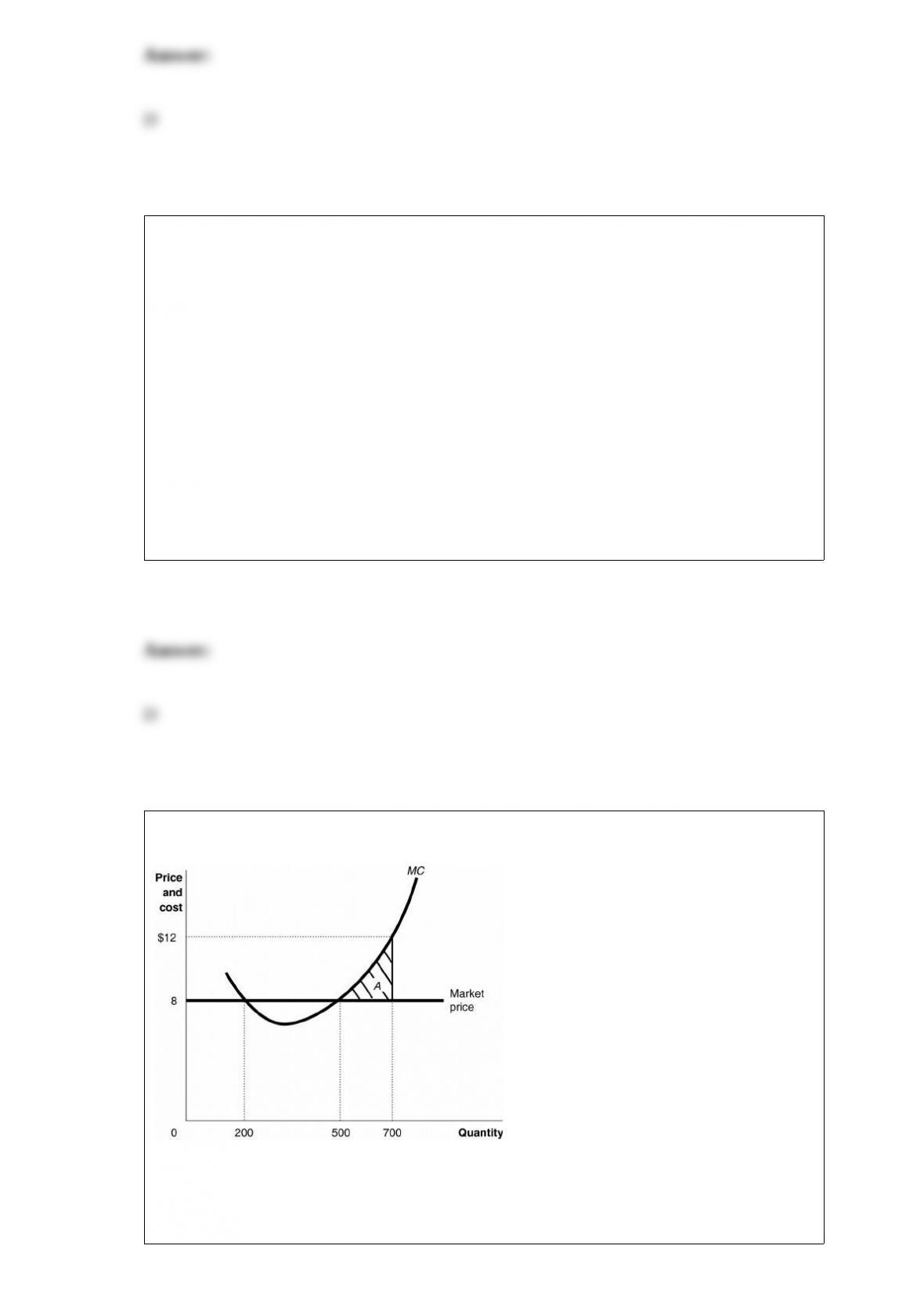
Figure 12-1
If the firm is producing 200 units
A) it breaks even.

B) it is making a loss.
C) it should cut back its output to maximize profit.
D) it should increase its output to maximize profit.
Assume that the LCD and plasma television sets industry is perfectly competitive.
Suppose a producer develops a successful innovation that enables it to lower its cost of
production. What happens in the short run and in the long run?
A) Initially, the firm will be able to increase its profit significantly, but in the long run
its profits will still be greater than zero but lower than its short run profits because other
firms would also innovate.
B) The firm will probably incur losses temporarily because of the high cost of the
innovation, but in the long run it will start earning positive profits.
C) This firm will be able to earn above normal profits indefinitely if it obtains a patent
for its innovation.
D) The firm will be able to increase its profits temporarily, but in the long run its profits
will be eliminated as other firms copy the innovation.