
1) Resource pricing is important because:
A.resource prices are a major determinant of money incomes.
B.resource prices allocate scarce resources among alternative uses.
C.resource prices, along with resource productivity, are important to firms in
minimizing their costs.
D.of all of these reasons.
2) If the money supply is constant when both nominal and real GDP are rising, we can
conclude that:
A.tax rates have been increased.
B.the velocity of money is rising.
C.interest rates are falling.
D.the unemployment rate is rising.
3) Resource X has many close substitutes whereas resource Y has no close substitutes.
Other things equal, we would expect:
A.the demand for resource Y to be more elastic than the demand for resource X.
B.resources X and Y to be close substitutes.
C.resource X to be more expensive than resource Y.
D.the demand for resource X to be more elastic than the demand for resource Y.
4) rapidly rising u.s. health care costs have:
a.slowed the growth of real wages.
b.diminished labor mobility.
c.caused some employers to use more part-time and temporary workers.
d.done all of these.
5) A fractional reserve banking system:
A.is susceptible to bank panics.
B.prevents money creation through the lending process.
C.only tends to exist in developing economies.
D.prevents the Federal Reserve from influencing the money supply.
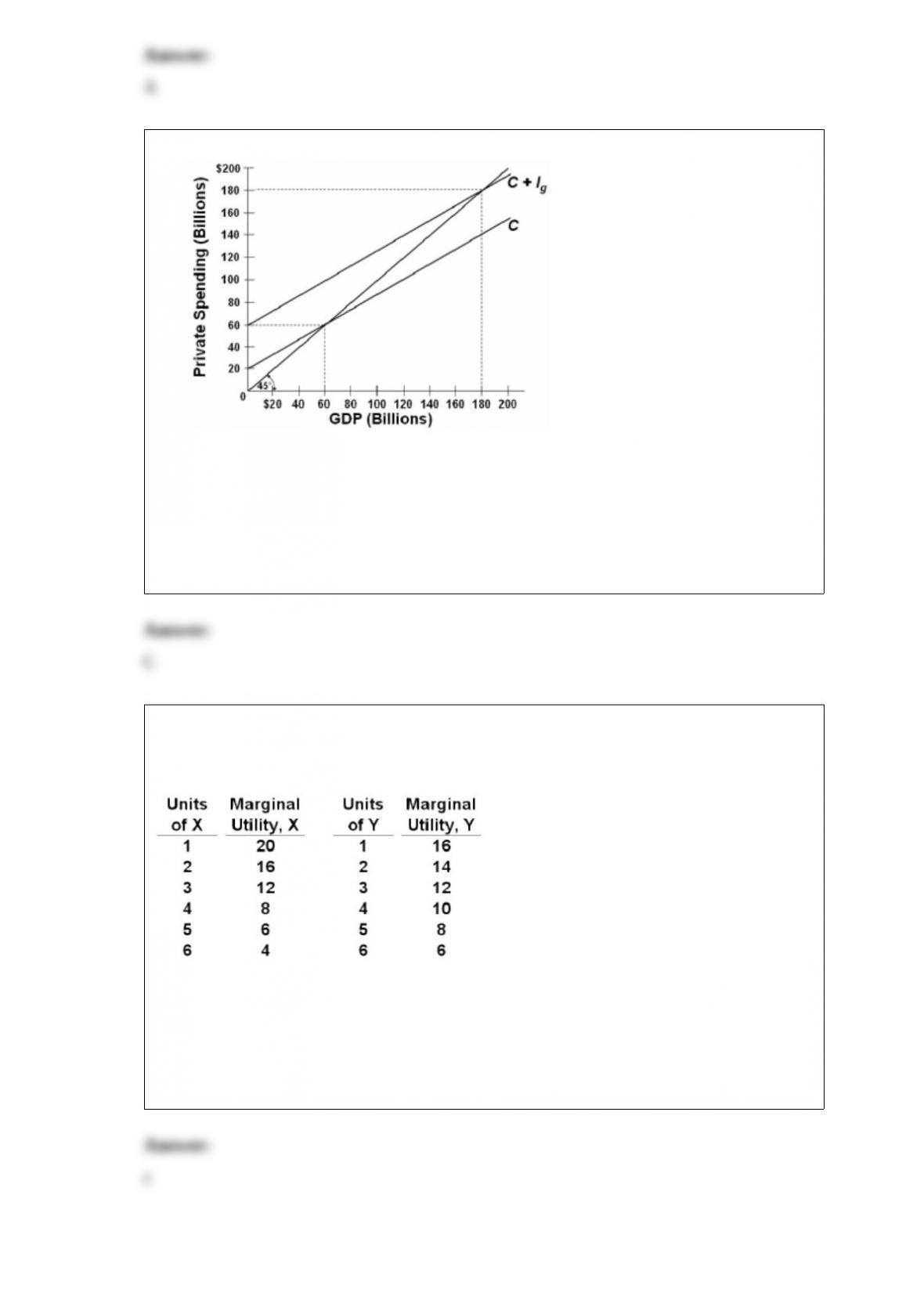
6)
Refer to the above diagram for a private closed economy. Aggregate saving in this
economy will be zero when:
A.C + Ig cuts the 45-degree line.
B.GDP is $180 billion.
C.GDP is $60 billion.
D.GDP is also zero.
7) the following marginal utility data for products x and y. assume that the prices of x
and y are $4 and $2 respectively and that the consumer’s income is $18.
refer to the above data. what quantities of x and y should be purchased to maximize
utility?
a.2 of x and 1 of y
b.4 of x and 5 of y
c.2 of x and 5 of y
d.2 of x and 6 of y
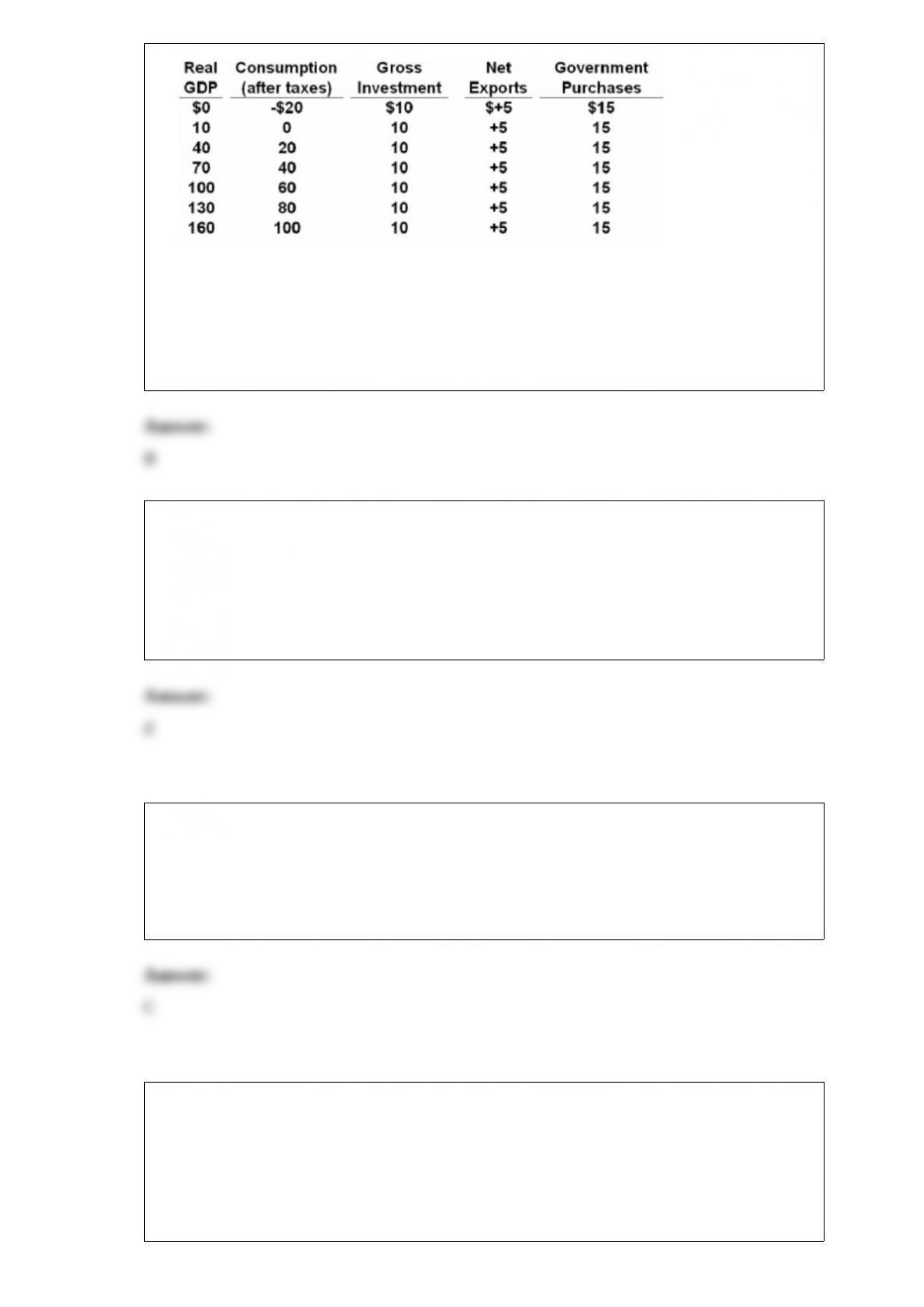
8)
Refer to the above table. An increase in net exports of $10 would:
A.increase real GDP by $10.
B.increase real GDP by $30.
C.decrease real GDP by $10.
D.decrease real GDP by $30.
9) (consider this) newspapers dispensing devices seemingly “trust” people to take only a
single paper but the devices actually rely on the law of:
a.supply.
b.increasing opportunity costs.
c.demand.
d.diminishing marginal utility.
10) When a commercial bank borrows from a Federal Reserve Bank:
A.the supply of money automatically increases.
B.it indicates that the commercial bank is unsound financially.
C.the commercial bank’s lending ability is increased.
D. the commercial bank’s reserves are reduced.
11) Suppose the aggregate demand and supply schedules for a hypothetical economy
are as shown below:
(a)What will be the equilibrium price and output level in this hypothetical economy? Is
it also the full-employment level of output? Explain.
(b)Why wont the 200 index be the equilibrium price level? Why wont the 300 index be
the equilibrium price level?
(c)Suppose demand increases by $120 billion at each price level. What will be the new
equilibrium price and output levels?
(d)List five factors that might cause a change in aggregate demand.
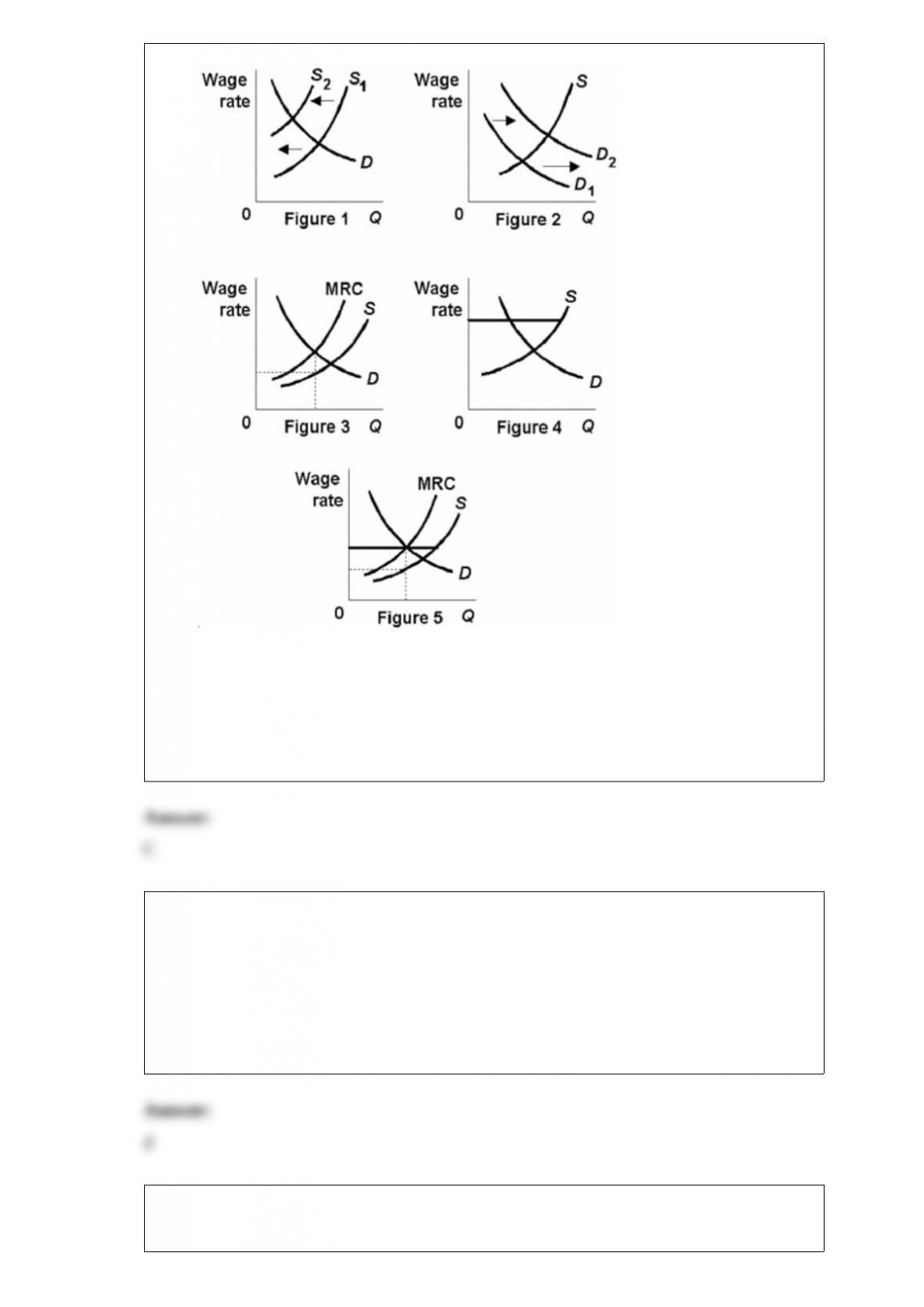
12)
Refer to the above labor market diagrams. A monopsonistic labor market is represented
by Figure:
A.5
B.4
C.3
D.2
13) suppose that ms. thomson is currently exhausting her money income by purchasing
10 units of a and 8 units of b at prices of $2 and $4 respectively. the marginal utility of
the last units of a and b are 16 and 24 respectively. these data suggest that ms. thomson:
a.has preferences that are at odds with the principle of diminishing marginal utility.
b.considers a and b to be complementary goods.
c.should buy less a and more b
d.should buy less b and more a
14) “Farm products” are generally produced in more ___________ markets, while
“food products” tend to be sold in markets that are more ____________.

A.monopolistic; competitive
B.competitive; oligopolistic
C.oligopolistic; competitive
D.oligopolistic; monopolistic
15) In terms of aggregate supply, a period in which nominal wages and other resource
prices are fully responsive to price-level changes is called the:
A.long run.
B.short run.
C.immediate market period.
D.very long run.
16) The Federal government has a large public debt that it finances through borrowing.
As a result, real interest rates are higher than otherwise and the volume of private
investment spending is lower. This illustrates the:
A.equation-of-exchange effect.
B.paradox of thrift.
C.crowding-out effect.
D.net export effect.