Consumers have to make tradeoffs in deciding what to consume because
A) not all goods give them the same amount of satisfaction.
B) the prices of goods vary.
C) they are limited by a budget constraint.
D) there are not enough of all goods produced.
Table 14-8
Two rival oligopolists in the athletic
supplements industry, the Power Fuel Company and the Brawny Juice Company, have
to decide on their pricing strategy. Each can choose either a high price or a low price.
Table 14-8 shows the payoff matrix with the profits that each firm can expect to earn
depending on the pricing strategy it adopts. If the firms act out of individual
self-interest, which prices will they select?
A) Both firms will select a high price.
B) Brawny Juice will select a high price, Power Fuel will select a low price.
C) Brawny Juice will select a low price, Power Fuel will select a high price.
D) Both firms will select a low price.

Vipsana’s Gyros House sells gyros. The cost of ingredients (pita, meat, spices, etc.) to
make a gyro is $2.00. Vipsana pays her employees $60 per day. She also incurs a fixed
cost of $120 per day. Calculate Vipsana’s variable cost per day when she produces 50
gyros using two workers?
A) $100
B) $124.40
C) $220
D) $240
When the Fed uses contractionary policy,
A) the price level rises higher than it would if the Fed did not pursue policy.
B) the price level rises less than it would if the Fed did not pursue policy.
C) it does not change the price level.
D) it causes inflation.
Figure 3-5
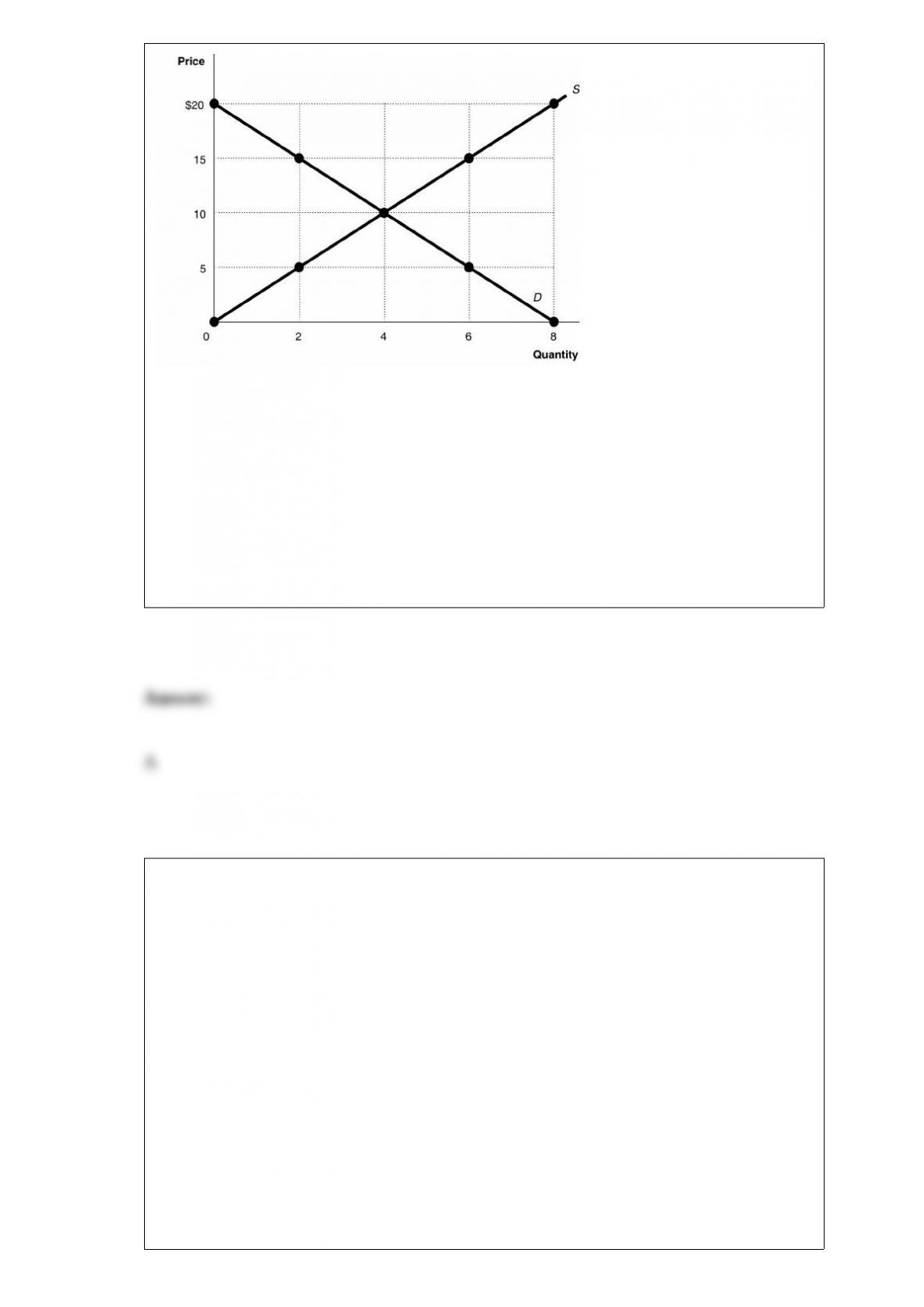
At a price of $20
A) there would be a surplus of 8 units.
B) there would be a shortage of 8 units.
C) there would be a surplus of 0 units.
D) there would be a shortage of 4 units.
Article Summary. Brandeis University economist Benjamin Shiller has written a
paper which explains how Netflix could combine demographic data with
customers’ Web browsing habits to more accurately predict how much a customer
would be willing to pay for a Netflix subscription, and how using this method of
first-degree price discrimination would generate higher profits. Shiller explains
that the more information a company has about its customers, the better it is at
being able to set prices to increase profits. As he stated in his paper, “Using all
variables to tailor prices, one can yield variable profits 1.39 percent higher than
variable profits obtained using non-tailored 2nd degree price-discrimination.
Using demographics alone to tailor prices raises profits by much less, yielding
variable profits only 0.14% higher than variable profits attainable under 2nd
degree [price discrimination].”
Source: Brian Fung, “How Netflix could use Big Data to make twice as much
money off you,” Washington Post, September 4, 2013.
If Netflix chose to use Shiller’s pricing method

A) consumer surplus would be zero.
B) producer surplus would be zero.
C) deadweight loss would be maximized.
D) consumer surplus, producer surplus, and deadweight loss would all be equal.
If the central bank can act as a lender of last resort during a banking panic, banks can
A) call in their loans to their customers and eventually restore the public’s faith in the
banking system.
B) satisfy customer withdrawal needs and eventually restore the public’s faith in the
banking system.
C) borrow more and more money from the central bank, and this will lower its reserves
and decrease the public’s faith in the banking system.
D) encourage the public to borrow directly from the central bank, and this will worsen
the banking panic.
Suppose a monopolistically competitive firm’s output where marginal revenue equals
marginal cost is 66 units and the price corresponding to this quantity is $18. If the
average total cost at this output is $16.55, then its total profit is
A) $1,188.
B) $1,092.30.

C) $95.70.
D) $1.45.
As the tax wedge associated with a given economic activity gets smaller, we would
expect
A) more of that economic activity to occur.
B) the distortions caused by taxes on that activity to be greater.
C) people to engage in less of that particular activity.
D) no change in the practice of that activity until the tax wedge ultimately disappears.
When the Fed increases the money supply,
A) the interest rate rises and this stimulates consumption spending.
B) people spend less because they have more money.
C) the interest rate falls and this stimulates investment spending.
D) the interest rate rises and this stimulates investment spending.

The problem causing most recessions is too little
A) money (currency plus checking accounts).
B) spending.
C) unemployment.
D) taxes.
A franchise is
A) a firm that buys and operates a brand name business in a new market.
B) a firm with the legal right to sell a good or service in a particular area.
C) a firm with no competitors.
D) a branch of a national company.
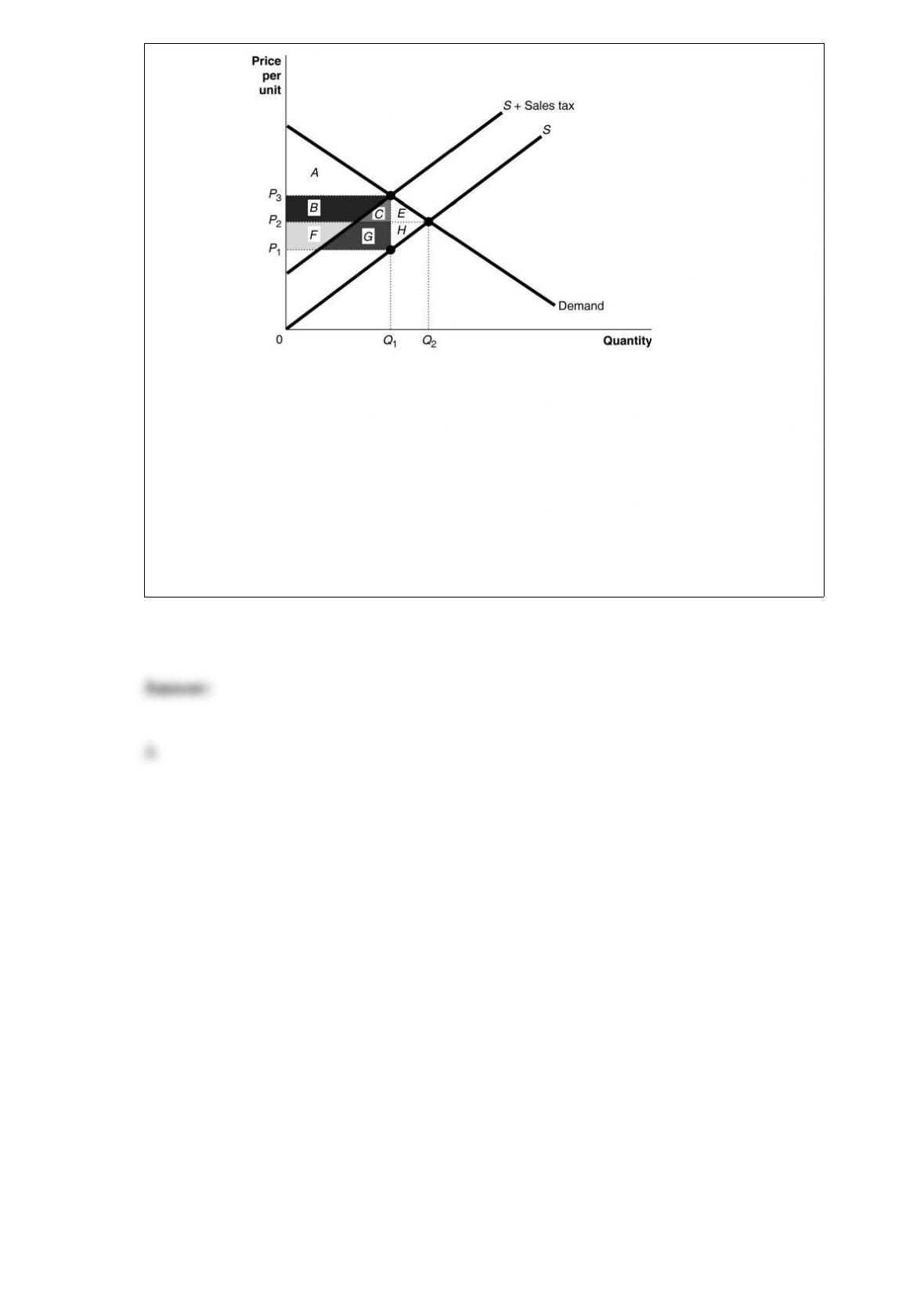
Figure 18-1
Area B + C represents
A) the portion of sales tax revenue borne by consumers.
B) the portion of sales tax revenue borne by producers.
C) the excess burden of the sales tax.
D) sales tax revenue collected by the government.