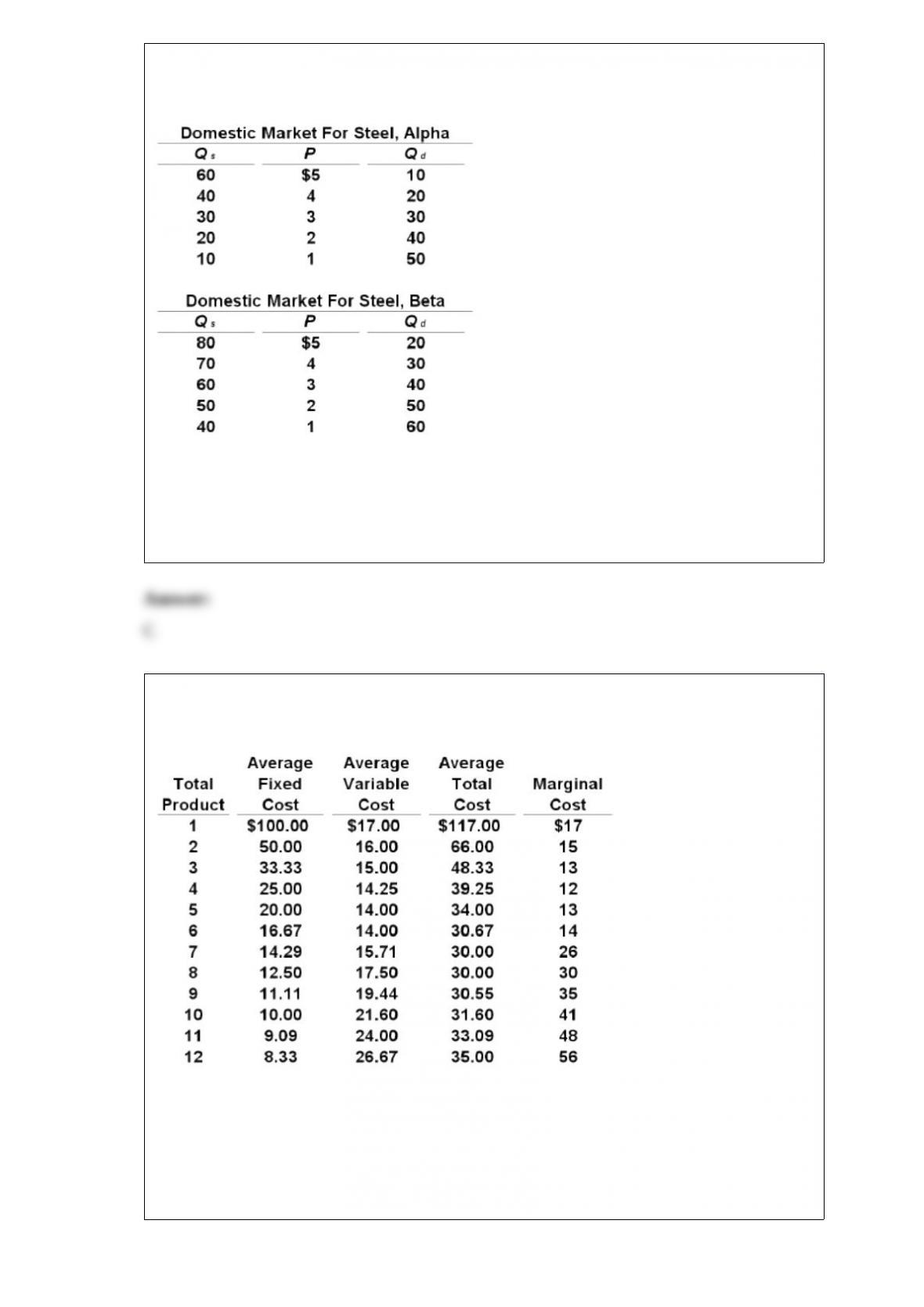
1) The following data for the hypothetical nations of Alpha and Beta. Qs is domestic
quantity supplied and Qd is domestic quantity demanded.
Refer to the above data. The equilibrium prices of steel in Alpha and Beta are:
A.$5 and $4, respectively.
B.$2 and $4, respectively.
C.$3 and $2, respectively.
D.$1 and $2, respectively.
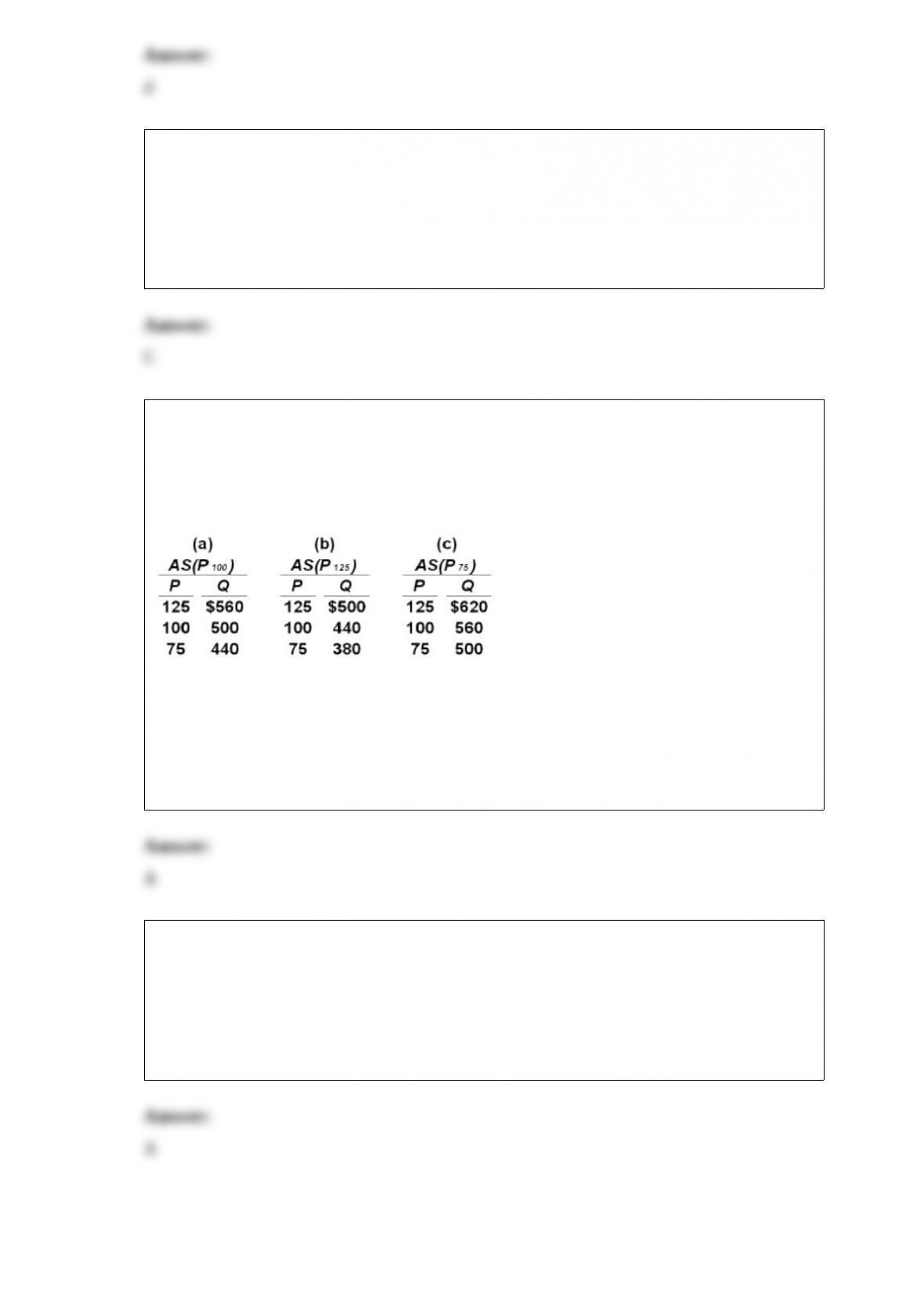
2) the following cost data for a firm that is selling in a purely competitive market:
refer to the above data. if the market price for the firm’s product is $12, the competitive
firm will produce:
a.4 units at a loss of $109.
b.4 units at an economic profit of $31.75.
c.8 units at a loss of $48.80.
d.zero units at a loss of $100.
3) If an increase in aggregate expenditures results in no increase in real GDP we can
surmise that the:
A.economy is in a deep recession.
B.MPC equals 1.
C.economy is already operating at full employment.
D.price level has fallen.
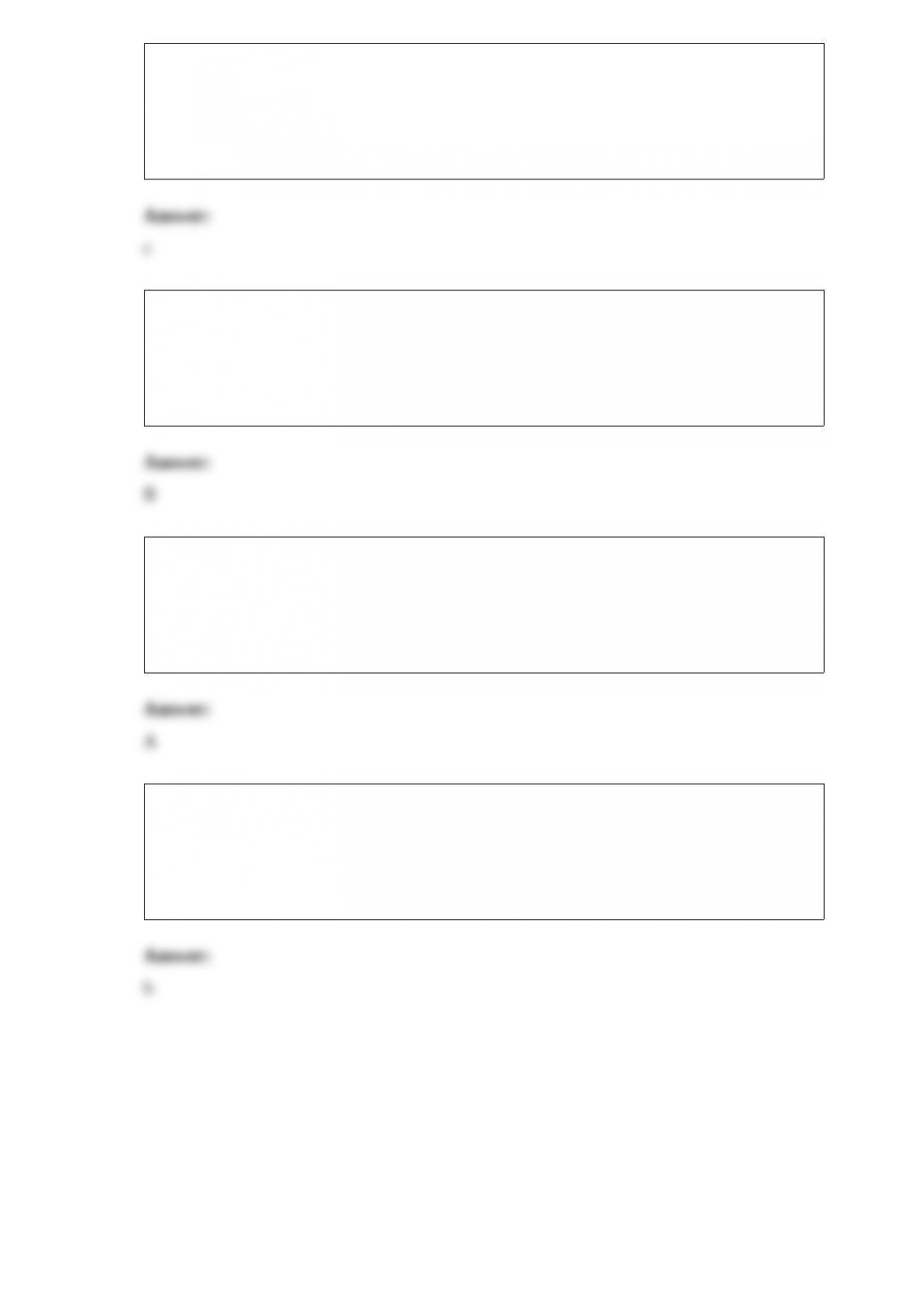
4) Suppose the full employment level of real output (Q) for a hypothetical economy is
$500, the price level (P) initially is 100, and that prices and wages are flexible both
upward and downward. Use the following short-run aggregate supply schedules to
answer the next question(s).
Refer to the information above. If the price level unexpectedly increases from 100 to
125, the level of real output in the short run will:
A.rise from $500 to $560.
B.fall from $500 to $440.
C.fall from $560 to $500.
D.rise from $440 to $500.
5) Tariffs:
A.may be imposed either to raise revenue (revenue tariffs) or to shield domestic
producers from foreign competition (protective tariffs).
B.are also called import quotas.
C.are excise taxes on goods exported abroad.
D.are per unit subsidies designed to promote exports.
6) the two main types of managed care organizations are:
a.u.s. veterans hospitals and university health clinics.
b.health maintenance organizations (hmos) and private nursing homes.
c.health maintenance organizations (hmos) and preferred provider organizations (ppos).
d.preferred provider organizations (ppos) and nonprofit hospitals.
7) The elasticity of resource demand measures the:
A.responsiveness of workers to changes in wage rates.
B.responsiveness of producers to changes in resource prices.
C.ratio of marginal revenue product to resource price.
D.sensitivity of marginal revenue product to changes in product price.
8) A government may be able to reduce the international value of its currency by:
A.selling its currency in the foreign exchange market.
B.buying its currency in the foreign exchange market.
C.selling foreign currencies in the foreign exchange market.
D.increasing its domestic interest rates.
9) all else equal, u.s. exports to germany create a:
a.demand for german marks.
b.supply of german marks.
c.supply of american dollars.
d.shortage of german marks.
10)
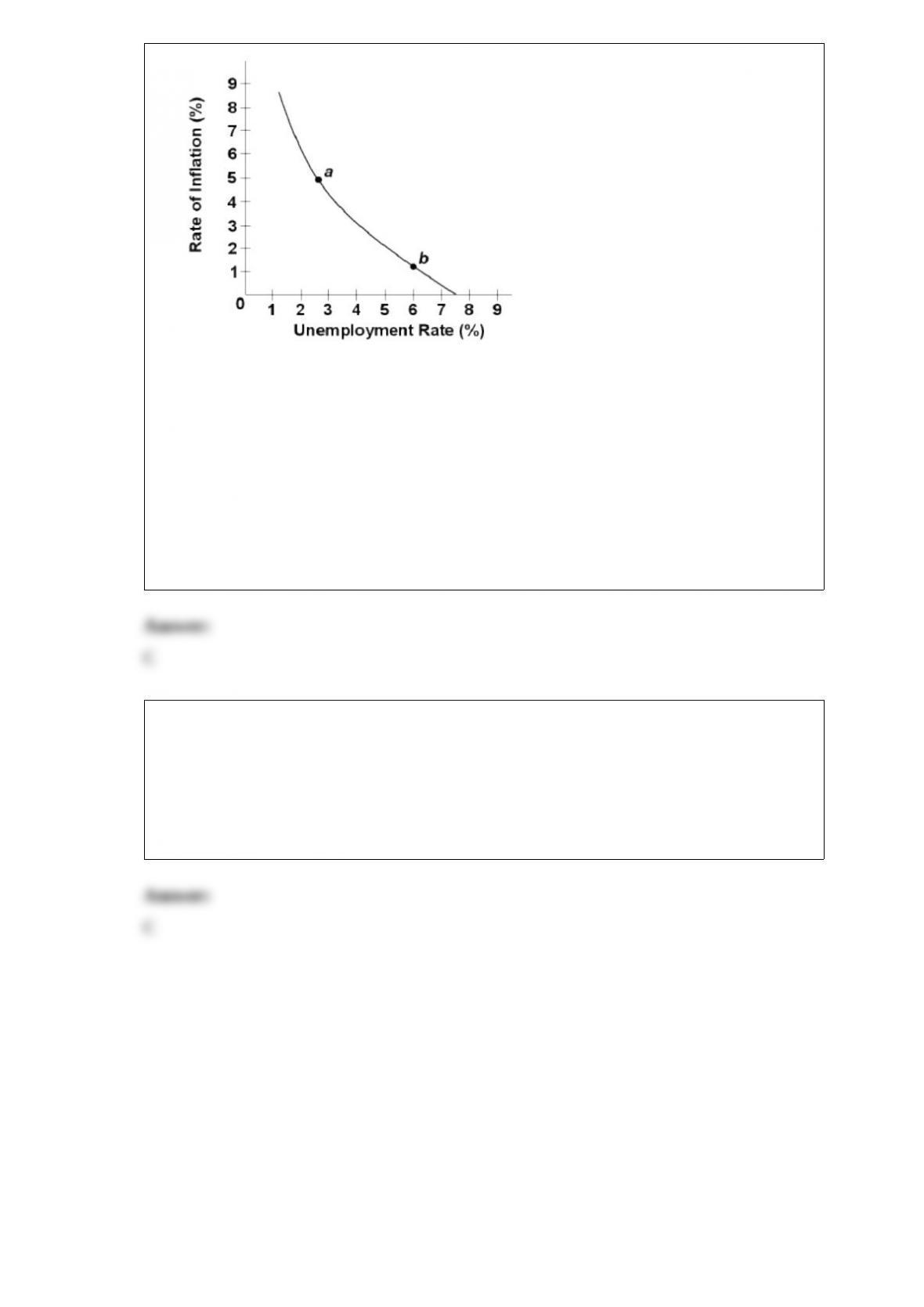
Refer to the above diagram for a specific economy. Which of the following best
describes a decision by policymakers that moves this economy from point b to point a?
A.Policymakers have instituted an expansionary monetary policy and/or a budgetary
deficit, thereby accepting more unemployment to reduce the rate of inflation.
B.Policymakers have instituted a restrictive monetary policy and/or a budgetary
surplus, thereby accepting a higher rate of inflation to reduce unemployment.
C.Policymakers have instituted an expansionary monetary and/or a budgetary deficit,
thereby accepting a higher rate of inflation to reduce unemployment.
D.Policymakers have instituted a restrictive monetary policy and/or a budgetary
surplus, thereby accepting more unemployment to reduce the rate of inflation.
11) Under the international gold standard a flow of gold from country A into country B
would be halted by:
A.a rise in the price of B’s currency measured in terms of A’s currency.
B.government export controls on gold.
C.rising prices and incomes in B and falling prices and incomes in A.
D.rising prices and incomes in A and falling prices and incomes in B.
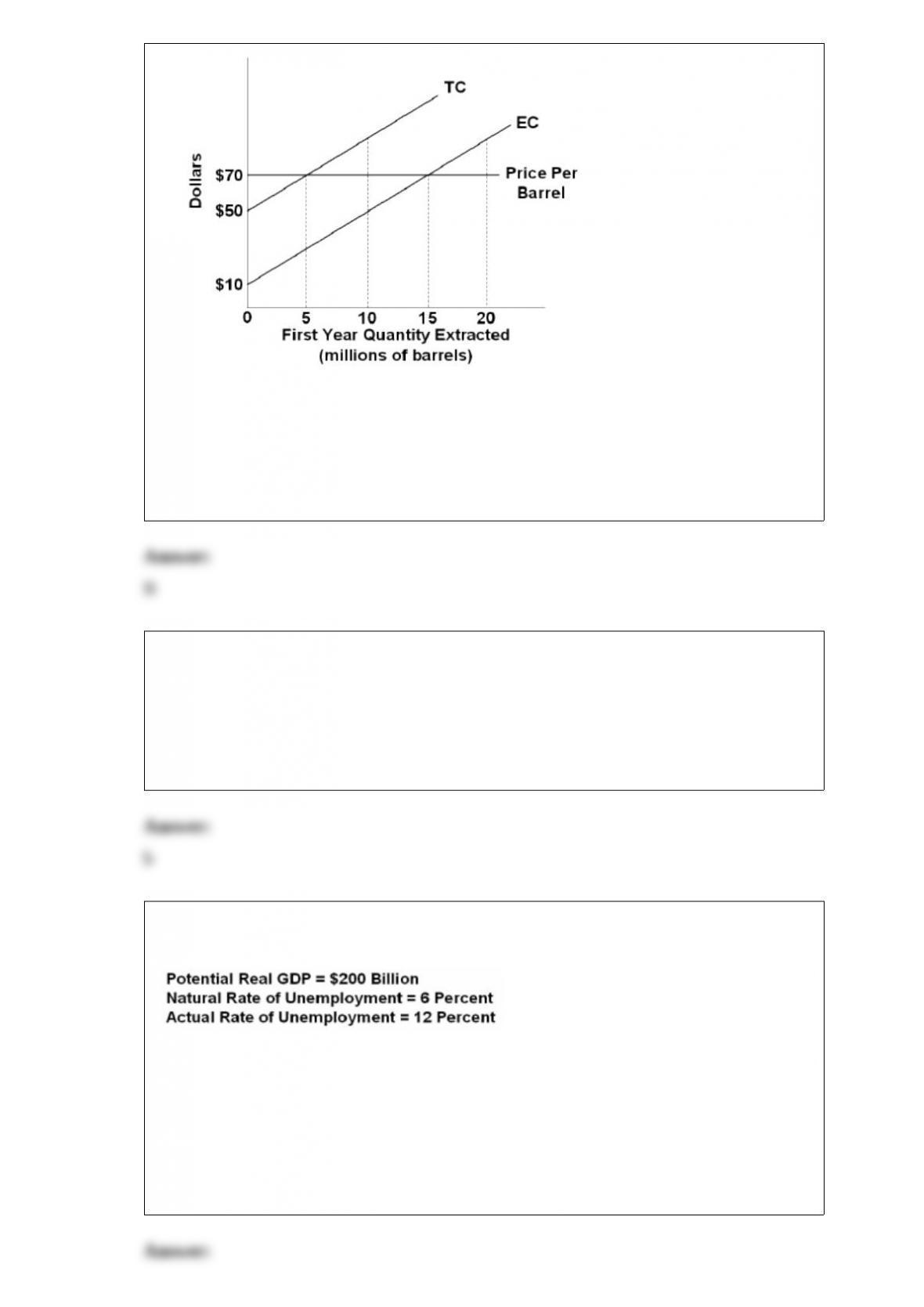
12)
Refer to the diagram above, representing Slippery Slope Oil Company. What is the user
cost of extracting a barrel of oil this year?
A.$20.
B.$40.
C.$50.
D.$70.
13) if the variable costs of a profit-maximizing pure monopolist decline, the firm
should:
a.produce more output and charge a higher price.
b.produce more output and charge a lower price.
c.reduce both output and price.
d.raise both output and price.
14) answer the next question(s) on the basis of the following information for a specific
year in a hypothetical economy for which okun’s law is applicable:
refer to the above data. if the unemployment rate in the above economy declined to 6
percent, we could conclude that:
a.only structural unemployment remained.
b.the economy’s production possibilities curve shifted outward.
c.the economy had moved from a point inside its production possibilities curve to a
point on or near the curve.
d.nominal gdp would rise but real gdp would fall.
15) money is not an economic resource because:
a.money, as such, is not productive.
b.idle money balances do not earn interest income.
c.it is not scarce.
d.money is not a free gift of nature.
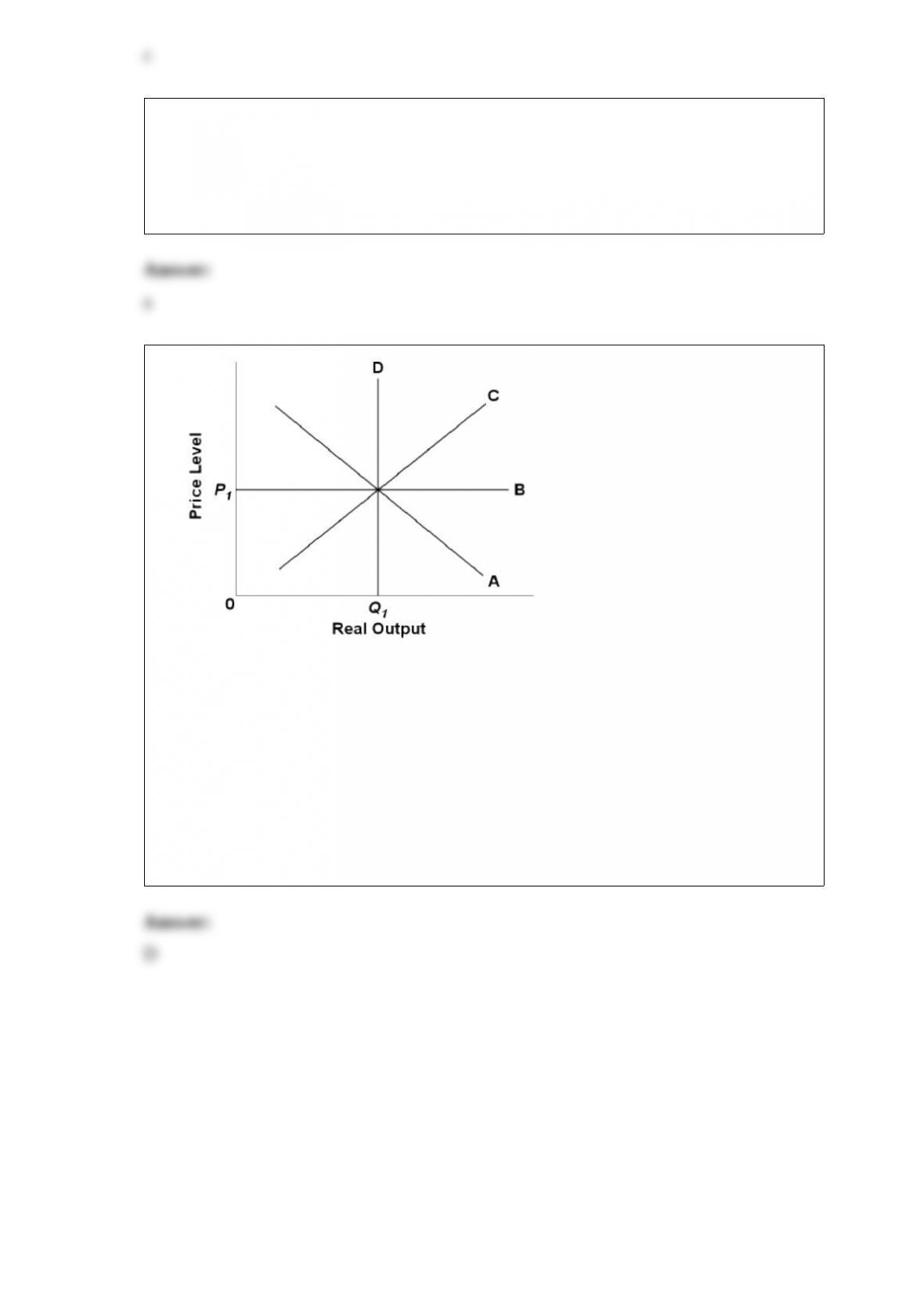
16)
Refer to the above diagram and assume that prices and wages are flexible both upward
and downward in the economy. In the extended AD-AS model:
A.demand-pull inflation would involve a rightward shift of curve A, followed by a
rightward shift of curve C.
B.cost-push inflation would involve a rightward shift of curve A, followed by a leftward
shift of curve C.
C.recession would involve a leftward shift of curve A, followed by a leftward shift of
curves C and D.
D.recession could be caused by either a leftward shift of curve A or a leftward shift of
curve C