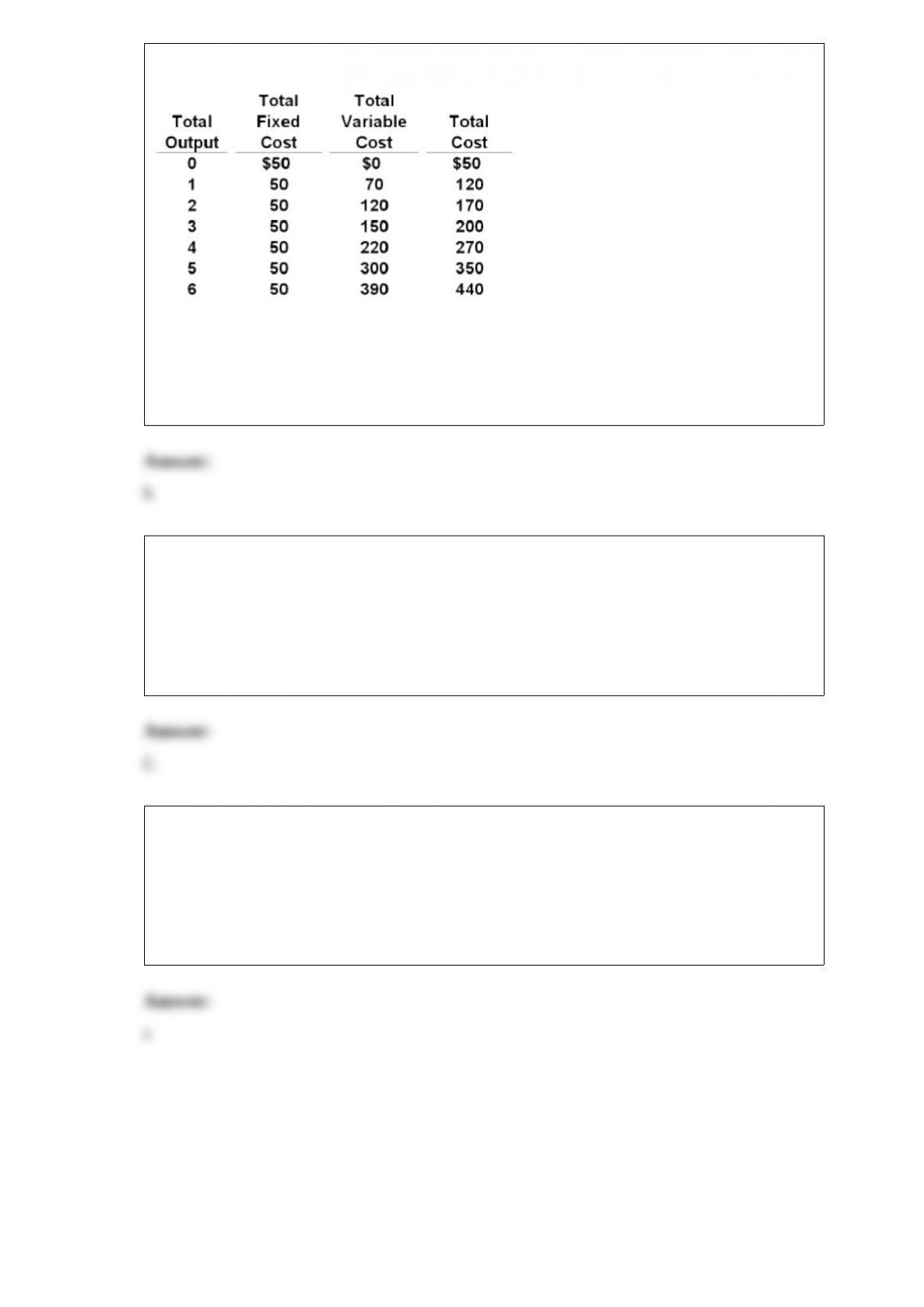
1) the following cost data for a purely competitive seller:
refer to the above data. if product price is $75, the firm will produce:
a.3 units of output.
b.4 units of output.
c.5 units of output.
d.6 units of output.
2) If a single large employer bargains with an inclusive union, the resulting labor
market model can best be described as:
A.a cartel.
B.countervailing power.
C.a bilateral monopoly.
D.an internal labor market.
3) because of modern economic growth, the worldwide average lifespan has grown to
about _____ years since the late 1700s.
a.32
b.56
c.67
d.78
4)
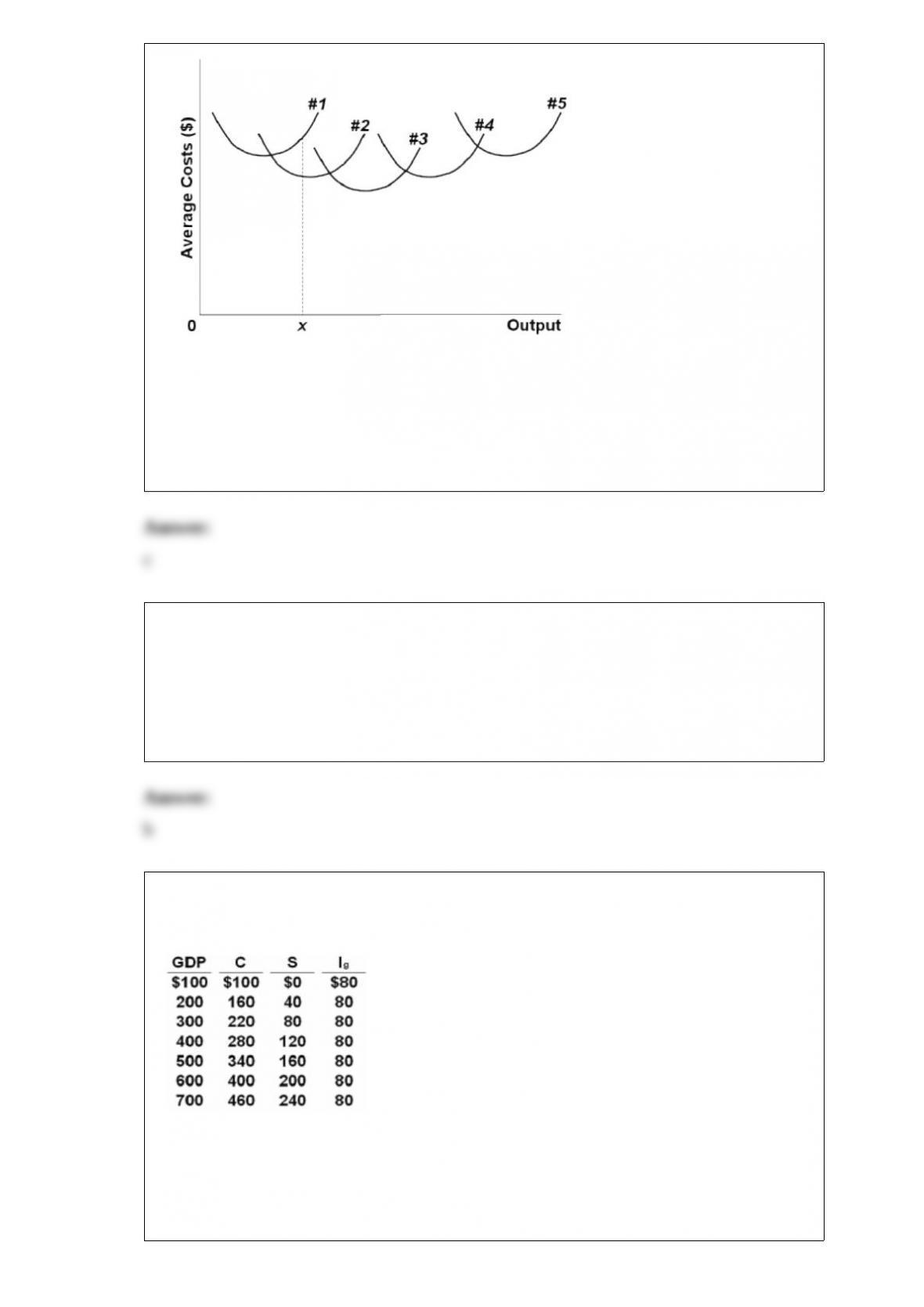
as the firm in the above diagram expands from plant size #3 to plant size #5, it
experiences:
a.increasing returns.
b.economies of scale.
c.diseconomies of scale.
d.constant costs.
5) critics of economic growth:
a.contend that growth and industrialization reduce pollution.
b.argue that economic growth does not resolve socioeconomic problems such as an
unequal distribution of income and wealth.
c.point out that growth results in greater economic security for workers.
d.say that its benefits accrue nearly exclusively to white males.
6) The following information is for a closed economy:
Refer to the above information. The introduction of $80 billion of government spending
has:
A.lowered the multiplier from 2.5 to 2.0.
B.increased the multiplier from 2.5 to 3.0.
C.increased the multiplier from 2.0 to 2.5.

D.had no effect on the size of the multiplier.
7) (Last Word) The final settlement of the United States vs. Microsoft case:
A.broke up Microsoft into two competing firms.
B.forced Microsoft to provide uniform royalty and licensing arrangements for Windows
with all manufacturers of personal computers.
C.forced Microsoft to sell off its major applications programs such as Word and
PowerPoint.
D.found Microsoft not guilty of violating the Sherman Act.
8) A monopsonist:
A.boosts the wage rate above the competitive level to attract more workers.
B.reduces the number of workers it employs so that it can pay each worker a lower
wage rate.
C.is a “wage taker.”
D.pays a wage rate equal to MRP.
9) suppose aiyanna’s pizzeria currently faces a linear demand curve and is charging a
very high price per pizza and doing very little business. aiyanna now decides to lower
pizza prices by 5 percent per week for an indefinite period of time. we can expect that
each successive week:
a.demand will become more price elastic.
b.price elasticity of demand will not change as price is lowered.
c.demand will become less price elastic.
d.the elasticity of supply will increase.
10) the gdp price index:
a.includes fewer goods and services than the consumer price index.
b.is identical to the consumer price index.
c.is another term for the producer price index.
d.includes all goods comprising the nation’s domestic output.
11)
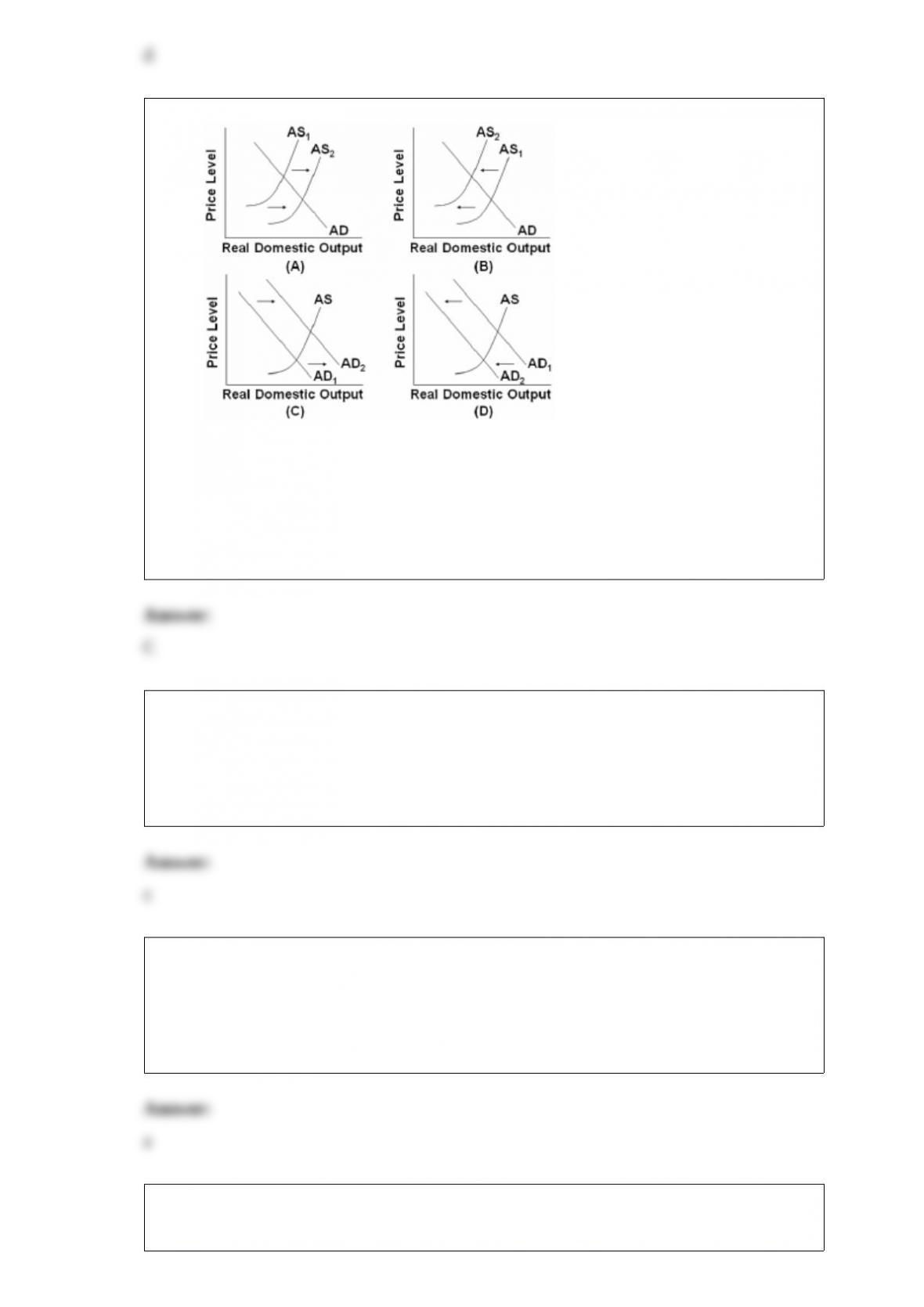
Which of the above diagrams best portrays the effects of an increase in foreign
spending on U.S. products?
A.A
B.B
C.C
D.D
12) the world trade organization (wto)
a.sets tariffs to balance international trade among nations.
b.is the successor to nafta.
c.hears and rules on trade disputes between nations.
d.sets exchange rates to balance international trade among nations.
13) the mr = mc rule can be restated for a purely competitive seller as p = mc because:
a.each additional unit of output adds exactly its price to total revenue.
b.the firm’s average revenue curve is downsloping.
c.the market demand curve is downsloping.
d.the firm’s marginal revenue and total revenue curves will coincide.
14) The “time-value of money” refers to the fact that:
A.a given amount of money becomes more valuable over time.

B.a given amount of money is more valuable the sooner it is obtained.
C.people expect monetary compensation for their labor time.
D.a given amount of money today is equivalent to a smaller amount of money in the
future.
15) The rational expectations perspective suggests that:
A.fiscal policy is more powerful than monetary policy.
B.monetary policy is more powerful than fiscal policy.
C.fiscal and monetary policy are not likely to achieve their stated aims.
D.fiscal policy works only to the extent that it is accompanied by fully anticipated
changes in the money supply.