
The ratio of the increase in equilibrium real GDP to the increase in autonomous
expenditure is called the
A) MPC.
B) multiplier.
C) MPS.
D) consumption function.
For a monopolistically competitive firm, marginal revenue
A) equals the price.
B) is greater than the price.
C) is less than the price.
D) and price are unrelated.
Which of the following describes the degree of control that the Fed has over the money
supply?
A) The Fed has absolute control over the money supply.
B) The Fed has no control of the money supply.
C) The Fed has substantial control over the money supply.

D) The Fed is not concerned about the level of the money supply, and does not attempt
to control it.
Which of the following best explains the negative slope of the short-run Phillips curve?
A) Weak growth in aggregate demand keeps the economy below potential GDP, so
unemployment rises but inflation falls.
B) Aggregate demand grows so quickly that the inflation rate rises as unemployment
rises.
C) Long-run aggregate supply increases quickly enough that inflation falls as
unemployment also falls.
D) Short-run aggregate supply increases at the same pace as aggregate demand
increases so that inflation and unemployment do not change.
The bargaining power of buyers increases if
A) there are many large buyers.
B) the input in question has few substitutes.
C) the input in question is not a critical component of production.
D) there are wide variations in the quality of inputs from supplier to supplier.
If real GDP in 2013 (using 2009 prices) is lower than nominal GDP of 2012, then
A) prices in 2013 are lower than prices in 2012.
B) nominal GDP in 2013 equals nominal GDP in 2012.
C) prices in 2013 are higher than prices in 2012.
D) real GDP in 2013 is larger than real GDP in 2012.
Figure 13-4
Given the economy is at point A in year 1, what will happen to the unemployment rate
in year 2?
A) It will rise.
B) It will fall.
C) It will remain constant.
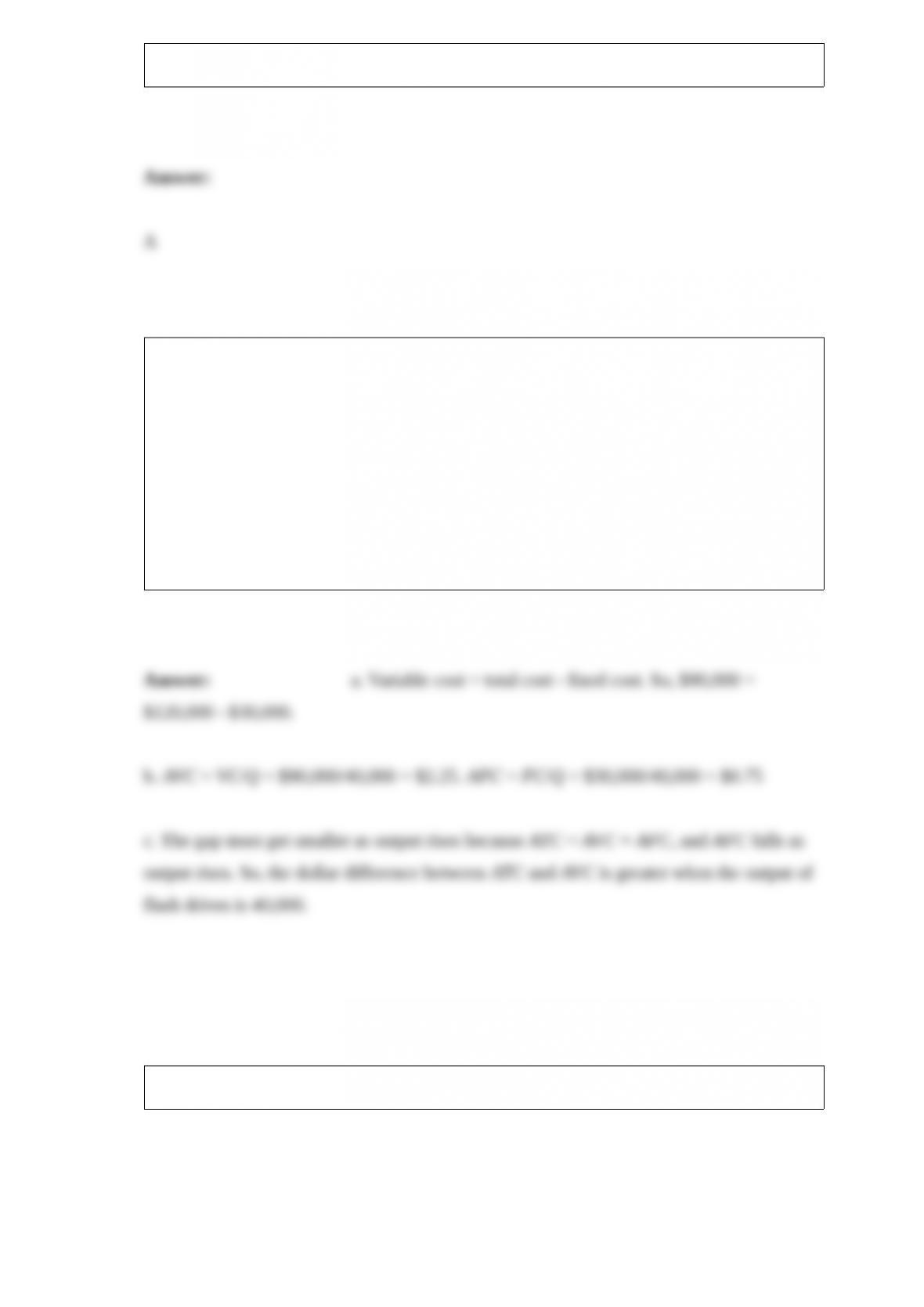
D) not enough information to answer the question
Suppose the total cost of producing 40,000 flash drives is $120,000, and the fixed cost
is $30,000.
a. What is the variable cost?
b. When output is 40,000, what are the average variable cost and the average fixed cost?
c. Assuming the cost curves have the usual shape, is the dollar difference between the
average total cost and the average variable cost greater when the output is 40,000 flash
drives or when the output is 60,000 flash drives? Explain.
Table 18-1
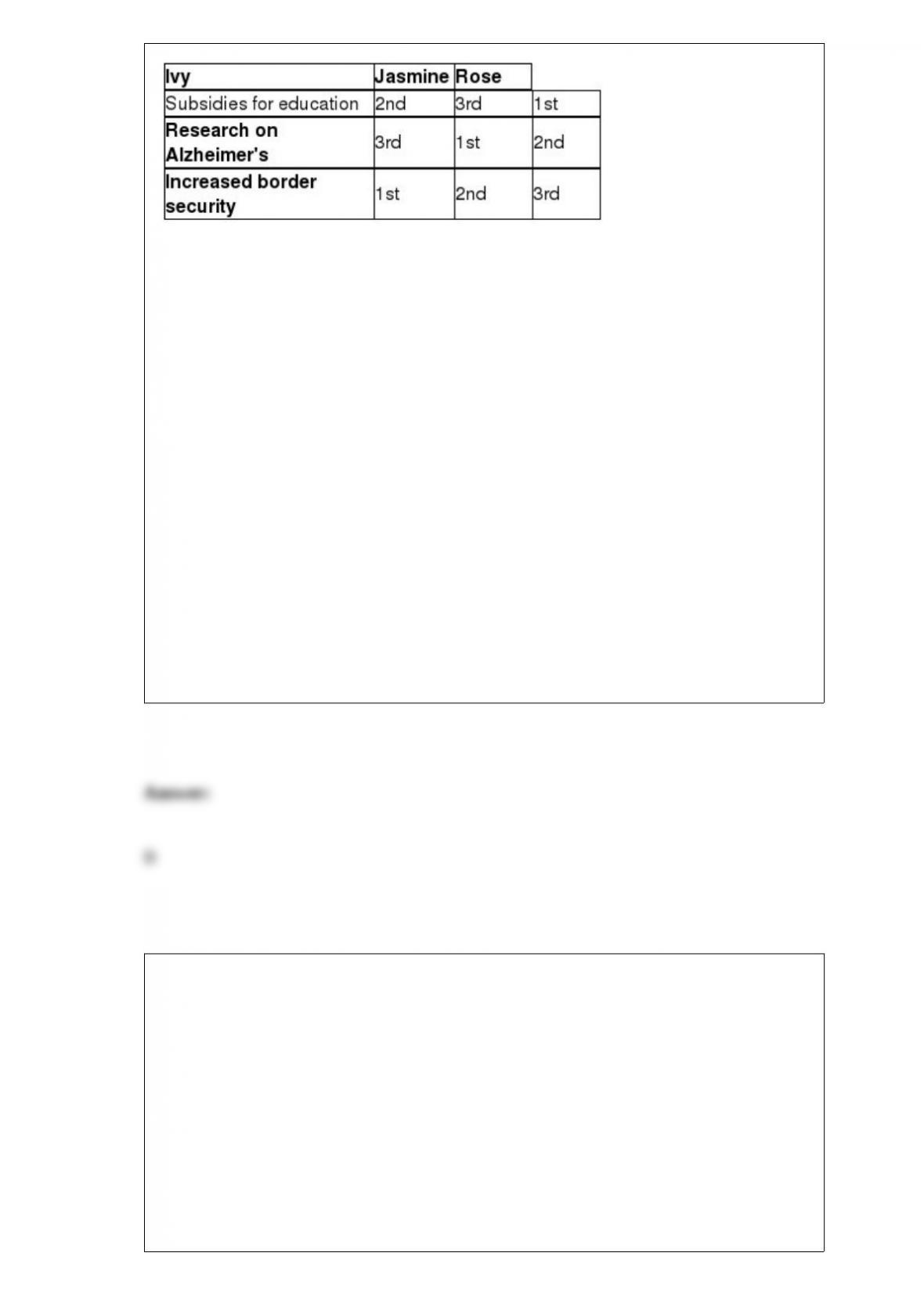
Suppose $1 billion is available in the budget and Congress is considering allocating the
funds to one of the following three alternatives: 1) Subsidies for education, 2) Research
on Alzheimer’s or 3) Increased border security. Table 18-1 shows three voters’ rankings
of the alternatives.
Suppose a series of votes are taken in which each pair of alternatives is considered in
turn. If the vote is between allocating funds to subsidies for education and research on
Alzheimer’s
A) Ivy and Jasmine vote for education subsidies, Rose votes for Alzheimer’s research,
and education subsidies wins.
B) Ivy and Rose vote for education subsidies, Jasmine votes for Alzheimer’s research,
and education subsidies wins.
C) Jasmine and Rose vote for Alzheimer’s research, Ivy votes for education subsidies,
and Alzheimer’s research wins.
D) Jasmine and Ivy vote for Alzheimer’s research, Rose votes for education subsidies,
and Alzheimer’s research wins.
In a decision tree, the difference between a decision node and a terminal node is that
A) at a decision node, all participants are free to make individual decisions, but at a
terminal node, they must agree on a collective decision.
B) at a decision node, all participants make the same decision, while at a terminal node,
different players may make different decisions.
C) at a decision node, a decision must be made, while a terminal node shows the payoff.
D) at a decision node, a decision must be made, while at a terminal node, the final
decision must be made.

In preparing their estimates of the stimulus package’s effect on GDP, Obama
administration economists estimated a government purchases multiplier of 1.57. This
indicates that a $1 billion increase in government purchases would increase equilibrium
real GDP by
A) $1 billion.
B) $1.57 billion.
C) $15.7 billion.
D) $157 billion.
Suppose the equilibrium real federal funds rate is 5 percent, the target rate of inflation is
3 percent, the current inflation rate is 5 percent, and real GDP is 4 percent above
potential real GDP. If the weights for the inflation gap and the output gap are both 1/2,
then according to the Taylor rule the federal funds target rate equals
A) 1 percent.
B) 9 percent.
C) 13 percent.
D) 17 percent.

Terence has $50 per week to spend on Subway sandwiches and milkshakes. The price
of a Subway sandwich is $5 and the price of a milkshake is $4. He buys 6 sandwiches
and 5 milkshakes. The marginal utility of the 6th sandwich = 25 and the marginal utility
of the 5th milkshake = 24. Which of the following is true?
A) He is not maximizing his utility and should buy more milkshakes.
B) He is maximizing his utility.
C) He is not maximizing his utility and should buy more Subway sandwiches.
D) He is not maximizing his utility because he is not spending all of his income.
Refer to the Article Summary. In an attempt to discourage smoking, New York City
Mayor Michael Bloomberg proposed a bill which would set a $10.50 minimum
price for a pack of cigarettes. The bill would also prohibit retailers from offering
any discounts such as 2-for-1 offers or accepting discount coupons. New York City
already has the highest cigarette tax in the country, at $5.85 per pack, and the state
of New York is one of many which already require cigarettes be marked up by a
specified percentage. This bill is a companion to one which would require stores to
keep tobacco products hidden from sight. Although the bills are expected to be
challenged in court, a precedent has been set in Rhode Island, where a court
upheld a ruling allowing the city of Providence to forbid retailers from accepting
coupons and offering discounts on cigarettes. Source: Vivian Yee, “Bloomberg
Seeks End to Cheap Cigarettes,” New York Times, March 26, 2013.
The minimum price of $10.50 per pack of cigarettes being proposed by mayor
Bloomberg would have which of the following effects on the market for cigarettes?
A) Consumer surplus will increase.
B) Producer surplus will increase.
C) Deadweight loss will increase.
D) Market efficiency will increase.