
As presented in the textbook, research by some economists has shown that even when
there is no difference between options provided to people
a. the way in which the options are framed has no impact on the outcome (i.e. there will
be no preference for one option over another).
b. the preferred option will always be the one that is stated most simplistically.
c. the preferred option will always be the one that sounds more complicated.
d. the way in which the options are framed impacts the outcome (i.e. which option is
preferred).
If real income rises in the economy and, at the same time, productivity in the agriculture
sector rises, too, then it follows that the demand for food will
a. rise (assuming that income elasticity of demand for food is greater than 1) and the
supply of food will remain constant.
b. rise (assuming that income elasticity of demand for food is greater than 0) and the
supply of food will increase, too.
c. fall (assuming that income elasticity of demand for food is greater than 1) and the
supply of food will fall, too.
d. fall (assuming that income elasticity of demand for food is equal to 1) and the supply
of food will rise.
e. none of the above
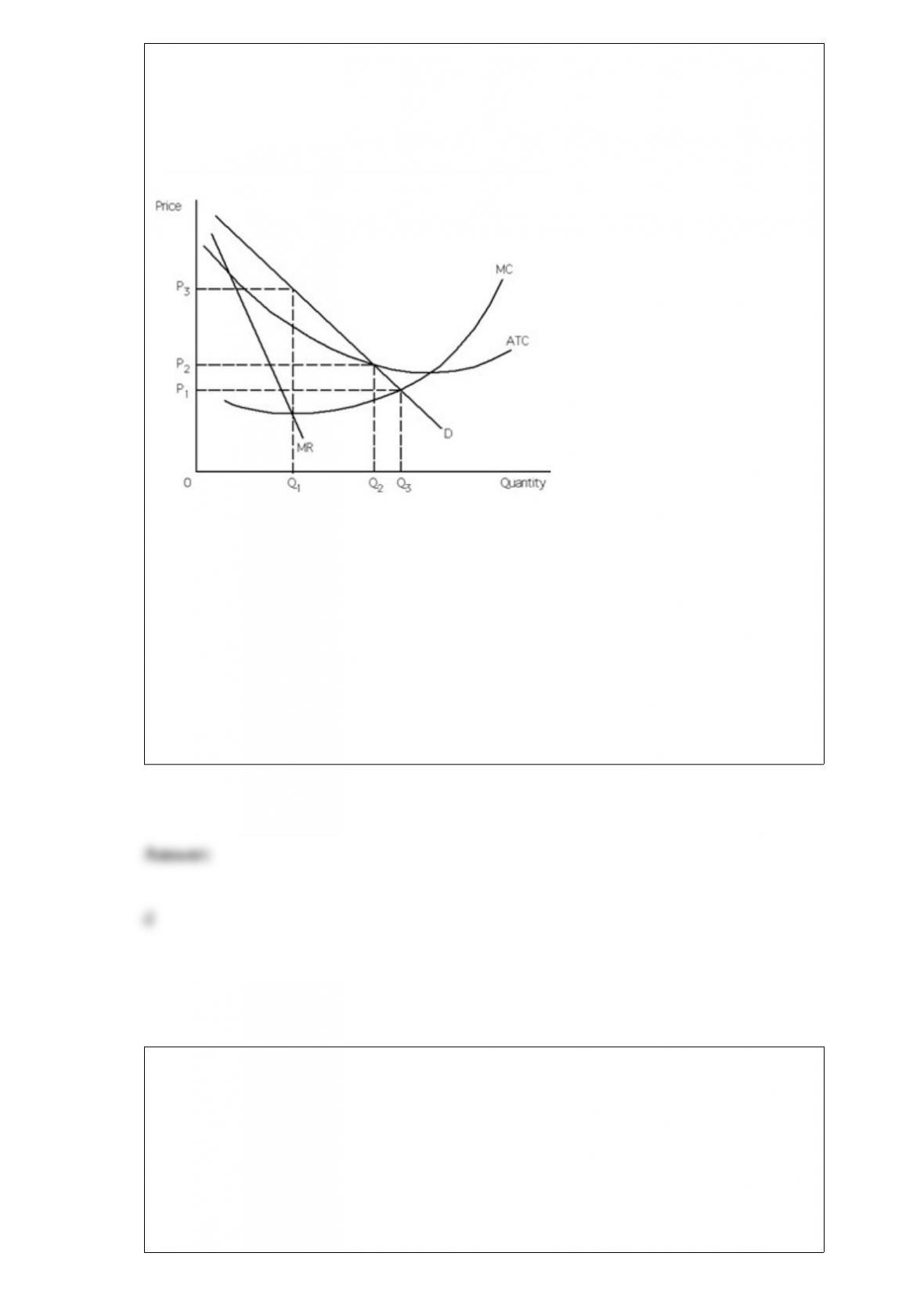
Refer to Exhibit 26-5. If the natural monopoly firm is regulated to charging a price per
unit that achieves resource-allocative efficiency, then it will produce __________
quantity of output and charge a price of __________ per unit.
Exhibit 26-5
a. Q1; P3
b. Q1; P2
c. Q2; P3
d. Q3; P1
e. none of the above
Which of the following statements is true?
a. The less you have of any one good, the less you would be willing to pay for one more
unit of it.
b. The less you have of any one good, the more you would be willing to pay for one
more unit of it.

c. The amount you have of any one good does not influence the price you would be
willing to pay for it, but it does affect the marginal utility received from consuming a
particular unit.
d. none of the above
The perfectly competitive firm should produce in the
a. short run if price is below average variable cost.
b. long run if price is below average variable cost.
c. short run if price is below average total cost but above average variable cost.
d. long run if price is below average total cost but above average variable cost.
When students arrive late to class and disrupt their classmates
a. a negative externality can arise.
b. a positive externality can arise.
c. a public good (education) becomes rivalrous.
d. a public good (education) becomes nonrivalrous.

If goods are not rationed according to price, if follows that
a. they won’t get rationed at all.
b. some non-price rationing device will be used to ration the goods.
c. first-come-first-served will necessarily be the rationing device used in the market.
d. there will be surpluses in the market.
e. none of the above
Which of the following is true at the level of output which maximizes profits for a
perfectly price-discriminating monopolist?
a. P > MC.
b. P < ATC.
c. P < MC.
d. a and b
e. none of the above

In order to make the income distribution more equal, the federal government could
a. increase taxes on the rich and increase transfer payments to the poor.
b. decrease transfer payments to the rich.
c. increase taxes on the poor.
d. increase taxes on the rich and increase transfer payments to the middle class.
e. a and d
Which of the following was declared illegal by the Sherman Act of 1890?
a. a conspiracy in restraint of trade
b. price discrimination
c. tying contracts
d. interlocking directorates

Which of the following is true for a monopsony?
a. It cannot buy additional units of a factor without increasing the price it pays for the
factor.
b. It can buy additional units of a factor without increasing the price it pays for the
factor.
c. The supply of labor it faces is the industry supply of labor.
d. a and c
e. b and c
If you place $10,000 in a savings account that pays 3 percent interest per year and you
leave all the money, principal plus interest earned, in the account for three years,
approximately how much money will you have at the end of the three years?
a. $10,090
b. $11,120
c. $10,927
d. $9,152
e. $10,124

Economists use the ceteris paribus assumption primarily in order to
a. make their analyses easier for them to conduct.
b. designate what they believe is the correct relationship between two variables.
c. explain why people sometimes consume more of a good when its price rises.
d. explain why those things that come first do not necessarily cause those things that
come later.
e. designate the difference between normative and positive economics.
Competition is legally prohibited when barriers to entry take the form of
a. public franchises.
b. economies of scale.
c. exclusive ownership of a resource.
d. all of the above
e. none of the above
Price falls from $9 to $8, and the quantity demanded rises from 360 units to 400 units.
What is the approximate price elasticity of demand between these two prices?

a. 0.89
b. 10.51
c. 0.68
d. 3.80
e. 1.12
A person buys a newly issued bond that matures in 6 years with a face value of $1,000
and a coupon rate of 5%.How much money will the bondholder receive in the sixth
year?
a. $1,050.
b. $1,500.
c. $1,000.
d. $50.
e. $500
The acreage allotment program involves
a. no direct payments to farmers.
b. direct payments to farmers.
c. the government leasing land to farmers that is to be cultivated by the farmers.
d. the government leasing land from farmers that is to be cultivated by the government.
e. none of the above
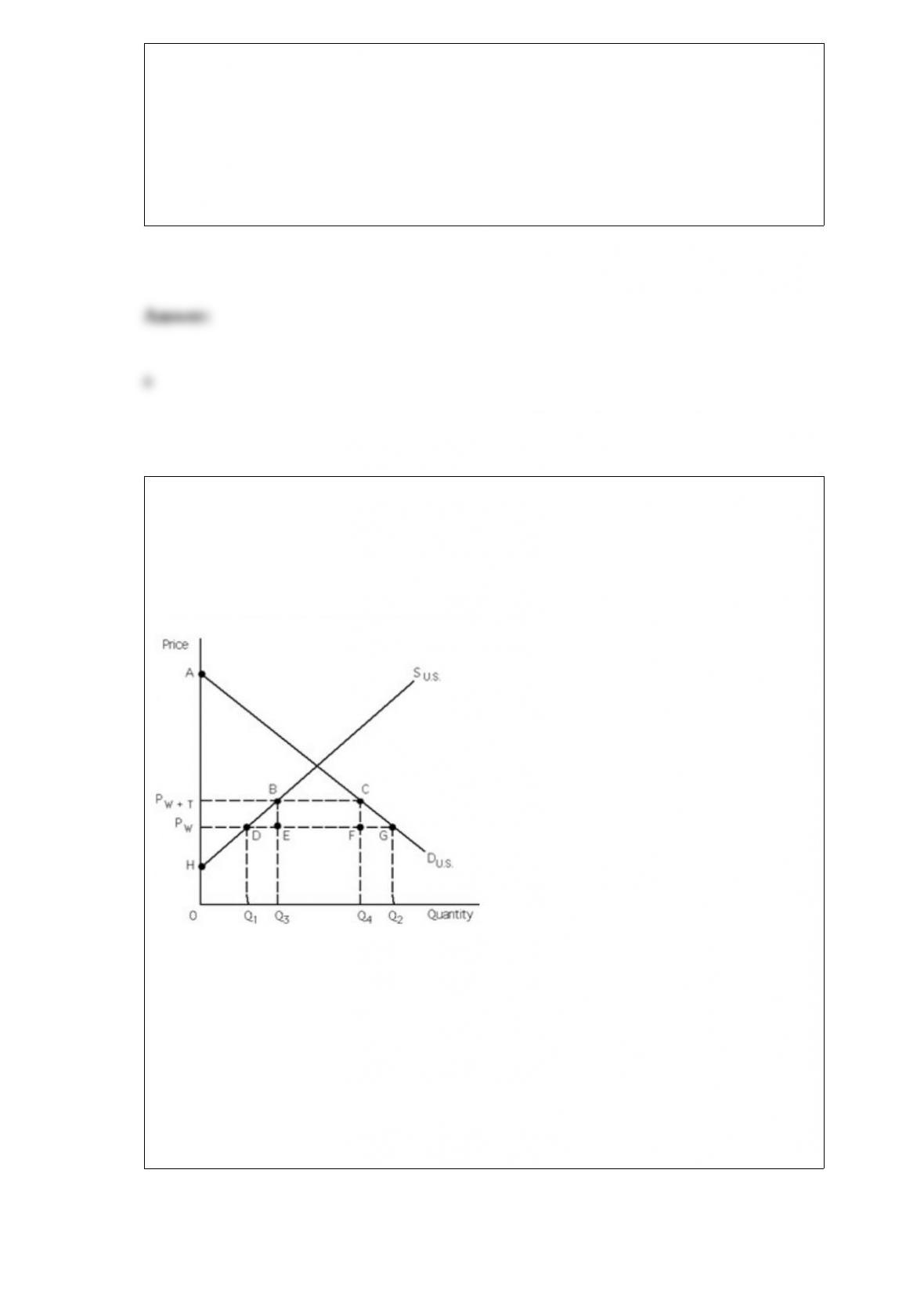
Refer to Exhibit 34-11. PW is the price that exists in the market before a tariff is
imposed and PW + T is the price that exists in the market after a tariff is imposed. Tariff
revenues equal the area
Exhibit 34-11
a. DBCG.
b. EBCF.
c. CFG.
d. BCGE.
e. DBCF.
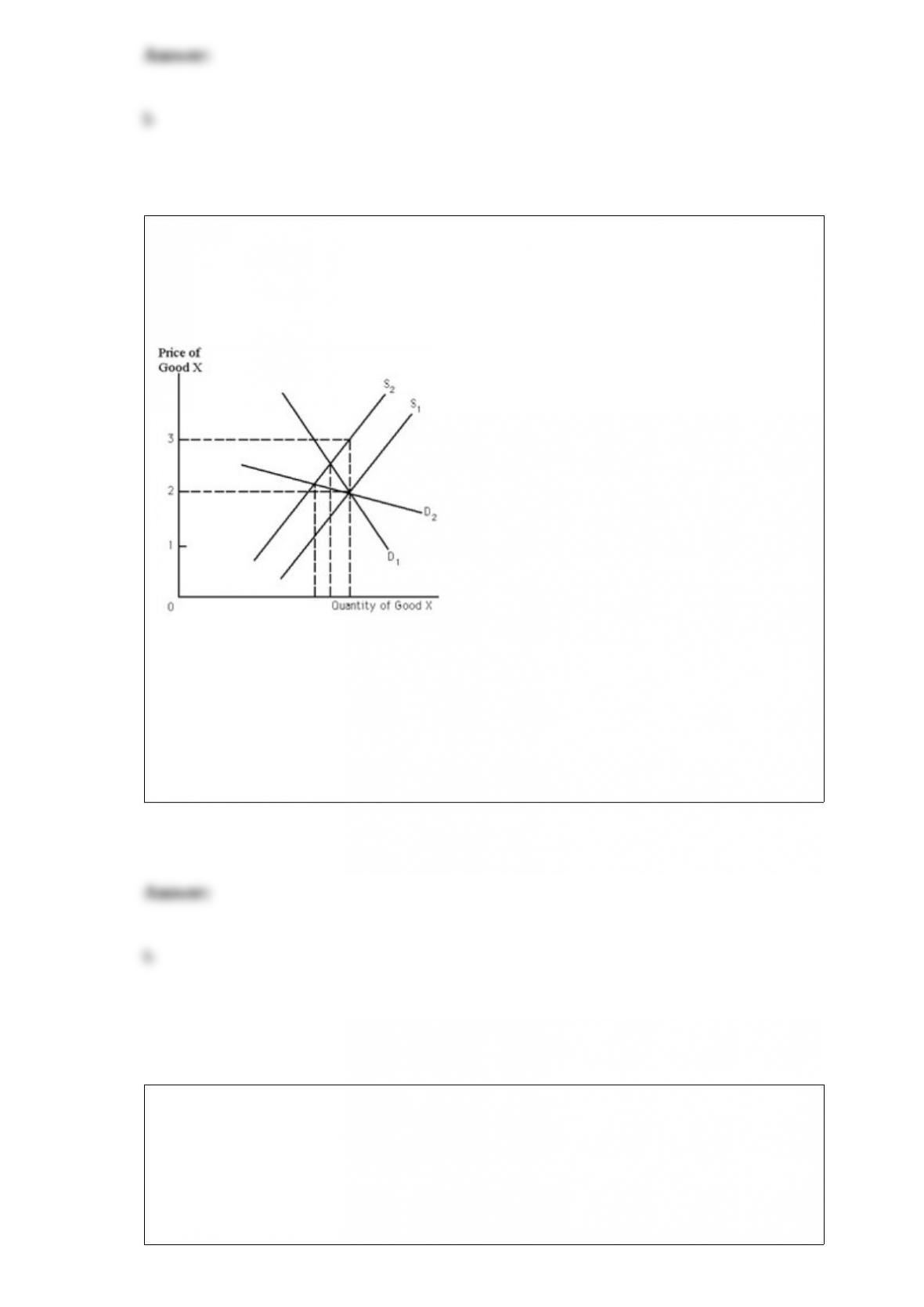
Refer to Exhibit 20-6. Let S1 be the supply curve of a producer. If S2 is the supply curve
of the same producer after the government imposes a per-unit tax, the share of the tax
paid by the producer as compared to the share of the tax paid by consumers will be
Exhibit 20-6
a. greater if D1 is the demand curve facing the producer.
b. greater if D2 is the demand curve facing the producer.
c. the same regardless of which demand curve the firm faces.
d. Any of the above, depending on the type of good the tax is imposed on.
Theory B predicts that everything that happens, happens for a reason – although we may
not know what the reason is.This theory
a. can be refuted.
b. probably cannot be refuted.

c. is a good explanation for what happens.
d. is the kind of theory that scientists like to build because it can explain so much.
If the government attempts to aid farmers by implementing a policy that results in a
leftward shift in the supply curve of agricultural products, the policy in question is most
likely
a. a price support.
b. an acreage allotment program.
c. a target price.
d. any of the above