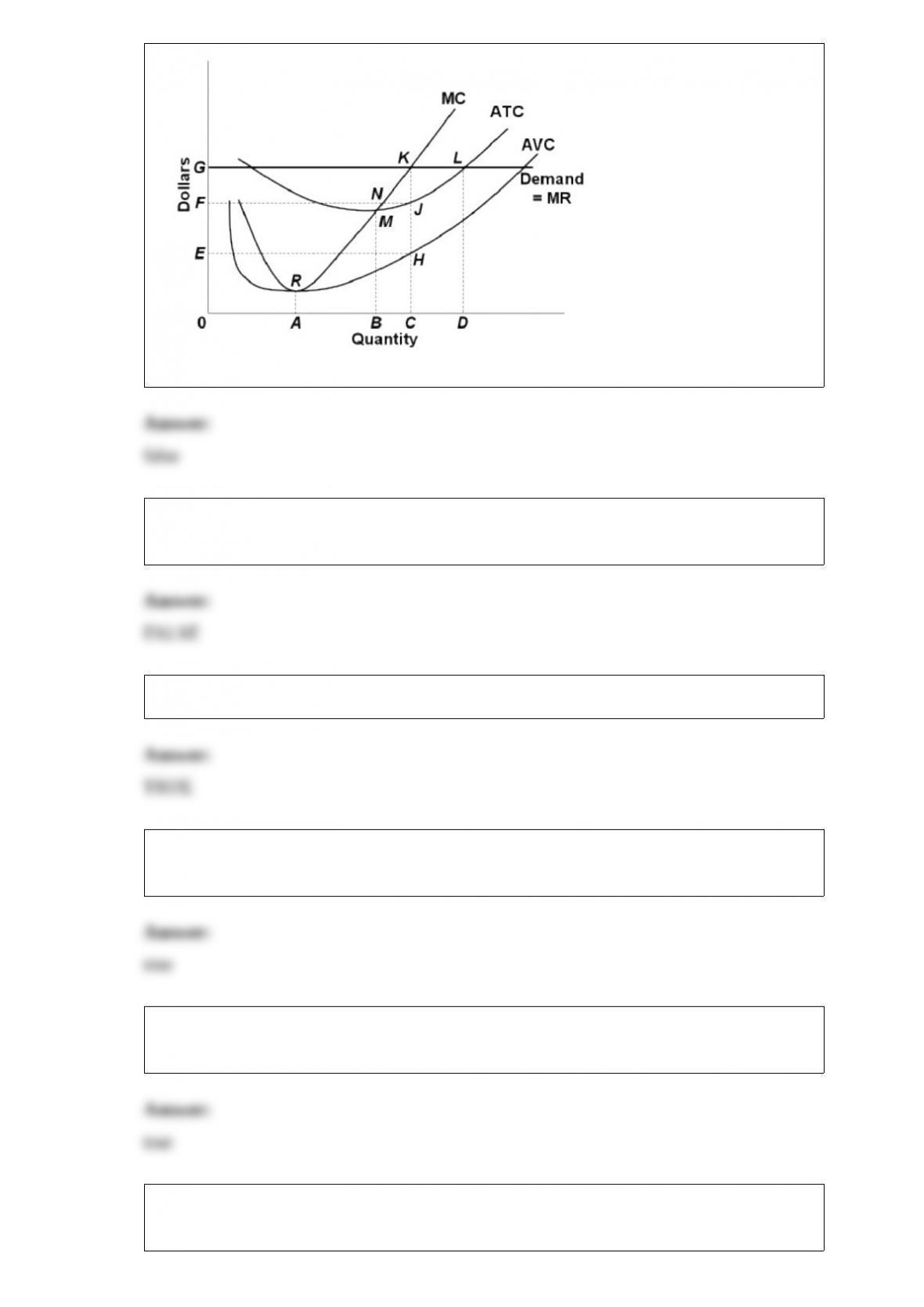
1)
refer to the above diagram. at output c average fixed cost is gf.
2) A $10 billion decrease in taxes will increase the equilibrium GDP by more than
would a $10 billion increase in government expenditures.
3) The higher the reserve requirement, the lower is the monetary multiplier.
4) some employers have reacted to rising health care costs by hiring more part-time and
temporary workers.
5) a market that is achieving allocative efficiency must also be achieving productive
efficiency.
6) The short-run aggregate supply curve is vertical and the long-run aggregate supply
curve is horizontal.

7) Fiscal policy is mainly undertaken by the Federal Reserve.
8) for a nondiscriminating imperfectly competitive firm:
a.the marginal revenue curve lies above the demand curve.
b.the demand and marginal revenue curves coincide.
c.the demand curve intersects the horizontal axis where total revenue is at a maximum.
d.marginal revenue will become zero at that output where total revenue is at a
maximum.
9) if the variable costs of a profit-maximizing pure monopolist decline, the firm should:
a.produce more output and charge a higher price.
b.produce more output and charge a lower price.
c.reduce both output and price.
d.raise both output and price.
10) The economic term for a sole employer in a nonunion community is:
A.monopsonist.
B.monopolist.
C.bilateral competitor.
D.bilateral monopolist.
11) Which of the following is not inversely related to per capita income?
A.mortality rates for children under 5 years of age
B.adult illiteracy rates
C.per capita energy consumption
D.population growth rates
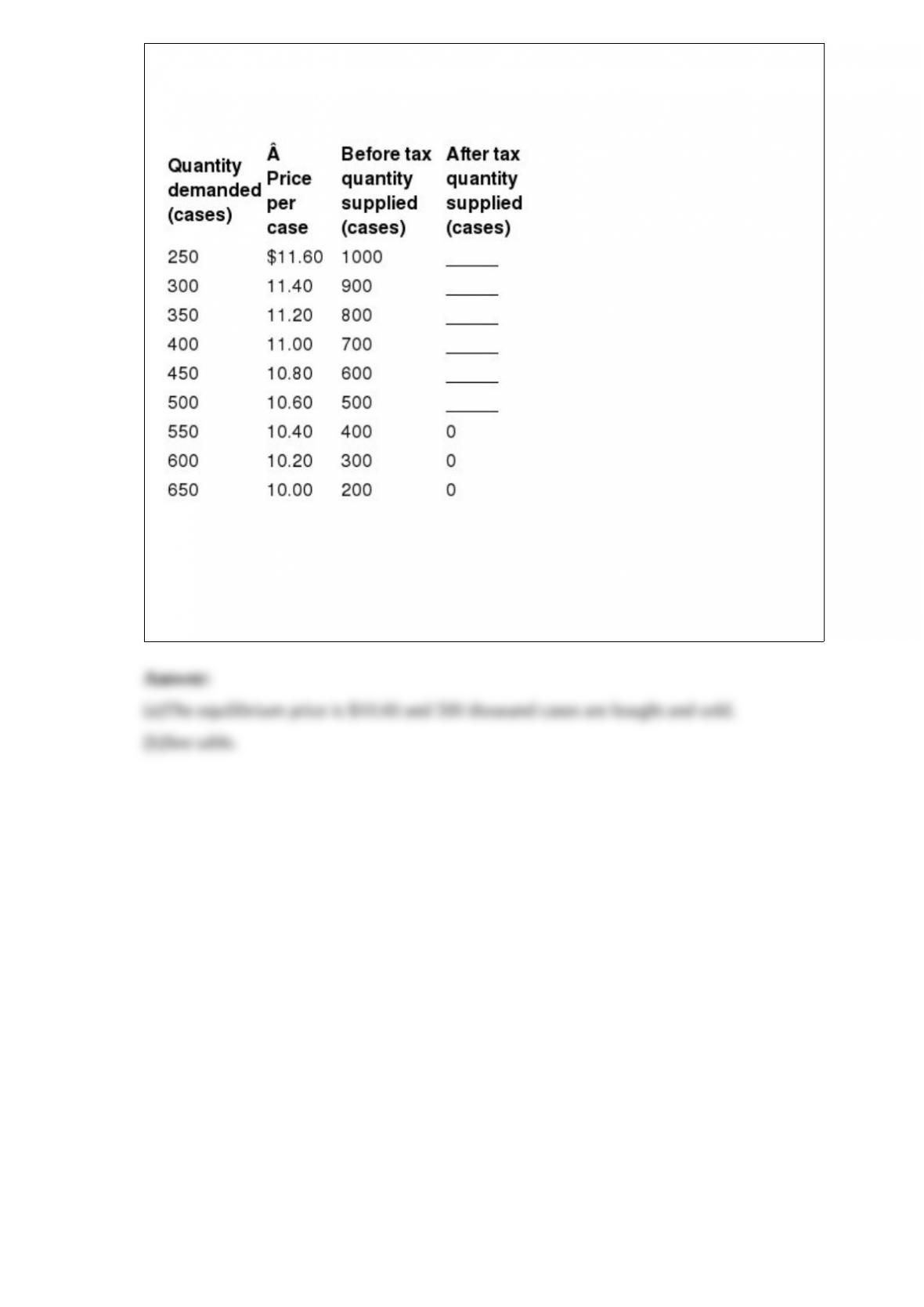
12) In the table below are the demand and supply schedules for beer in thousands of
cases in a state.
(a)What is the equilibrium price and quantity before a tax is imposed?
(b)If state government now imposes an excise tax of $0.60 per case of beer, what is the
after-tax supply schedule?
(c)What is the equilibrium price of beer after the tax is imposed? How much of the
$0.60 is borne by the buyer and how much by the seller?
13) in moving along a given budget line:
a.the prices of both products and money income are assumed to be constant.
b.each point on the line will be equally satisfactory to consumers.
c.money income varies, but the prices of the two goods are constant.
d.the prices of both products are assumed to vary, but money income is constant.
14) about ________ of recent annual labor force growth in the united states is the result
of immigration.
a.one-tenth
b.one-fifth
c.one-third
d.one-half
15) At the equilibrium GDP for an open economy:
A.net exports may be either positive or negative.
B.imports will always exceed exports.
C.exports will always exceed imports.
D.exports and imports will be equal.
16) aggregate u.s. health care spending in 2006 was about:
a.6 percent of domestic output.
b.12 percent of domestic output.
c.16 percent of domestic output.
d.20 percent of domestic output.
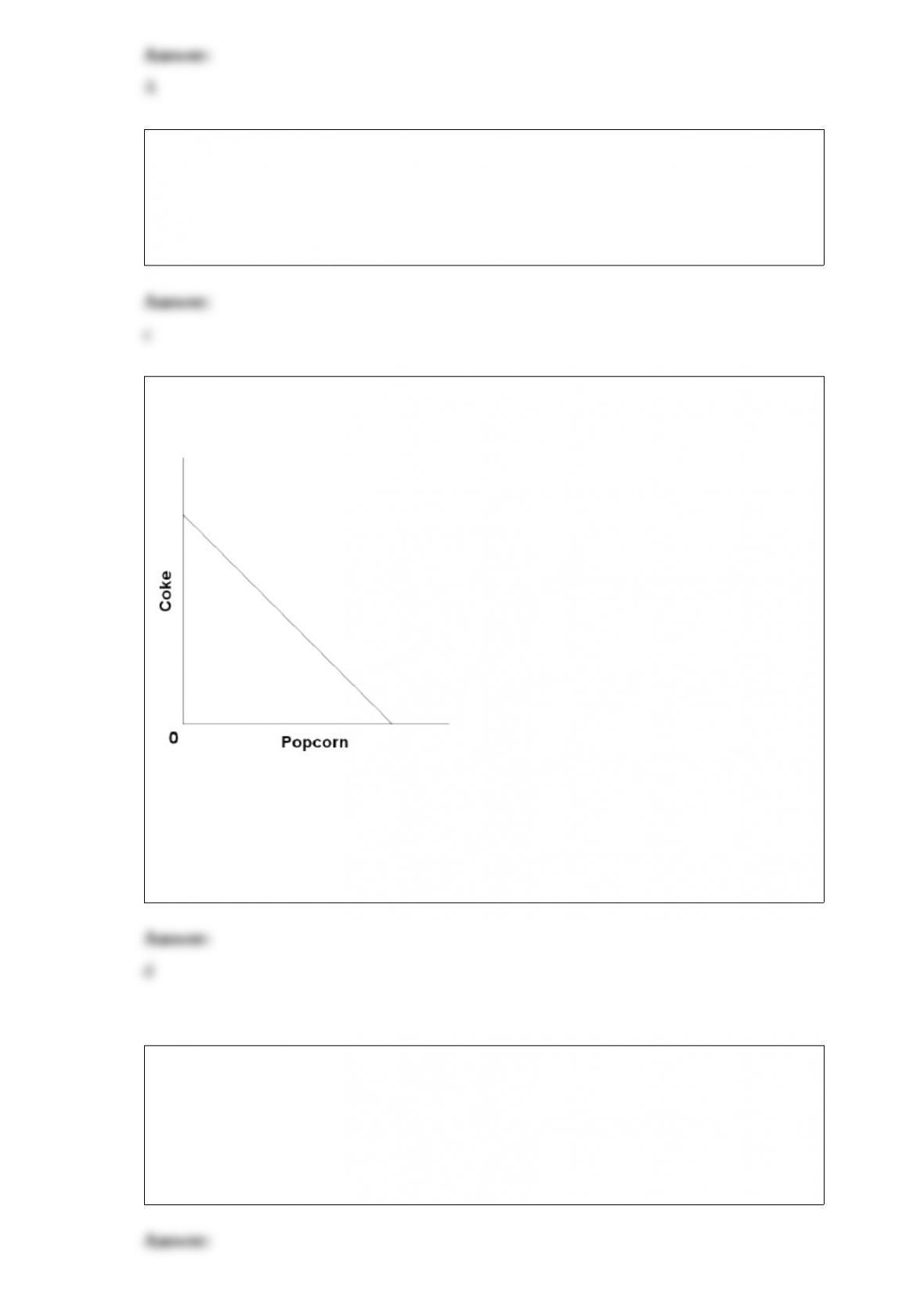
17)
suppose elroy’s budget line is as shown on the above diagram. if his tastes change in
favor of coke and against popcorn, the budget line will:
a.become steeper.
b.become flatter.
c.shift rightward.
d.be unaffected.
18) in the short run a purely competitive firm that seeks to maximize profit will
produce:
a.where the demand and the atc curves intersect.
b.where total revenue exceeds total cost by the maximum amount.
c.that output where economic profits are zero.
d.at any point where the total revenue and total cost curves intersect.

19) (Last Word) Construction of the first working computer “mouse” best exemplifies:
A.invention.
B.scientific determinism.
C.diffusion.
D.creative destruction.
20) Critics of unions argue that unions diminish efficiency and productivity by:
A.engaging in featherbedding.
B.precipitating strikes.
C.causing a misallocation of labor.
D.doing all of these.
21) The Federal Deposit Insurance Corporation (FDIC) insures deposits up to $100,000
in:
A.mutual fund companies and pension fund companies.
B.thrifts and insurance companies.
C.commercial banks and thrifts.
D.securities firms and insurance companies.
22) The union wage advantage:
A.has consistently been in the 25-30 percent range since the Second World War (1945).
B.is estimated to be about 15 percent.
C.has steadily increased along with the relative decline in unionism occurring since
1955.
D.reached a record-high level in 2003.
23) supporters of offshoring claim that its benefits include:
a.increased demand for workers in complementary jobs.
b.keeping u.s. firms profitable by lowering production costs.
c.reduced prices for consumers.
d.all of these.
24) What is the difference between nominal and real wages?
25) Define labor market discrimination. How much of the differences in the earnings of
workers are explained by discrimination?
26) Distinguish between the nominal and real rates of interest using an example.
27) Explain the problem of adverse selection. How might this problem affect
transactions in the insurance industry?
28) How does investors preference for risk affect the slope of the security market line?
29) What is the magnitude of the differences in GDP per capita between industrially
advanced countries and developing countries?