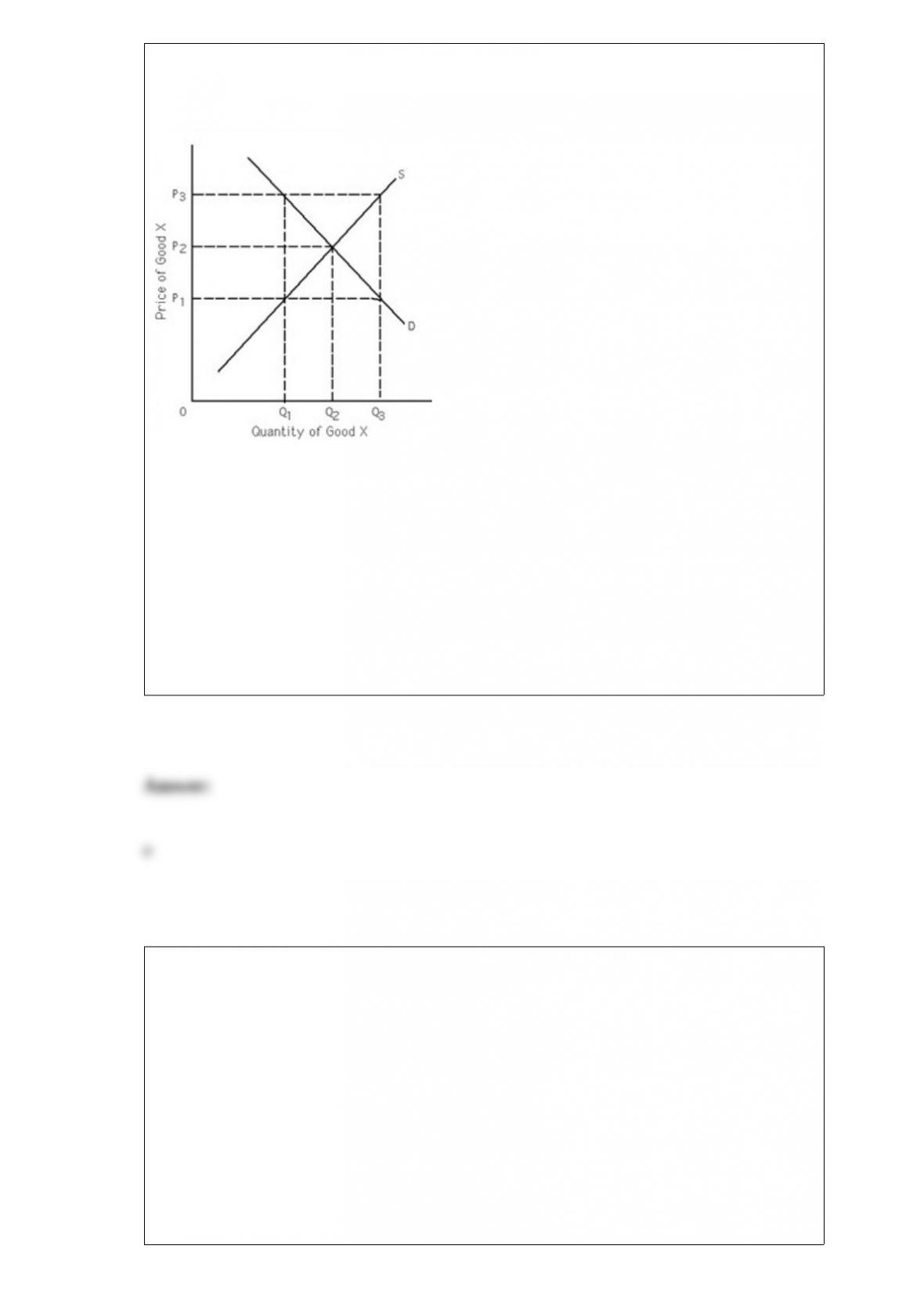
Refer to Exhibit 4-3. If price P3 is a price ceiling, then
Exhibit 4-3
a. the price ceiling does not have an effect on the market for good X.
b. the price at which exchange takes place is P3.
c. the price at which exchange takes place is P2.
d. there is a shortage in the market for good X.
e. both a and c
The larger a percentage of the population a person is, the ______________ likely that
person will have to further engage with people she meets.This implies that she will
generally be ____________ likely to behave unethically and poorly with the people in
her town as the population of her town increases.
a. more; less
b. less; less
c. more; more
d. less; more
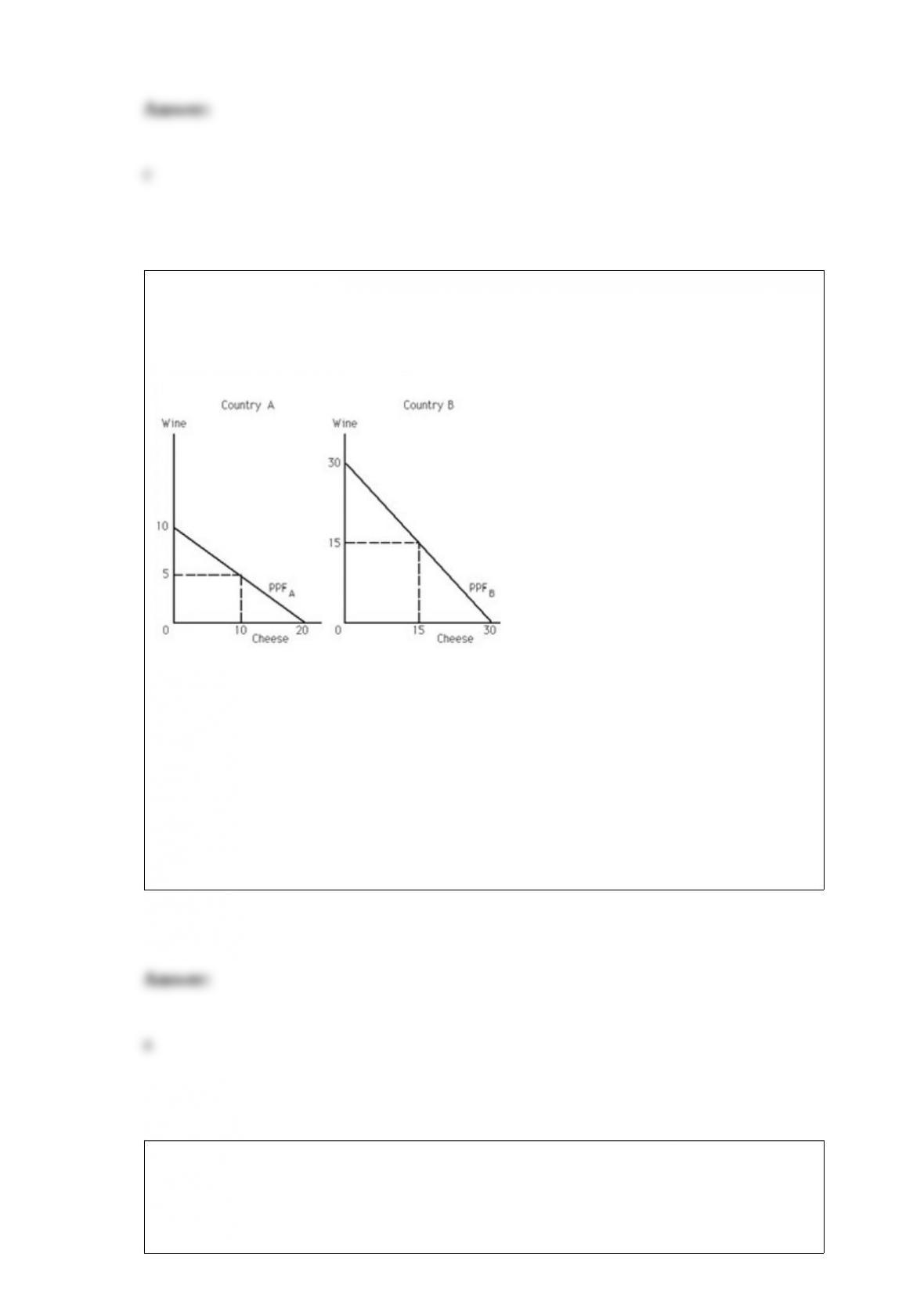
Refer to Exhibit 34-6. The opportunity cost of 1 unit of cheese in terms of units of wine
is __________ for country A.
Exhibit 34-6
a. 1/2
b. 2
c. 10
d. 5
e. none of the above
The purpose of the ceteris paribus assumption is to allow economists to
a. determine the relationship among several variables.
b. determine the impact of several variables on another variable.
c. isolate the impact of one variable on several variables.
d. isolate the relationship between two variables.
If a contestable market does not satisfy all of the conditions of a perfectly competitive
market, that contestable market _______________ achieve resource allocative
efficiency.
a. will not
b. will definitely
c. could possibly
d. This is a trick question since only monopolies achieve resource allocative efficiency.
Because of one assumption in the theory of monopolistic competition, the excess
capacity theorem exists. What is the assumption?
a. There are many sellers and buyers.
b. Each firm produces and sells a slightly differentiated product.
c. There is easy entry into the industry.
d. There is easy exit from the industry.
The Celler-Kefauver Antimerger Act of 1950
a. made interlocking directorates illegal.
b. banned anticompetitive mergers that occurred as a result of one company acquiring
the physical assets of another company.
c. attempted to decrease the failure rate of small businesses by protecting them from the
competition of large and growing chain stores.
d. both a and b
e. all of the above
The economy was at point A producing 100X and 200Y. It moved to point B where it
produces 200X and 300Y. It follows that
a. point A may have been a point below the economy’s PPF, while point B may lie on
the PPF.
b. the economy’s PPF could have shifted outward and point A was a point on the
economy’s old PPF.
c. the economy has moved from one point on its PPF to another point on the same PPF.
d. a or b
e. a or c
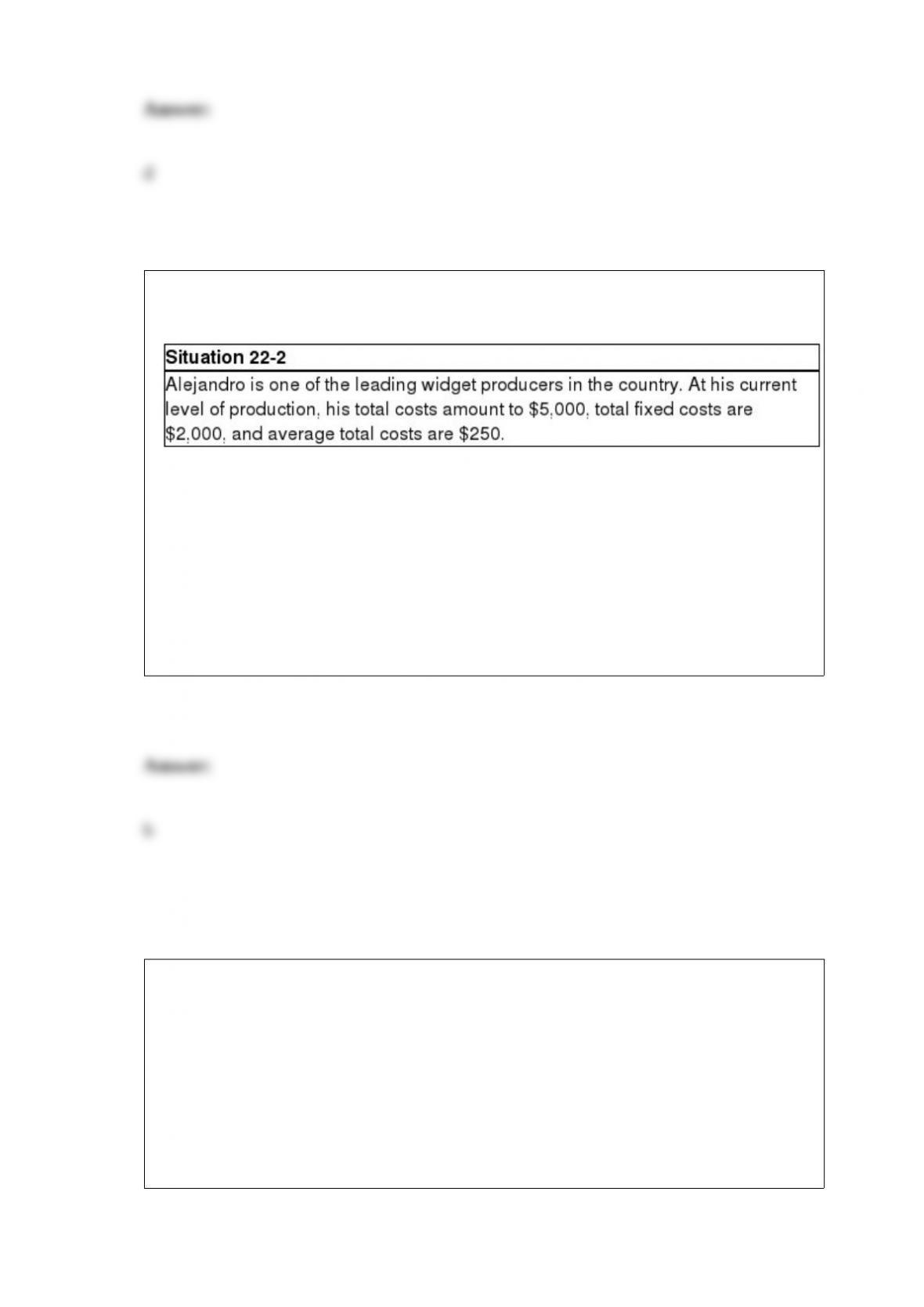
Refer to Situation 22-2. What are Alejandro’s average variable costs at the present level
of production?
a. $60
b. $150
c. $100
d. $200
e. There is not enough information to answer the question.
To an economist, utility refers to the
a. usefulness of a good or service.
b. satisfaction that results from the consumption of a good.
c. relative scarcity of a good.
d. rate of decline in the demand curve.

When the government imposes taxes on firms that are earning high profits, there could
be an unintended effect of reducing the supply of goods in that market compared to
what the supply would be if the profits were not taxed.
a. True
b. False
Which of the following statements represents a correct and sequentially accurate
economic explanation?
a. A tax is placed on the production of good X, the supply curve of good X shifts to the
left, equilibrium price rises, equilibrium quantity falls, and buyers pay 100 percent of
the tax.
b. A tax is placed on the production of good X, the supply curve of good X shifts to the
left, equilibrium price rises, equilibrium quantity stays constant, and buyers pay 100
percent of the tax.
c. A tax is placed on the production of good X, the supply curve of good X shifts to the
left, equilibrium price does not change, equilibrium quantity rises, and sellers pay 50
percent of the tax.
d. A tax is placed on the production of good X, the supply curve of good X shifts to the
right, equilibrium price falls, equilibrium quantity falls, and sellers pay 100 percent of
the tax.
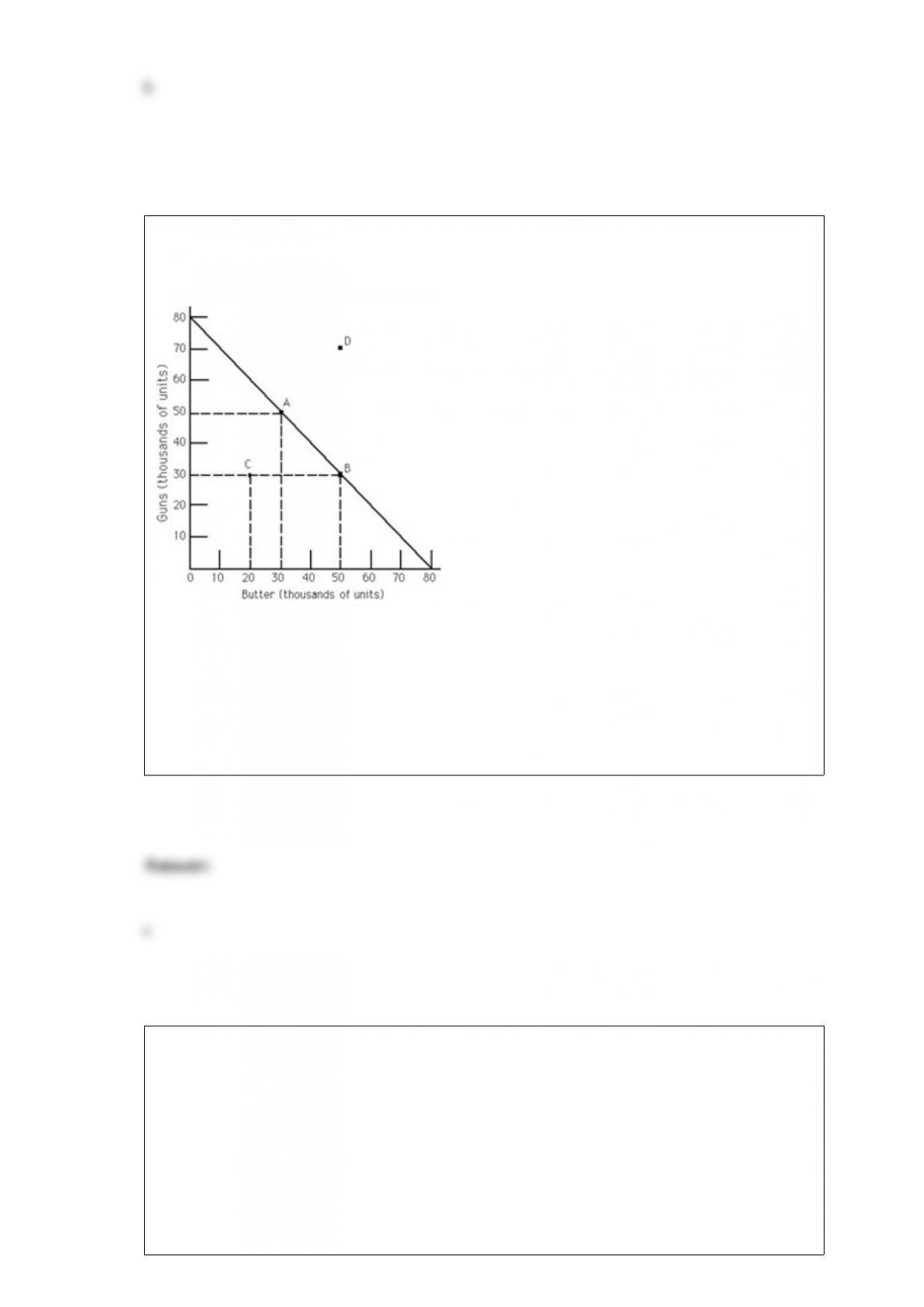
Refer to Exhibit 2-1. The opportunity cost of moving from point A to B is
Exhibit 2-1
a. 10,000 units of butter.
b. 20,000 units of butter.
c. 20,000 units of guns.
d. 10,000 units of guns.
If a union seeks to maximize the total wage bill received by its members, then it should
negotiate the
a. highest possible wage rate.
b. wage rate at which all of its members are employed.
c. wage rate that maximizes the firm’s profits.
d. wage rate at which the elasticity of demand for workers is 1.
e. wage rate at which the elasticity of demand for workers is at its highest.
All economists assert that the National Collegiate Athletic Association (NCAA) is a
type of cartel that enforces the monopsony behavior of universities and colleges in the
market for college athletes.
a. True
b. False
When P = $65, the quantity demanded of a good is 80 units, and the quantity supplied
of the good is 40 units.For every $10 increase in the price of this good, quantity
demanded falls by 10 units and quantity supplied rises by 10 units.The equilibrium
price of this good is ___________and the equilibrium quantity of this good is
_________ units.
a. $55; 30
b. $75; 50
c. $75; 70
d. $85; 50
e. $85; 60
One of the necessary conditions for a contestable market is that new firms entering the
market have a cost advantage over the existing firms.
a. True
b. False