
Which of the following statements is true?
a. An extra dollar earned by a millionaire necessarily brings him or her less utility than
an extra dollar earned by a poor person.
b. If marginal utility is constant, then total utility for two units of a good is equal to the
marginal utility of the second unit of the good.
c. The marginal and total utility of a good are the same for the first unit of the good.
d. Total utility will rise if marginal utility is negative.
e. a and c
Suppose an industry is made up of four firms, all with equal sales. The four-firm
concentration ratio of that industry is
a. 0.125.
b. 0.50.
c. 1.00.
d. This cannot be determined without more information.
Demand for a food item increases by more than the supply of the food item. One thing
for certain is that
a. the price of the food item rises.
b. income elasticity of demand (for the food item) is greater than 1.
c. the supply curve is price elastic.
d. real income rises as a result.
e. none of the above
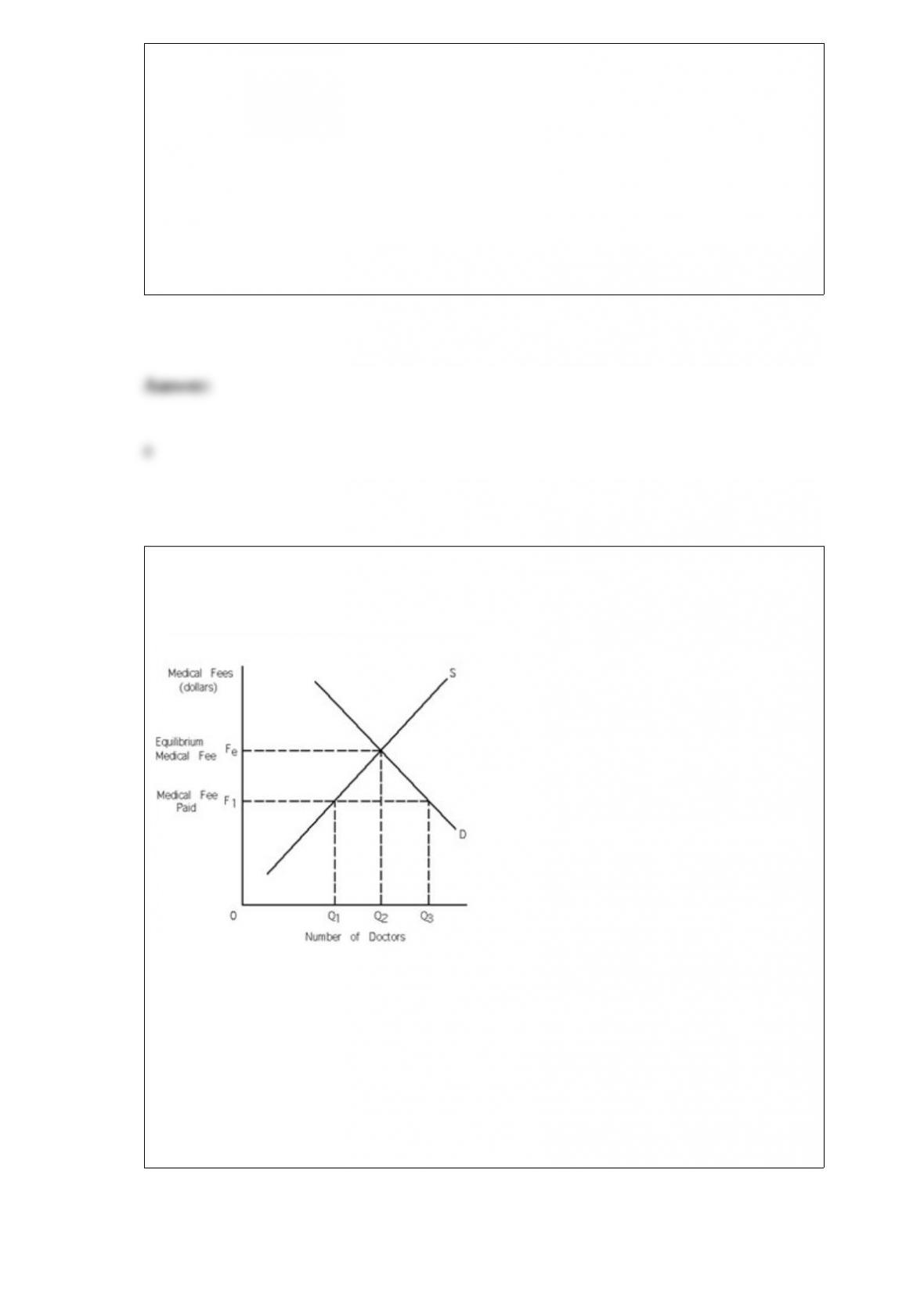
Refer to Exhibit 3-15. In Exhibit 3-15, at fee F1 there is a
Exhibit 3-15
a. shortage of(Q3 – Q1) doctors.
b. surplus of (Q3 – Q1) doctors.
c. surplus of (Q2 – Q1) doctors.
d. shortage of (Q2 – Q1) doctors.
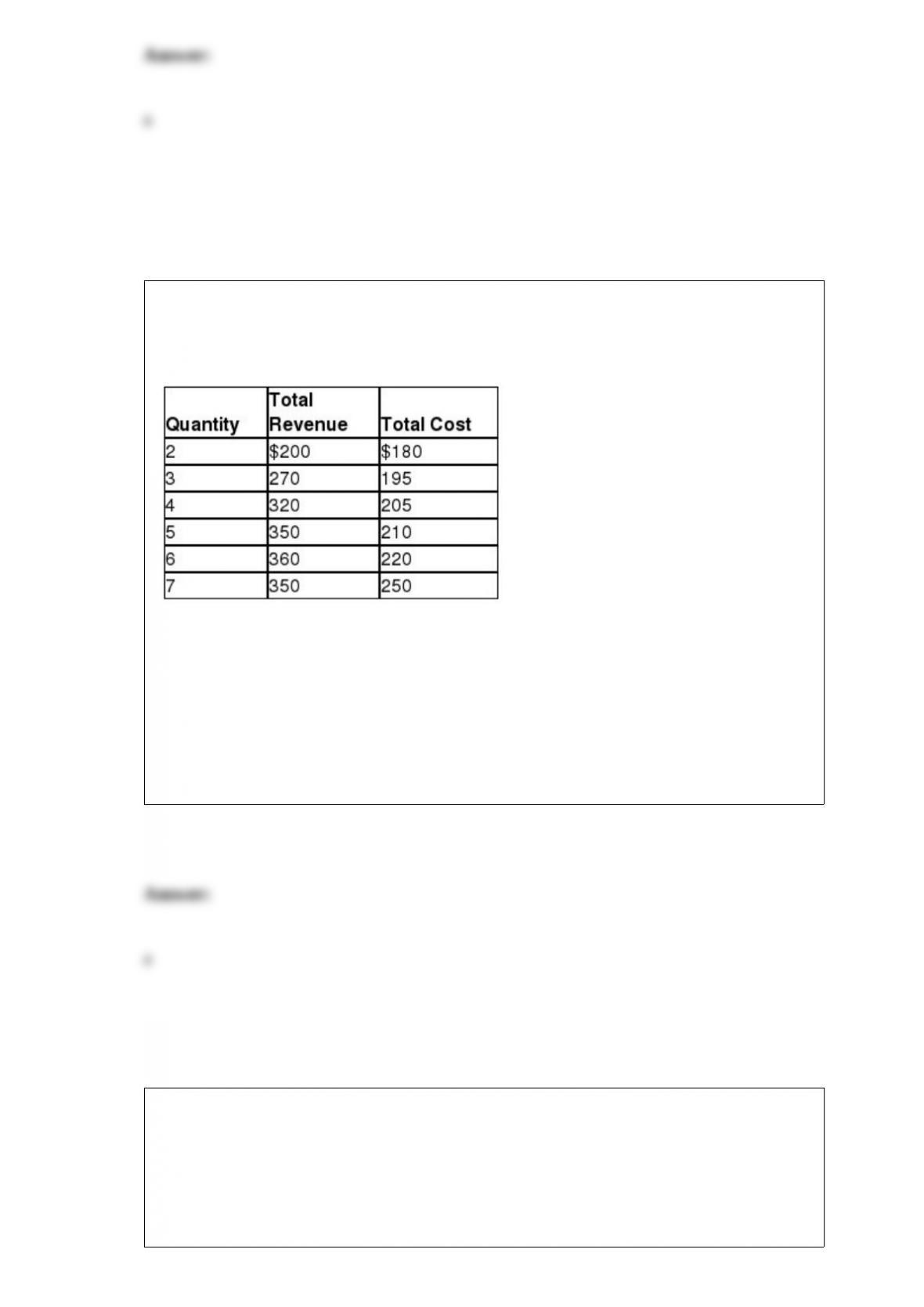
Refer to Exhibit 25-8. The marginal cost of the last unit produced at the
profit-maximizing output level equals
Exhibit 25-8
a. $10.
b. $40.
c. $20.
d. $5.
Suppose the government decides that every family should own its own home. To bring
this about, the government decides to subsidize the home-construction industry by
giving the home-construction companies $10,000 for every house that they build. As a
result of this,
a. the supply curve of new houses would shift leftward, since it now costs $10,000 more

for builders to produce a house.
b. the demand curve for new houses would shift rightward, since now every family
would want to buy a house.
c. the demand curve for new houses would shift leftward.
d. the supply curve of new houses would shift rightward, since builders would be
willing to produce and sell more houses at each given price.
e. c and d
Costs that do not change with output are called __________ costs.
a. marginal
b. average
c. fixed
d. variable
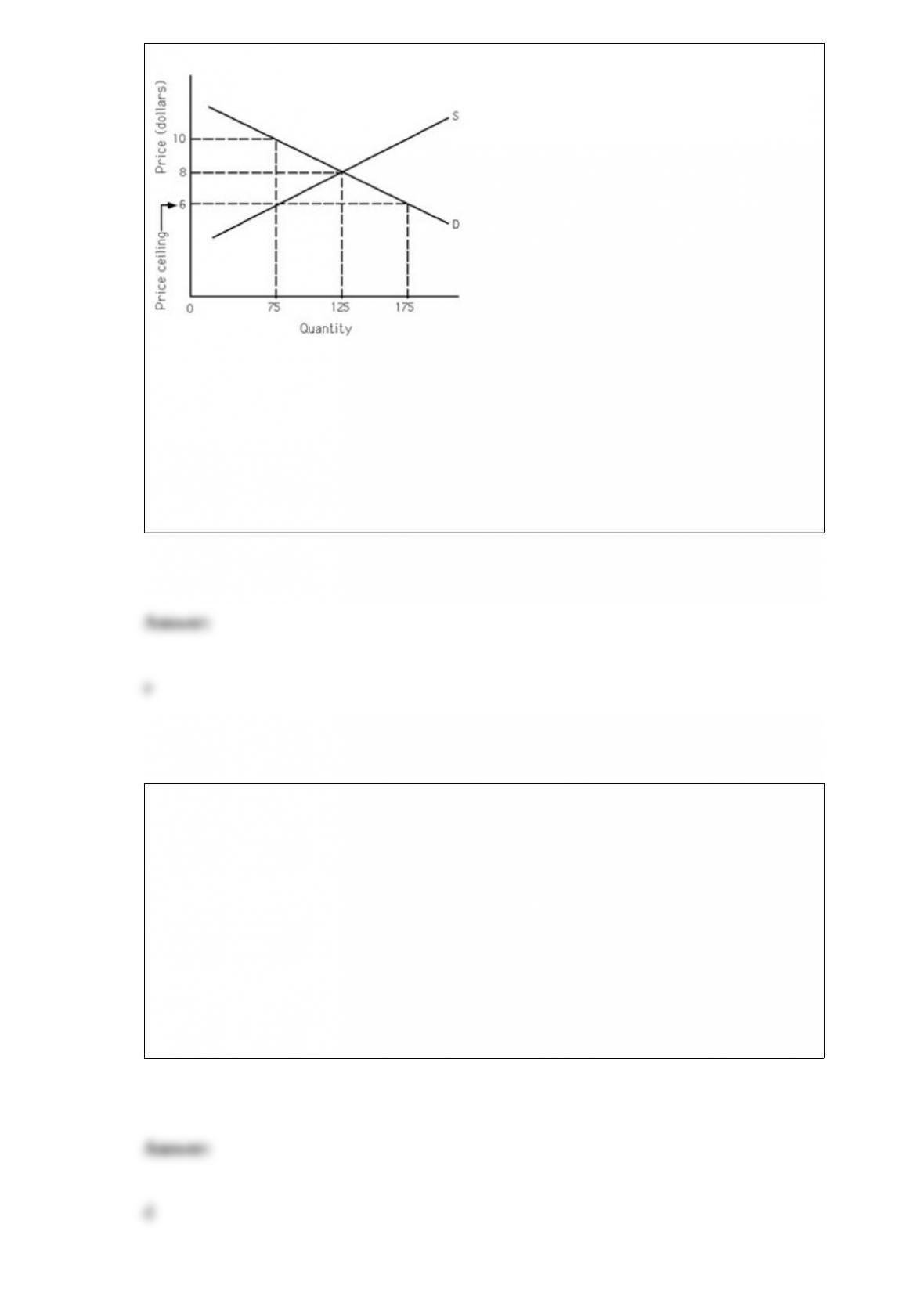
Refer to Exhibit 4-1. The number of units exchanged at the price ceiling is
Exhibit 4-1
a. 75.
b. 125.
c. 175.
d. 100.
Which of the following statements is false?
a. If people were more alike in terms of their marketable innate abilities and attributes,
there would be less income inequality.
b. Some degree of income inequality can be attributed to the fact that some people
consume less leisure than others.
c. Schooling is referred to as human capital.
d. Education differences are generally not reflected in income differences.

From the sellers’ perspective, it is most desirable for a product to be perfectly elastic in
demand.
a. True
b. False
If a market comes close to meeting (but does not perfectly meet) all the assumptions of
the theory of perfect competition, it follows that
a. the market is not perfectly competitive.
b. the theory of perfect competition still may be able to predict behavior in the market.
c. firms in the market cannot be price takers.
d. firms in the market do not try to maximize profit.
e. a and c
The combination of low income elasticity of demand for food and high agricultural
productivity leads to the demand for food increasing and the supply of food increasing
even more, which has lead to rising prices of food.
a. True

b. False
For a perfectly competitive firm,
a. marginal revenue is equal to price.
b. price is equal to marginal cost at the output level that maximizes profit.
c. selling an additional unit of the good it produces increases total revenue by the price
of the good.
d. a and b
e. a, b, and c
It is unlikely that very many (pure) monopsony firms exist today, given that workers are
increasingly mobile.
a. True
b. False

On a supply-and-demand diagram, consider a price for which the horizontal distance to
the supply curve is shorter than the horizontal distance to the demand curve. There is a
__________ at that price and the current price must be __________ the equilibrium
price.
a. shortage; above
b. shortage; below
c. surplus; above
d. surplus; below
For a monopolist, if price is above average total cost, the monopolist is
a. earning an economic profit.
b. taking an economic loss.
c. minimizing total fixed costs.
d. minimizing total variable costs.

The answer is: “When the official price of a currency is lowered.” What is the question?
a. What is overvaluation?
b. What is revaluation?
c. What is appreciation?
d. What is depreciation?
e. none of the above