
As presented in the textbook, research on neuroeconomics has shown that when
individuals are presented with present-future choices the
a. analytic system (which weights the future heavily) seems to win out over the limbic
system (which weights the present heavily).
b. limbic system (which weights the present heavily) seems to win out over the analytic
system (which weights the future heavily).
c. limbic system and the analytic system are equally weighted, making the individuals
indifferent to the choices presented.
d. limbic system (which weights the future heavily) seems to win out over the analytic
system (which weights the present heavily).
In general, a dry cleaner in a small town is ______________ likely to be unethical in
his business practices than a dry cleaner in a large city.This is because the larger a
percentage of the population one person is, the _____________likely that person will
have to further engage with people he encounters.
a. more; less
b. less; less
c. more; more
d. less; more
Suppose that prices in the United States rise relative to prices in France. We expect that
(on the foreign exchange market) the demand for U.S. dollars will __________ and the
supply of dollars will __________.
a. increase; increase
b. increase; decrease
c. decrease; increase
d. decrease; decrease
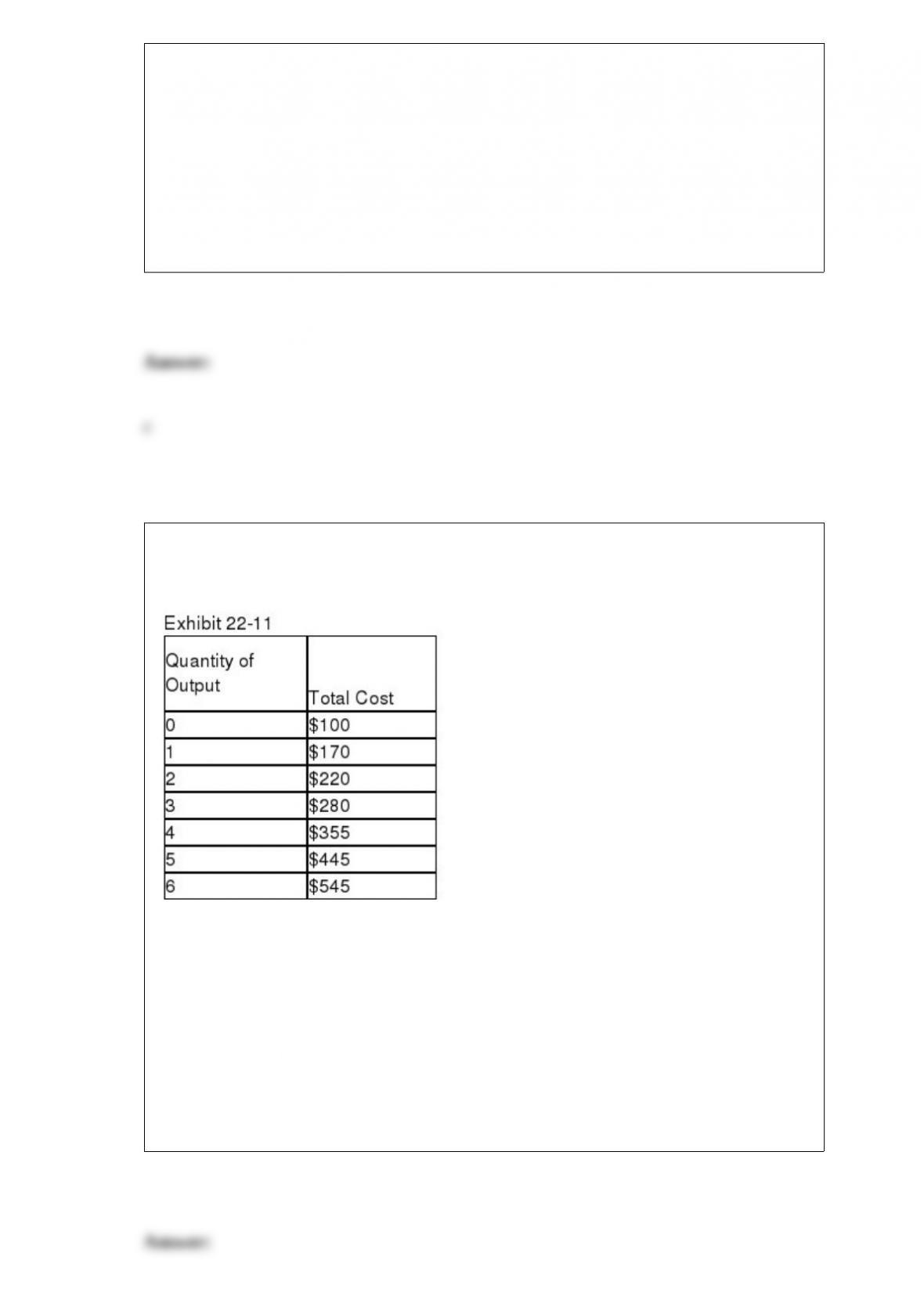
Average total cost of the sixth unit of output is
a. $50.
b. $100.
c. $300.
d. $90.83.
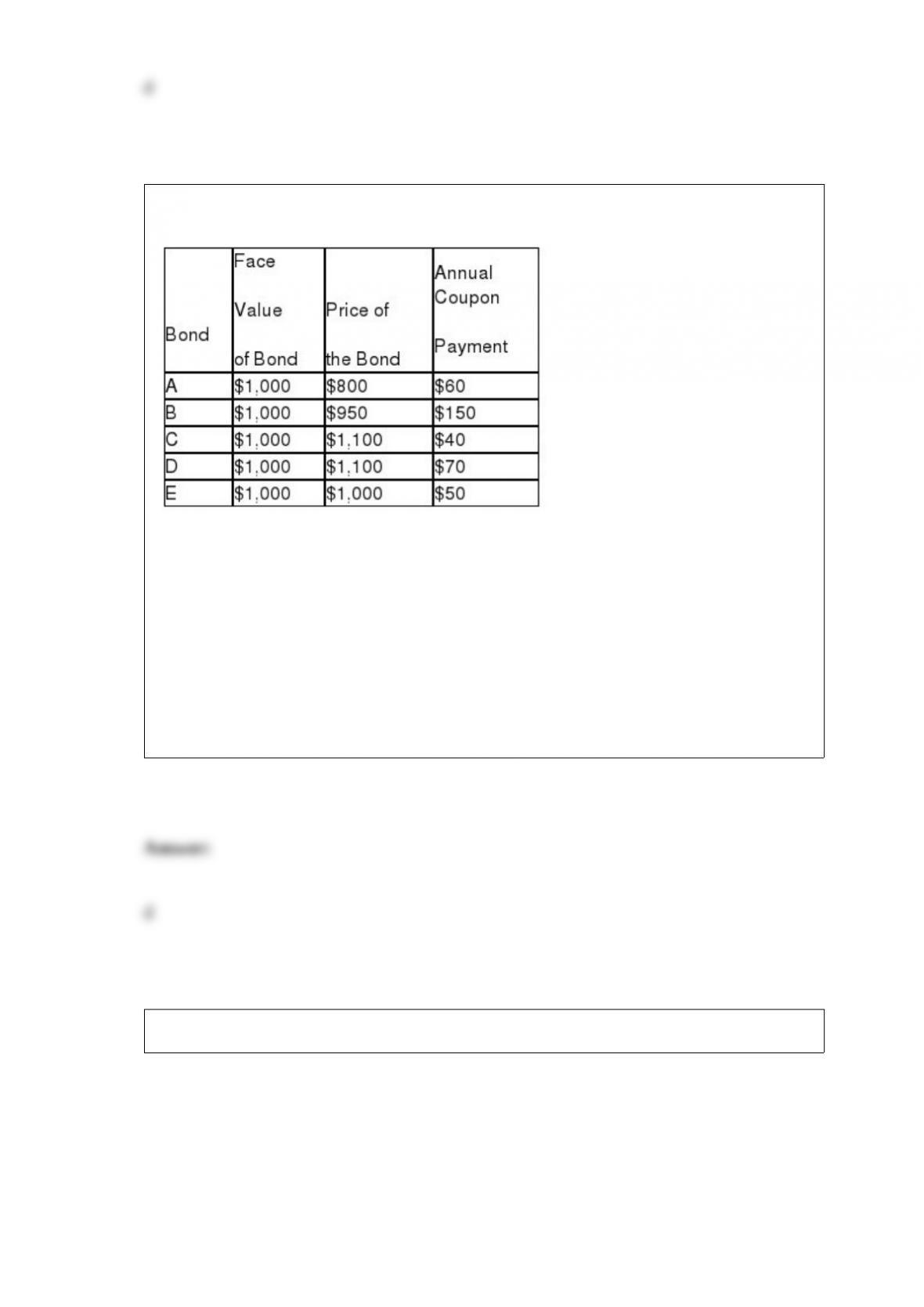
Exhibit 38-1
The yield on bond E is approximately
a. 37.5 percent.
b. 0.38 percent.
c. 0.45 percent.
d. 5.0 percent.
Exhibit 34-8
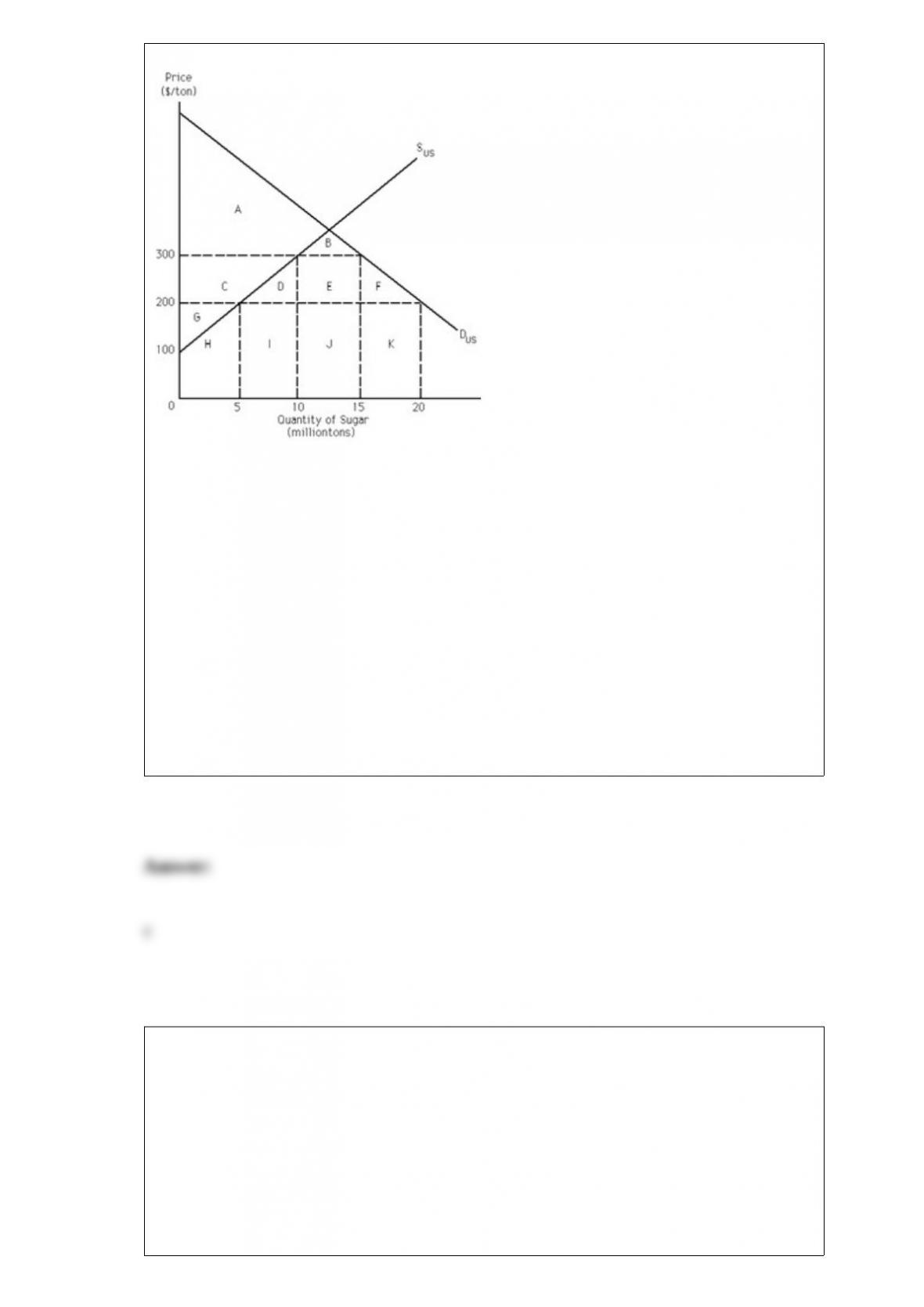
Assume that the current price of sugar in the United States is $300 per ton (which
includes a $100 per ton tariff on sugar imports). Consumers’ surplus is equal to the area
__________ while producers’ surplus is equal to the area __________.
a. A + B + C + D + E + F;G + H + I + J + K
b. A + C + G;B + D + E + F
c. A + B;C + G
d. A + C;G
e. A + C;B + D + E + F
Marginal social costs are equal to
a. marginal private costs + external costs.
b. marginal private costs – external costs.
c. marginal private costs + internal costs.
d. marginal private costs – internal costs.

Marginal factor cost (MFC) is
a. the additional cost incurred by employing an additional factor unit.
b. the additional output generated by employing an additional factor unit.
c. equal to factor price for a factor price taker.
d. a and c
e. b and c
The rivalry versus nonrivalry issue is
a. relevant to the issue of market failure.
b. not relevant to the issue of market failure.
c. relevant to the free-rider problem.
d. a and c
e. b and c
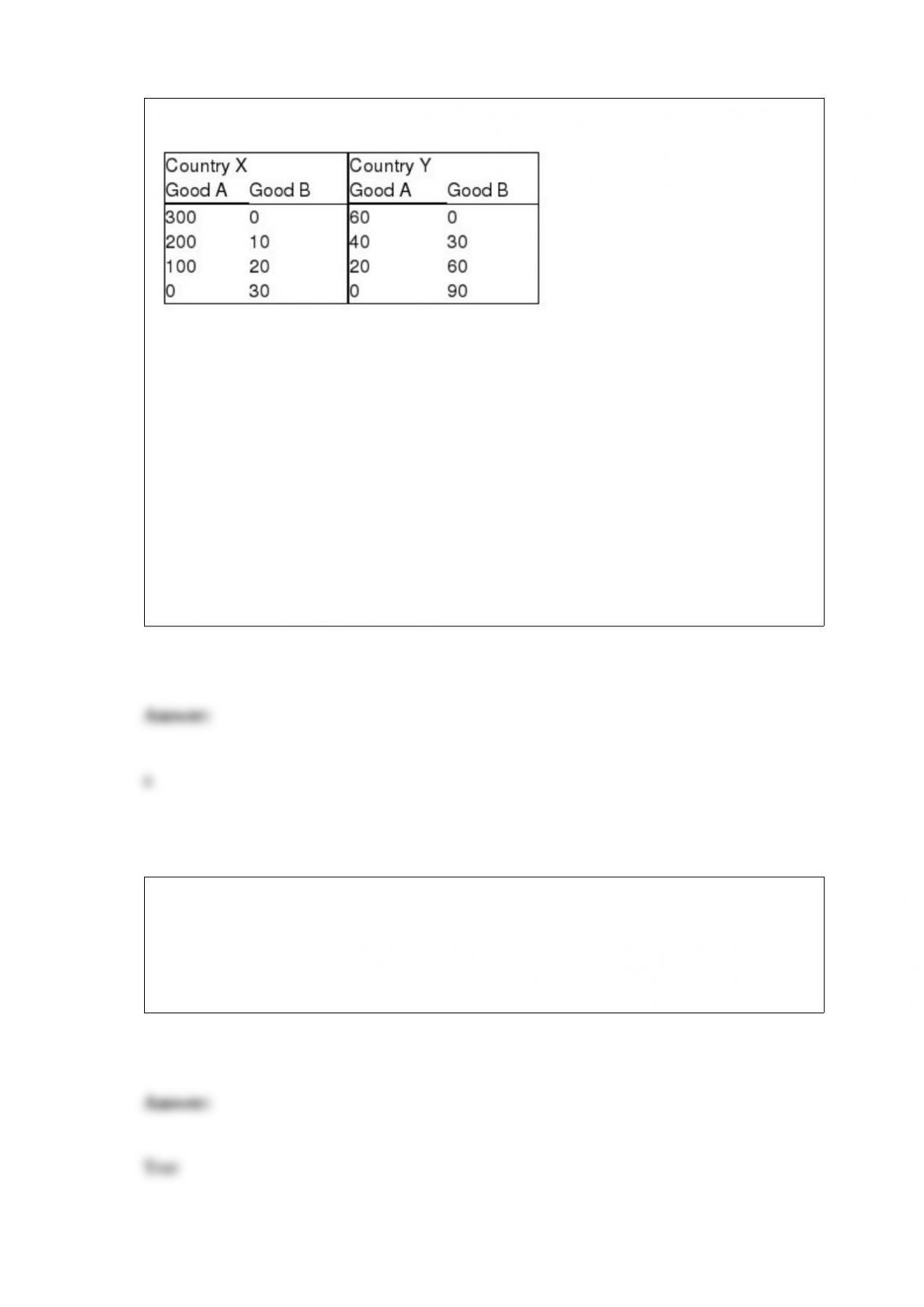
Exhibit 34-9
For country Y, the opportunity cost of producing one unit of good B is __________
unit(s) of good A.
a. 1.5
b. 2
c. 2/3
d. 1/3
e. 3
To an economist, the terms factor and resource are synonyms.
a. True
b. False

Monopolistic competitive firms and perfectly competitive firms are similar in that both
a. set price equal to marginal cost.
b. face a horizontal demand curve.
c. face no barriers to entry or exit.
d. produce a homogeneous product.
e. all of the above
The short-run industry supply curve is the
a. horizontal summation of the short-run supply curves for all firms in the industry.
b. vertical summation of the short-run supply curves for all firms in the industry.
c. average of the short-run supply curves for all firms in the industry.
d. same as that of the typical firm in the industry.
Which of the following statements is false?
a. A theory should be judged based upon whether or not it tells us the things we want to
hear.
b. Scientists are interested in finding out when their theories are wrong or right.
c. Scientists are interested in building theories that can be refuted.

d. If evidence is consistent with a theory€s predictions, we state that the evidence fails
to reject the theory.
To know whether the dollar is overvalued, we need to know
a. what foreign currency the dollar is being compared with.
b. the real interest rate in the United States and the real interest rate in whatever
country’s currency the dollar is being compared with.
c. the equilibrium exchange rate between the dollar and the foreign currency the dollar
is being compared with.
d. whether Federal Reserve monetary policy is expansionary or contractionary.
e. There is not enough information to answer the question.
An economist might say, “The market guides and coordinates individuals’ actions.”
Which of the following is an example of this happening?
a. An employer tells an employee to get to work early.
b. As the price of oranges rises, more individuals begin to produce oranges.
c. The manager of a plant issues a directive that there will be no more smoking in the
cafeteria.
d. a and c

e. a, b, and c
Which of the following is an example of a trade restriction?
a. quotas
b. tariffs
c. dumping
d. a and b
e. a, b, and c