1)
Which of the following supports the contention that monopolistic competitors have a
strong incentive to engage in R&D?
A.Entry to monopolistic competitive industries is relatively easy and thus profit from
innovation is quickly competed away.
B.Most monopolistic competitive industries are decreasing cost industries.
C.The desire to differentiate products from competitors may motivate monopolistic
competitors to engage in R&D.
D.Monopolistic competitors have large retained earnings that are available to finance
R&D.
2)
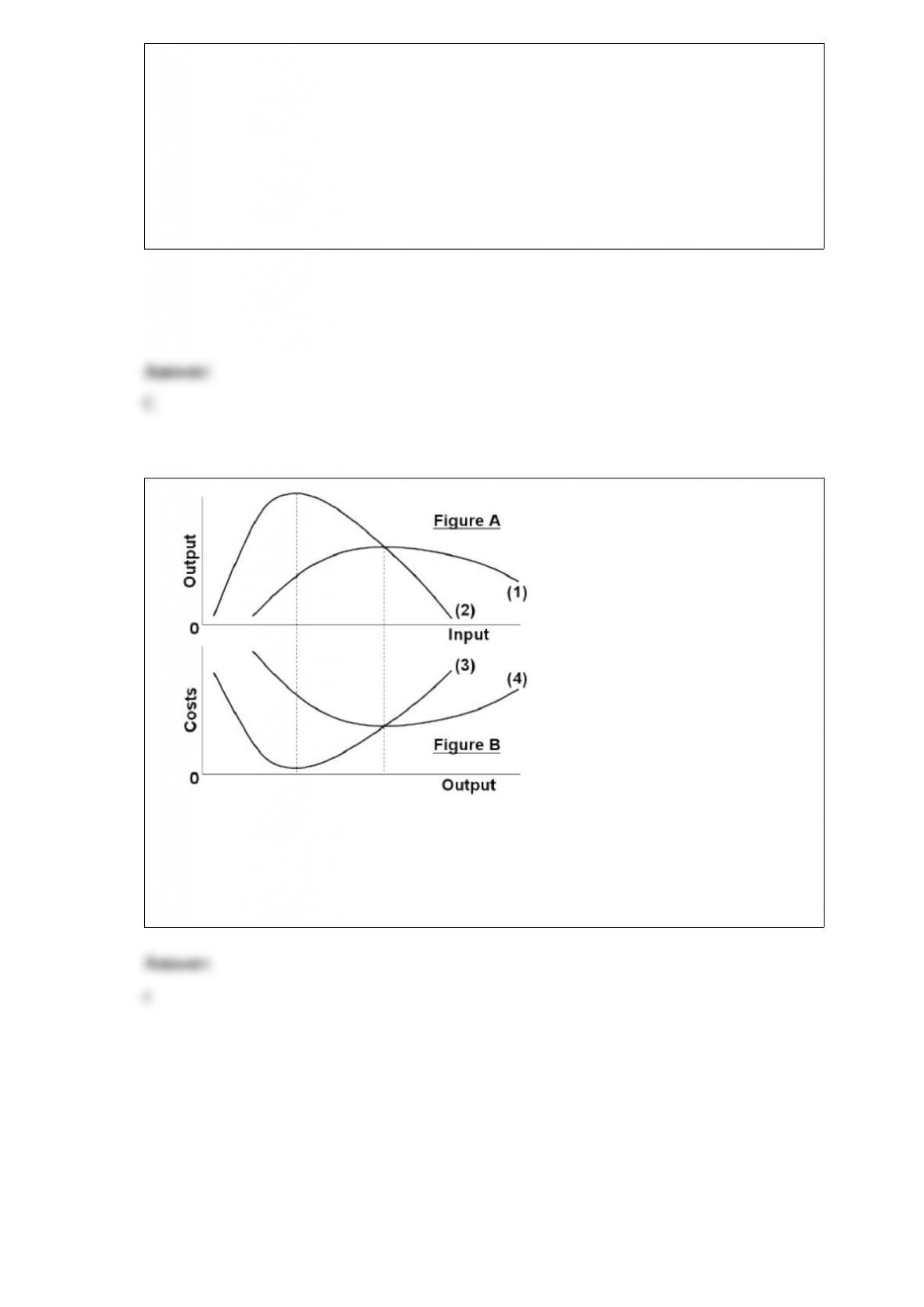
refer to the above short-run production and cost data. in figure a curve (1) is:
a.total product and curve (2) is average product.
b.total product and curve (2) is marginal product.
c.average product and curve (2) is marginal product.
d.marginal product and curve (2) is average product.
3)
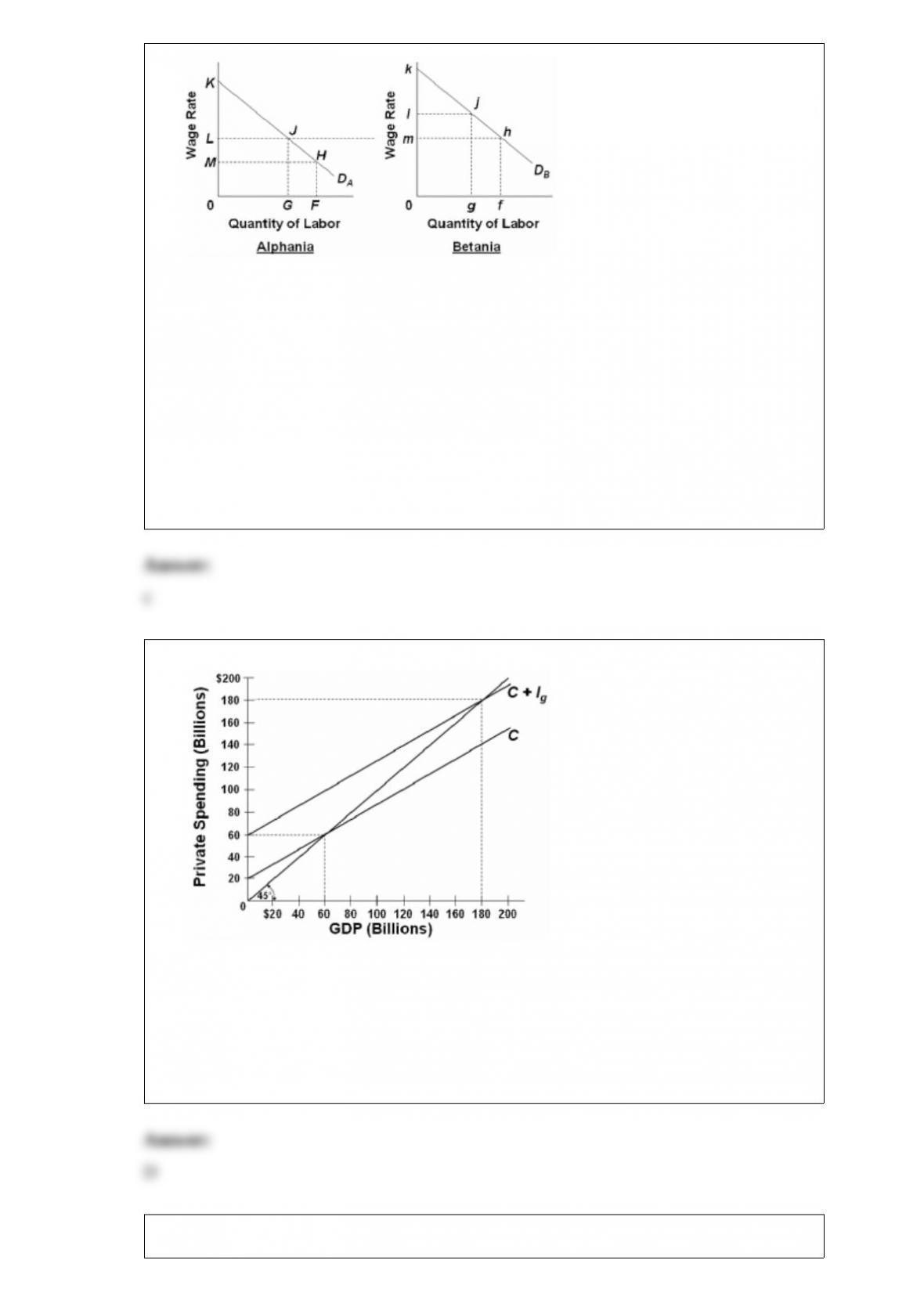
assumptions: (1) the demand for labor in alphania and betania are as shown by da and
db, respectively; (2) alphania’s native labor force is f and that of betania is g; (3) wage l
in alphania is equal to wage m in betania; and (4) full employment exists in both
countries.
refer to the above diagram and assumptions. if migration is costless and unimpeded, the
average level of wages will:
a.decrease in betania, but remain unchanged in alphania.
b.increase in alphania, but remain unchanged in betania.
c.increase in alphania and decrease in betania.
d.increase in betania and decrease in alphania.
4)
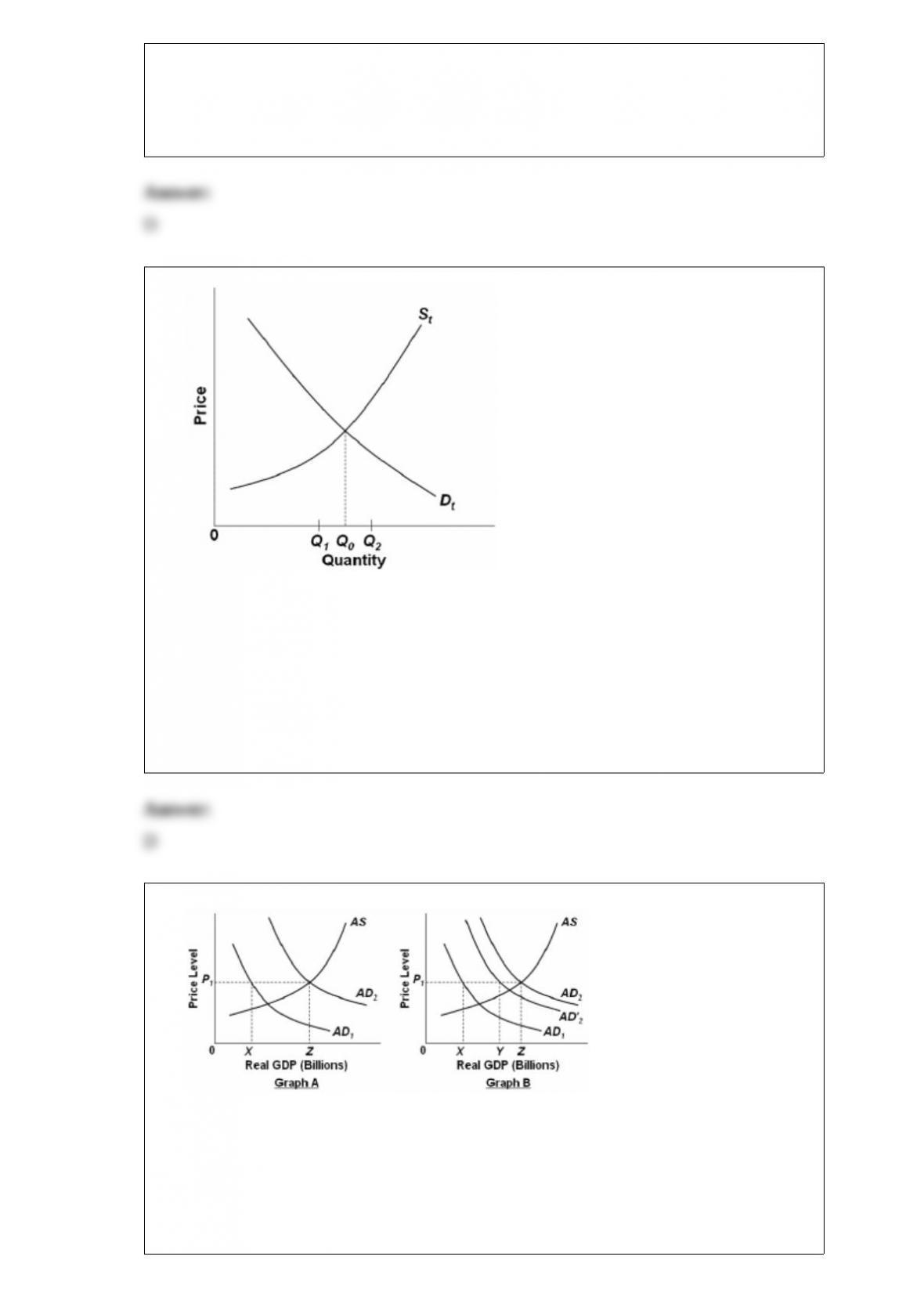
Refer to the above diagram for a private closed economy. In this economy aggregate
expenditures:
A.do not change as GDP increases.
B.increase by $2 for every $5 increase in GDP.
C.increase by $2 for every $4 increase in GDP.
D.increase by $2 for every $3 increase in GDP.
5) When a bank has a check drawn and cleared against it:
A.excess reserves in the banking system decline.
B.the nation’s total money supply falls.
C.the bank’s balance sheet does not change.
D.the amount of required reserves the bank must have will fall.
6)
Refer to the above diagram of the market for product X. Curve St embodies all costs
(including externalities) and Dt embodies all benefits (including externalities)
associated with the production and consumption of X. Assuming the equilibrium output
is Q1, we can conclude that the existence of external:
A.costs has resulted in an overallocation of resources to X.
B.benefits has resulted in an overallocation of resources to X.
C.costs has resulted in an underallocation of resources to X.
D.benefits has resulted in an underallocation of resources to X.
7)
Suppose real GDP is X, as shown in graph A. If the economy’s MPC is .8, X is $200
billion and full-employment real GDP Y is $300 billion, an appropriate fiscal policy
would be to reduce taxes by:
A.$100 billion.
B.$20 billion.
C.$25 billion.
D.$164 billion.
8) which of the following is correct?
a.if demand is elastic, an increase in price will increase total revenue.
b.if demand is elastic, a decrease in price will decrease total revenue.
c.if demand is elastic, a decrease in price will increase total revenue.
d.if demand is inelastic, an increase in price will decrease total revenue.
9) which of the following statements is correct?
a.average total cost is the difference between average variable cost and average fixed
cost.
b.marginal cost measures the cost per unit of output associated with any level of
production.
c.when marginal product rises, marginal cost must also rise.
d.marginal cost is the price or cost of an extra variable input (for example, an additional
worker) divided by its marginal product.
10) Suppose that Book-Cost Busters (BCB), without authorization, reproduced a
best-selling novel and placed it for downloading on the BCB pay-for-use website. This
action would violate the publisher’s:
A.profit rights.
B.patent.
C.copyright.
D.trademark.
11)
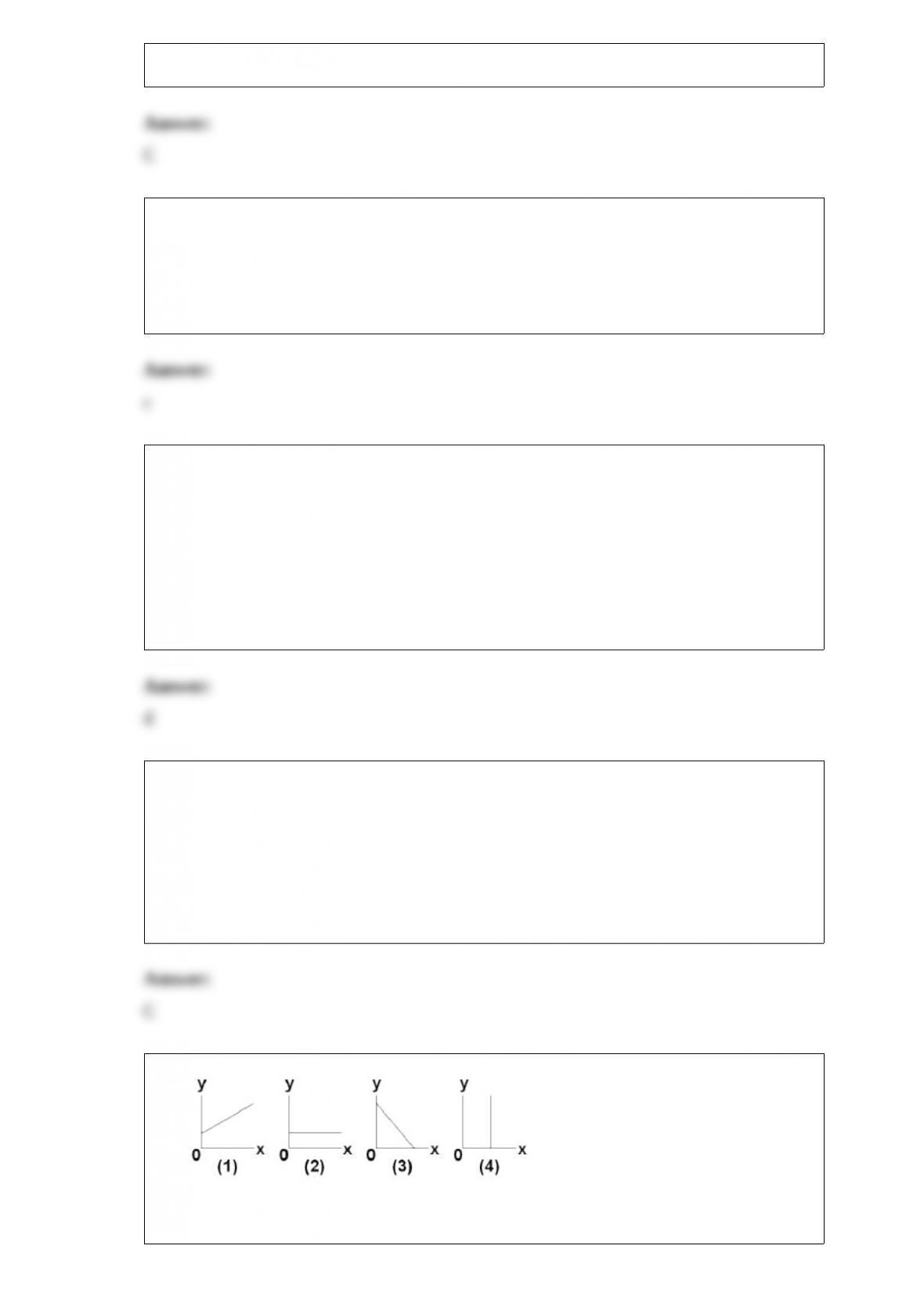
answer on the basis of the relationships shown in the above four figures. the amount of
y is directly related to the amount of x in:

a.both 1 and 3
b.both 1 and 2
c.2 only
d.l only