
The immediate impetus for the establishment of the Federal Reserve System came from
a. severe outbreaks of inflation in the early 1900s.
b. four severe banking panics between 1873 and 1907.
c. the discovery of gold in Alaska.
d. the desire to copy the founding of the Bank of England.
Which of the following is an example of an indirect tax?
a. value-added tax
b. income tax
c. inheritance tax
d. head tax
U.S. imports are most likely to increase when
a. U.S. GDP decreases.
b. U.S. unemployment rates fall.
c. U.S. prices fall.

d. foreign prices rise.
A rise in the domestic interest rate leads to capital outflows and makes the currency
depreciate.
a. True
b. False
The aggregate supply curve slopes
a. downward because firms can sell more at lower prices.
b. downward because firms can hire more workers at lower prices.
c. upward because firms want to hire more workers at higher wage levels.
d. upward because firms can hire labor at fixed wages for short-run periods.

An inflationary gap will exist when the full employment level of GDP is
a. equal to equilibrium GDP.
b. greater than equilibrium GDP.
c. less than equilibrium GDP.
d. greater than disposable income.
The difference between the equation of exchange and the quantity theory of money is
that the
a. equation of exchange assumes that the level of real GDP is constant.
b. quantity theory of money assumes that the Fed has no control over the money supply.
c. equation of exchange assumes that the level of nominal GDP is constant.
d. quantity theory of money assumes that velocity is virtually constant.
In macroeconomics, the vertical axis in a supply-demand model measures the price
level rather than a particular product’s price.
a. True

b. False
Which of the following observations concerning the Phillips curve is not true?
a. They are normally upward-sloping.
b. They are more commonly constructed for price inflation.
c. They depict the inverse relation between wage inflation and unemployment.
d. They depict the rate of unemployment on the horizontal axis.
The highest-income fifth of the U.S. population earns more than 50 percent of all
income.
a. True
b. False

Which of these contributes to the existence of monopoly power?
a. a continuously decreasing long-run average cost curve
b. possession of a patent
c. control over essential output
d. All of the above are correct.
Which of the following is not a method to reduce the inflationary gap?
a. Increasing government spending
b. Reducing transfer payments
c. Raising taxes
d. Decreasing government expenditure
Trade between two nations is complicated by
a. the variability in exchange rates of the respective nation’s currencies.
b. different production techniques in the nations.
c. the age and experience of the respective nation’s diplomats.
d. the variability in climate between the nations.
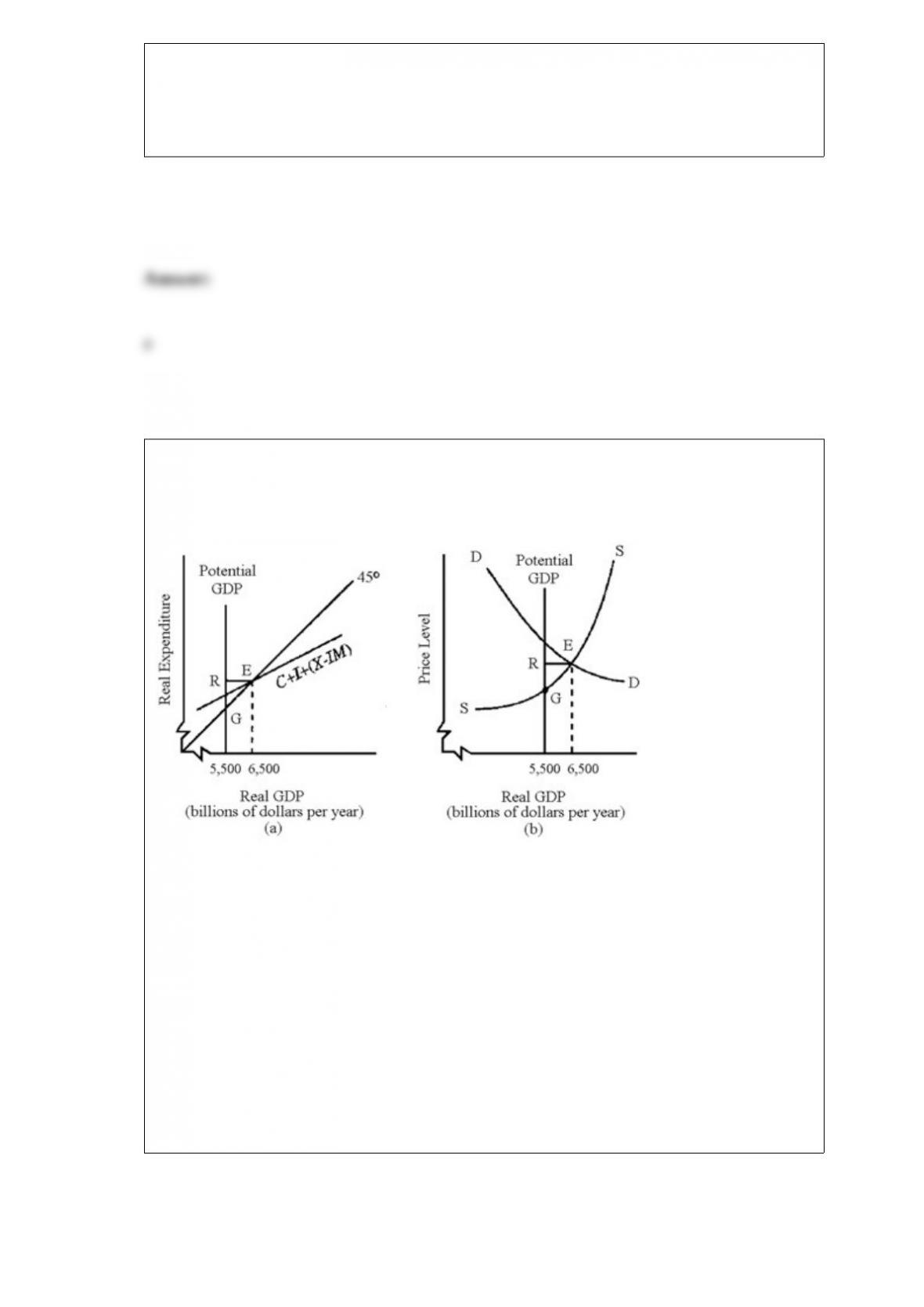
Figure 10-3
When the economy represented in Figure 10-3 has completed the self-correcting
adjustment process, the expenditure line in graph (a) will be
a. flatter.
b. steeper.
c. higher.
d. lower.
e. unchanged.

A theory is an abstraction used often by economists to
a. describe a problem.
b. keep all assumptions in their proper places.
c. explain why things work the way they do.
d. describe a hierarchical ordering of facts.
e. arrange variables into a graphical format.
Foreign competition will always put a domestic industry at a disadvantage. This leads to
massive trade adjustment assistance on the part of each country.
a. True
b. False
Which of the following had prompted the Chinese authorities to stand ready to buy or

sell dollars steadily and in large volume?
a. Huge current account deficit
b. Currency pegged to the dollar
c. Floating rate policy
d. Adherence to the old gold standard
Scarcity and choice are the basic problems of economics; the supply and demand
mechanism is the basic investigative tool of economics.
a. True
b. False
Figure 11-3
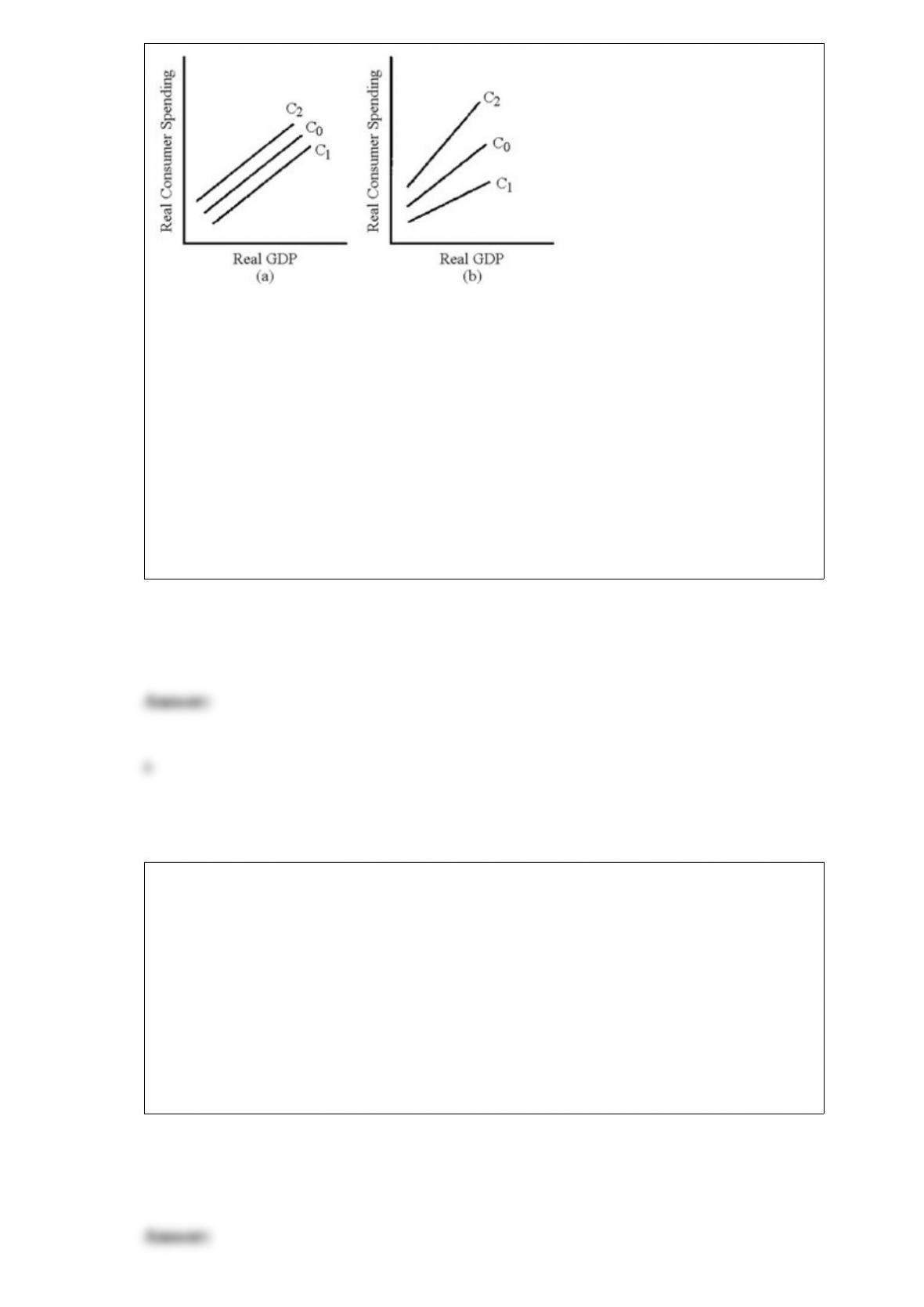
In Figure 11-3, which line represents the change in the consumption schedule caused by
an increase in the residential property tax?
a. C1 in graph (a)
b. C2 in graph (a)
c. C1 in graph (b)
d. C2 in graph (b)
If the interest rate is positive, the present value of $10 to be received in the future is
a. less than $10.
b. equal to $10.
c. more than $10.
d. Any of the above is possible, depending on the interest rate and when the payment is
to be received.

Although economists generally favor a negative income tax, there is little political
support for it.
a. True
b. False
For a corporation, issuing bonds is riskier than issuing stock.
a. True
b. False
Figure 4-4
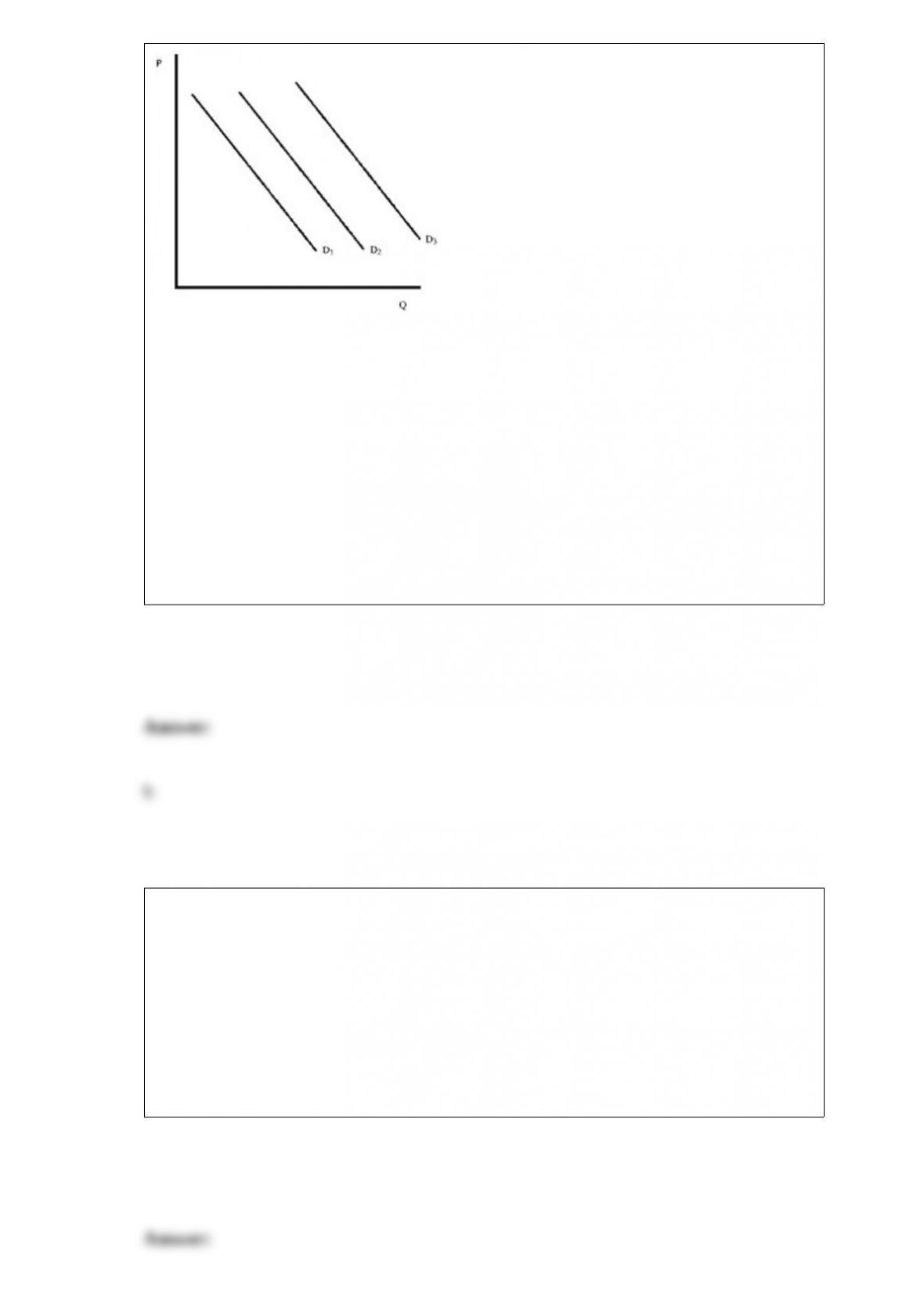
Assume that Figure 4-4 shows demand for new houses. A decrease in income of buyers
will change demand from
a. D1 to D2.
b. D2 to D1.
c. D2 to D3.
d. D1 to D3.
Higher rates of investment spending contribute most to higher levels of
a. political progress.
b. consumption spending.
c. technological progress.
d. government development.

Which of the following would be associated with an inflationary gap?
a. interest rates too low
b. business expectations pessimistic
c. inventory levels too low
d. stock market crash
e. All of the above.
Which of the following affects the marginal physical product of labor?
a. a worker’s abilities and degree of work effort
b. the amount of capital available per worker
c. the technical know-how of the management of the firm
d. all of the above

When the dollar depreciates, the prices of imported inputs
a. fall and aggregate supply shifts outward.
b. fall and aggregate supply shifts inward.
c. rise and aggregate supply shifts outward.
d. rise and aggregate supply shifts inward.
The structural deficit can be used to estimate the thrust of current fiscal policy.
a. True
b. False
Figure 9-1
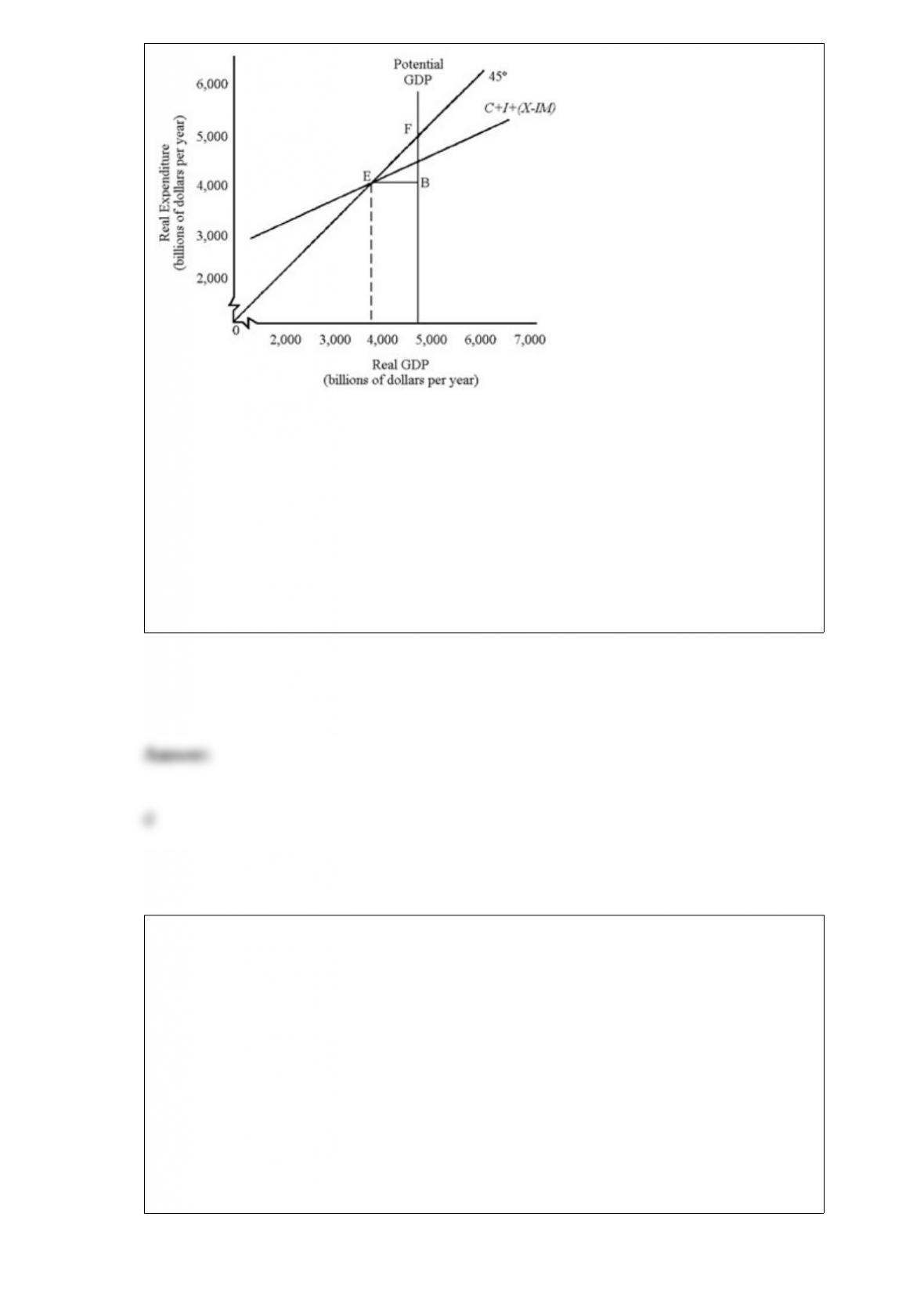
In Figure 9-1, at $7,000 billion real GDP,
a. inventories are increasing.
b. spending falls short of output.
c. spending exceeds output.
d. Both a and b are correct.
When a banker accepts a deposit of $1,000 in cash and puts $200 aside as required
reserves and then makes a loan of $800 to a new borrower, this set of transactions
a. decreases the money supply by $1,000.
b. decreases the money supply by $200.
c. does not change the money supply.
d. increases the money supply by $200.
e. increases the money supply by $800.

The typical total profit graphical presentation is shown as
a. a square.
b. a rectangle.
c. a hill, or mound.
d. an S curve.
Critics of supply-side economics argue that tax cuts favored by supply-siders will have
the greatest effect on
a. aggregate supply.
b. tax receipts.
c. aggregate demand.
d. the money supply.

One of the justifications of government stabilization policy is that it may
a. increase the fluctuations in inflation and employment.
b. increase the multiplier effect of changes in autonomous spending.
c. increase the volatility of economic variables.
d. reduce the severity of inflation and unemployment.
Once the federal funds rate is reduced to zero, conventional restrictive monetary policy
is no longer an option.
a. True
b. False
In 1862, the Homestead Act made land available to farmers at zero cost. Yet many
farmers preferred to purchase land along the rail line from the railroad. The farmers
a. were duped by the railroads.
b. knew the soil was better near the railroads.
c. realized that crops would be less costly to grow and transport on land near the
railroads.

d. were exploited by the railroads.