
1) The interest-rate cost-of-funds curve is perfectly elastic because firms can borrow as
much or as little as they want at market interest rates.
2) The interest rate is the price paid for the use of money.
3) in the short run a competitive firm will always choose to shut down if product price
is less than the lowest attainable average total cost.
4) Commercial banks increase the supply of money when they purchase either personal
IOU’s or government bonds from businesses and households.
5) Large, well-established firms are more likely to use retained earnings to finance
R&D, while small start-up firms are more likely to rely on venture capital.
6) An increase in imports (independent of a change in the U.S. price level) will increase
both U.S. aggregate supply and U.S. aggregate demand.
7) In the private closed economy, equilibrium GDP occurs where C + Ig = GDP.

8) the total revenue curve of a competitive seller graphs as a straight, upsloping line.
9) A major source of funding of R&D in large, established corporations is:
A.venture capital.
B.dividends.
C.mutual funds.
D.retained earnings.
10) The socially optimal amount of pollution abatement occurs where society’s
marginal:
A.benefit of abatement exceeds its marginal cost of abatement by the greatest amount.
B.benefit of abatement equals its marginal cost of abatement.
C.benefit of abatement is zero.
D.cost of abatement is at its maximum.
11) Long-run real wages in the United States have:
A.risen, because growth in the demand for labor has exceeded growth in the supply of
labor.
B.risen, because the supply of labor has fallen over time.
C.fallen, because growth in the supply of labor has exceeded growth in the demand for
labor.
D.fallen, because the demand for labor has fallen over time.
12) assume that if the interest rate that businesses must pay to borrow funds were 20
percent, it would be unprofitable for businesses to invest in new machinery and
equipment so that investment would be zero. but if the interest rate were 16 percent,
businesses will find it profitable to invest $10 billion. if the interest rate were 12
percent, $20 billion would be invested. assume that total investment continues to
increase by $10 billion for each successive 4 percentage point decline in the interest
rate.
refer to the above information. using i and i to indicate the interest rate and investment
(in billions of dollars) respectively, which of the following is the correct tabular
presentation of the described relationship?

a.choice a
b.choice b
c.choice c
d.choice d
13) Coins in people’s pockets and purses are:
A.included in M1, but not in M2.
B.included in both M1 and in M2.
C.included in M2, but not in M1.
D.excluded from M1 and M2 because people can exchange them for Federal Reserve
notes.
14) The following table shows the percentage of income received by quintile. In the
graph below, draw a Lorenz curve using the before taxes and transfer data and a Lorenz
curve for the after taxes and transfer data. Label the Lorenz curves and each axis of the
graph.

15) a pure monopolist’s demand curve is:
a.downsloping.
b.upsloping.
c.parallel to the vertical axis.
d.parallel to the horizontal axis.
16)
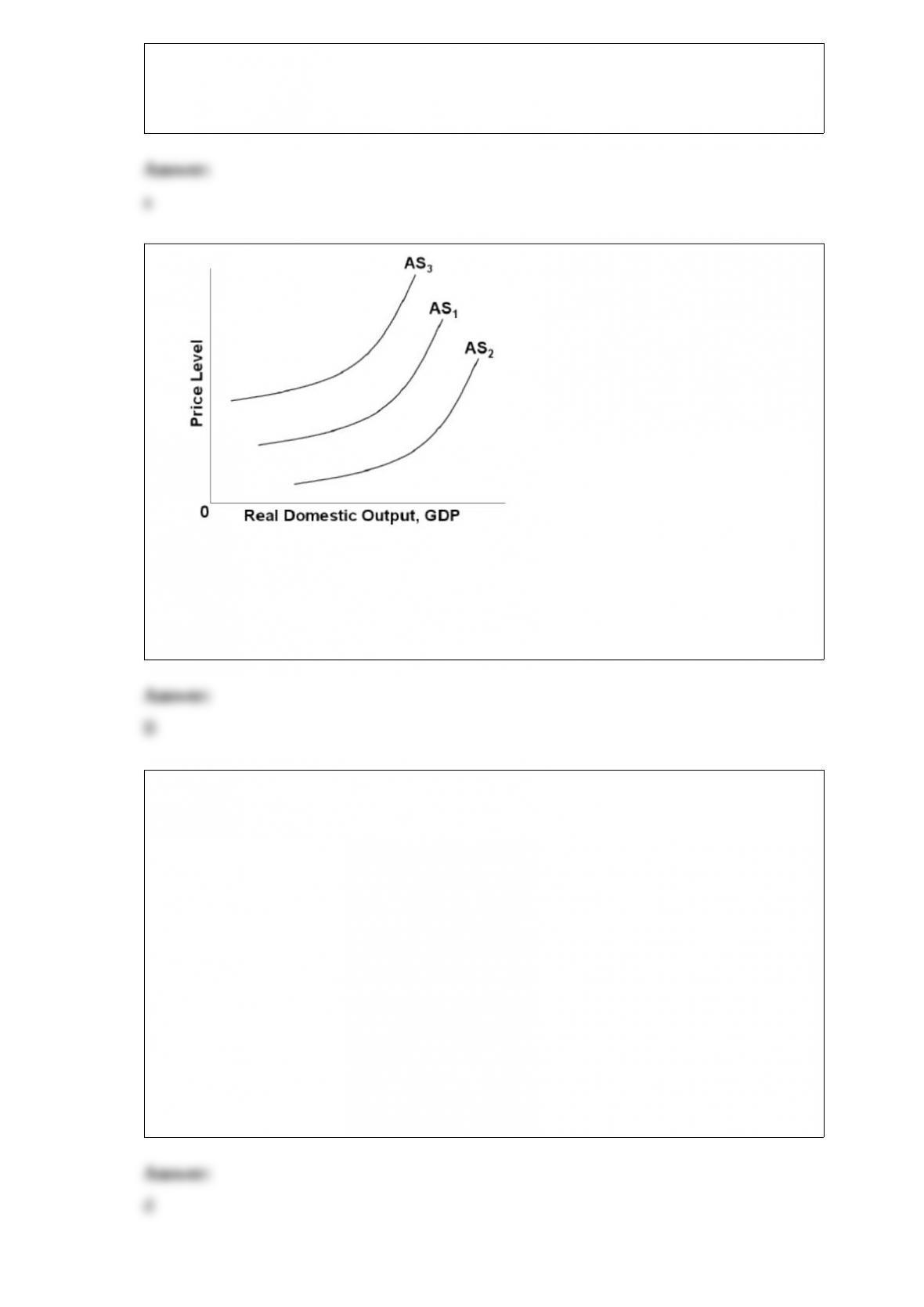
In the above diagram, a shift from AS2 to AS3might be caused by a(n):
A.decrease in interest rates.
B.increase in business taxes and costly government regulation.
C.decrease in the prices of domestic resources.
D.decrease in the price level.
17) susie buys two goods – rounds of golf and massages. suppose that the price of a
round of golf is $20, and the price of a massage is $30. in a typical week susie will play
two rounds of golf, getting 20 units of satisfaction from the second round. she normally
buys three massages each week, with the third giving her 30 units of satisfaction. if she
were to buy a fourth massage in a week, it would give her 20 units of satisfaction. if the
price of massages is reduced to $15, which of the following outcomes might we expect
to occur?
a.susie would leave her consumption choices unchanged because of diminishing
marginal utility in the consumption of massages.
b.susie would buy more massages and fewer rounds of golf, as predicted by the income
effect.
c.susie would buy more massages and more rounds of golf, as predicted by the
substitution effect.
d.susie would buy more massages and fewer rounds of golf, as predicted by the
substitution effect.

18)
Refer to the above graphs. Stanville has a comparative advantage in producing:
A.product A.
B.product B.
C.both product A and B.
D.neither product A nor B.
19) the utility-maximizing rule:
a.is inconsistent with the law of demand.
b.implies a perfectly elastic demand curve.
c.implies a leftward shifting demand curve.
d.is consistent with the law of demand.
20) suppose that scoobania, which has full employment, can obtain 1 unit of capital
goods by sacrificing 2 units of consumer goods domestically, but can obtain 1 unit of
capital goods from another country by trading 1 unit of consumer goods for it. this
reality illustrates:
a.a rightward (outward) shift of the production possibilities curve.
b.increasing opportunity costs.
c.achieving points beyond the production possibilities curve through international
specialization and trade.
d.productive efficiency.
21) the number of years required for real gdp to double can be found by:
a.dividing the annual growth rate by .07.
b.multiplying the annual growth rate by 70.
c.dividing 70 by the annual growth rate.
d.adding 14 to annual growth rate.
22) What fiscal policy is most likely to be invoked during a period of recession and
high unemployment? A period of rapid inflation? What political, investment, and
international problems might the U.S. Congress encounter in enacting these policies and
putting them into effect?
23) What phase of the business cycle is our economy experiencing at the present time?
Justify your answer.
24) Who sits on the Federal Open Market Committee and what does this committee do?
25) How does the case of Japan in the late 1990s and early 2000s illustrate the
asymmetry of monetary policy?
26) Of what significance is the will to develop?
27) What is the median-voter model and what are two implications from it?
28) Why are price fixing among firms and price discrimination treated differently under
antitrust legislation?
29) Price discrimination is often used by businesses. Explain the conditions under
which price discrimination is practiced.