
A marginal tax rate is
A) the fraction of income that must be paid in taxes.
B) the fraction of each additional dollar of income that must be paid in taxes.
C) the incremental income one must earn to offset each additional dollar of tax.
D) the ratio of a change in income to a change in taxes paid.
Economic incentives are designed to make individual self-interest coincide with social
interest. According to economists, which of the following methods of pollution control
best uses economic incentives to reduce pollution?
A) rewarding environmental groups for monitoring the activities of private firms that
produce products which generate pollution
B) imposing quantitative limits on the amount of pollution and imposing a penalty for
non-compliance with these limits
C) requiring the installation of specific pollution control devices
D) instituting a system of tradable emissions allowances
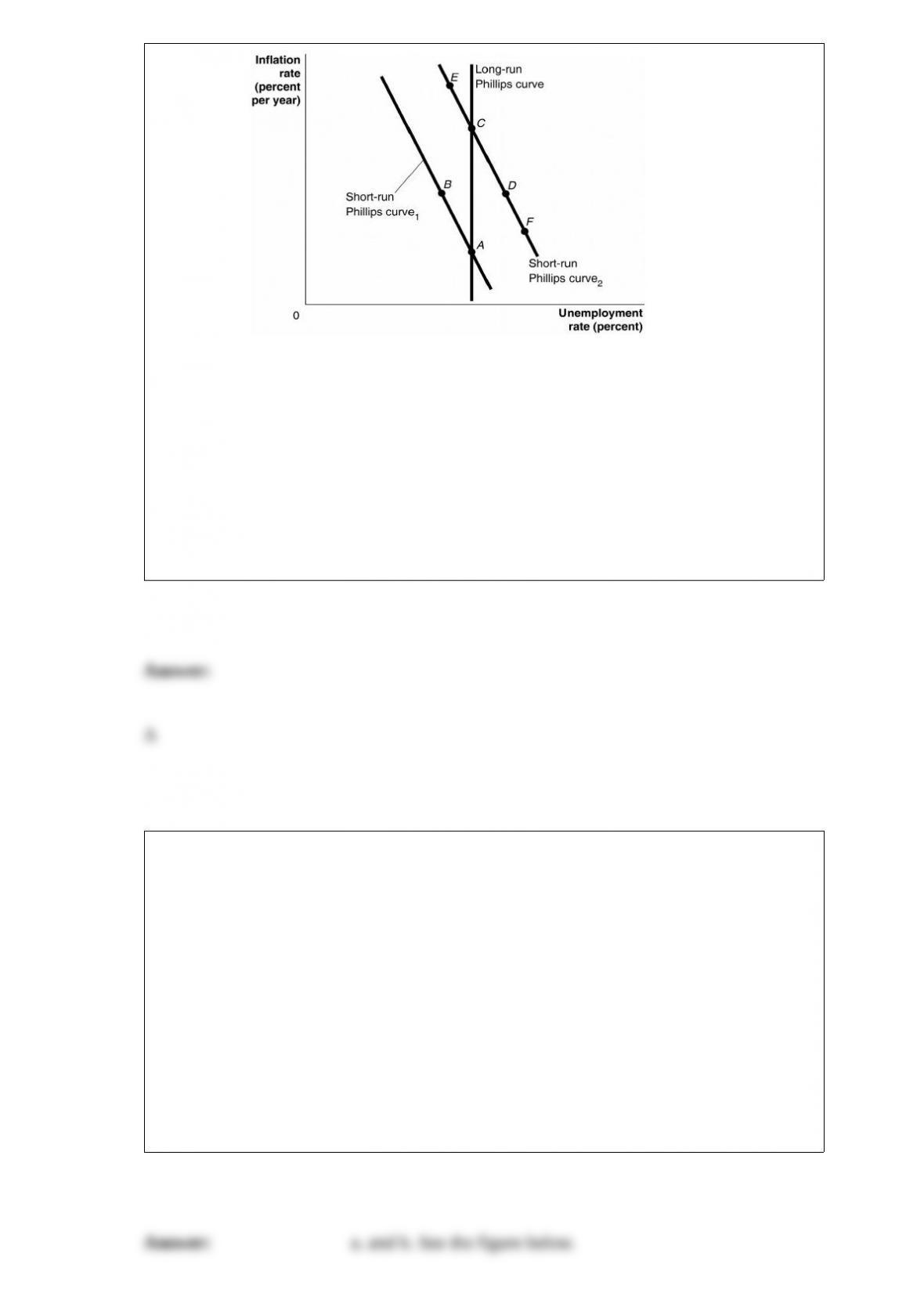
Figure 28-9
A(n) ________ would be depicted as a movement from A to D to C.
A) supply shock, such as rising oil prices,
B) increase in aggregate demand
C) implementation of contractionary monetary policy
D) increase in short-run aggregate supply
Consider the collectors’ market for first editions of two popular children’s books, Harry
Potter and the Order of the Phoenix by J. K. Rowling and Ruby in the Smoke by Philip
Pullman. Sales of the Harry Potter novel are much greater than sales of Ruby in the
Smoke yet the price of the Harry Potter novel is much lower than the price of Pullman’s
novel. a. On one large diagram, draw a demand and supply graph for first editions of
Harry Potter and the Order of the Phoenix and another demand and supply graph for
first editions of Ruby in the Smoke.
b. Show how it is possible for the price of the Harry Potter novel to be much lower than
the price of Pullman’s novel, even though the demand for the Harry Potter novel is
much greater than the demand for Ruby in the Smoke.
c. Provide a written explanation to accompany your graphical illustration.
The marginal product of labor is defined as
A) the additional sales revenue that results when one more worker is hired.
B) the additional output that results when one more worker is hired, holding all other
resources constant.
C) the additional number of workers required to produce one more unit of output.
D) the cost of hiring one more worker.
A decrease in a fixed exchange rate from $1.75 per pound to $1.60 per pound is called
a(n) ________ of the pound.

A) devaluation
B) depreciation
C) appreciation
D) revaluation
A(n) ________ is represented by a rightward shift of the demand curve while a(n)
________ is represented by a movement along a given demand curve.
A) increase in demand; decrease in demand
B) increase in demand; increase in quantity demanded
C) decrease in demand; decrease in quantity demanded
D) increase in quantity demanded; increase in demand
A tax rebate by the government would
A) increase your pretax income, but not your disposable income.
B) increase your disposable income, but not your pretax income.
C) decrease your pretax income, but not your disposable income.
D) decrease your disposable income, but not your pretax income.

Pegging a country’s exchange rate to the dollar can be advantageous in all of the
following situations except
A) if the country has extensive trade with the United States.
B) if investors believe the dollar to be more stable than the domestic country’s currency.
C) if a country wishes to conduct independent monetary policy.
D) if imports are a significant fraction of the goods the country’s consumers buy.
The “underground economy” is also referred to as
A) the informal sector.
B) the formal sector.
C) the halfway economy.
D) the net domestic product economy.
If national income increases by $20 million and consumption increases by $5 million,
the marginal propensity to consume is
A) 4.
B) 0.75.
C) 0.5.
D) 0.25.
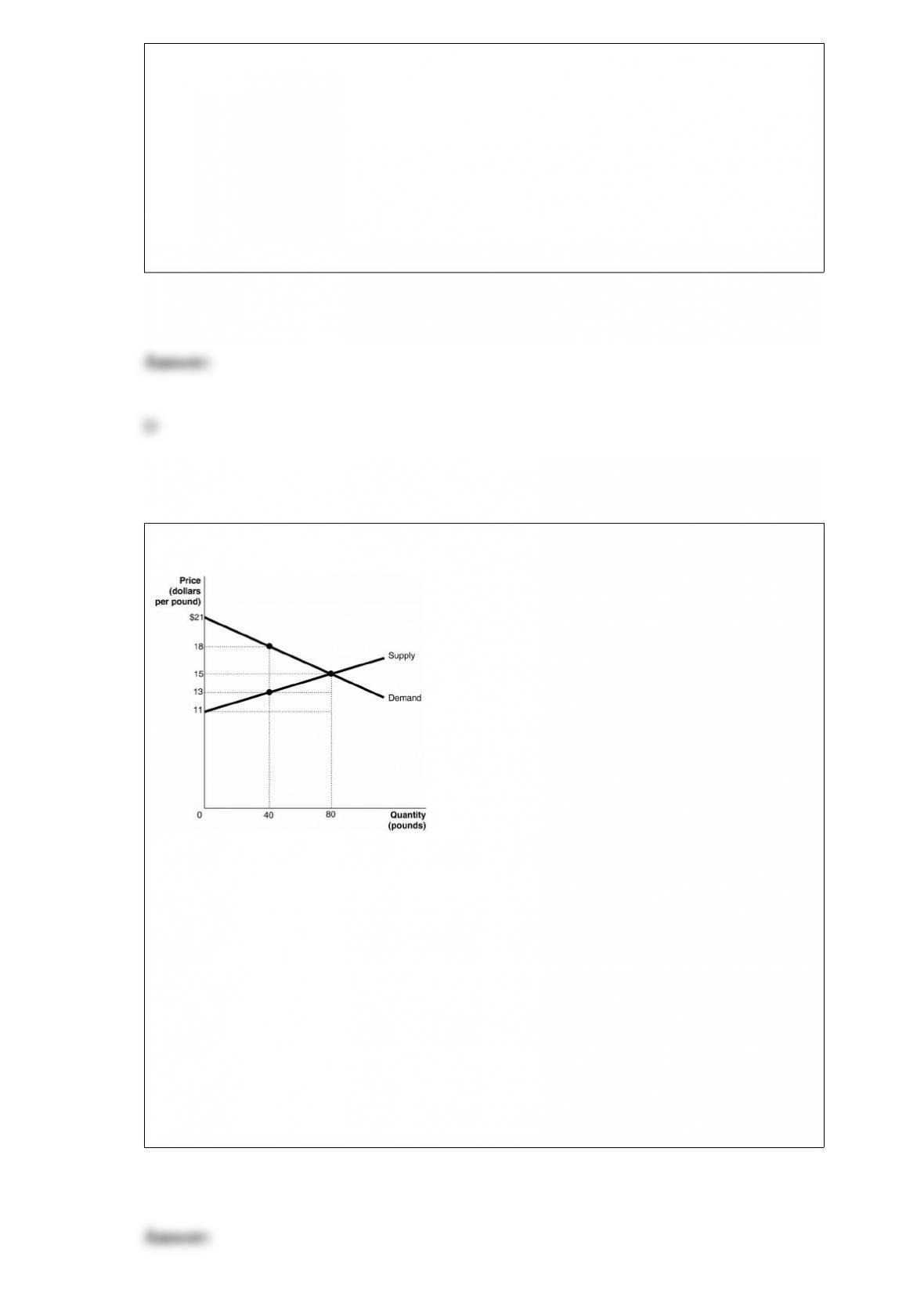
Figure 4-3
Figure 4-3 shows the market for tiger shrimp. The
market is initially in equilibrium at a price of $15 and a quantity of 80. Now suppose
producers decide to cut output to 40in order to raise the price to $18.
At a price of $18 consumers are willing to buy 40pounds of tiger shrimp. Is this an
economically efficient quantity?
A) No, the marginal benefit of the 40th unit exceeds the marginal cost of that 80th unit.
B) Yes, otherwise consumers would not buy 40 units.
C) Yes, because $18 shows what consumers are willing to pay for the product.
D) No, the marginal cost of the 40th unit exceeds the marginal benefit of the 40th unit.

Parker Hannifin benefitted when the Federal Reserve slashed the federal funds rate to
near-zero levels in 2008. Lower interest rates increased demand for its machinery
components, which would allow Parker Hannifin to ________ employment and
________ prices.
A) increase; increase
B) increase; decrease
C) decrease; increase
D) decrease; decrease
How has the growing popularity of factory outlet stores affected the market for clothing
at retail department stores?
A) the demand curve for clothing at retail department stores shifts to the right.
B) the demand curve for clothing at retail department stores shifts to the left.
C) the supply curve for clothing at retail department stores shifts to the right.
D) the supply curve for clothing at retail department stores shifts to the left.

The Bureau of Labor Statistics has taken several steps to reduce the bias in the
consumer price index. Which of the following is not one of the steps taken to reduce the
bias?
A) using statistical methods to reduce the size of the quality bias
B) updating the market basket every two years, rather than every 10 years
C) incorporating substitutions by consumers when prices of specific products rise
rapidly
D) conducting a point-of-purchase survey to track where consumers actually make their
purchases
When new firms are encouraged to enter a monopolistically competitive market
A) some existing firms must be earning economic profits.
B) they do so because there is insufficient product differentiation.
C) the demand curve facing an existing firm shifts to the right.
D) the marginal cost curve facing an existing firm shifts downwards.
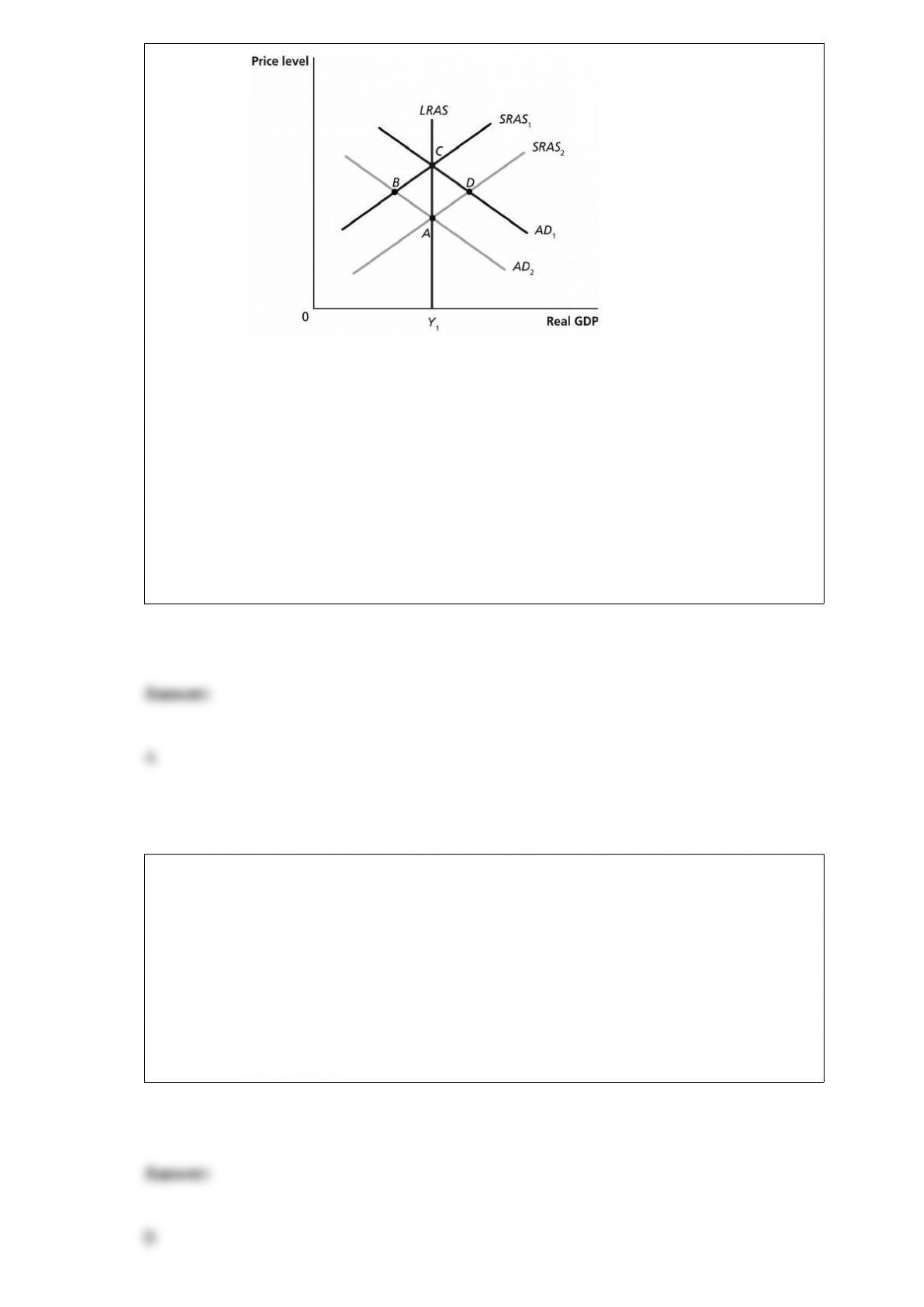
Figure 24-3
Suppose the economy is at point C. If government spending decreases in the economy,
where will the eventual long-run equilibrium be?
A) A
B) B
C) C
D) D
A free market fails when
A) there is government intervention.
B) there is an external effect in either production, consumption, or both.
C) firms that produce goods which create positive externalities go bankrupt.
D) firms that produce goods which create negative externalities earn high profits.