
If a country sets a pegged exchange rate that is above the equilibrium exchange rate,
how can the country maintain the peg?
A) by purchasing surplus domestic currency at the pegged rate
B) by selling surplus domestic currency at the pegged rate
C) by purchasing surplus domestic currency at the equilibrium exchange rate
D) by increasing the pegged exchange rate
Health insurance markets have a problem with insuring people who are “poor health
risks” while many people who are “good health risks” do not buy insurance. This
problem is an example of
A) moral hazard.
B) adverse selection.
C) market signaling.
D) asymmetric information.
In order to support an undervalued euro, the European Central Bank must ________
dollars. Over time, this action will cause the rate of inflation in the EU to ________.
A) buy; decrease
B) buy; increase

C) sell; increase
D) sell; decrease
Which of the following is part of an economic model?
A) preferences of economic agents
B) data
C) norms
D) opinions
All of the following actions were taken by the Thai government to help Thailand
maintain its peg against the dollar in the 1990s except
A) borrowing dollars from the International Monetary Fund in exchange for baht.
B) buying baht on the foreign exchange market to support higher demand for the baht.
C) increasing domestic interest rates to attract more foreign investors.
D) imposing restrictions on exports to the United States to prevent too many dollars
from entering the economy.
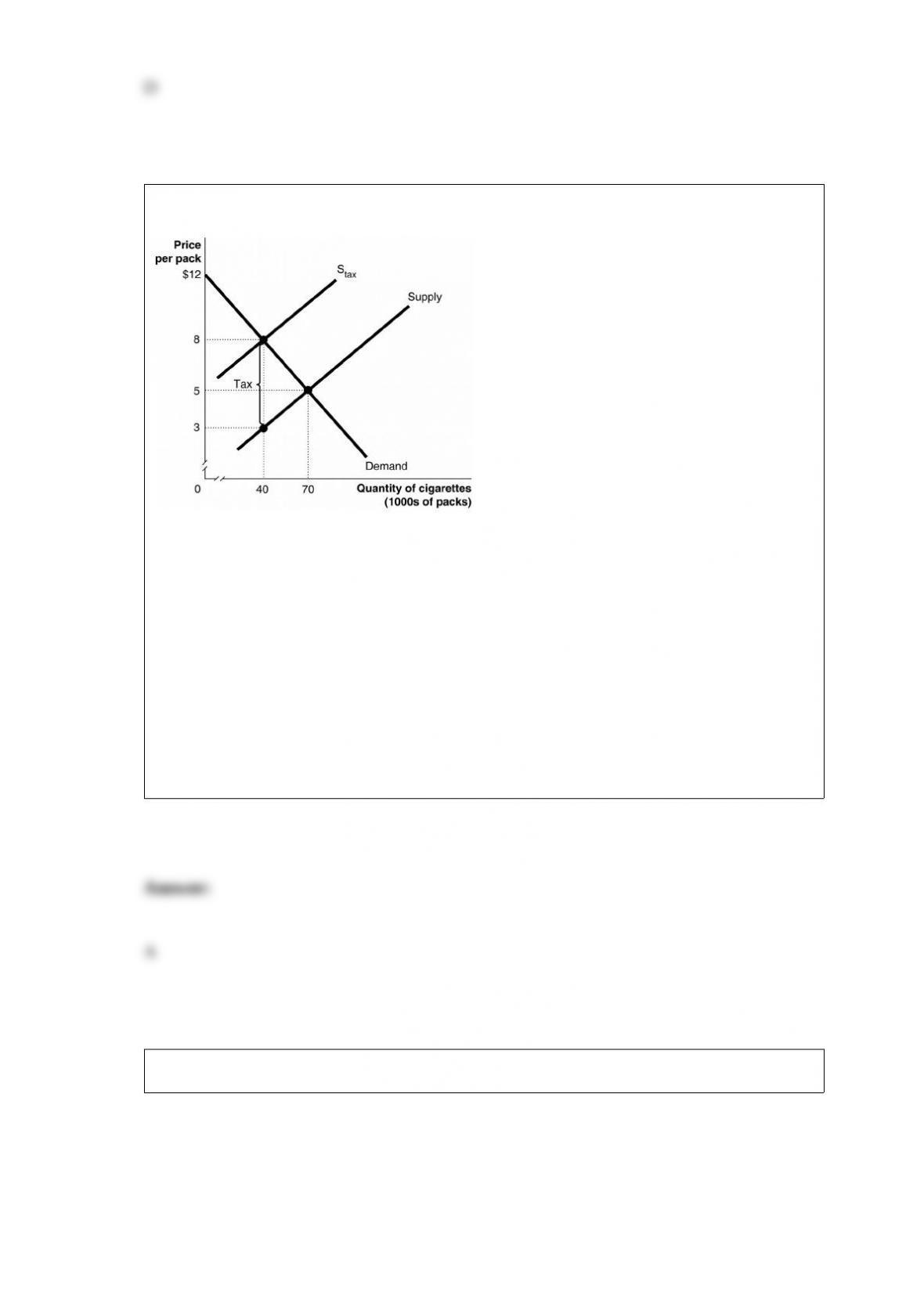
Figure 4-9
Figure 4-9 shows the market for cigarettes. The government plans to impose a unit tax
in this market.
Refer to Figure 4-9. As a result of the tax, is there a loss in producer surplus?
A) Yes, because producers are not selling as many units now.
B) No, because the consumer pays the tax.
C) No, because the market reaches a new equilibrium
D) No, because producers are able to raise the price to cover their tax burden.
Figure 7-3
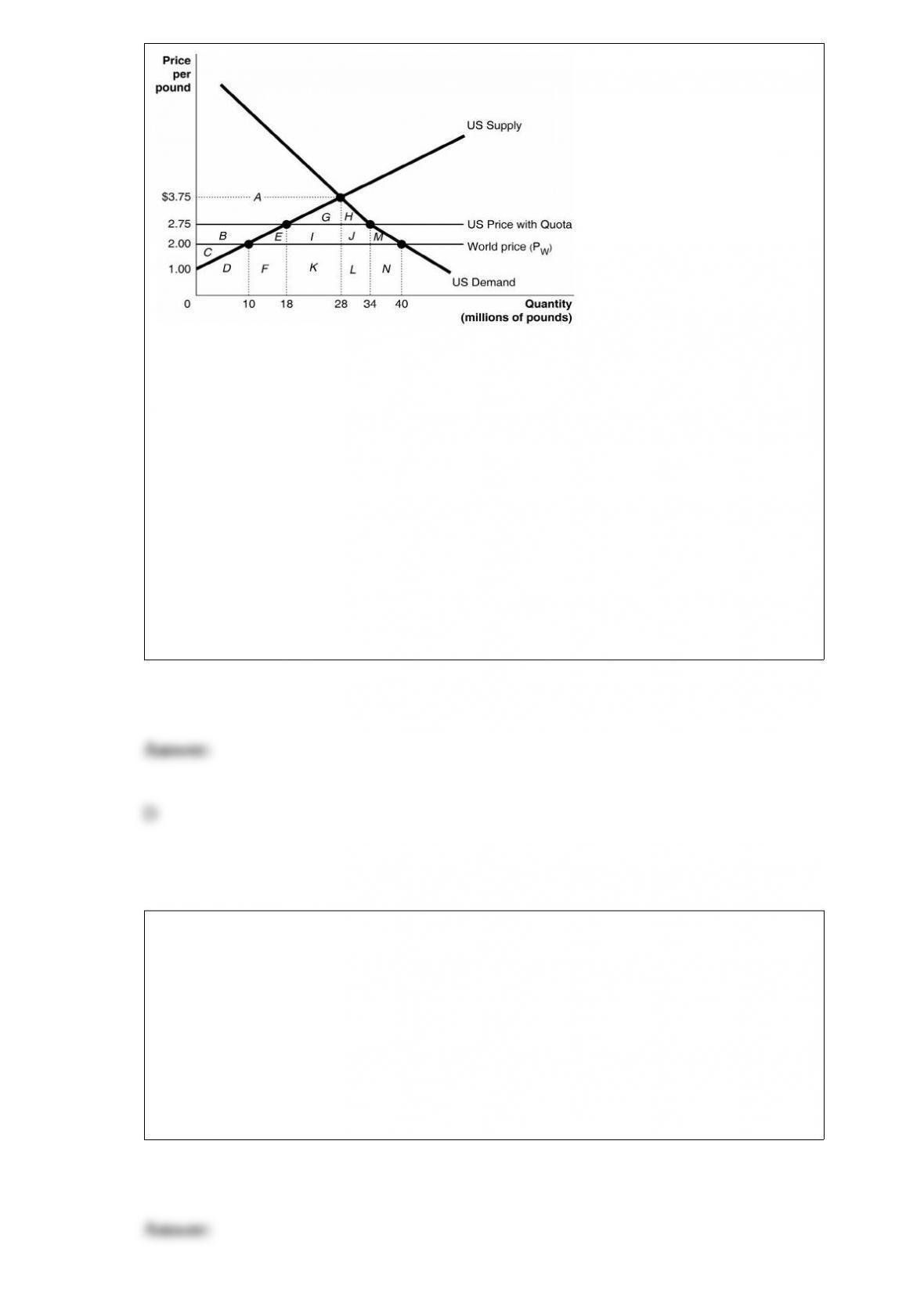
Since 1953 the United States has imposed a quota to limit the imports of peanuts.
Figure 7-3 illustrates the impact of the quota.
Refer to Figure 7-3. Without the quota, the domestic price of peanuts equals the world
price which is $2.00 per pound. What is the quantity of peanuts demanded by domestic
consumers in the absence of a quota?
A) 10 million pounds
B) 28 million pounds
C) 30 million pounds
D) 40 million pounds
Which of the following will reduce consumer expenditures?
A) a decrease in interest rates
B) a general increase in housing prices
C) a decrease in expected future income
D) a decrease in the price level

It is ________ difficult to effectively time fiscal policy than monetary policy because
________.
A) more; fiscal policy can be quickly decided and changed
B) more; fiscal policy takes longer to implement
C) less; monetary policy takes longer to decide and change
D) less; monetary policy takes longer to implement
If the U.S. government removes tariffs it had placed on imports from countries that
have been accused of deliberately undervaluing their currencies, the price of these
imports will ________ and the demand for the undervalued currency will ________.
A) rise; rise
B) rise; fall
C) fall; rise
D) fall; fall
If real GDP per capita doubles between 2005 and 2020, what is the average annual

growth rate of real GDP per capita?
A) 4.7%
B) 10.5%
C) 15%
D) 21%
The average period of unemployment was ________ following the 2007-2009 recession
as following any other recession since the end of World War II.
A) three times as low
B) approximately the same
C) twice as high
D) eight times as high
The statement, “My iPhone is worth $300” represents money’s function as
A) a medium of exchange.
B) a unit of account.
C) a store of value.
D) a standard of deferred payment.

In the desire to have a celebrity’s image protected to prevent it from being used in ways
he would not approve, a celebrity’s estate
A) will probably not be successful, since there are no laws regulating this kind of use in
the United States.
B) will have to be granted a patent declaring the celebrity’s image a new product, and
this will give the estate protection for 7 years.
C) can rely on U.S. laws that protect intellectual property rights to prevent the
unauthorized use of his image.
D) will most likely be more successful in developing countries than in high-income
countries, since property regulations are better enforced in developing countries.
Figure 3-5

Refer to Figure 3-5. At a price of $5,
A) there would be a surplus of 4 units.
B) there would be a scarcity of 4 units.
C) there would be a shortage of 6 units.
D) there would be a shortage of 4 units.