1) A paper plant produces water pollution during the production process. If the
government forces the plant to internalize the negative externality, then the
a.supply curve for paper would shift to the right.
b.supply curve for paper would shift to the left.
c.demand curve for paper would shift to the right.
d.demand curve for paper would shift to the left.
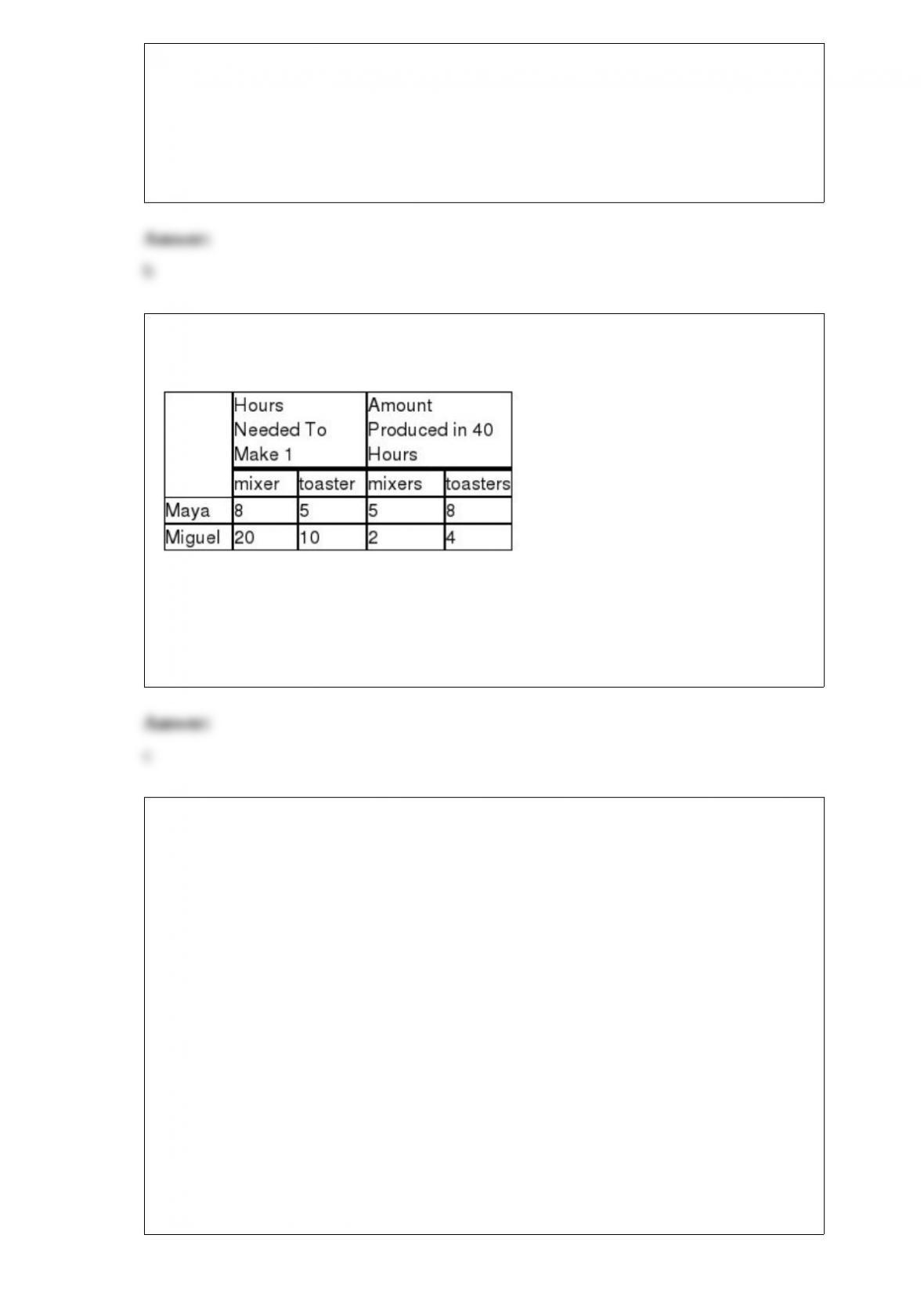
2) Assume that Maya and Miguel can switch between producing mixers and producing
toasters at a constant rate.
The opportunity cost of 1 mixer for Maya is
a.0.625 toasters.
b.5 hours of labor.
c.1.6 toasters.
d.20 hours of labor.
3) Scenario 16-7
Consider the problem facing two firms, YumYum and Bertollini, in the frozen food
market. Each firm has just come up with an idea for a new “frozen meal for two”which
it would sell for $9. Assume that the marginal cost for each new product is a constant
$2, and the only fixed cost is for advertising. Each company knows that if it spends $12
million on advertising it will get 1.5 million consumers to try its new product. YumYum
has done market research which suggests that its product does not have any ‘staying”
power in the market. Even though it could get 1.5 million consumers to buy the product
once, it is unlikely that they will continue to buy the product in the future. Bertollini’s
market research suggests that its product is very good, and consumers who try the
product will continue to be consumers over the ensuing year. On the basis of its market
research, Bertollini estimates that its initial 1.5 million customers will buy one unit of
the product each month in the coming year, for a total of 18 million units.
By its willingness to spend money on advertising, Bertollini
a.signals the quality of its new product to consumers.
b.signals that it is not a profit maximizer.
c.is detracting from the efficiency of markets.
d.will drive YumYum out of the market.
4) According to Arthur Laffer, the graph that represents the amount of tax revenue
(measured on the vertical axis) as a function of the size of the tax (measured on the
horizontal axis) looks like
a.a U.
b.an upside-down U.
c.a horizontal straight line.
d.an upward-sloping line or curve.
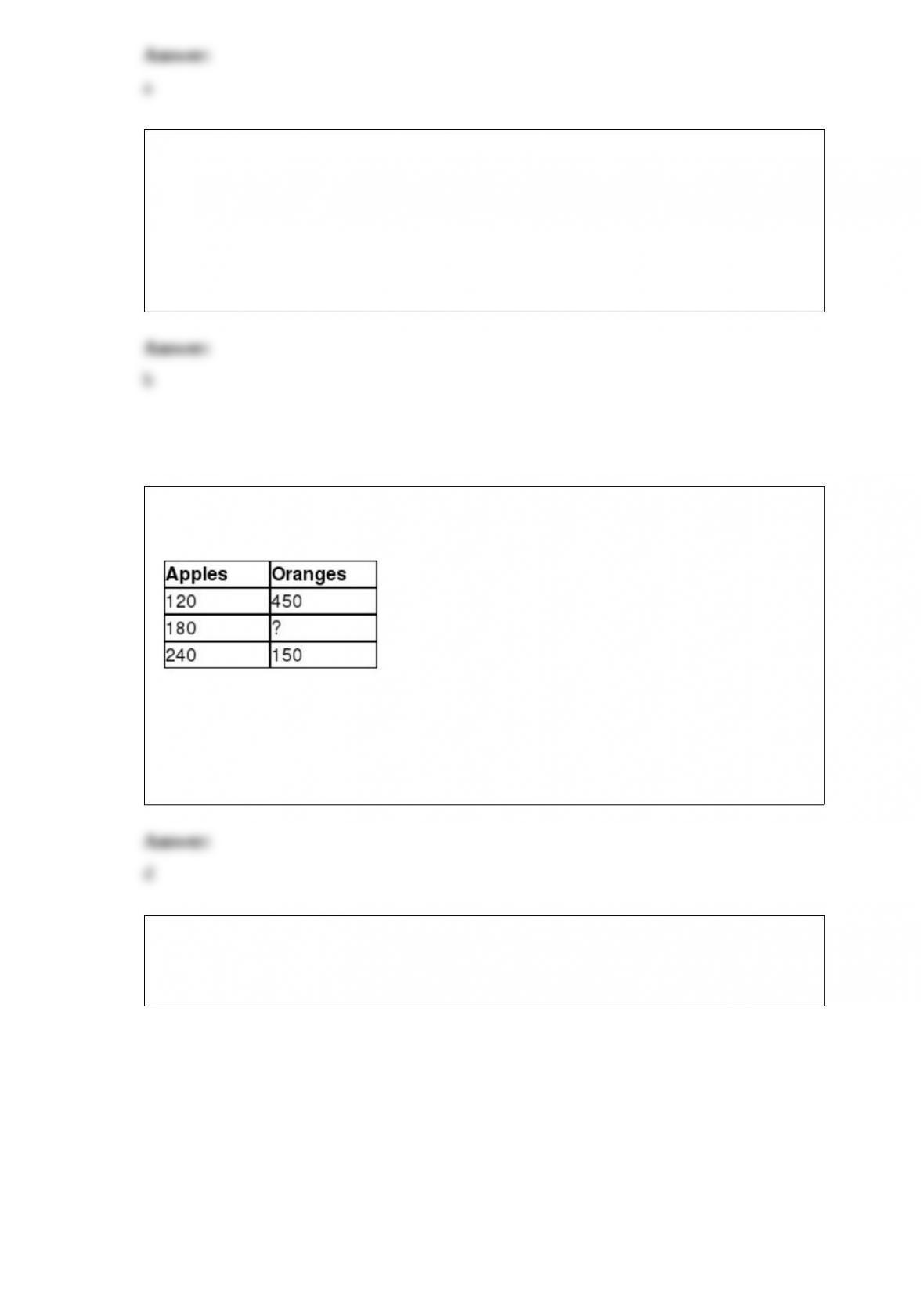
5) The following table contains some production possibilities for an economy for a
given month.
If the production possibilities frontier is bowed outward, then “?” could be
a.150
b.225
c.300
d.375
6) A country club usually only allows members to purchase tickets for its celebrity golf
tournament, but the club is considering allowing non-members to purchase tickets this
year. The demand and supply schedules are as follows:
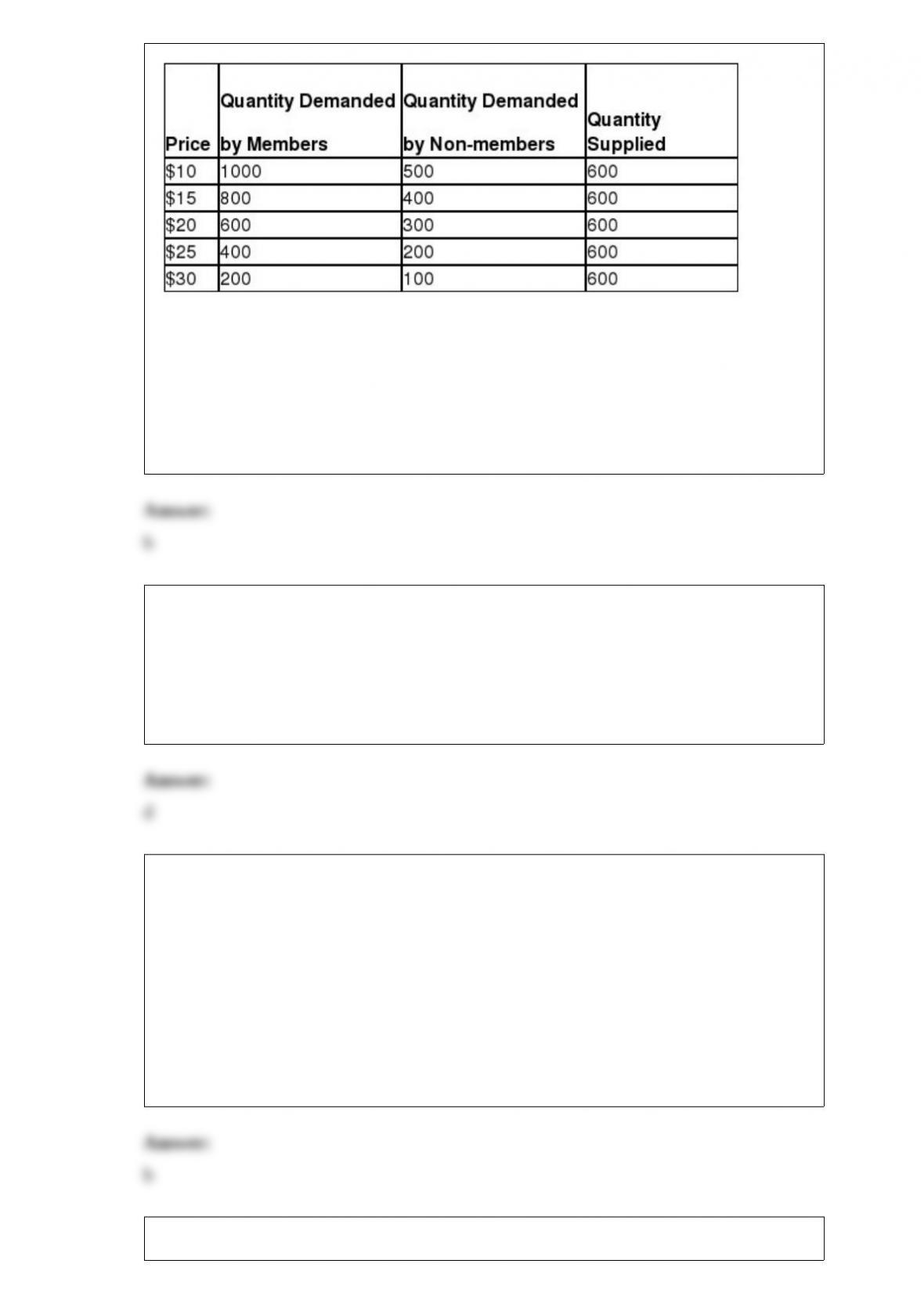
If both members and non-members are allowed to purchase tickets to this year’s
celebrity golf tournament and the country club sets the ticket price at $30, then there
will be
a.a shortage of 300 tickets.
b.a surplus of 300 tickets.
c.600 tickets sold.
d.600 tickets unsold.
7) Round-trip airline tickets are usually cheaper if you stay over a Saturday night before
you fly back. What is the reason for this price discrepancy?
a.Airlines are practicing imperfect price discrimination to raise their profits.
b.Airlines charge a different rate based on the different nature of peoples’ travel needs.
c.Airlines are attempting to charge people based on their willingness to pay.
d.All of the above are correct.
8) A mother gives her teenage daughter two choices: spend 20 minutes cleaning her
room today or spend 25 minutes cleaning her room tomorrow. The same mother gives
her same daughter two additional choices: clean out the garage for 20 minutes next
Tuesday or 25 minutes next Wednesday. According to economic theory,
a.if the daughter chooses to procrastinate, she is behaving irrationally.
b.the daughter will likely choose to clean out her room tomorrow but clean out the
garage next Tuesday.
c.the daughter will likely choose to clean out her room tomorrow and clean out the
garage next Wednesday.
d.if the daughter chooses to procrastinate, she is exhibiting satisficing behavior.
9) When a firm experiences continually declining average total costs, the firm is a

a.government-created monopoly.
b.price taker.
c.natural monopoly.
d.revenue maximizer.
10) Table 12-6
The table below shows the marginal tax rates for an unmarried taxpayer for various
levels of taxable income.
For this tax schedule, what is the average tax rate for an individual with $280,000 in
taxable income?
a. 39.9%
b. 40.2%
c. 42.7%
d. 44.8%
11) When the nation of Mooseland first permitted trade with other nations, domestic
producers of sugar experienceda decrease in producer surplus of $5 million and total
surplus in Mooseland’s sugar market increased by $2 million We can conclude that
a.Mooseland became an exporter of sugar.
b.the overall economic well-being of participants in the sugar market in Mooseland fell
because of trade.
c.consumer surplus in Mooseland increased by $7 million.
d.the opening of trade caused the domestic demand curve for sugar in Mooseland to
shift to the right.

12) A monopolist’s profits with price discrimination will be
a.lower than if the firm charged a single, profit-maximizing price
b.the same as if the firm charged a single, profit-maximizing price.
c.higher than if the firm charged just one price because the firm will capture more
consumer surplus.
d.higher than if the firm charged a single price because the costs of selling the good will
be lower.