
1) the problems of corporations such as enron and worldcom occurred because:
a.they failed to offer stock to executives to encourage profit-seeking decisions.
b.providing stock as part of executive compensation encouraged fraudulent practices
designed to exaggerate profits and artificially inflate the value of the stock.
c.incompetent auditing failed to identify unprofitable practices.
d.the industries in which those companies operated were no longer profitable.
2) any combination of goods lying outside of the budget line:
a.implies that the consumer is not spending all his income.
b.yields less utility than any point on the budget line.
c.yields less utility than any point inside the budget line.
d.is unattainable, given the consumer’s income.
3) empirical studies suggest that:
a.labor productivity has declined throughout u.s. history.
b.technological advances account for about 40 percent of u.s. productivity growth.
c.the achieving of economies of scale is the most important factor in u.s. economic
growth.
d.all u.s. economic growth from between 2001 and 2007 can be attributed to increases
in the quantity of labor.
4) Use the graphs below to answer the following questions:
(a)What types of schedules do graphs A and B represent?
(b)If in graph A line A2 shifts to A3 because households consume more and this change
is not due to changing taxes, then in graph B, what would happen to line B2?
(c)If in graph B, line B2 shifts to B1 because households save less, then in graph A,
what will happen to line A2?
(d)In graph A, what has caused the movement from point A to point B on line A2?
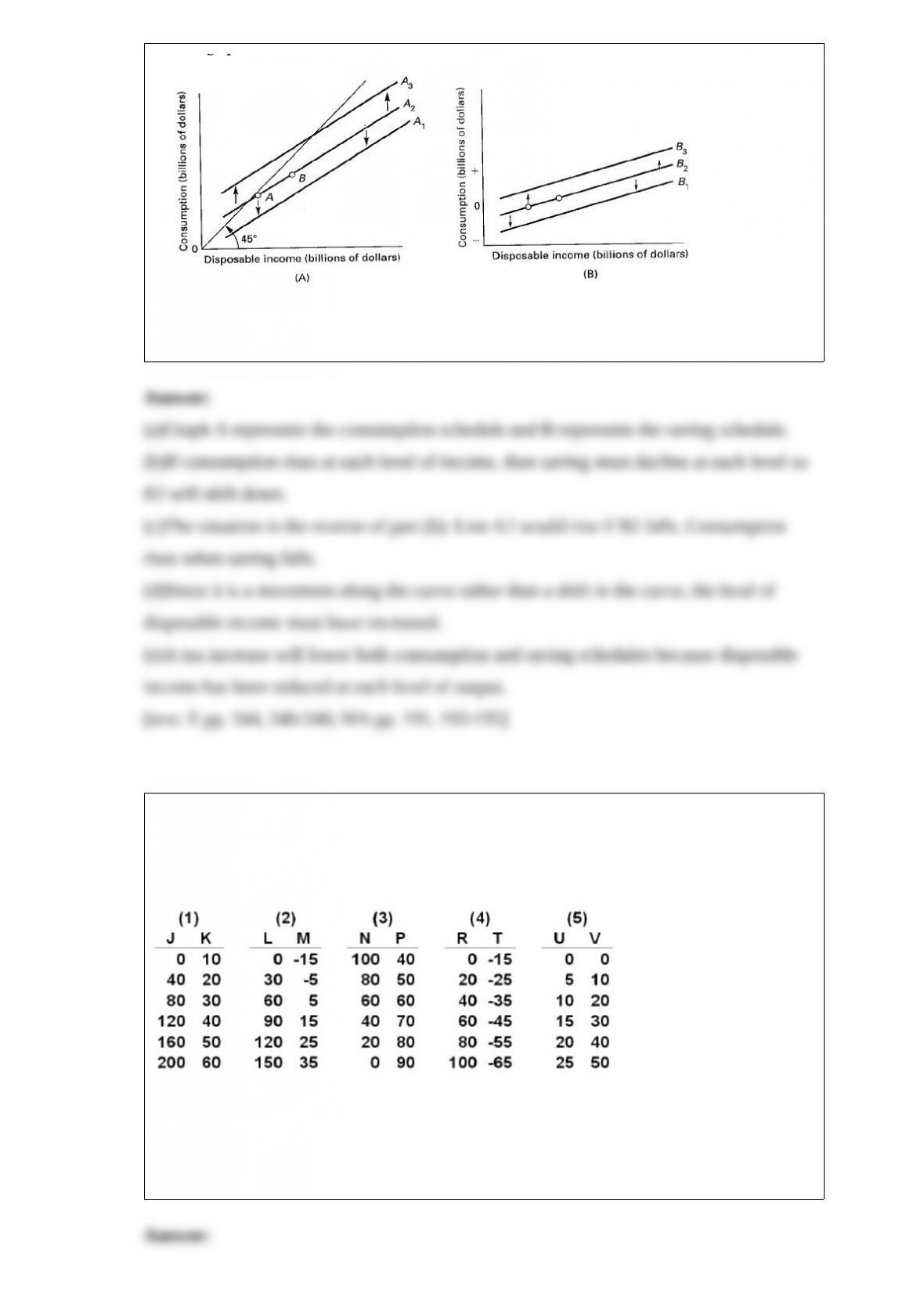
(e)If there
is a lump-sum tax increase causing line A2 to shift to A1, then in graph B, what will
happen to B2?
5) answer the next question(s) on the basis of the following five data sets wherein it is
assumed that the variable shown on the left is the independent variable and the one on
the right is the dependent variable. assume in graphing these data that the independent
variable is shown on the horizontal axis and the dependent variable on the vertical axis.
refer to the above data sets. the equation for data set 3 is:
a.p = 90 – .5n.
b.p = 90 + .5n.
c.p = .5n.
d.p = 40 + .5n.

6)
Assumptions: These two graphs show two sectors of the labor market for a particular
kind of labor. Relevant product markets are competitive. The two labor demand curves
are identical and initially the quantities of labor employed in the two sectors are L1and
L’1and the wage rate in each sector is Wn.
Refer to the above diagrams and assumptions. If all the workers who lose their jobs in
the union sector because of a Wn to Wu union wage increase are reemployed in
nonunion sector 2, output in that sector will:
A.decrease by F + G.
B.increase by F + G.
C.increase by E + F.
D.increase by E.
7) Within the past decade, Congress has:
A.permitted banks and thrifts to ‘self-insure” rather than participate in the FDIC system.
B.allowed holders of government bonds to add these bonds to their insured checking
accounts.
C.ended restrictions on banks’ merging with insurance companies, securities firms, and
other firms offering financial services.
D.ended restrictions on banks’ buying of non-bank firms such as manufacturers,
corporate farms, and real estate companies.

8)
Suppose real GDP is X, as shown in graph A. If the economy’s MPC is .8, X is $200
billion and full-employment real GDP Y is $300 billion, an appropriate fiscal policy
would be to reduce taxes by:
A.$100 billion.
B.$20 billion.
C.$25 billion.
D.$164 billion.
9) Which of the following policies has succeeded in reducing fishery catch sizes
without creating an “arms race” among fishers?
A.Limiting the length of the catch season.
B.Limiting the number of boats allowed in a given area.
C.Limiting catch size (TAC).
D.Issuing Individual Transferable Quotas (ITQs).
10) The XYZ Corporation can make a real (inflation-adjusted) return on an investment
of 9 percent. The nominal rate of interest is 13 percent and the rate of inflation is 7
percent. We can conclude that the:
A.investment will be profitable.
B.investment will be unprofitable.
C.real rate of interest is 4 percent.
D.real rate of interest is 2 percent.
11) an effective ceiling price will:
a.induce new firms to enter the industry.
b.result in a product surplus.
c.result in a product shortage.
d.clear the market.

12) Labor unions are restrained in their wage demands because:
A.legislation limits annual increases in nominal wages to 6 percent.
B.the labor demand curve is downsloping.
C.marginal wage cost curves lie above labor supply curves in most labor markets.
D.most unions deal with monopsonists who have superior bargaining power.
13) In considering euros and dollars, the rates of exchange for the euro and the dollar:
A.are directly related.
B.are inversely related.
C.are unrelated.
14) the construction of a production possibilities curve assumes:
a.the quantities of all resources are unlimited.
b.technology is fixed.
c.some resources are unemployed.
d.there is no inflation in the economy.
15) in the depth of the great depression, the unemployment rate in the united states was
about:
a.15 percent.
b.33 percent.
c.25 percent.
d.40 percent.
16) Suppose that the CPI for a particular economy rose from 110 to 120 in year 1, 120
to 130 in year 2, and 130 to 140 in year 3. We could conclude that this economy is
experiencing:
A.accelerating inflation.

B.deflation.
C.disinflation.
D.a constant rate of inflation.