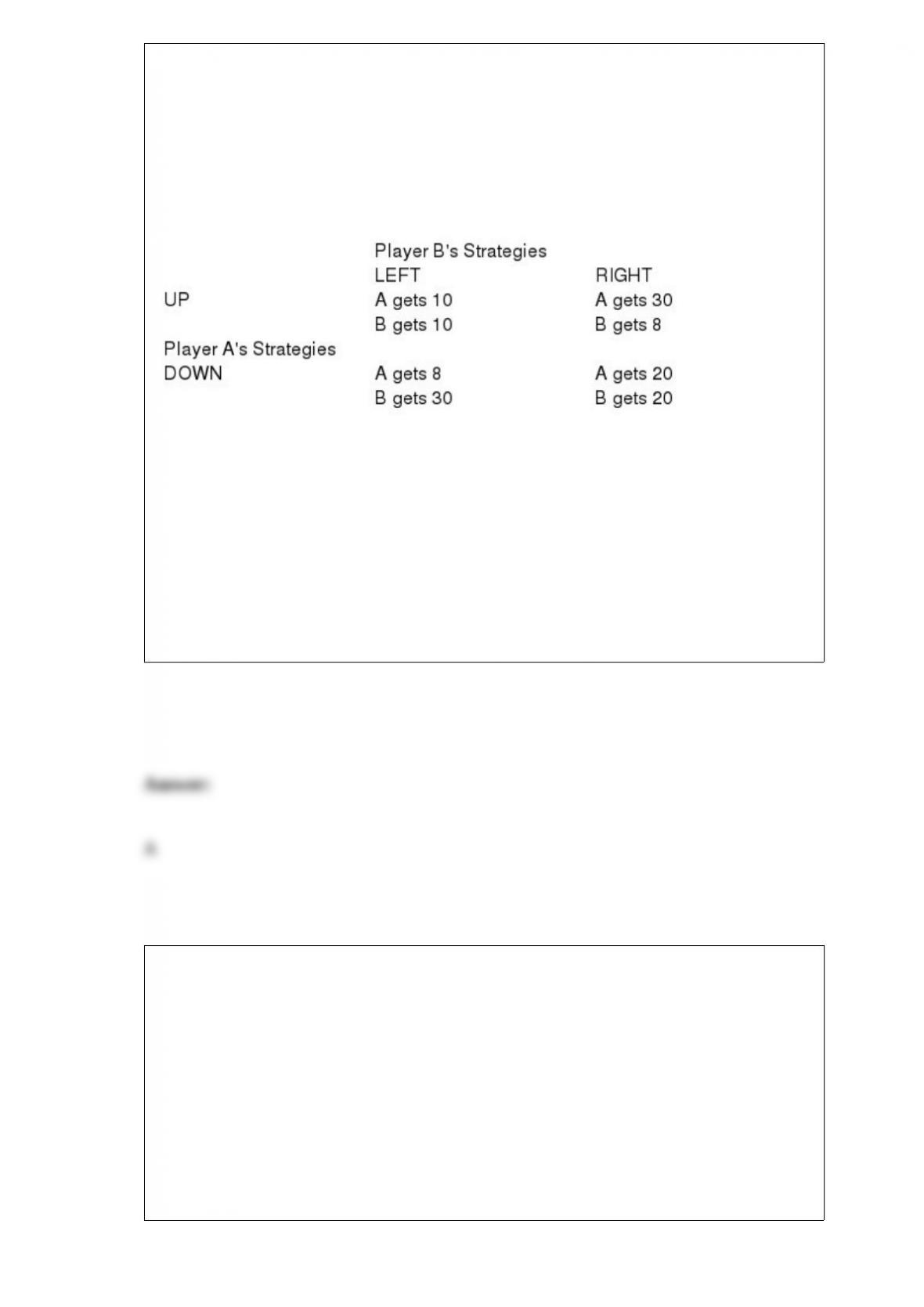
Game Matrix IV
The following questions refer to the game matrix below.
Player A can play the strategies UP and DOWN and Player B can play the strategies
LEFT and RIGHT.
The Nash Equilibrium for the game is
a. UP, LEFT
b. UP, RIGHT
c. DOWN, LEFT
d. DOWN, RIGHT
Moe and Curley have identical skills. Their jobs are identical, except Moe’s job
provides more on-the-job training experiences than does Curley’s job. Who will have
the higher observed wage rate?
a. Moe’s wage rate will be higher than Curley’s.
b. Curley’s wage rate will be higher than Moe’s.
c. Moe and Curley will be paid the same wage rate.
d. There is insufficient information to determine who will be paid the higher wage.

Prof. Epstein’s normative theory of law argues that the common law ought to
a. promote a more desirable distribution of income.
b. impose punitive damages more often.
c. seek economic efficiency.
d. promote the Good Samaritan ethic.
Marginal revenue product for labor for any type of firm is
a. the additional revenue that a firm earns when it employs one more unit of labor.
b. the additional revenue that a firm earns when it produces one more unit of output.
c. the additional cost of employing one more unit of output.
d. the difference between the revenue from employing one more unit of labor and the
wage rate.

Suppose that the pizza business is a competitive, constant-cost industry. An increase in
demand for pizza, will, in the long-run lead to
a. an increase in price and industry output, but no increase in the output of existing
firms.
b. no increase in price, no increase in the output of existing firms but an increase in
industry output because of new firms.
c. no increase in price and an increase in industry output as each existing firm produces
more.
d. no changes in price, output of existing firms or the number of firms in the industry.
Firms rarely offer unlimited warranties on their products, because then their customers
would be less careful with upkeep and maintenance. This situation is an example of
a. confiscation of rents.
b. a speculative bubble.
c. moral hazard.
d. the principal-agent problem.

Under a standard of contributory negligence, a plaintiff cannot collect for damages if
his cost of preventing the accident is less than
a. the defendant’s cost of preventing the accident.
b. the damages incurred from the accident.
c. the damages incurred times the probability of the accident’s occurrence.
d. the punitive damages imposed by the court.
Suppose notebooks are produced by a competitive constant-cost industry. Which of the
following must cause Nanna’s Notebooks to exit the industry in the long run?
a. Nanna’s is notified of a rent increase, but her competitors’ rents are unchanged.
b. A fire destroys half of Nanna’s inventory.
c. A photographer wins a $10,000 judgment from a lawsuit charging that Nanna’s used
his photos on notebook covers without permission.
d. The price of cardboard used in notebook production rises.
Budget Lines
The following questions refer to the following diagram, which shows the budget lines
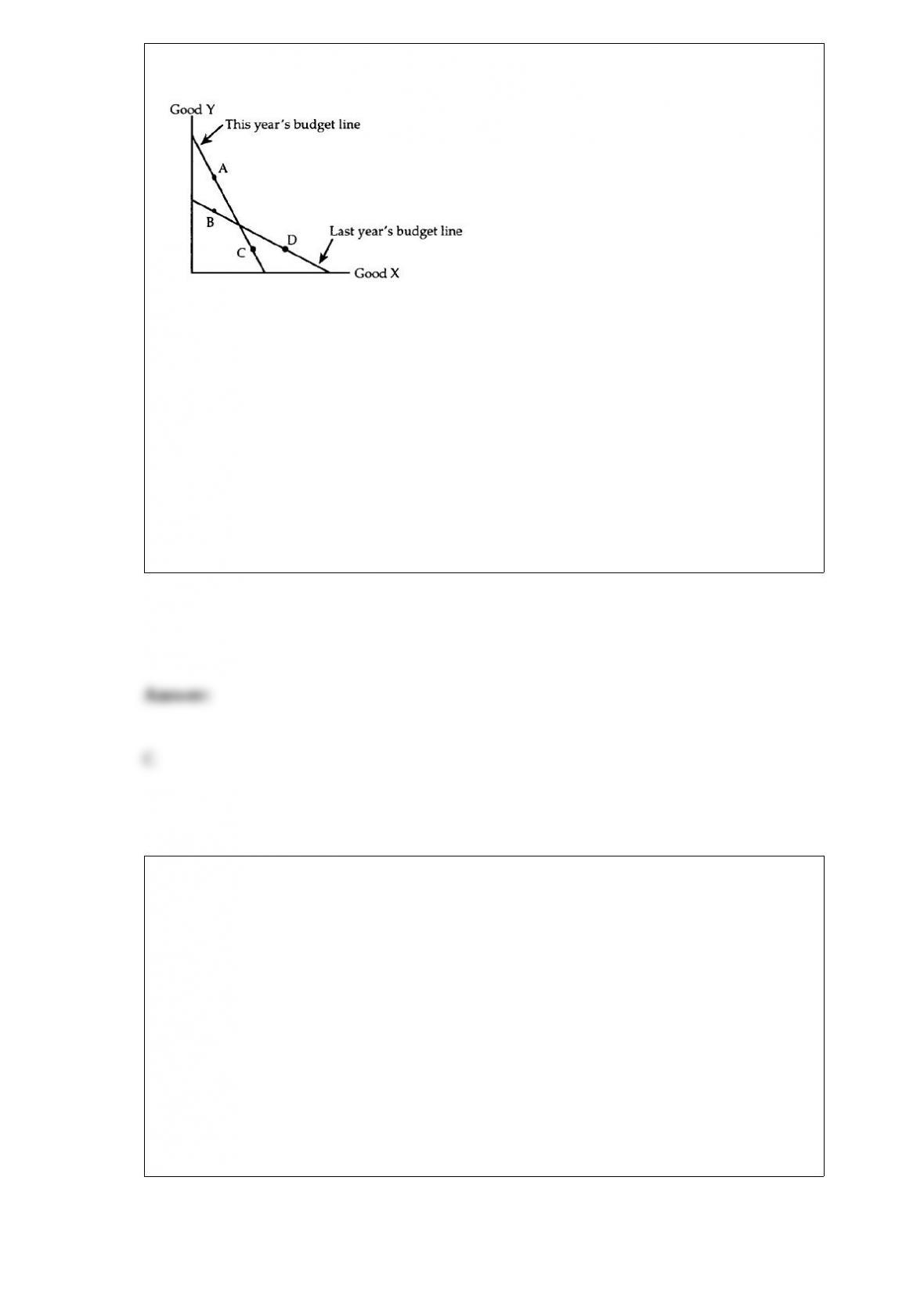
faced by a consumer last year and this year.
If the consumer purchased basket D last year and basket A this year,
a. They are definitely better off this year than last year.
b. They were definitely better off last year than this year.
c. They could be equally well off in the two years.
d. It is impossible to tell wether they are better or worse off, even if we knew the
person’s preferences.
Monopoly Problem. Consider a monopoly with constant marginal costs of $20.
Consumers in the market for this monopoly’s product have demand of Q = 100 – 2P.
This monopoly will produce
a. 20 units.
b. 30 units.
c. 40 units.
d. 60 units.

A cartel member has the incentive to cheat on the cartel agreement because
a. it fears that other members may also cheat on the agreement.
b. the cartel prevents the member from charging the monopoly price.
c. undercutting the cartel price will increase the cartel member’s profit.
d. the cartel outcome is not Pareto optimal for the cartel members.
Marginal cost is defined as
a. the additional cost attributable to the last unit produced.
b. the change in fixed costs associated with the production of one more unit of output.
c. the difference between total revenue and total cost.
d. price times quantity.

The marginal product of labor is defined to be
a. the additional output attributable to the last unit of labor employed.
b. the amount of output obtained, on average, from each unit of labor employed.
c. the percentage increase in output caused by a 1% rise in labor usage.
d. the amount of capital that the firm can use to replace one unit of labor.
Which of the following will result in a firm increasing its level of production?
a. An increase in its Marginal Costs.
b. A decrease in its Marginal Revenue.
c. An increase in its Fixed Costs.
d. An increase in the price of its product.
Computer software is an example of a good that is
a. both nonexcludable and nonrivalrous.
b. nonexcludable, but not nonrivalrous.
c. nonrivalrous, but not nonexcludable.

d. a pure private good.
A Negative Externality Problem
Demand for a good is given by Q = 100 – P. The private marginal cost of production is
MCP = 10 + Q. There is a $10 per unit negative production externality in this situation.
The equation for social marginal cost is
a. MCS = 10 + Q
b. MCS = Q
c. MCS = 20 + Q
d. MCS = 10 + 10Q
When a person is risk-preferring, his indifference curves are
a. convex.
b. concave.
c. linear.
d. upward sloping.
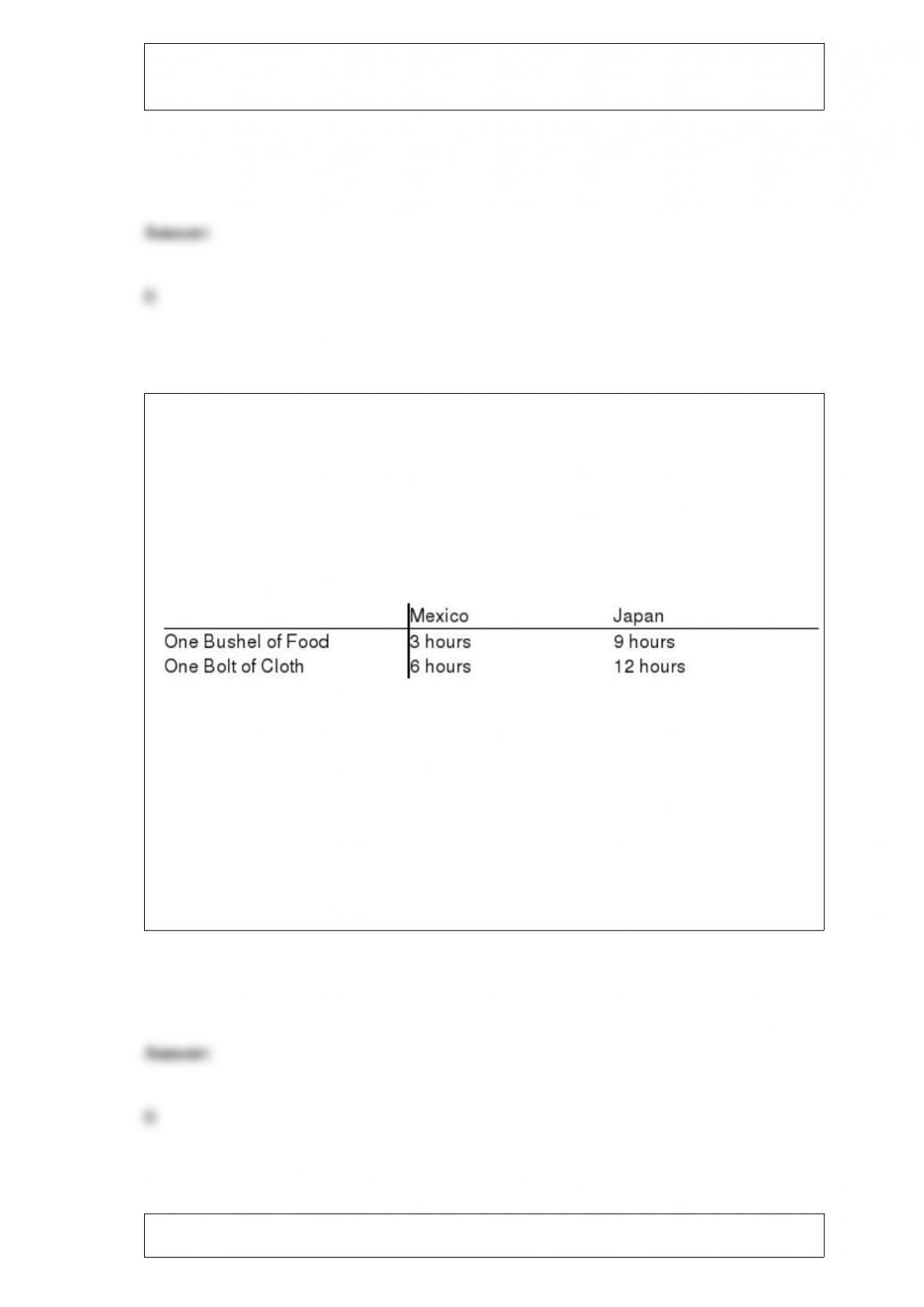
Mexico and Japan
The following questions refer to the following table which shows the abilities of
Mexico and Japan to produce food and cloth. Food and cloth are the only two
commodities in the world and their production requires only labor. The amounts of
labor required to produce one unit of each of these commodities in the two countries are
shown in the table below.
What is the cost of producing 1 bolt of clothing in Mexico?
a. 6 hours of labor.
b. 2 bushels of food.
c. 3 bushels of imported Japanese food.
d. 4 bolts of imported Japanese cloth.
A monopolist will always end up choosing to operate

a. even if its profits are negative.
b. on the elastic portion of its demand curve.
c. until such time as a new competitor enters its market.
d. only if it can capture the entire consumer surplus.
Shares in XM Radio currently sell for $20. If the satellite it plans to launch works well,
the share value will increase by $35. If the satellite fails to function, the share price will
fall by $5. The expected return of the stock is
a. 25%.
b. 50%.
c. 75%.
d. 100%.
When is an individual’s labor supply curve most likely to be backward bending?
a. When substitution effects are large.
b. When income effects are large.

c. When wages are relatively low.
d. When nonlabor income is low.
BP and Exxon both produce petroleum products and sell them at the wholesale and
retail levels. One of them is also in the coal business. The merger of the two firms is an
example of
a. horizontal integration.
b. vertical integration.
c. both horizontal and vertical integration.
d. a tournament.
If all firms in a competitive industry experience and increase in marginal costs, then
which of the following is most likely to occur in the short run?
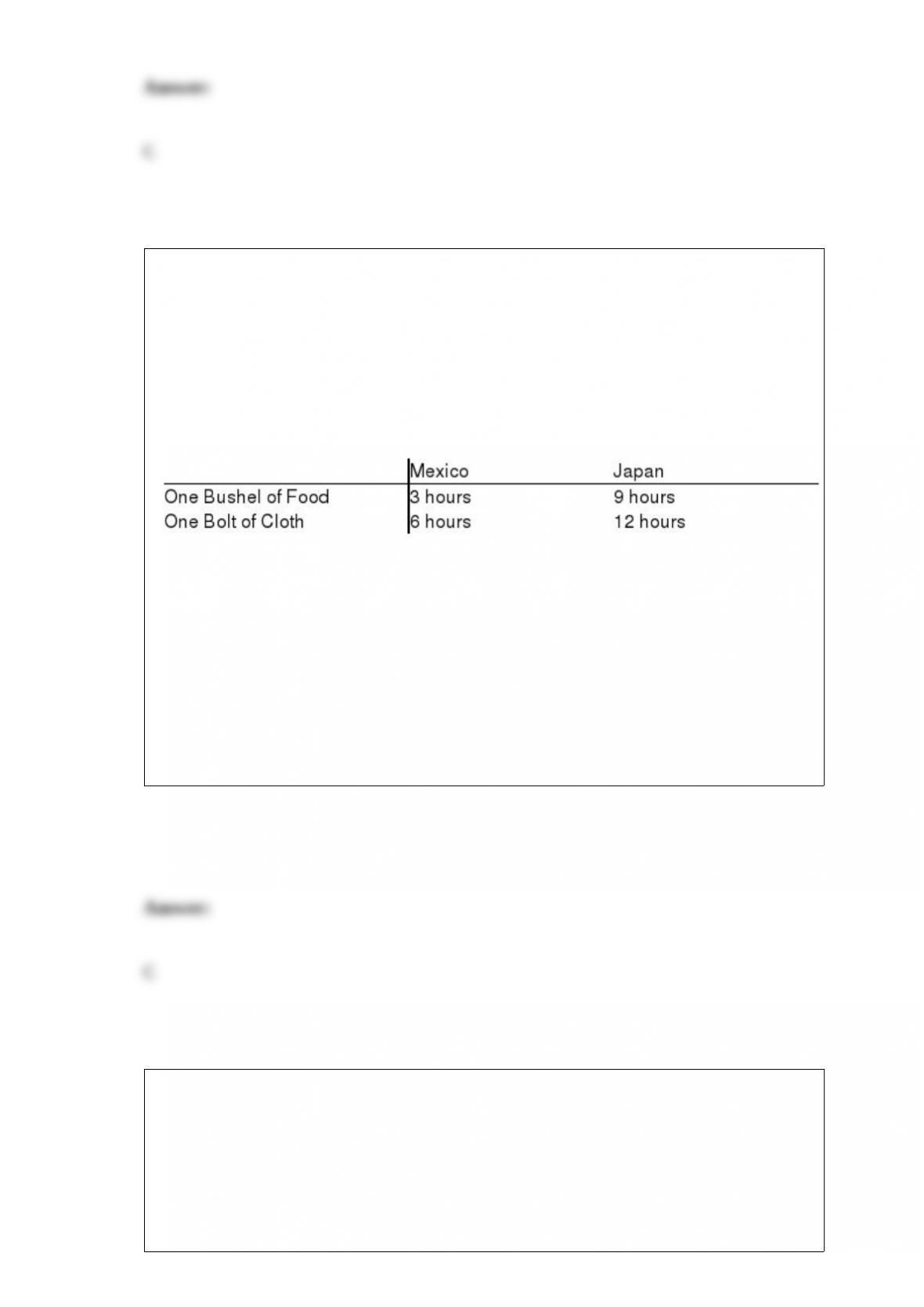
Mexico and Japan
The following questions refer to the following table which shows the abilities of
Mexico and Japan to produce food and cloth. Food and cloth are the only two
commodities in the world and their production requires only labor. The amounts of
labor required to produce one unit of each of these commodities in the two countries are
shown in the table below.
What is the cost of producing one unit of food in Japan?
a. 2 bolts of cloth per bushel.
b. 4/3 bolts of cloth per bushel.
c. 3/4 bolts of cloth per bushel.
d. none of the above.
Which of the following would result in a decrease in the demand for coffee?
a. A frost in Brazil that damages coffee plants.
b. The proliferation of coffee shops in an area.
c. A 10 cent tax on the sale of a doughnut.

d. Colder than normal temperatures in winter.
The marginal cost of producing tea can be measured in dollars per pound of tea.
The Fabian socialists argued that there would be no social cost associated with
a. a proportional income tax.
b. the sharp price declines caused when a speculative bubble bursts.
c. limits on employer monitoring imposed to protect employees’ privacy.
d. the appropriation of rents by the government.

The set of income-quantity pairs showing the amount of a good the consumer buys at
various levels of income is called
a. a compensated demand curve.
b. a budget line.
c. an income-elasticity curve.
d. an Engel curve.
If an activity is worth pursuing at all, then the only information the decision maker
needs to make a choice is
a. total benefits.
b. marginal benefits and marginal costs.
c. total costs.
d. fixed costs.
Suppose we examine how the consumer’s optimum changes when the price of good X
changes, while the consumer’s tastes, income, and the price of all other goods are held
constant. This procedure is used to derive
a. the Engel curve for good X.

b. the (ordinary) demand curve for good X.
c. the compensated demand curve for good X.
d. the substitution and income effects for good X.
Risk-averse investors choose to hold only two assets: a risk-free asset and a market
portfolio.
Suppose the demand curve for a good is given by the equation P = 200 – 1/2 Q and the
supply curve is given by the equation P = 50 + 1/4 Q, where P represents the price of
the good (measured in dollars per unit) and Q represents the quantity of the good
(measured in units per week).
(i) Find the equilibrium price and quantity for this market.
(ii) Suppose the government imposes a sales tax of $9 per unit on this good. Find the
new formula for the demand curve, the new equilibrium quantity, the post-tax price
received by suppliers, and the post-tax price paid by demanders.
(iii) What fraction of the economic burden of this tax is borne by demanders and what
fraction is borne by suppliers?

If the cross-price elasticity for oranges with respect to apples is 1.2 and the price of
apples increase by 5%, then we can expect the quantity demanded of oranges to
decrease by 6%.
All economists agree that a public good is one the is nonrivalrous and nonexcludable.
One deficiency of labor-leisure indifference curve analysis is that because indifference
curves are always tangent to the worker’s budget line, the model can not explain why

some people choose not to work.
In the principal-agent problem, assigning full liability to the agent gives no incentive
for the principal to avoid damages.
For a Nash equilibrium to exist, at least one player must have a dominant strategy.
Consider a fall in the wage rate. How does the substitution effect change the amount of
labor that a firm hires? How does the scale effect change the amount of labor that a firm
hires? What do these effects imply about the firm’s long-run demand for labor?

An increase in a worker’s marginal productivity can cause an increase in the worker’s
non-labor income.
A firm has the incentive to cheat on a cartel agreement only when it fears that other
cartel members will also cheat.
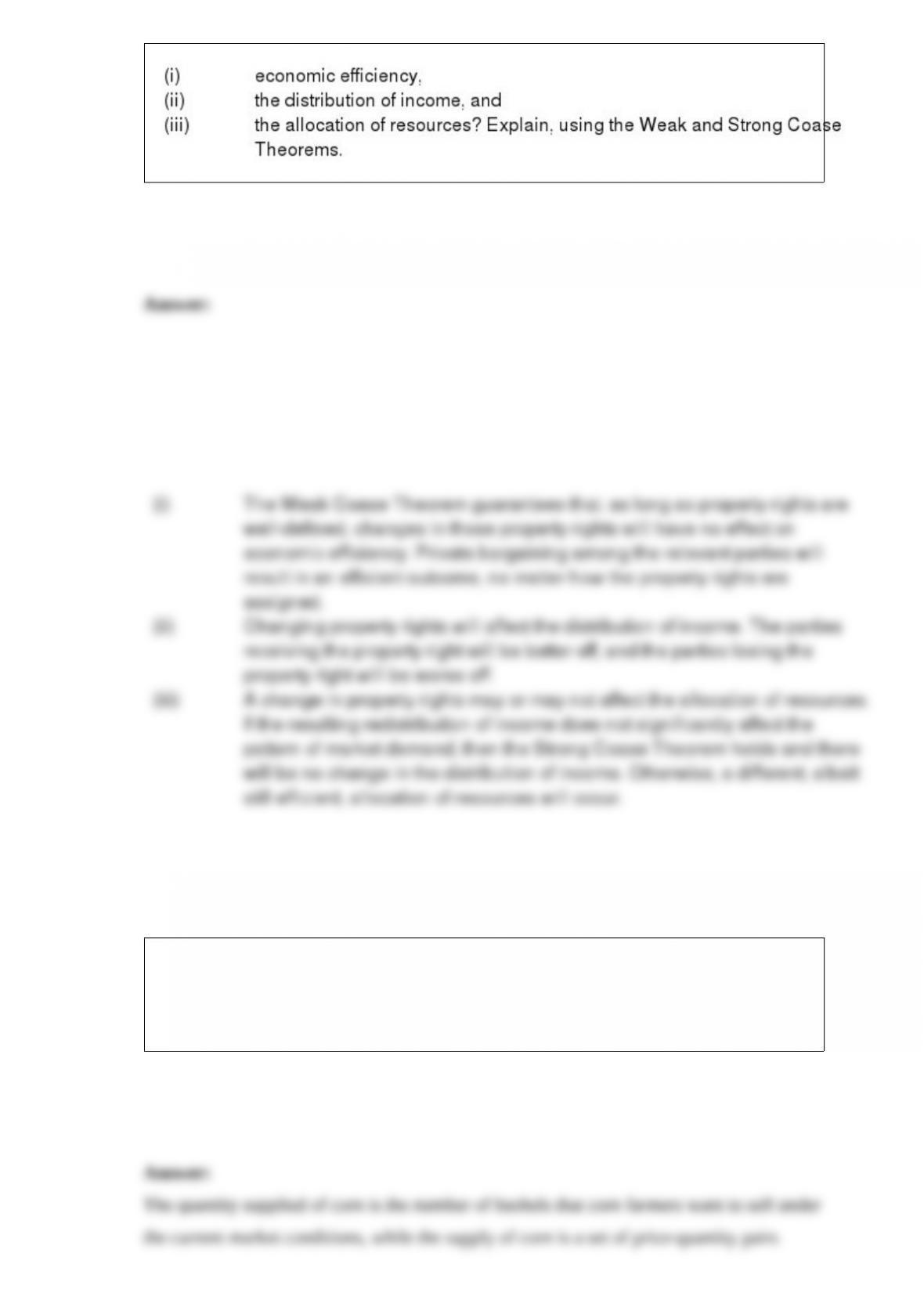
In a world without transactions costs, how will a change in property rights affect
What is the difference between the quantity supplied of corn and the supply of corn?
What could cause a rise in the quantity supplied of corn, and what could cause a rise in
the supply of corn? How would these changes be shown graphically using a supply
curve?

The consumer’s income has no effect of the slope of the consumer’s budget line.
A simple profit-maximizing monopoly will choose its price and quantity from the
elastic portion of its demand curve.
The cross elasticity of demand will be positive when goods are substitutes and negative
when goods are complements.

An excise tax of 20 cents on gasoline shifts demand down by exactly 20 cents.