1)
Refer to the above data. If a lump-sum tax (the same tax amount at each level of GDP)
of $40 is imposed in this economy, the marginal propensity to consume is:
A..8 before taxes and .6 after taxes.
B..8 both before and after taxes.
C..6 before taxes and .8 after taxes.
D..8 before taxes and .4 after taxes.
2) in the second quarter (3-month period) of 2001, u.s. nominal gdp increased but u.s.
real gdp declined. we can conclude that:
a.nominal income declined by more than personal income.
b.the price level rose by more than nominal gdp.
c.real wages declined by more than real gdp.
d.the price level fell by more than real gdp.
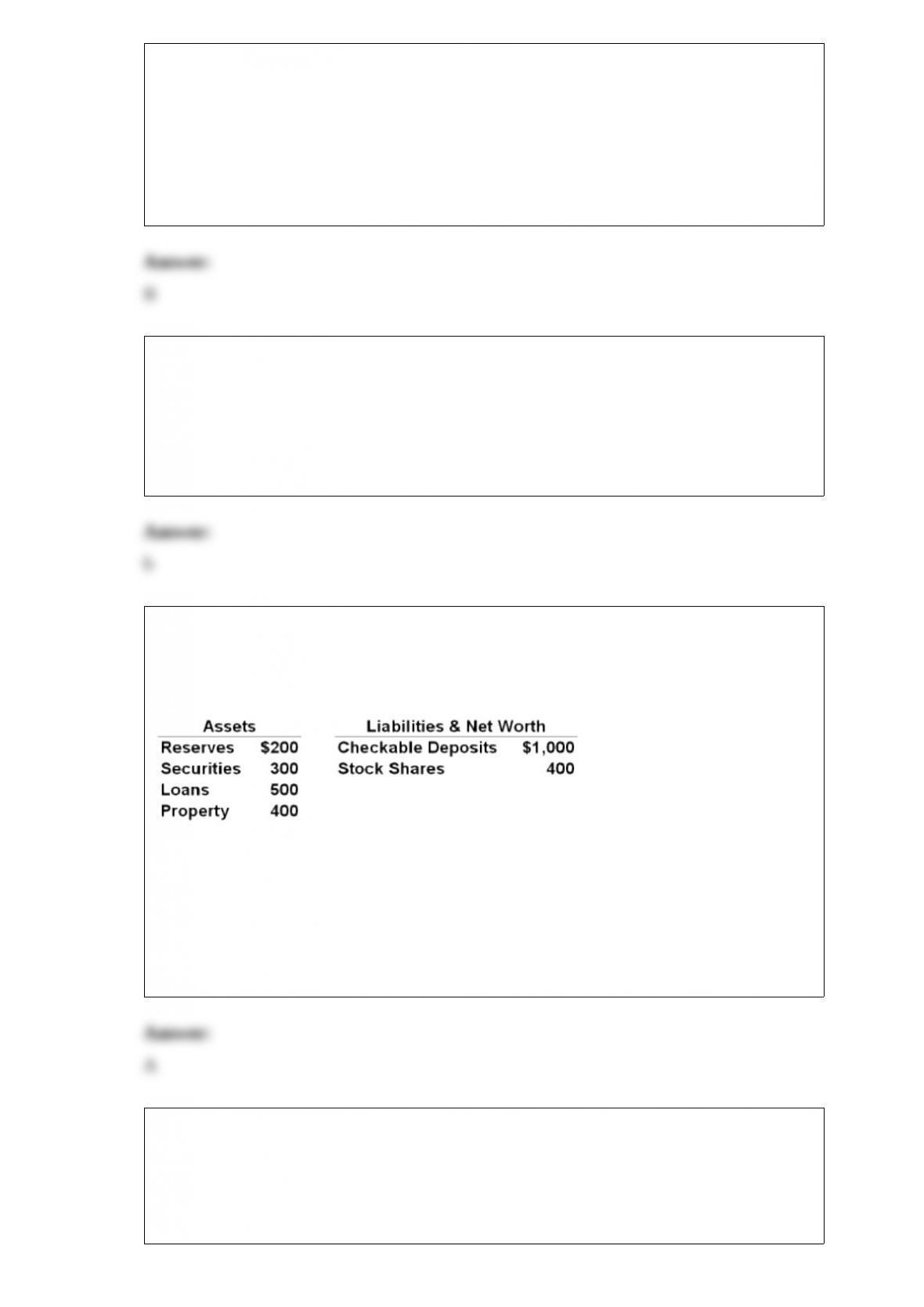
3) The following consolidated balance sheet of the commercial banking system.
Assume that the reserve requirement is 20 percent. All figures are in billions and each
question should be answered independently of changes specified in all preceding ones.
Refer to the above data. Suppose the Fed wants to increase the money supply by $1000
billion to drive down interest rates and stimulate the economy. To accomplish this it
could lower the reserve requirement from 20 percent to:
A.10 percent.
B.12 percent.
C.14 percent.
D.16 percent.
4) the “play or pay” proposal for health care reform is designed to:
a.increase access to health care by inducing more employers to provide health
insurance.
b.make health care vouchers freely available to all people living in poverty.
c.provide health care to all americans through the federal government as the single
insurer.
d.contain health care costs through government determination of doctors’ fees and
hospital charges.
5) Price supports:
A.decrease pollution because participants must practice organic farming.
B.neither increase nor decrease environmental pollution.
C.increase pollution because supports encourage the cultivation of marginal land and
the use of more pesticides and fertilizers.
D.discourage rent-seeking activity.
6) Farm programs such as those of the United States and the European Union cause a
misallocation of international agricultural resources primarily because:
A.they distort domestic and world agricultural prices.
B.they inhibit technological progress in agriculture.
C.production and trade occur on the basis of comparative advantage.
D.price supports are set below market-clearing levels.
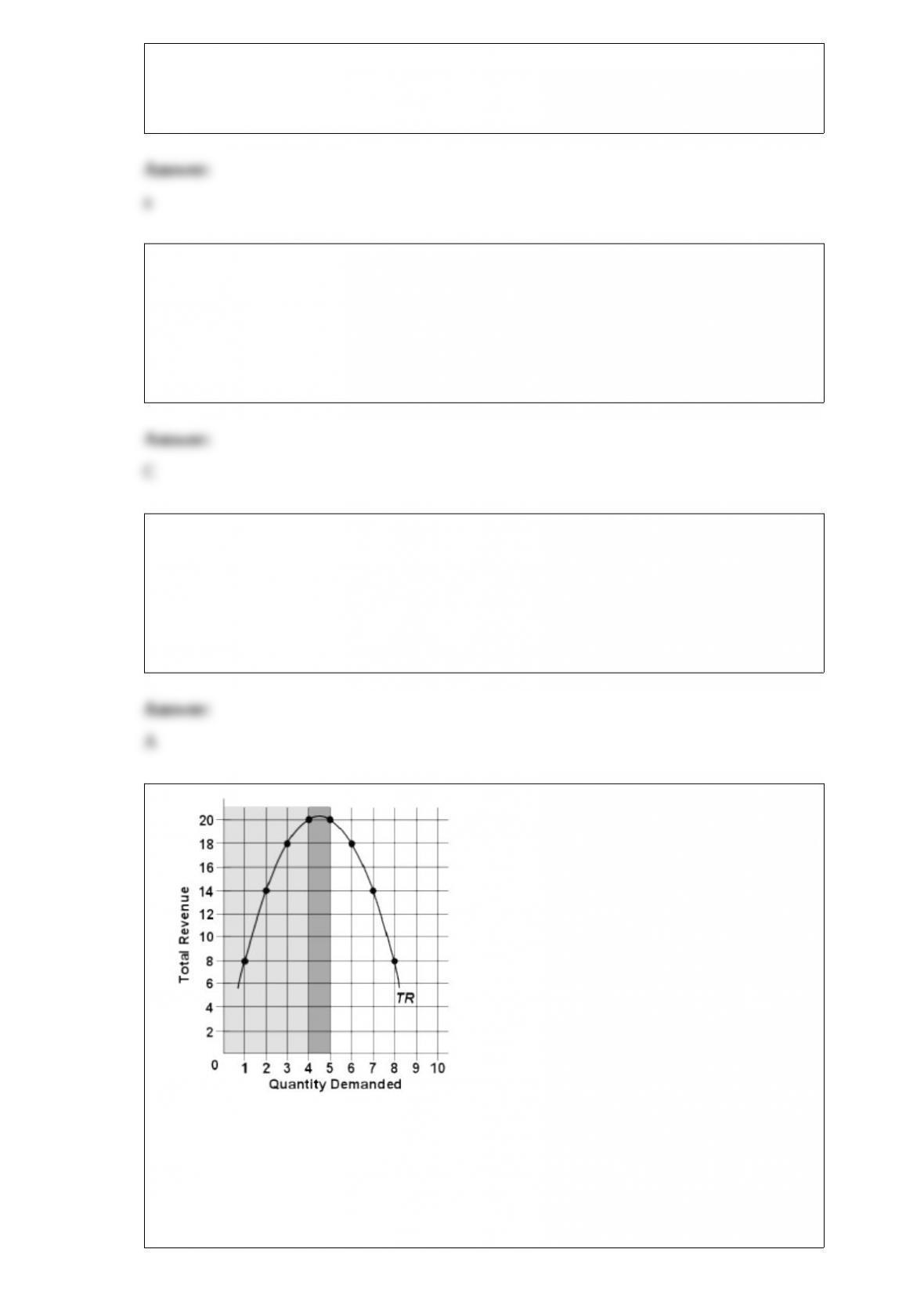
7)
suppose that the above total revenue curve is derived from a particular linear demand
curve. that demand curve must be:
a.inelastic for price declines that increase quantity demanded from 2 units to 3 units.
b.elastic for price declines that increase quantity demanded from 5 units to 6 units.
c.unit elastic for price increases that reduce quantity demanded from 5 units to 4 units.
d.inelastic for price increases that reduce quantity demanded from 4 units to 3 units.

8) one of the criticisms of national health insurance is that the shift from insurance
premiums to taxes in financing health care will:
a.redistribute income toward greater equality.
b.necessarily increase the public debt.
c.redistribute income toward greater inequality.
d.necessarily reduce the growth of real wages.
9) International transactions fall into what two broad categories?
A.Manufacturing trade and services trade.
B.International trade and international asset transactions.
C.Currency transactions and services trade.
D.Newly created assets and preexisting assets.
10) assume the price of product y (the quantity of which is on the vertical axis) is $15
and the price of product x (the quantity of which is on the horizontal axis) is $3. also
assume that money income is $60. the absolute value of the slope of the resulting
budget line:
a.is 5.
b.is 1/5.
c.is 4.
d.is 20.
11) False advertising and the misrepresentation of products were made illegal by the:
A.Federal Trade Commission Act.
B.Wheeler-Lea Act.
C.Sherman Act.
D.Clayton Act.
12) Assume that aggregate demand in the economy is excessive, causing demand-pull
inflation. Which of the following would be most in accord with appropriate government
fiscal policy?
A.an increase in Federal income tax rates
B.an increase in the size of income tax exemptions for each dependent
C.passage of legislation providing for the construction of 8,000 new school buildings
D.an increase in soil conservation subsidies to farmers
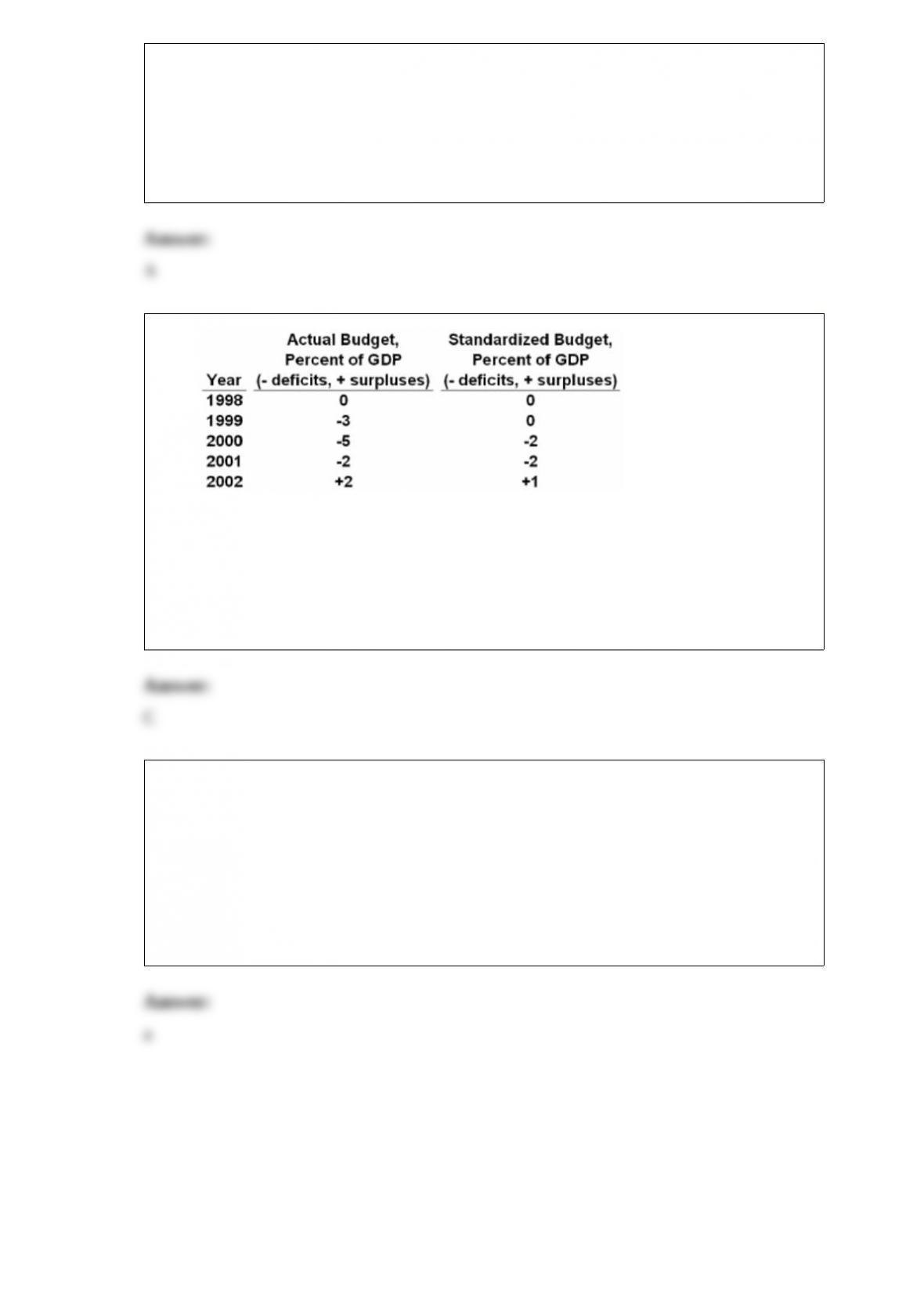
13)
Refer to the above table for a fictional economy. The changes in the budget conditions
between 2000 and 2001 best reflect:
A.demand-pull inflation.
B.cost-push inflation.
C.an expansion of real GDP and an automatic increase in tax revenues.
D.a contractionary fiscal policy.
14) refer to the above diagram. the equilibrium points shown in the diagram along with
the price change that produced the shift of the budget line from ab to ac:
a.are consistent with a downsloping demand curve for product k.
b.imply that the consumer’s money income has declined, but his or her real income has
increased.
c.imply consumer irrationality since the dearer product is being substituted for the
cheaper product.
d.suggest that k is an inferior good.