
1) A fishery is a stock of fish or other marine animal thought of as a logically distinct
group, and usually identified by its location and species.
2) a market that achieves productive efficiency is producing the quantity of goods most
desired by society.
3) African-Americans have higher unionization rates than whites.
4) Price fixing is illegal under Section 1 of the Sherman Act.
5) Economists agree that corporations always shift the corporate income tax to
consumers by raising product prices.
6)
Effective usury laws cause:
A.a surplus of money in money markets.
B.the quantity of money demanded to be brought into balance with the quantity
supplied.
C.the quantity of money supplied to exceed the quantity demanded.
D.a shortage of money in money markets.
7) we would expect an industry to expand if firms in that industry are:
a.earning normal profits.
b.earning economic profits.
c.incurring economic losses.
d.earning accounting profits.
8) The true size of Federal budget deficits may be understated because:
A.a portion of government spending is public investment.
B.inflation reduces the real value of the public debt.
C.Social Security surpluses are included as government tax revenues in measuring the
budget deficit.
D.foreign holdings of the debt have recently increased.
9) Taxes represent:
A.a leakage of purchasing power, like saving.
B.an injection of purchasing power, like investment.
C.an injection of purchasing power, like government spending.
D.a leakage of purchasing power, like government spending.
10)
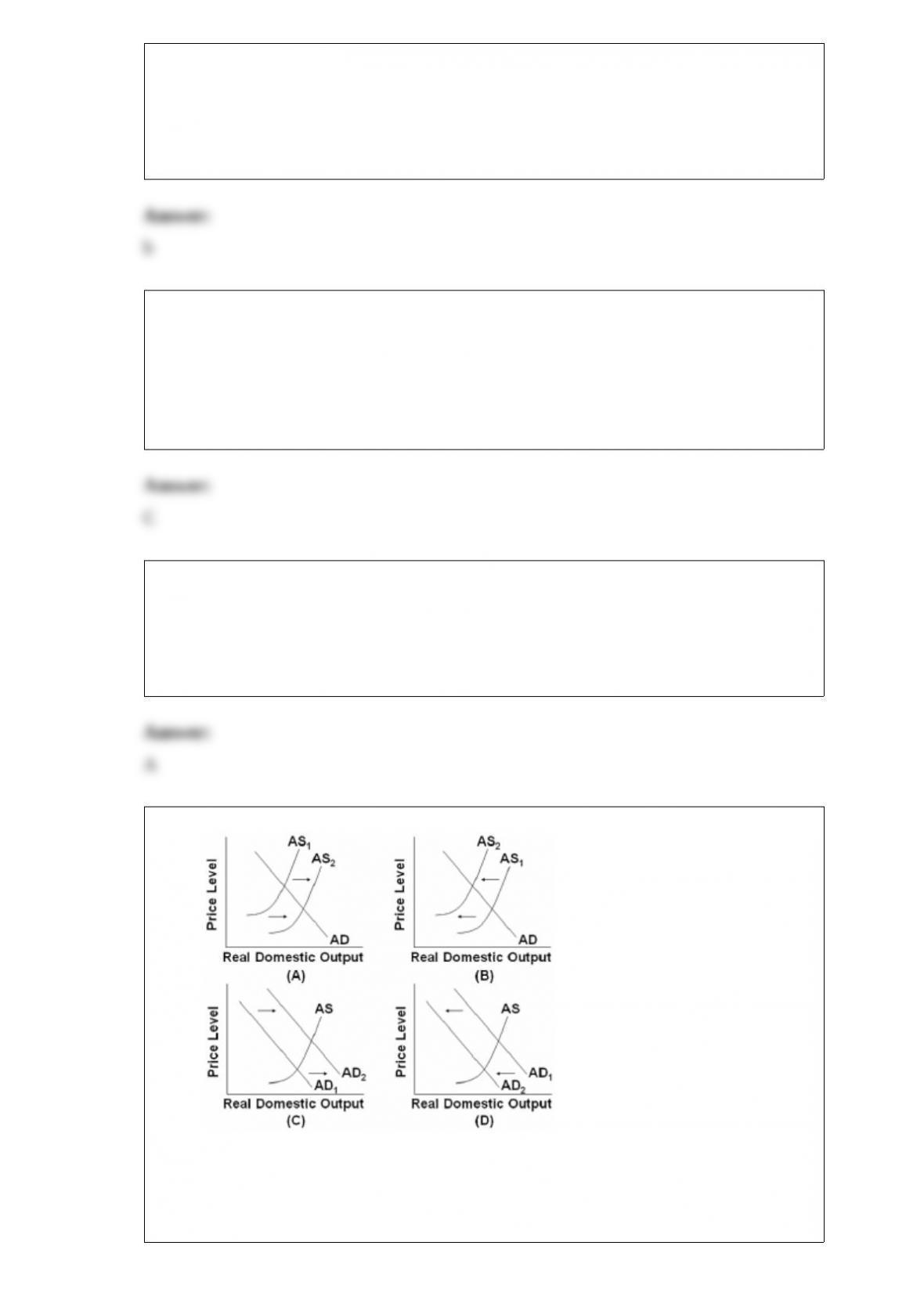
Which of the above diagrams best portrays the effects of declines in the prices of
imported resources?
A.A
B.B

C.C
D.D
11) some modern theories of consumer behavior have:
a.emphasized that consumption is basically an instantaneous act.
b.contended that in the mux/px = muy/py equation mu is understated for time-intensive
goods.
c.introduced the opportunity cost of time as a component of product price.
d.argued that inflationary expectations negate the theory of consumer behavior.
12) The U.S. poverty rate(s) for:
A.Hispanics and African-Americans both exceed 20 percent.
B.African-Americans is much lower than the rate for Hispanics.
C.whites is greater than the overall poverty rate.
D.persons aged 65 or older is higher than for children under 18.
13) suppose an economist says that “other things equal, the lower the price of bananas,
the greater the amount of bananas purchased.” this statement indicates that:
a.the quantity of bananas purchased determines the price of bananas.
b.all factors other than the price of bananas (for example, consumer tastes and incomes)
are assumed to be constant.
c.economists can conduct controlled laboratory experiments.
d.one cannot generalize about the relationship between the price of bananas and the
quantity purchased.
14) an increase in money income shifts the consumer’s:
a.budget line to the right.
b.budget line to the left.
c.indifference curves to the left.
d.indifference curves to the right.
15) the average tax rate is:
a.equal to the marginal tax rate if the tax is progressive.
b.the total tax rate minus the marginal tax rate.
c.the ratio of total taxes paid to total taxable income.
d.the tax rate that applies to incremental dollars of income.
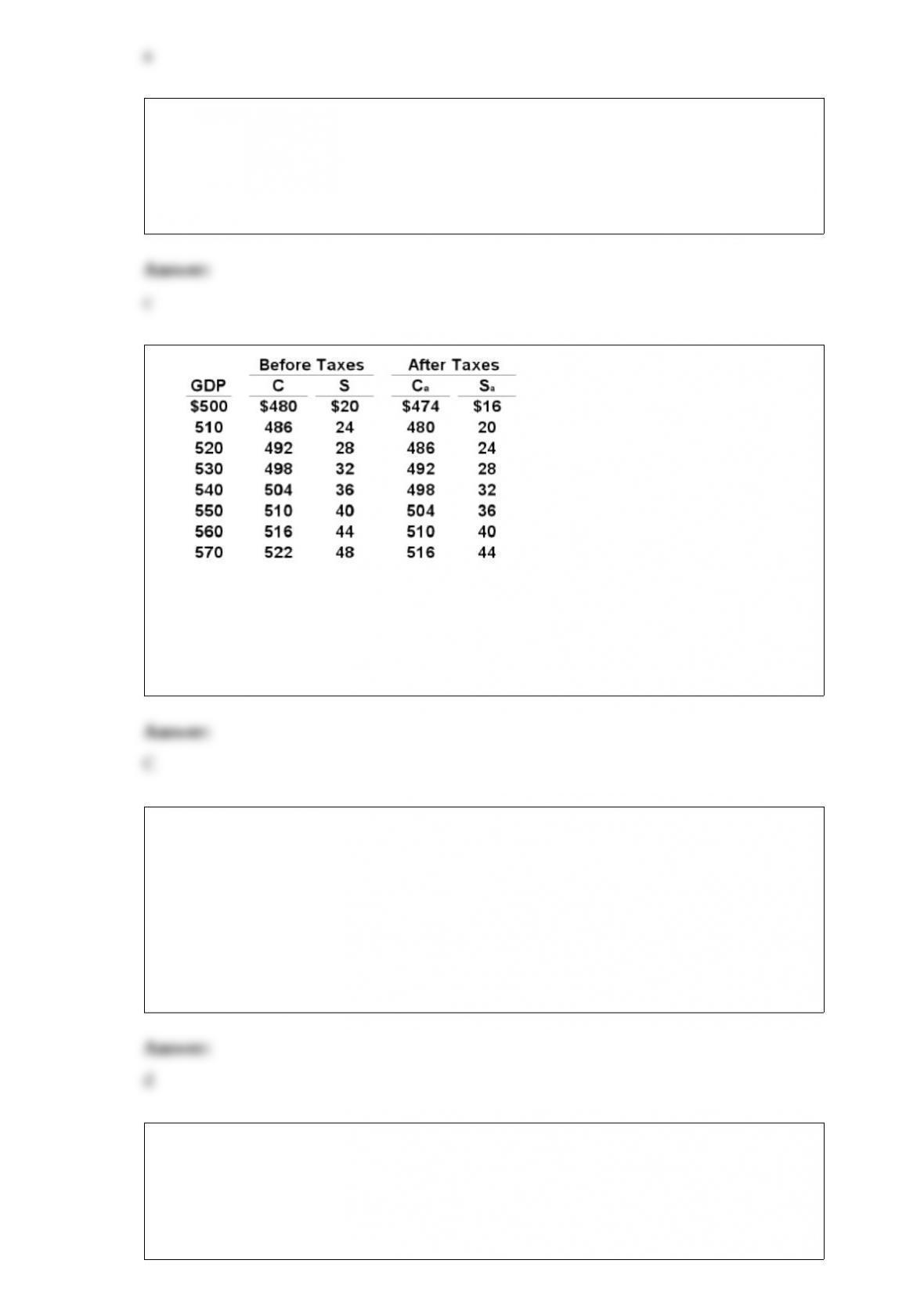
16)
The tax in the above economy is a:
A.10 percent proportional tax.
B.lump-sum tax of $20.
C.lump-sum tax of $10.
D.progressive tax.
17) the dilemma of regulation refers to the idea that:
a.the regulated price which achieves allocative efficiency is also likely to result in
persistent economic profits.
b.the regulated price which results in a “fair return” restricts output by more than would
unregulated monopoly.
c.regulated pricing always conflicts with the “due process” provision of the constitution.
d.the regulated price which achieves allocative efficiency is also likely to result in
losses.
18) economic profits are calculated by subtracting:
a.explicit costs from total revenue.
b.implicit costs from total revenue.
c.implicit costs from normal profits.
d.explicit and implicit costs from total revenue.
19) the free-rider problem is associated with:
a.all market goods.
b.the structure of airline fares.
c.producing goods that have characteristics of public goods.
d.the overallocation of the resources to transportation facilities.
20) How can money be destroyed in the same way that checkable deposits expand the
money supply?
21) A firm combines two resources, X and Y, to produce an output level Q in a purely
competitive market. The cost of a unit of X is $15 and the cost of a unit of Y is $8. The
marginal product of X is 30 units and the marginal product of Y is currently 24 units at
output level Q. What would you recommend that the firm do given this resource
combination?
22) Explain how a nation might persistently import more than it exports and still
maintain an equilibrium in its balance of payments.
23) What is the effect on the money supply when a commercial bank sells government
securities to the public?
24) (Consider This) How has the influx of women into the paid labor force over the past
half century influenced economic growth? State at least three of the six reasons given
for the increase in the number of women in the paid workforce over the past half
century.
25) What is the relationship between the multiplier and the marginal propensities?
26) Discuss the relative merits of monetary policy under conditions of demand-pull
inflation or recession.
27) Why are payroll taxes regressive?