1) studies of the minimum wage suggest that the price elasticity of demand for teenage
workers is relatively inelastic. this means that:
a.an increase in the minimum wage would increase the total incomes of teenage
workers as a group.
b.an increase in the minimum wage would decrease the total incomes of teenage
workers as a group.
c.the unemployment effect of an increase in the minimum wage would be relatively
large.
d.the cross elasticity of demand between teenage and adult workers is positive and very
large.
2) a pure market economy overallocates resources to the production of goods that:
a.involve negative externalities.
b.involve positive externalities.
c.are public goods.
d.are inexpensive to produce.
3) in a market economy a significant change in consumers’ desire for product x will:
a.alter the profits or losses received by certain firms.
b.cause a reallocation of scarce resources.
c.cause some industries to expand and others to contract.
d.do all of these.
4) Kodak introduced to the marketplace a digital camera which uses no film, but which
takes photos that can be shown on personal computers. This is an example of:
A.economies of scale.
B.product innovation.
C.process innovation.
D.venture capital.
5) (consider this) the feudal practice of clipping coins illustrates the idea of:
a.taxation through inflation.
b.good money driving out bad money.
c.the derived demand for resources.
d.cost-push inflation.
6)
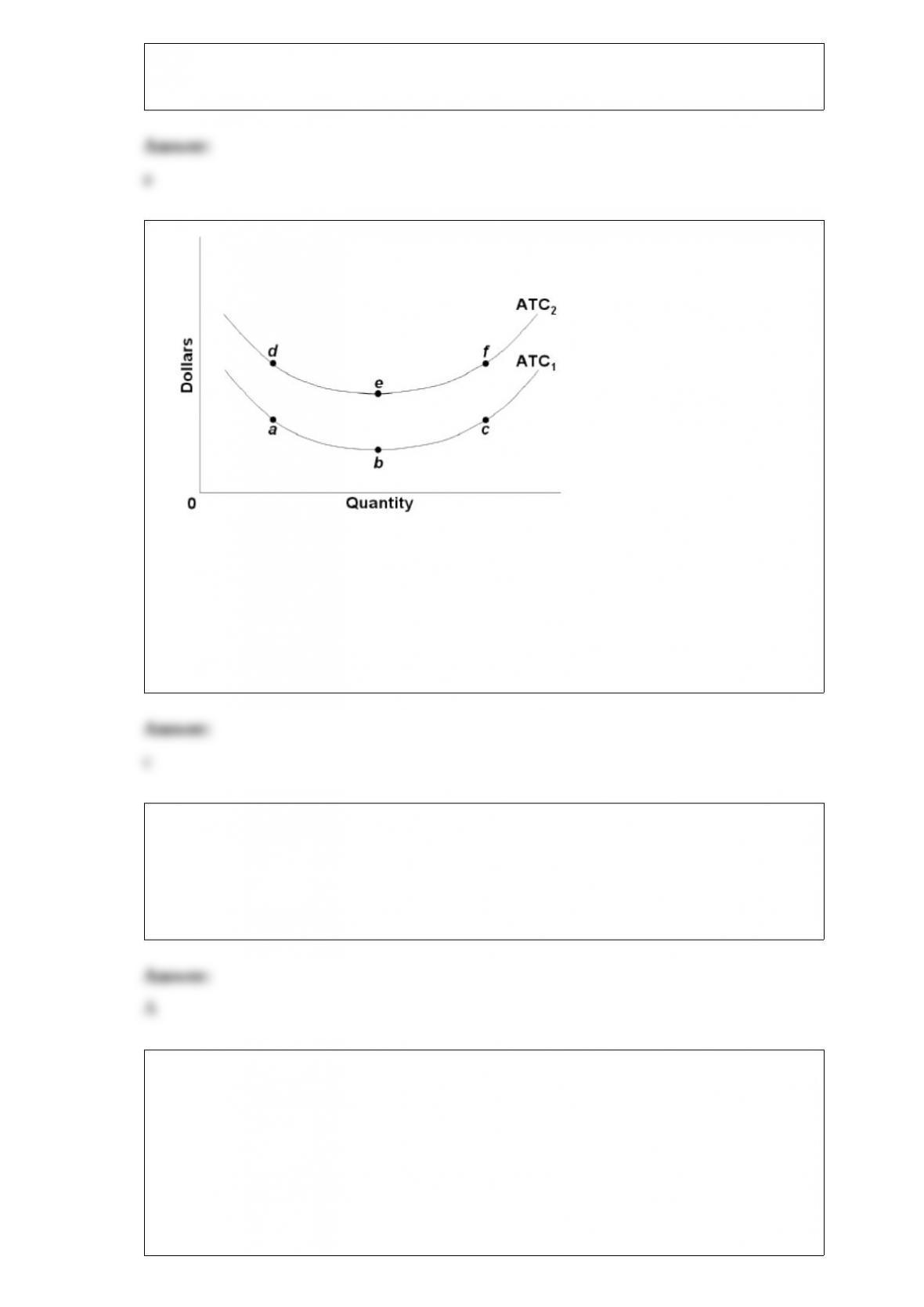
refer to the above graph. which one of the following would cause a move from point e
on short-run average total cost curve atc2 to point b on short-run average cost curve
atc1?
a.diminishing marginal returns
b.an increase in the wage rate
c.a decrease in the wage rate
d.increasing marginal returns
7) Currency speculators aid international trade by:
A.absorbing exchange rate risk that others do not want to bear.
B.increasing the volatility of exchange rates.
C.making the demand for imports less elastic.
D.promoting barter.
8) the following is cost information for the creamy crisp donut company:
entrepreneur’s potential earnings as a salaried worker = $50,000
annual lease on building = $22,000
annual revenue from operations = $380,000
payments to workers = $120,000
utilities (electricity, water, disposal) costs = $8,000
value of entrepreneur’s talent in the next best entrepreneurial activity = $80,000
entrepreneur’s forgone interest on personal funds used to finance the business = $6,000
refer to the above data. creamy crisp’s explicit costs are:
a.$286,000.
b.$150,000.
c.$94,000.
d.$156,000.
9) If a 10 percent wage increase in a particular labor market results in a 5 percent
decline in employment in that market, labor demand is:
A.unit elastic.
B.elastic.
C.inelastic.
D.perfectly elastic.
10) Unless a tariff is prohibitive, it does not inhibit competition as much as a quota.
Evaluate.
11) In 2001, the United States Senate:
A.voted 95-0 to approve the Kyoto agreement.
B.opposed the Kyoto agreement 95-0, concluding that climate change was not a
credible threat.
C.opposed the Kyoto agreement 95-0, concluding that complying with treaty provisions
would seriously harm the U.S. economy.
D.voted to override President Bush’s veto of the Kyoto agreement.
12)
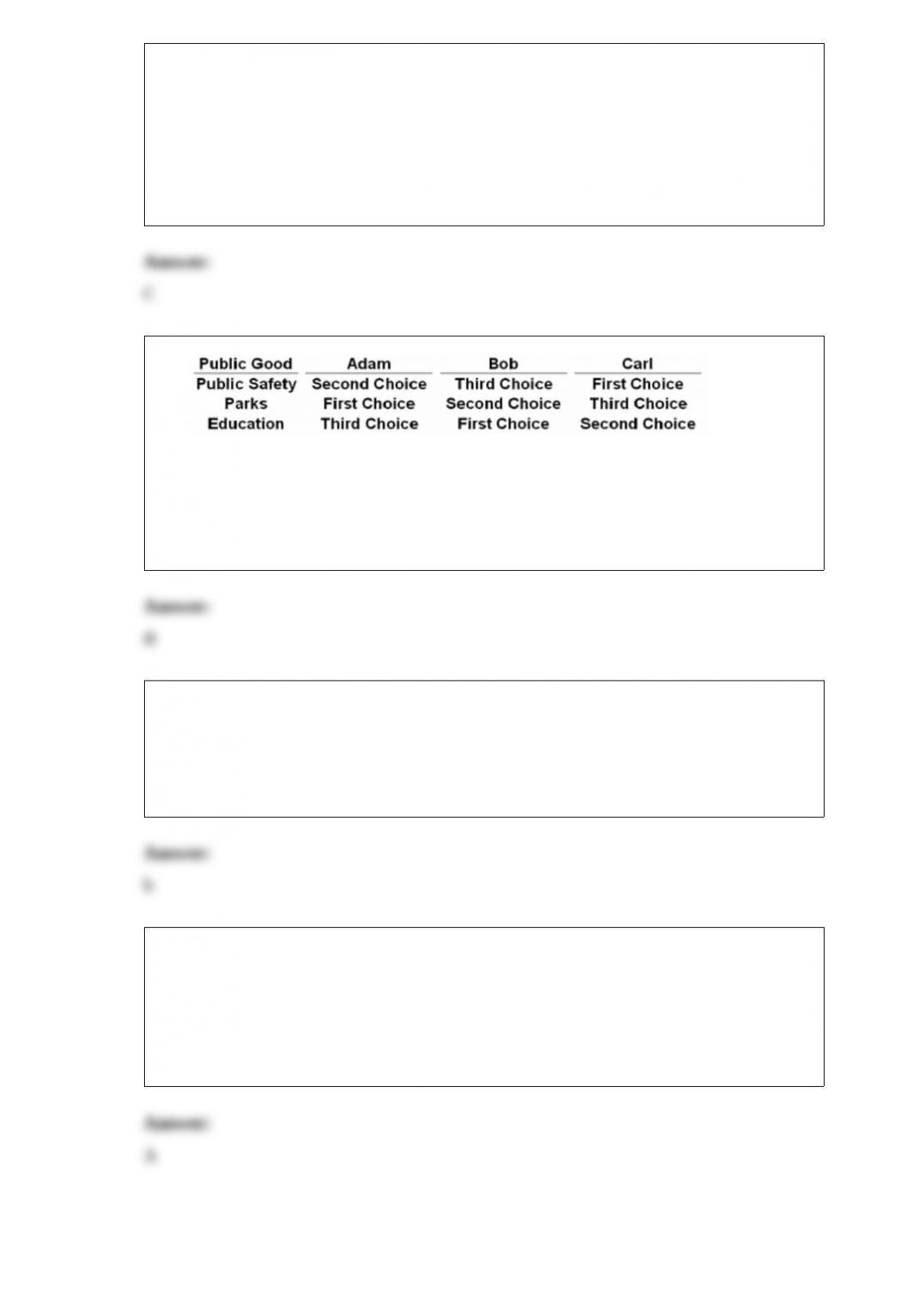
Refer to the above table. In a choice between parks and education:
A.no voter decision is possible.
B.a majority of voters would favor education.
C.the outcome would depend on which item was listed first on the ballot.
D.a majority of voters would favor parks.
13) when a firm is maximizing profit it will necessarily be:
a.maximizing profit per unit of output.
b.maximizing the difference between total revenue and total cost.
c.minimizing total cost.
d.maximizing total revenue.
14) If a nation’s goods exports are $55 billion, while its goods imports are $50 billion,
we can conclude with certainty that this nation has a:
A.balance of trade (goods) surplus.
B.balance of payments surplus.
C.positive balance on current account.
D.positive balance on goods and services.
15)
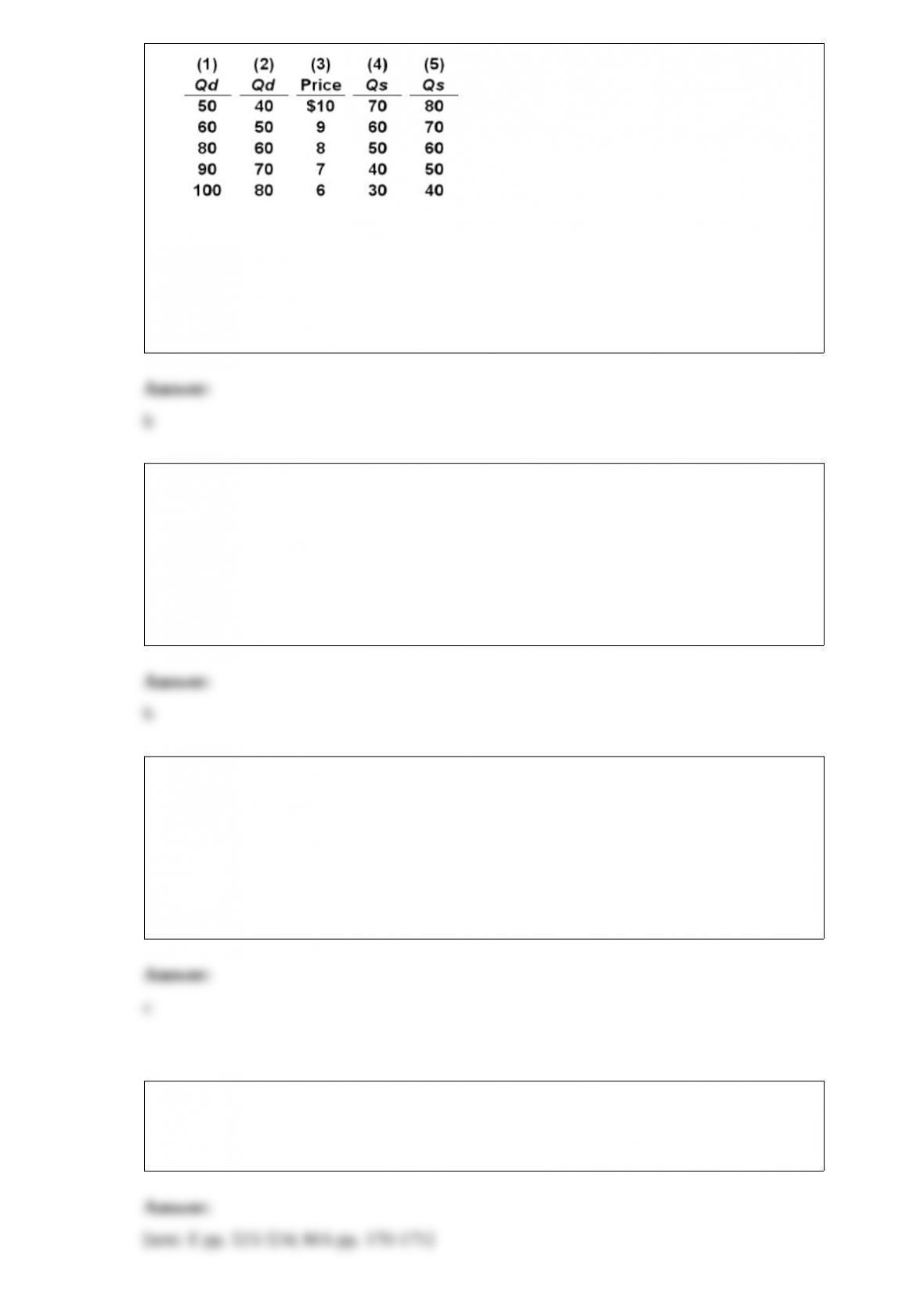
refer to the above table. in relation to column (3), a change from column (4) to column
(5) would most likely be caused by:
a.government placing an excise tax on the good.
b.an improvement in production technology.
c.an increase in consumer income.
d.an increase in input prices.
16) assume that society places a higher value on the last unit of x produced than the
value of the resources used to produce that unit. with no spillovers, this information
means that:
a.total cost is greater than total revenue.
b.price is greater than marginal cost.
c.marginal cost is greater than price.
d.resources are being overallocated to x.
17) economy a: gross investment equals depreciation economy b: depreciation exceeds
gross investment economy c: gross investment exceeds depreciation
refer to the above information. positive net investment is occurring in:
a.economy a only.
b.economy b only.
c.economy c only.
d.economies a and b only.
18) In the table below are statistics showing the civilian non-institutional population,
the civilian labor force and total employment in year 1 and year 2. Make the
computations necessary to complete the table. (Number of persons is in thousands.)
19) Describe the major demand and supply factors that have turned the beer industry
into an oligopoly over the years.
20) What is the relationship between the Federal funds rate and the prime interest rate?
Why doesnt the Federal Reserve target the prime interest rate?
21) What is the difference between an exclusive union and an inclusive union? What
are the economic effects of each type?
22) Using the extended ADAS model, explain how inflation depends on aggregate
demand and not the level of real GDP.
23) Why is there a large amount of U.S. currency circulating abroad? What are the
economic effects on the global economy?

24) Distinguish between the two main kinds of mutual funds.