
Who operates and controls a corporation in its day-to-day activities?
A) the board of directors
B) stockholders
C) employees
D) management
Economist Jerry Hausman estimated the price elasticity of demand for “Post Raisin
Bran” and “All types of breakfast cereals.” He found that the price elasticity of demand
for Post Raisin Bran was -2.5 and the price elasticity of demand for “All types of
breakfast cereals” was -0.9. Which of the following can be implied from Hausman’s
estimates?
A) The demand for “All types of breakfast cereals” is elastic.
B) A 1 percent increase in the price of Post Raisin Bran will lead to a 25 percent
decrease in the quantity demanded of Post Raisin Bran.
C) The demand for Post Raisin Bran is more elastic than the demand for “All types of
breakfast cereals.”
D) A 1 percent decrease in the price of breakfast cereals will lead to a 2.5 percent
increase in the quantity demanded of Post Raisin Bran.
Which of the following is a positive economic statement?
A) The inflation rate in the United States is too high.

B) Unemployment insurance payments increase when the unemployment rate rises.
C) The government should defund Obamacare.
D) States should be able to enact their own marijuana legalization laws.
Which of the following is an example of an efficiency-equity trade-off faced by
economic agents?
A) According to an article by in the American Journal of Public Health by Edward
Kaplan and Michael Merson of Yale University School of Medicine, the federal
government’s current method of allocating HIV-prevention resources is not
cost-effective. Instead of allocating resources to states in proportion to reported AIDS
cases, resources should flow first to those activities that prevent more infections per
dollar and then to less and less effective combinations of programs and populations
until funds are exhausted, even if it means that some populations would be left without
any prevention services.
B) Concerned about the falling birth rate, the French government has pledged more
money for families with three children, in an effort to encourage working women to
have more babies.
C) Some U.S. colleges are actively recruiting foreign students for their
technology-based programs.
D) All New York City art museums are considering adopting a free-admission policy
for local residents one weekend per month.
During a recession, spending on ________ tends to fall more dramatically than

spending on ________.
A) necessities; luxuries
B) durable goods; nondurable goods
C) nondurable goods; durable goods
D) food; cars
Article Summary. In what is being called a “bail-in,” the finance ministers of the
17-nation Eurozone agreed to step in to assist the banking system in the nation of
Cyprus. With this arrangement, the banks receive an infusion of capital, but
depositors are being changed a special bank levy of up to 10% on deposit accounts.
Like in the United States, Cyprus does have deposit insurance which guarantees
deposits up to a certain level, but the size of the debt owed by the Cypriot banks
was so large that agreeing to the special bank levy and ignoring the deposit
insurance seemed necessary to get support from the European Union. Some
analysts have also stated that the levy may have been needed to prevent bank runs
on foreign-owned accounts, which have been estimated to make up one-third of the
total deposits in Cypriot banks.
Source: Megan McArdle, “After Cyprus Bank Bailout, Depositors Race to
Withdraw Their Cash. Is the Rest of Europe Next?” Daily Beast, March 17, 2013.
In 2013, the European Union agreed to essentially bail out the banks in the nation of
Cyprus, but in doing so also included what is being called a special bank levy which
was changed to bank depositors. This levy may have been needed to prevent bank runs,
which are situations in which
A) a majority of the shareholders in a bank decide to sell off all their shares of stock.
B) many depositors simultaneously decide to withdraw money from a bank.
C) a majority of the bank’s loans go into default all at once.
D) a bank stops paying interest on all of its interest-bearing accounts.

Economists estimated that the price elasticity of beer is -0.30 and the income elasticity
of beer is 0.09. This means that
A) an increase in the price of beer will increase the quantity demanded of beer and beer
is a normal good.
B) an increase in the price of beer will lead to an increase in revenue for beer sellers
and beer is a normal good.
C) a decrease in the price of beer will lead to an increase in revenue for beer sellers and
beer is an inferior good.
D) an increase in the price of beer will lead to a decrease in the quantity demanded of
beer and beer is a necessity.
The invention of the integrated circuit by Jack Kilby of Texas Instruments gave rise to
the information age. What did this technological change do the short-run supply curve?
A) It shifted the short-run aggregate supply curve to the left.
B) It shifted the short-run aggregate supply curve to the right.
C) It moved the economy up along a stationary short-run aggregate supply curve.
D) It moved the economy down along a stationary short-run aggregate supply curve.
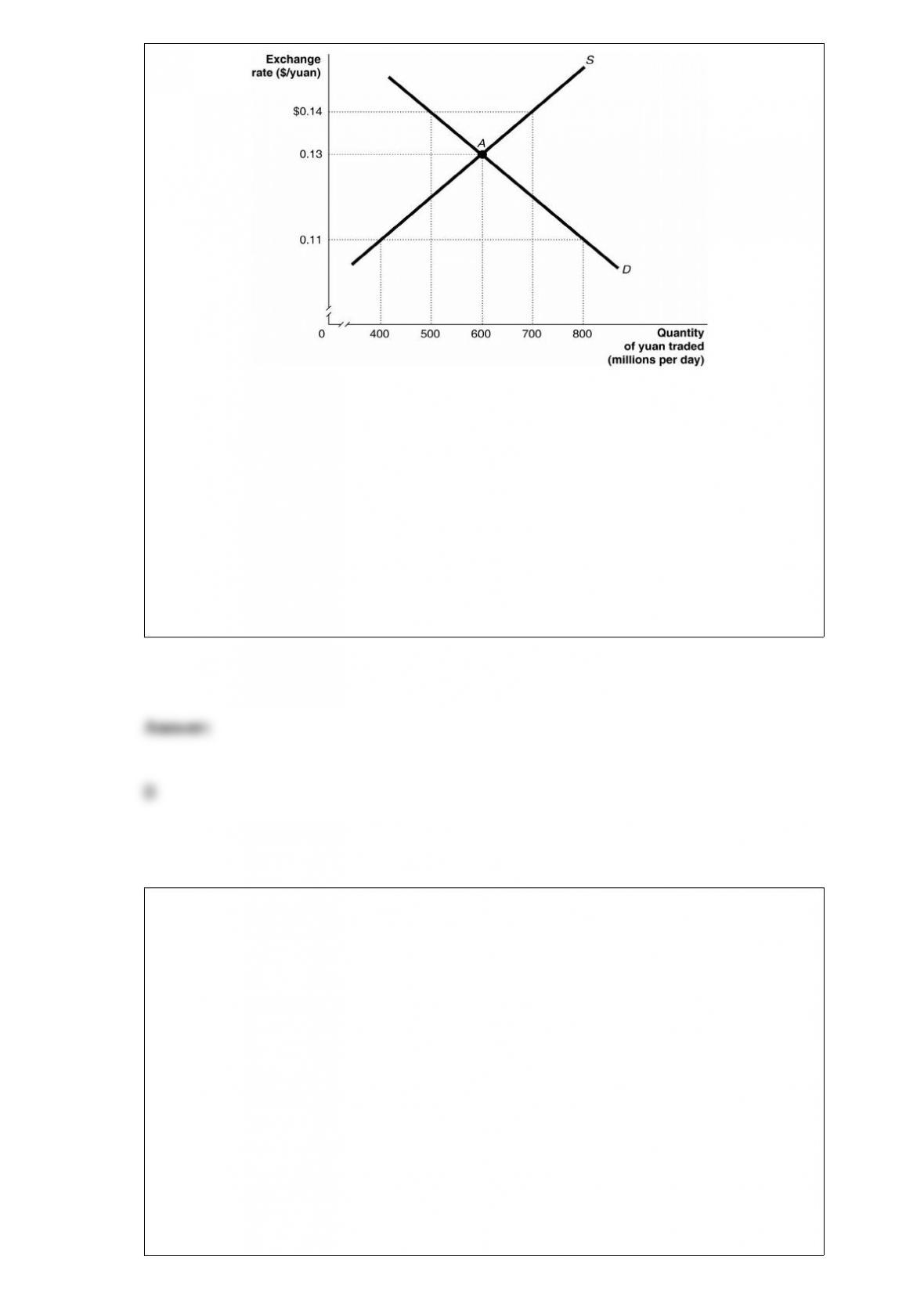
Figure 19-5
Suppose the pegged exchange rate is $0.14/yuan and U.S. consumers increase their
demand for Chinese products. Using the figure above, this would
A) increase the surplus of Chinese yuan.
B) decrease the surplus of Chinese yuan.
C) decrease the shortage of Chinese yuan.
D) increase the shortage of Chinese yuan.
Assume that the demand curve for sunblock is linear and downward sloping. Which of
the following statements about the slope of the demand curve for sunblock and the price
elasticity of demand for sunblock are true?
A) The slope and the price elasticity of demand are constant at all points along the
demand curve for sunblock.
B) The slope is constant, but the price elasticity of demand is not constant at all points
along the demand curve for sunblock.
C) The slope is not constant, but the price elasticity of demand is constant at all points
along the demand curve for sunblock.
D) The slope of the demand curve for sunblock is constant and equal to zero; demand is
perfectly inelastic.