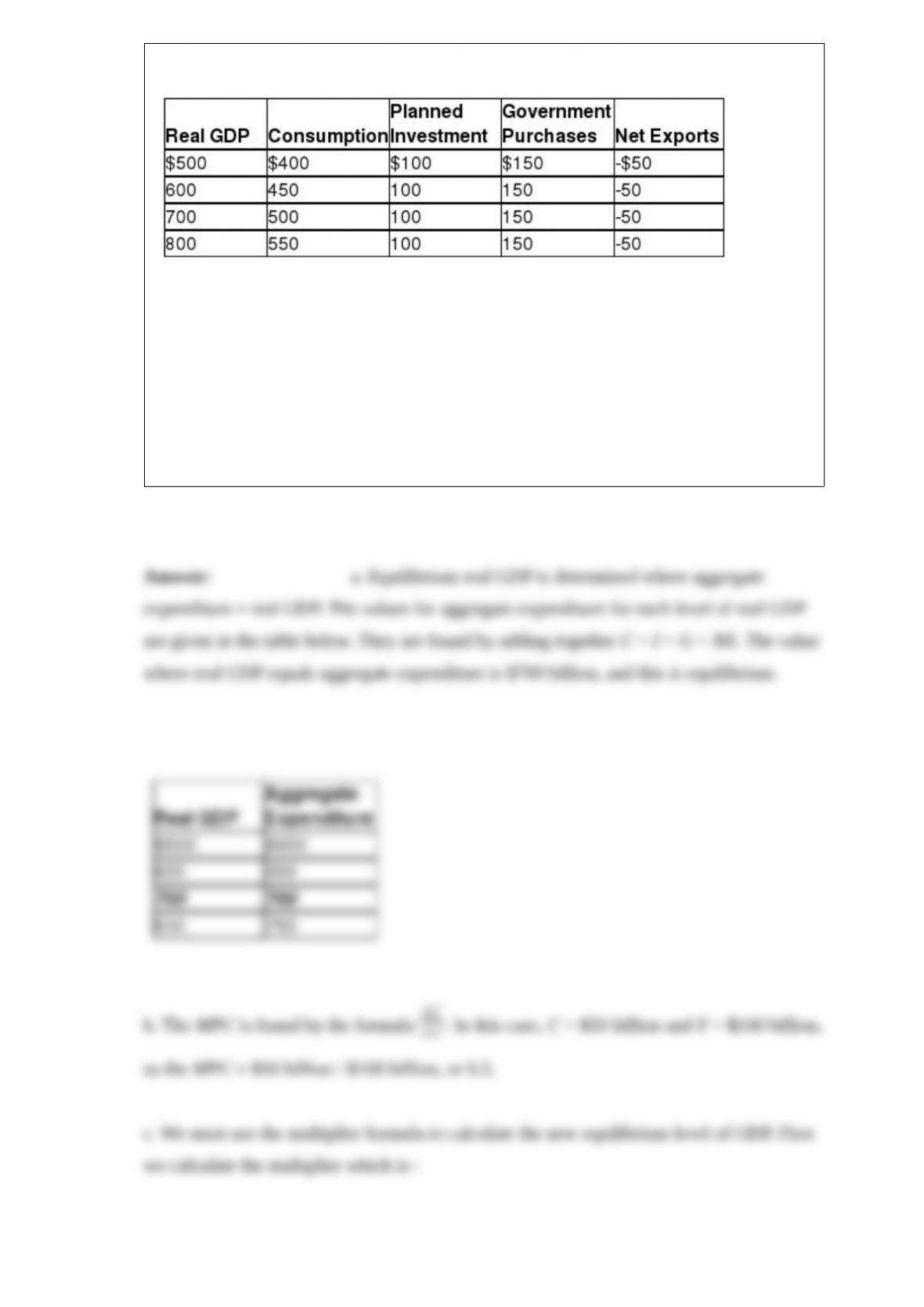
Table 12-13
Refer to Table 12-13. Using the table above, answer the following questions. The
numbers in the table are in billions of dollars.
a. What is the equilibrium level of real GDP?
b. What is the MPC?
c. If investment spending declines by $50 billion, what will happen to equilibrium
GDP?

Which of the following would result in GDP for an economy equal to $10 trillion?
A) C = $6 trillion
I = $2 trillion
G = $1.5 trillion
NX = -$2 trillion
B) C = $7 trillion
I = $2 trillion
G = $4 trillion
NX = $3 trillion
C) C = $5 trillion
I = $5 trillion
G = $2 trillion
NX = -$2 trillion
D) C = $4 trillion
I = $3 trillion
G = $2 trillion
NX = -$1 trillion
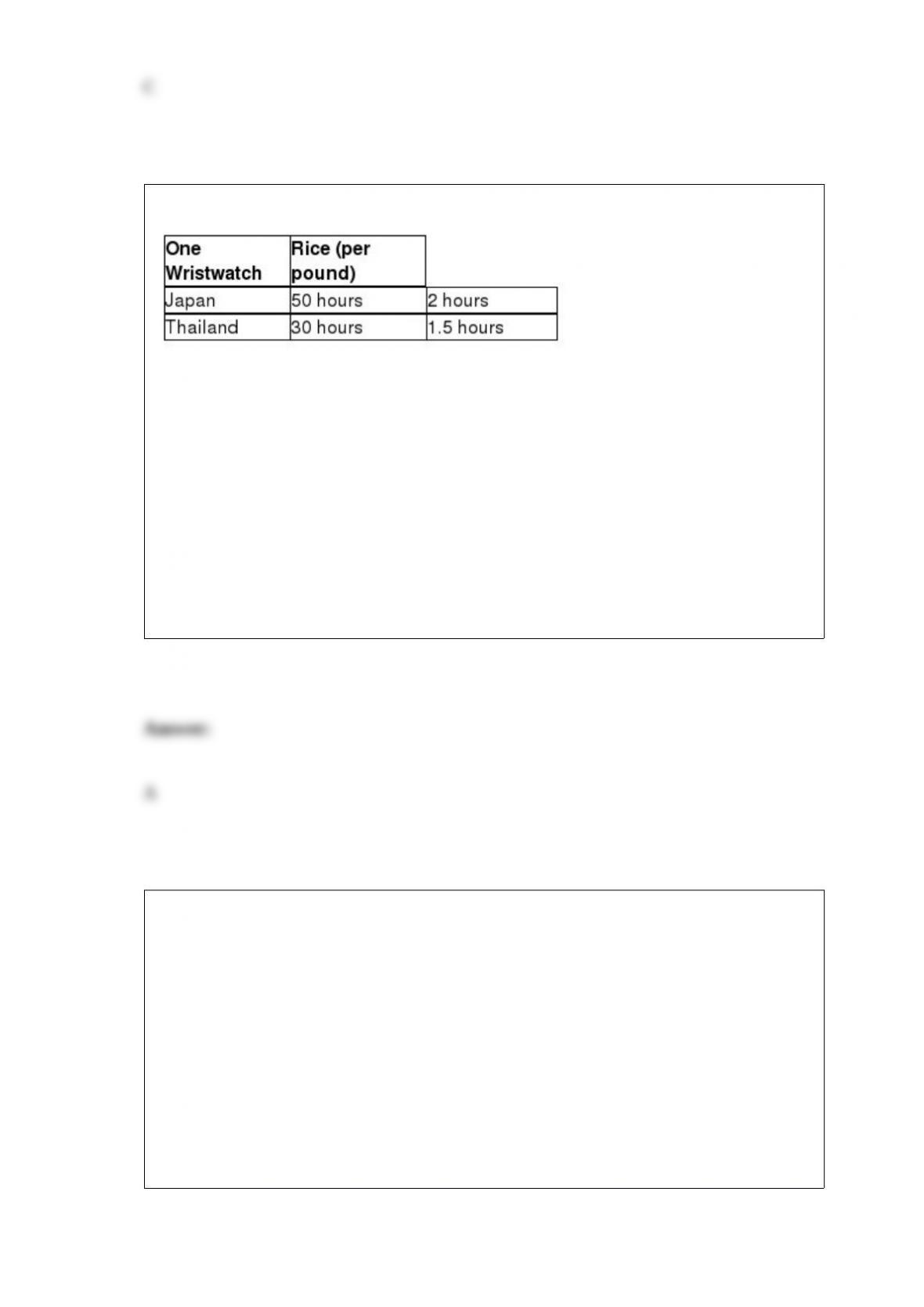
Table 2-9
Table 2-9 shows the number of labor hours required to produce a wristwatch and a
pound of rice in Japan and Thailand.
Refer to Table 2-9. What is Japan’s opportunity cost of producing one pound of rice?
A) 0.04 units of a wristwatch
B) 4 wristwatches
C) 25 wristwatches
D) 40 wristwatches
When Zynga, the company behind the social games CityVille and Words With Friends,
sold stock to the public for the first time in December 2011, funds were being raised in
a ________ market, and when those newly issued shares are resold to other buyers, the
sales take place in a ________ market.
A) primary; primary
B) primary; secondary
C) secondary; primary
D) secondary; secondary

Money is
A) an asset that people are willing to accept in exchange for goods and services.
B) a liability that people are willing to accept in exchange for goods and services.
C) the income one earns over a period of time.
D) one’s assets net of one’s liabilities at any point in time.
If the Fed pursues an expansionary monetary policy, investment in the United States
will ________ and net exports will ________.
A) decrease; decrease
B) decrease; increase
C) increase; decrease
D) increase; increase
The experience of Paul Volcker’s fight against inflation during the late 1970s and early
1980s indicates that firms and workers may have
A) had adaptive expectations.
B) had rational expectations but didn’t trust Fed announcements.
C) preferred high unemployment to high inflation.
D) Both A and B are correct answers.
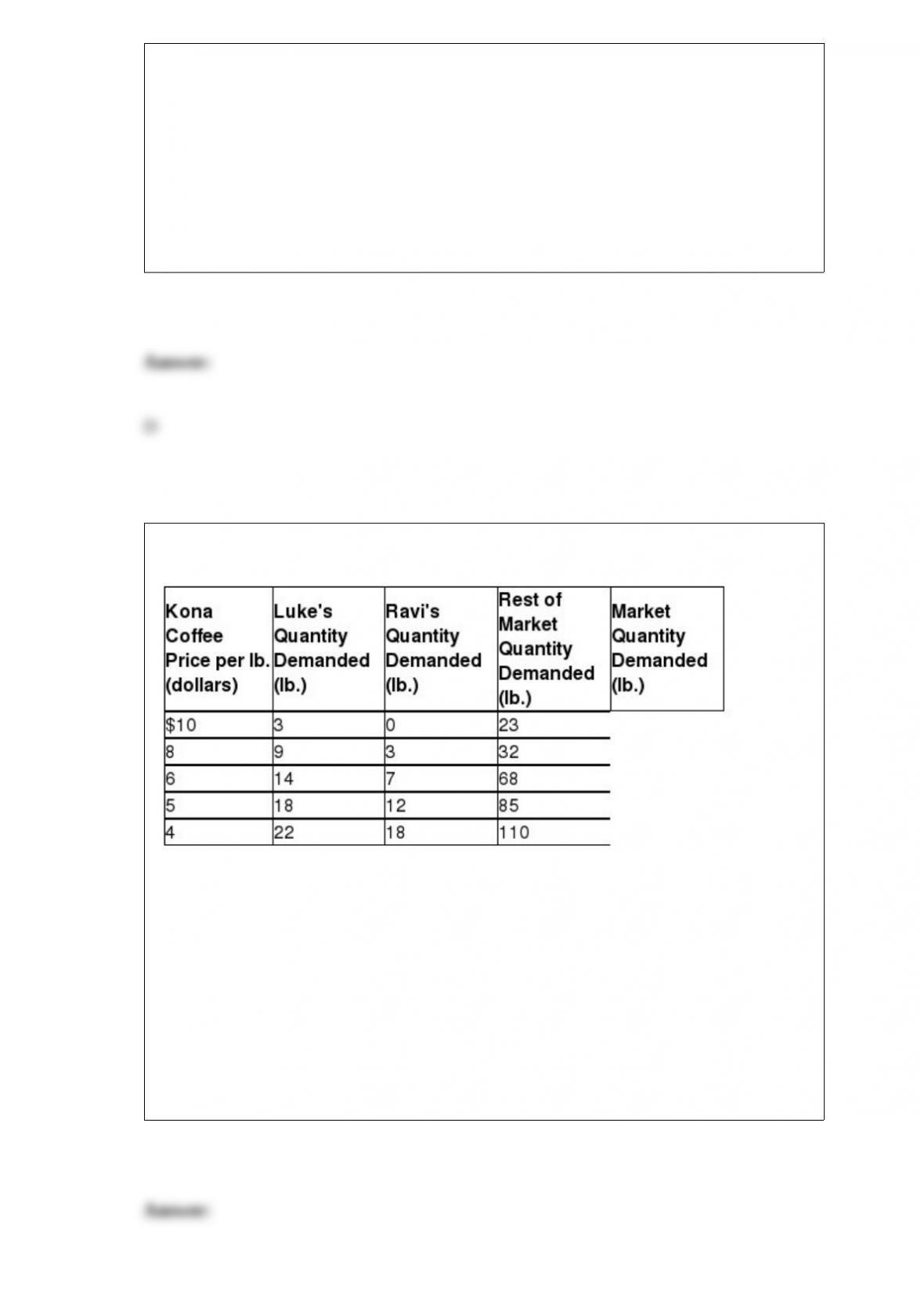
Table 3-1
Refer to Table 3-1. The table above shows the demand schedules for Kona coffee of
two individuals (Luke and Ravi) and the rest of the market. If the price of Kona coffee
falls from $6 to $4, the market quantity demanded would
A) decrease by 89 lb.
B) increase by 26 lb.
C) increase by 61 lb.
D) increase by 110 lb.

In August 1979, President Jimmy Carter appointed ________ as chairman of the Board
of Governors of the Federal Reserve System.
A) Ben Bernanke
B) Alan Greenspan
C) G. William Miller
D) Paul Volcker
Autarky is a situation in which a country
A) only exports products.
B) only imports products.
C) does not trade with other countries.
D) has no absolute advantage in any production.
Expansionary fiscal policy involves
A) increasing government purchases or decreasing taxes.

B) increasing taxes or decreasing government purchases.
C) increasing the money supply and decreasing interest rates.
D) decreasing the money supply and increasing interest rates.
Between 2013 and 2014, the CPI of a small nation rose from 182 to 185. If household
incomes rose by 3% during that period of time, which of the following is true?
A) The purchasing power of household income rose between 2013 and 2014.
B) The purchasing power of household income fell between 2013 and 2014.
C) The purchasing power of household income remained constant between 2013 and
2014.
D) The CPI cannot be used to determine how the purchasing power of household
income changes over time.
Textbook examples of trade between two nations are simplified in order to show how
two nations both benefit from trade. These examples are misleading because
A) in the real world, rich countries can take advantage of poor countries.
B) they do not account for the reduction in wages that occurs in both countries as a
result of trade.
C) some individuals in both countries may be made worse off because of trade.
D) trade restrictions are likely to be imposed as trade grows over time.
Consider a tax cut which affects not only consumer disposable income, but also
after-tax earnings from labor supplied to labor markets and from financial assets
acquired through saving. In the long run we would expect this tax cut to
A) decrease both the price level and increase real GDP.
B) increase both the price level and the level of real GDP.
C) increase the level of real GDP.
D) increase the price level.
What are the three main exchange rate systems, and how do they operate?
In September of 2007, the Federal Reserve Board Open Market Committee voted to
lower interest rates for the first time that year. Explain how lower interest rates affect
the aggregate demand curve.
What are three primary reasons for the growth of international trade over the past 50
years?
Explain the difference between substitutes and complements.
Explain the term “economics.”
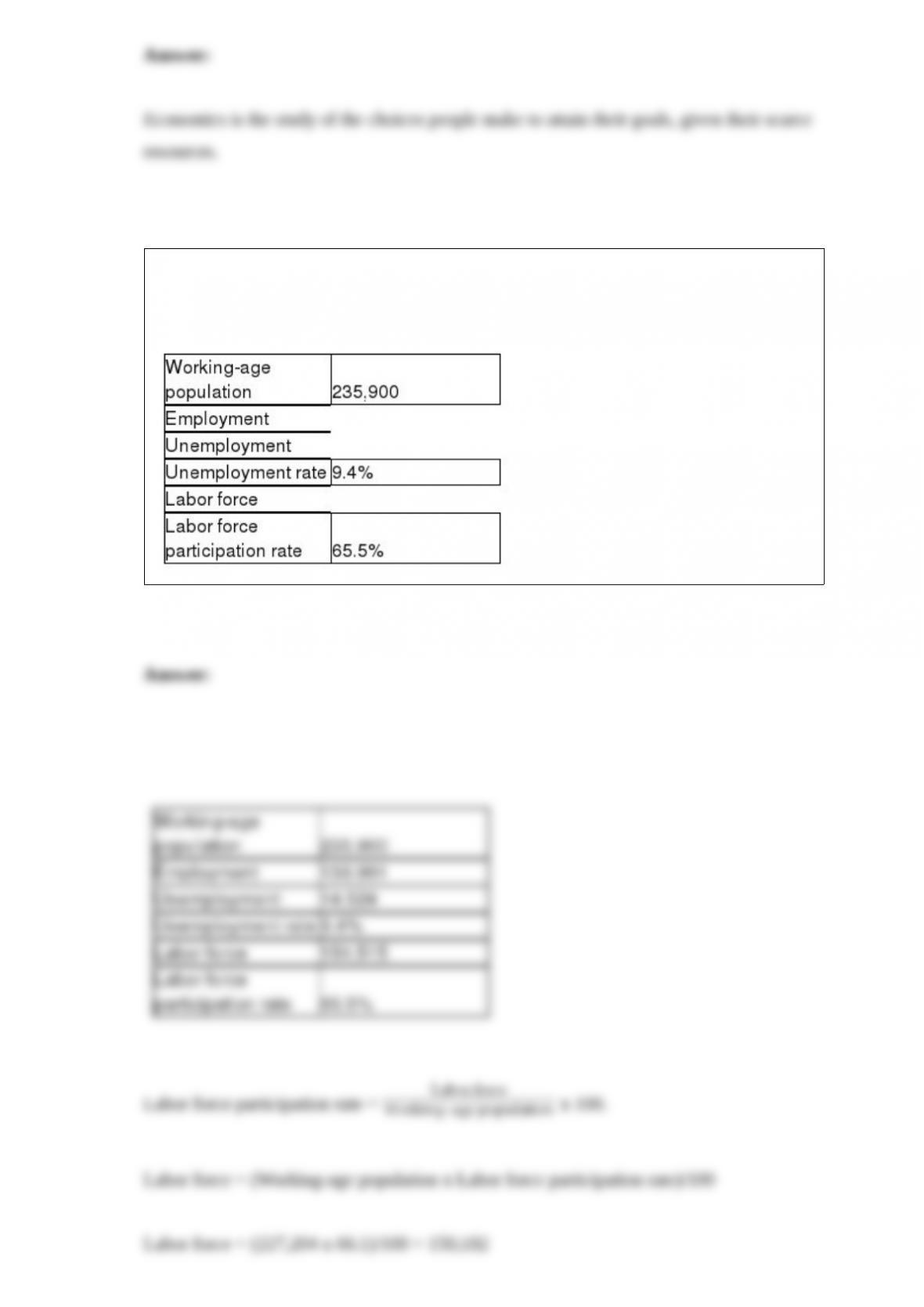
Fill in the missing values in the table of data collected in the household survey for
November, 2009. The working-age population, employment, unemployment, and labor
force are measured in thousands. Show your work.
Would the invention of money, as opposed to barter, increase the growth rate of real
GDP in a country over time? Why or why not?