Inflation targeting, typically, has been accompanied by lower inflation.
The question of whether economic growth is desirable is a positive question, easily
settled by economic analysis.
Ceteris paribus, an increase in the money supply will lower short-term interest rates.
Eliminating frictional unemployment would be good for the economy.
Empirical evidence shows that the impact of government budget deficits and surpluses
on the equilibrium interest rate is quite large.
The Federal Reserve could target both the money supply and the interest rate at the
same time if it controlled money demand along with money supply.
Changes in interest rates affect all four components of aggregate demand.
Producer surplus is the difference between the highest price a firm is willing to accept
for a product and the price it actually receives for the product.

A surplus is defined as the situation that exists when the quantity of a good supplied is
greater than the quantity demanded.
During an expansion, how do inflation and unemployment typically change?
A) Inflation and unemployment both rise.
B) Inflation and unemployment both fall.
C) Inflation falls and unemployment rises.
D) Inflation rises and unemployment falls.
Structural unemployment is the result of
A) a persistent mismatch between the skills and characteristics of workers and the
requirements of the jobs.
B) the search process of matching workers with jobs.
C) the ups and downs in inflation.
D) a slowdown in the economy.

If the long-run aggregate supply curve is vertical,
A) the economy stays at the natural rate of inflation in the long run.
B) the short-run Phillips curve must be vertical.
C) unemployment and inflation are positively related in the long run.
D) the trade-off between unemployment and inflation cannot be permanent.
Hurricane Katrina destroyed oil and natural gas refining capacity in the Gulf of Mexico.
This subsequently drove up natural gas, gasoline, and heating oil prices. As a result, this
should
A) shift the short-run aggregate supply curve to the left.
B) shift the short-run aggregate supply curve to the right.
C) move the economy up along a stationary short-run aggregate supply curve.
D) move the economy down along a stationary short-run aggregate supply curve.
For the federal deficit to be lowered,
A) the federal government must decrease its spending and increase net exports.
B) the federal government’s expenditures must be lower than its tax revenue.

C) the Federal Reserve must raise interest rates and lower the required reserve ratio.
D) the Federal Reserve must reduce the money supply.
If the Fed does not take into account the additional policy channels available in an open
economy, then ________ when conducting contractionary monetary policy,
A) it is likely to decrease GDP too much and cause a recession
B) it is likely to decrease GDP too little and inflation will persist
C) it is likely to increase GDP too much and inflation will persist
D) it is likely to increase GDP too little and cause a recession
After the recession of 2007-2009, the unemployment rate peaked at 10.0 percent in
October 2009. Eighteen months later, it had
A) dropped by 50 percent.
B) declined by only 1 percentage point.
C) remained at 10.1 percent.
D) fallen to the natural rate of unemployment.

According to the World Bank, Albania does one of the worst jobs as a country enforcing
the rule of law. The consequence of a weak rule of law is
A) difficulty in attracting investment and low economic growth.
B) a decrease in cash transactions and increased efficiency.
C) more risk taking on the part of entrepreneurs and greater economic investment.
D) strong property rights enforcement leading to greater investment.
If government saving is negative, then
A) T > TR.
B) G > T.
C) T – TR < G.
D) Y + TR < C – T.
If the CPI changes from 125 to 120 between 2012 and 2013, how did prices change
between 2012 and 2013?

A) Prices increased by 5%.
B) Prices decreased by 5%
C) Prices increased by 25%.
D) Prices decreased by 4%.
The largest and fastest-growing category of federal government expenditures is
A) grants to state and local governments.
B) interest on the national debt.
C) national park spending.
D) transfer payments.
The growing popularity of energy conservation has enticed large home improvement
stores like Home Depot and Lowes to offer tankless water heaters. How does the fact
that home improvement stores now offer these products affect the tankless water heater
market?
A) The demand curve for tankless water heaters shifts to the right.
B) The demand curve for tankless water heaters shifts to the left.
C) The supply curve for tankless water heaters shifts to the right.
D) The supply curve for tankless water heaters shifts to the left.
Dr. Goldfinger decides to invest in companies which he believes can “improve the
productivity and efficiency” of health care services. What would Dr. Goldfinger need to
do to try to achieve allocative efficiency?
A) invest in companies that produce goods and services based on consumer preferences
B) invest in companies that produce goods and services at the lowest possible cost
C) invest in companies that fairly distribute their products and services
D) invest in companies that produce up to the point where the marginal cost of the last
unit produced is zero
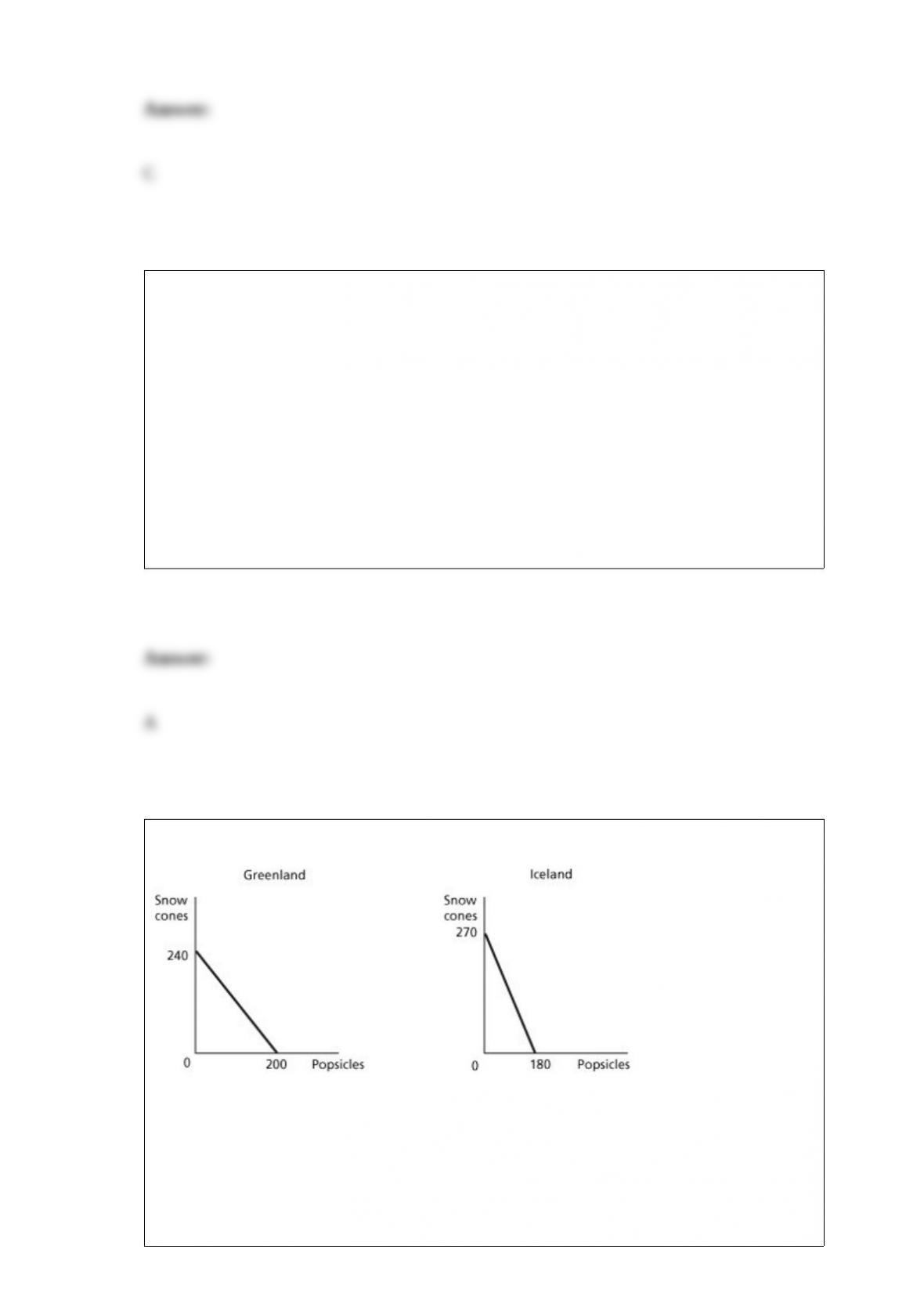
Figure 2-9
Figure 2-9 shows the production possibilities frontiers for Greenland and Iceland. Each
country produces two goods, snow cones and popsicles.
Refer to Figure 2-9. What is the opportunity cost of producing 1 snow cone in
Greenland?
A) 2/3 of a popsicle

B) 5/6 of a popsicle
C) 1 1/5 popsicles
D) 200 popsicles
The consumption function describes the relationship between
A) consumption spending and national income.
B) consumption spending and aggregate income.
C) consumption spending and disposable income.
D) consumption spending and personal income.
The short-run aggregate supply curve has a(n) ________ slope because as prices of
________ rise, prices of ________ rise more slowly.
A) positive; final goods and services; inputs
B) infinite; final goods and services; inputs
C) positive; inputs; final goods and services
D) infinite; inputs; final goods and services
If the tax multiplier is -1.5 and a $200 billion tax increase is implemented, what is the
change in GDP, holding everything else constant? (Assume the price level stays
constant.)
A) a $300 billion decrease in GDP
B) a $300 billion increase in GDP
C) a $30 billion increase in GDP
D) a $133.33 billion decrease in GDP
E) a $133.33 billion increase in GDP
Describe the process of “creative destruction” using a specific example.
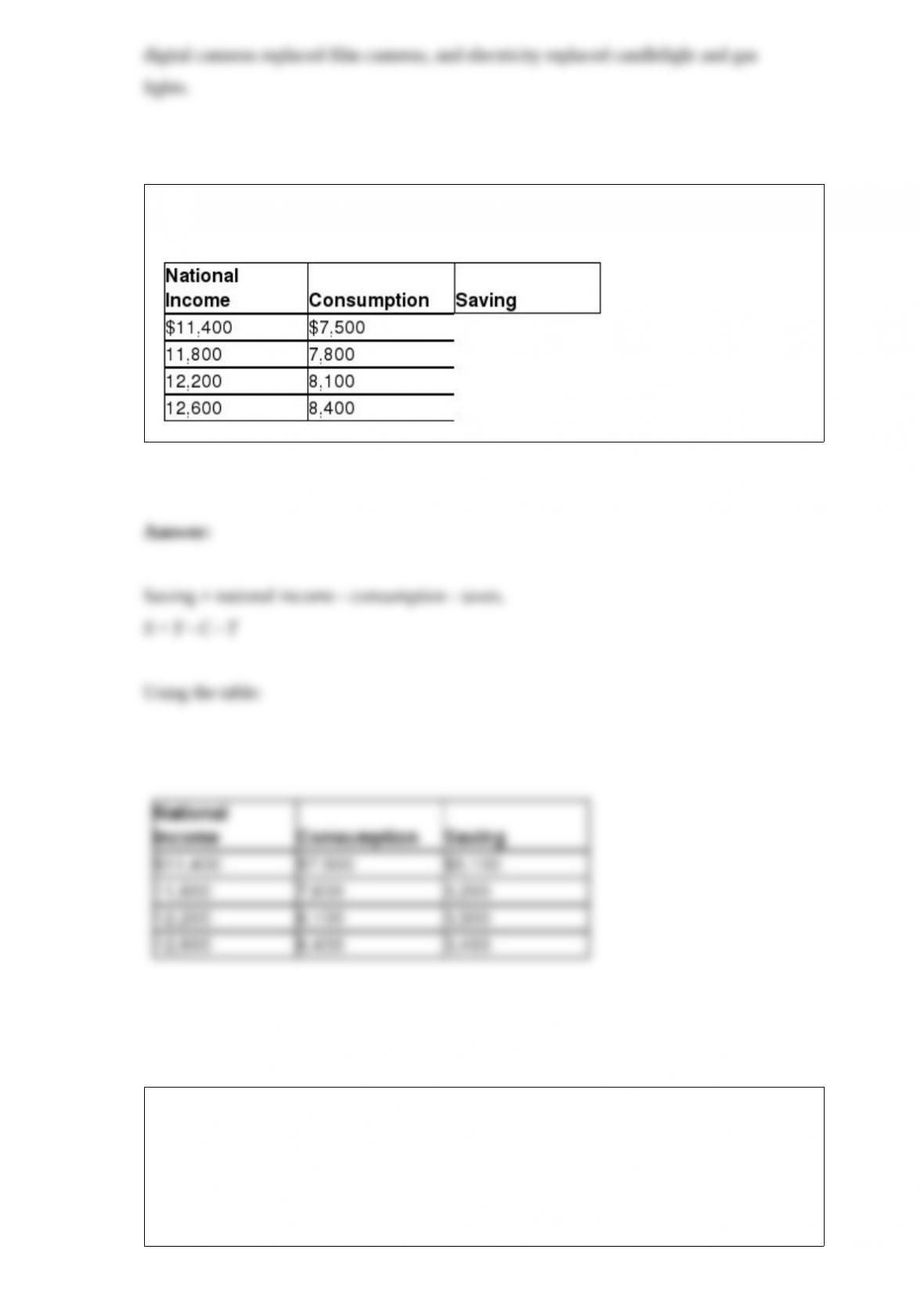
Given Table 12-6 below, fill in the values for saving. Assume taxes = $800.
Table 12-6
Your friend owns a snow cone stand that he works by himself. He produces about 25
snow cones per hour. He wants to be able to produce twice as many snow cones per
hour so he buys a second machine. He notices that he can only produce 10 more snow
cones an hour. He jokes that he could have doubled his output with the second machine
if he only had four hands. Using your knowledge of the production process, explain to
your friend what you think has happened when he added more capital to his production
process.
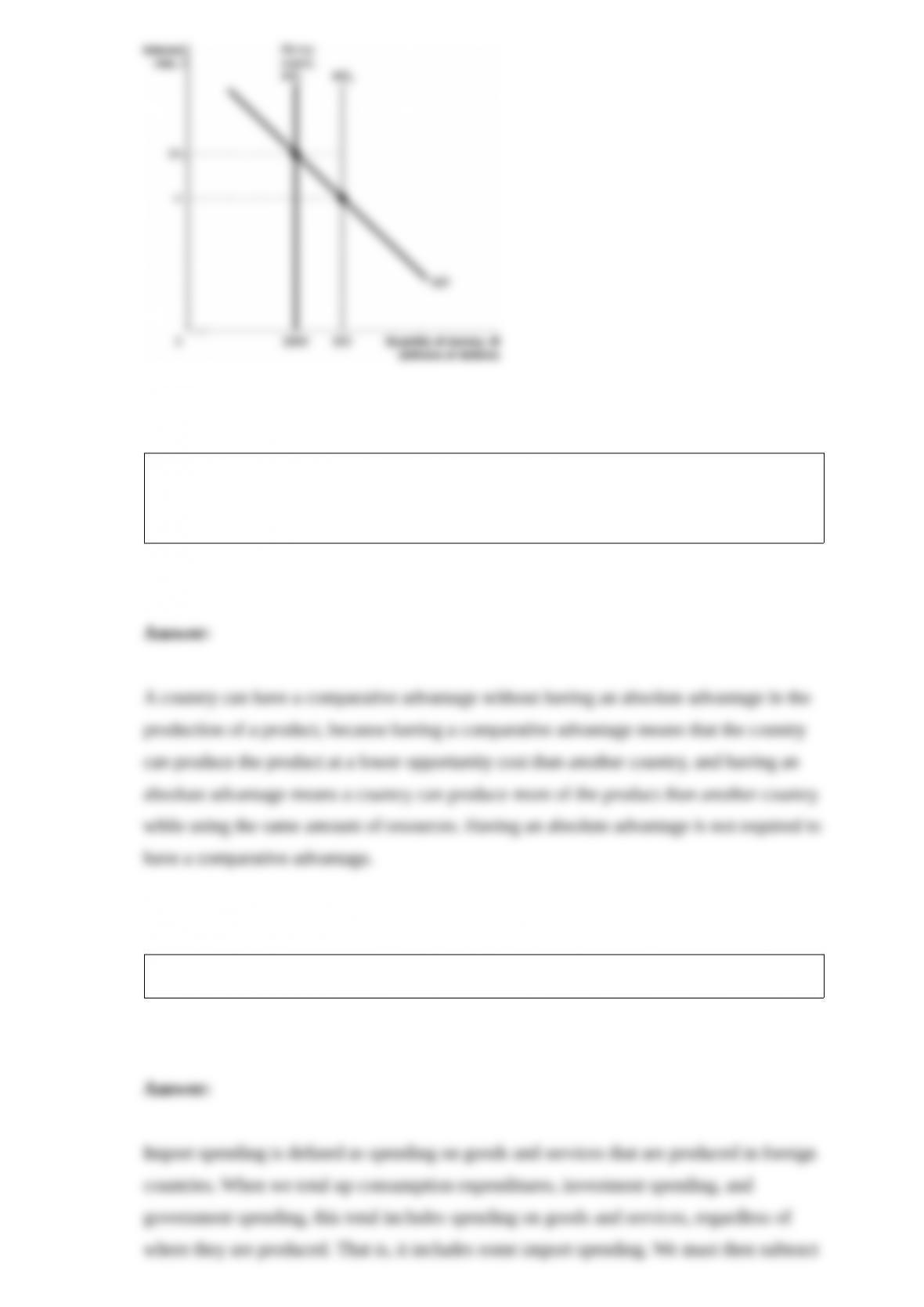
Use the money demand and money supply model to show the money market in
equilibrium with an interest rate of 5 percent and the quantity of money of $800 billion.
Suppose the Federal Reserve increases the money supply to $850 billion. At the
previous equilibrium interest rate of 5 percent, will households and firms now be
holding more money or less money than they want to hold, and will they be buying or
selling short-term financial assets? At the new equilibrium interest rate, households and
firms will desire to hold the entire $850 billion of the money supply. What causes
households and firms to want to hold the additional $50 billion of the money supply?
Explain whether it is possible for a country to have a comparative advantage in the
production of a product without having an absolute advantage in the production of that
product.
Why do we subtract import spending from total expenditures?
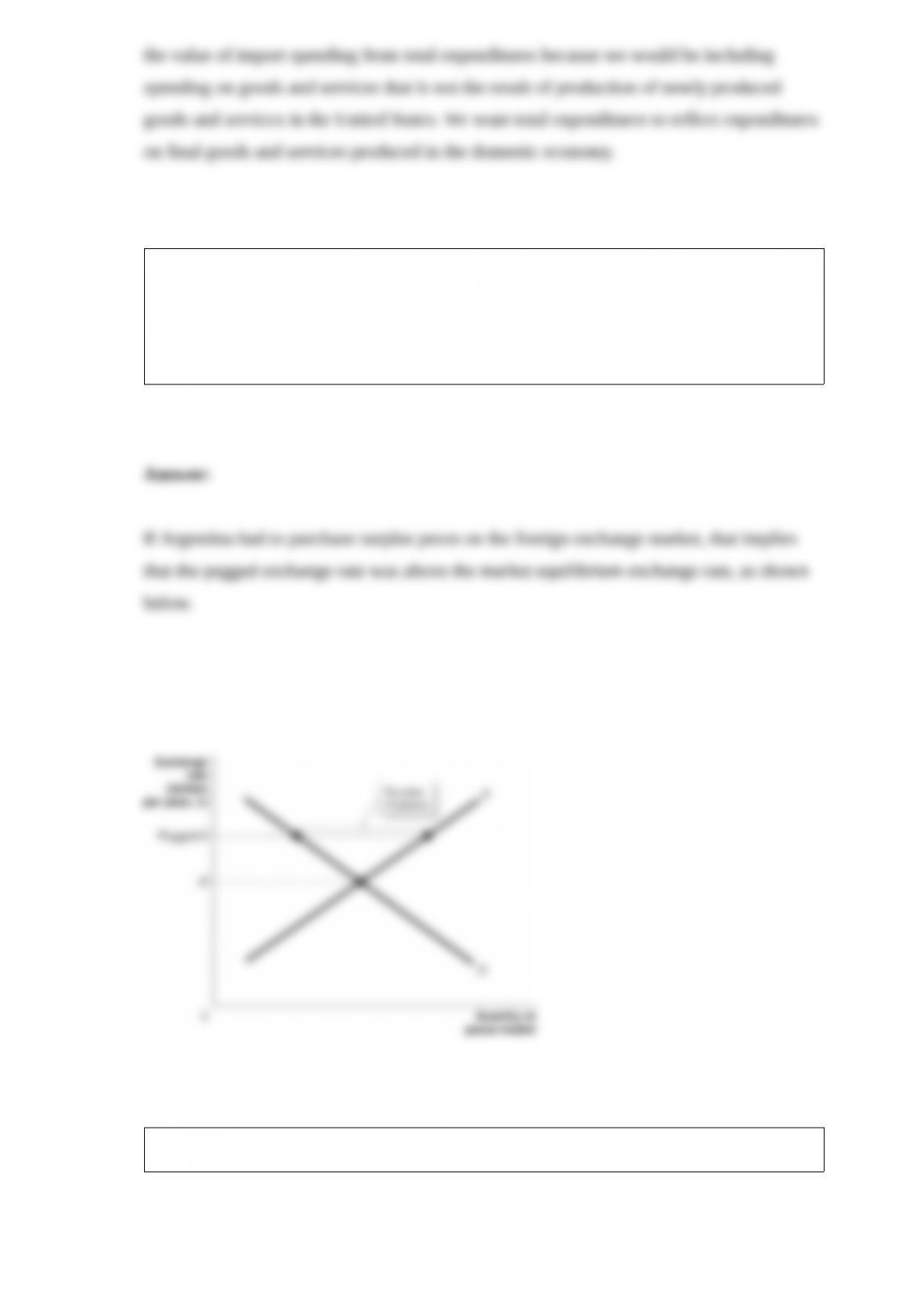
In 1991, Argentina decided to peg its currency (the Argentinean peso) to the U.S. dollar.
To maintain the peg, Argentina had to purchase surplus pesos on the foreign exchange
market, depleting its reserves of dollars to such an extent that it eventually had to
abandon the peg. Show graphically what this implies about the peg relative to the
equilibrium exchange rate in the market for the Argentinean peso.
If the value added of a firm is positive, will the firm necessarily have positive profits?