
The federal funds rate is
A) the interest rate the Fed charges commercial banks.
B) the interest rate a bank charges its best customers.
C) the interest rate banks charge each other for overnight loans.
D) the interest rate on a Treasury Bill.
An ________ is represented by a rightward shift of the demand curve while an
________ is represented by a movement along a given demand curve.
A) increase in demand; decrease in demand
B) increase in demand; increase in quantity demanded
C) decrease in demand; decrease in quantity demanded
D) increase in quantity demanded; increase in demand
if government spending and the price level increase, then
A) the interest rate increases, consumption declines, and investment spending declines.
B) the interest rate decreases, consumption declines, and investment spending declines.
C) the interest rate increases, consumption increases, and investment spending
increases.
D) the interest rate decreases, consumption increases, and investment spending
increases.
Actions taken by investors who sell a country’s currency in anticipation of buying it
back later at a lower price is known as
A) purchasing power parity.
B) currency arbitrage.
C) destabilizing speculation.
D) exchange rate manipulation.
Which of the following is not a reason why the wages of workers and the prices of
inputs rise more slowly than the prices of final goods and services?
A) Contracts make prices and wages ‘sticky.”
B) Firms are often slow to adjust wages.
C) Menu costs make some prices sticky.
D) Unions are successful in pushing up wages.
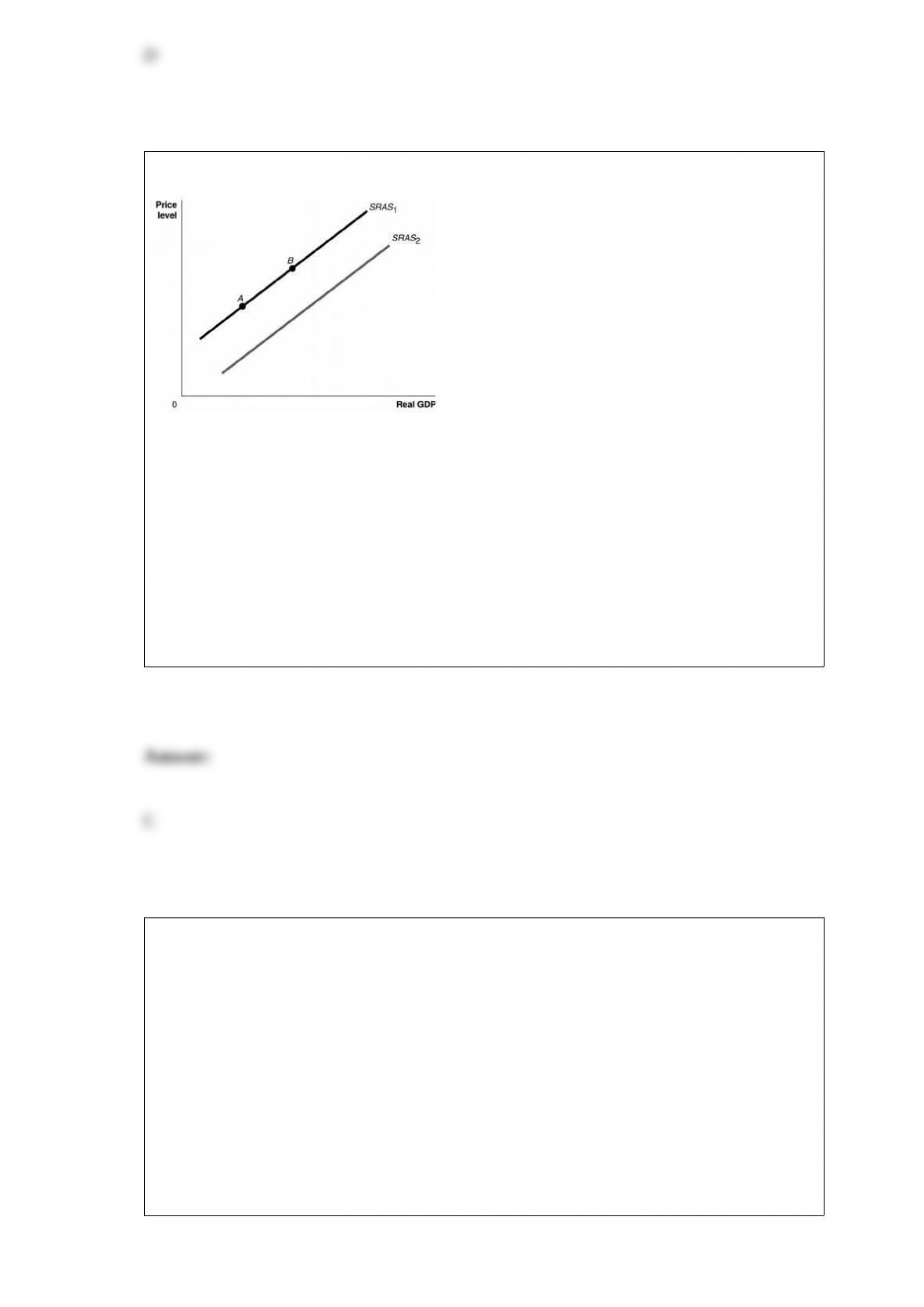
Figure 13-2
Refer to Figure 13-2. Ceteris paribus, an increase in the price level would be
represented by a movement from
A) SRAS1 to SRAS2.
B) SRAS2 to SRAS1.
C) point A to point B.
D) point B to point A.
Deadweight loss refers to
A) the opportunity cost to firms from producing the equilibrium quantity in a
competitive market.
B) the sum of consumer and producer surplus.
C) the loss of economic surplus when the marginal benefit equals the marginal cost of
the last unit produced.
D) the reduction in economic surplus resulting from not being in competitive
equilibrium.

From an initial long-run equilibrium, if aggregate demand grows more slowly than
long-run and short-run aggregate supply, then Congress and the president would most
likely
A) increase the required reserve ratio and decrease government spending.
B) decrease government spending.
C) decrease oil prices.
D) decrease taxes.
E) lower interest rates.
According to the production possibility model, if more resources are allocated to the
production of physical and human capital, then all of the following are likely to happen
except
A) fewer goods will be produced for consumption today.
B) the production possibilities frontier will be shift outward in the future.
C) future economic growth is enhanced.
D) the country’s total production will fall.

When Tesla, a U.S. company, purchases Italian-made Pirelli tires for its automobiles,
the purchase is
A) both a U.S. and an Italian import.
B) a U.S. import and an Italian export.
C) a U.S. export and an Italian import.
D) neither an export nor an import for either country.
An increase in aggregate expenditure has what result on equilibrium GDP?
A) Equilibrium GDP rises.
B) Equilibrium GDP is not affected by a decrease in aggregate expenditure.
C) Equilibrium GDP falls.
D) Equilibrium GDP may rise or fall depending on the size of the decrease in aggregate
expenditure relative to the initial level of GDP.
Table 8-3
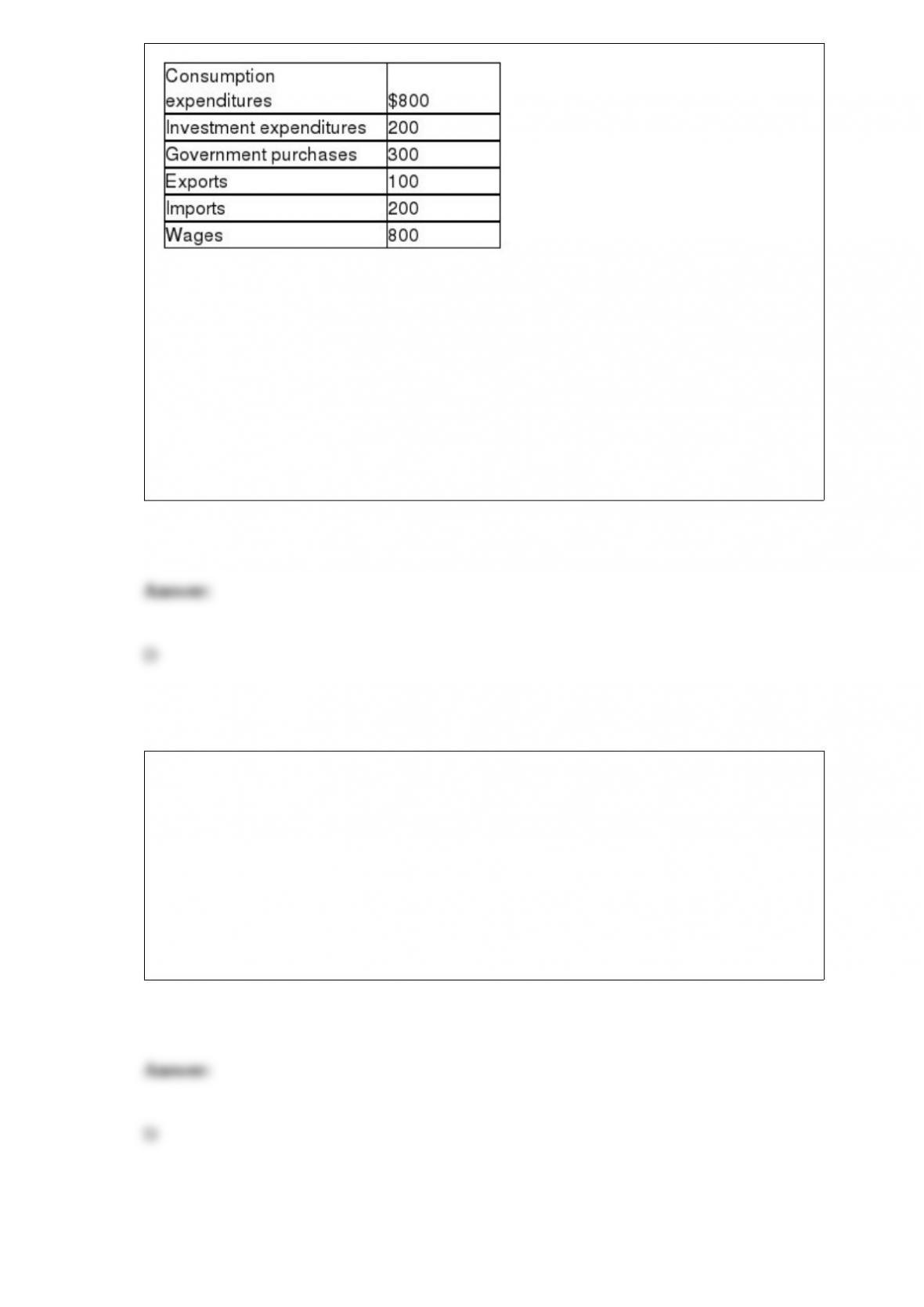
Refer to Table 8-3. Consider the data above (in billions of dollars) for an economy:
Gross domestic product (in billions of dollars) for this economy equals
A) $2,200.
B) $1,600.
C) $1,400.
D) $1,200.
Which is the smallest component of aggregate expenditure?
A) planned investment expenditures
B) consumption expenditures
C) government expenditures
D) net export expenditures

The short-run aggregate supply curve has a
A) negative slope.
B) positive slope.
C) slope equal to infinity.
D) slope equal to zero.
If Ebenezer Scrooge spends rather than saves his vast wealth, he will
A) slow economic growth because he is reducing the amount of funds available for
investment.
B) slow economic growth because he is increasing the amount of funds available for
investment.
C) promote economic growth because he is increasing the amount of funds available for
investment.
D) promote economic growth because he is decreasing the amount of funds available
for investment.
Figure 13-4
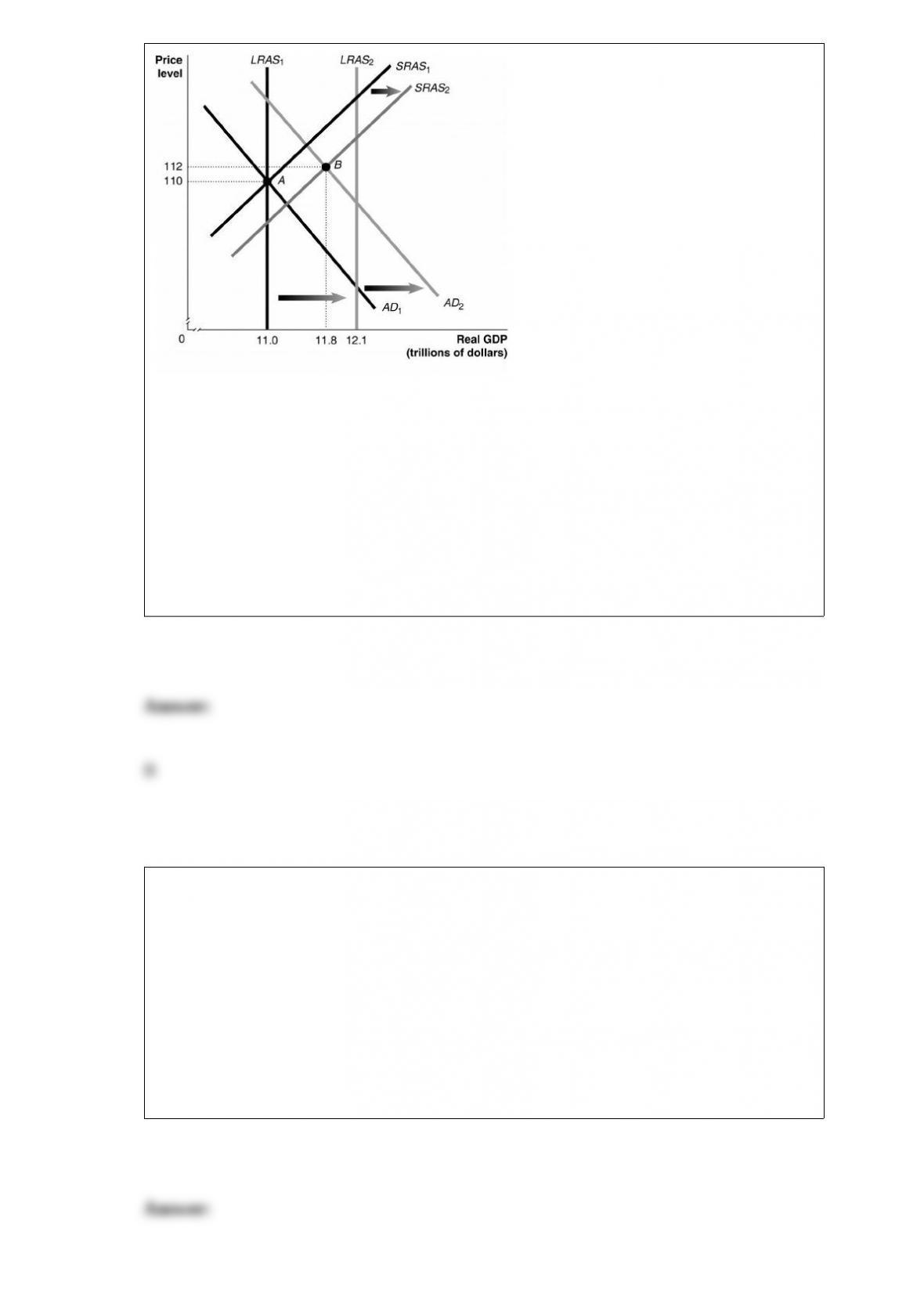
Refer to Figure 13-4. Given the economy is at point A in year 1, what is the inflation
rate between year 1 and year 2?
A) 0.9%
B) 1.8%
C) 2.7%
D) 3.0%
Expansionary monetary policy will have what effect on the components of aggregate
demand?
A) Consumption, investment, and net exports will rise.
B) Consumption and investment will rise, but net exports will fall.
C) Consumption will rise, but investment and net exports will fall.
D) Consumption will fall, but investment and net exports will rise.
Scenario 8-1
CANOES-R-US makes canoes. It buys the shell of the canoe from another firm for
$300 and uses its labor and intermediate goods to make the canoe. It sells the finished
canoe to a retail canoe store for $800. The retail canoe store then sells the canoe to a
consumer for $1,200.
Refer to Scenario 8-1. The value of each canoe in gross domestic product equals
A) $1,200.
B) $800.
C) $500.
D) $400.