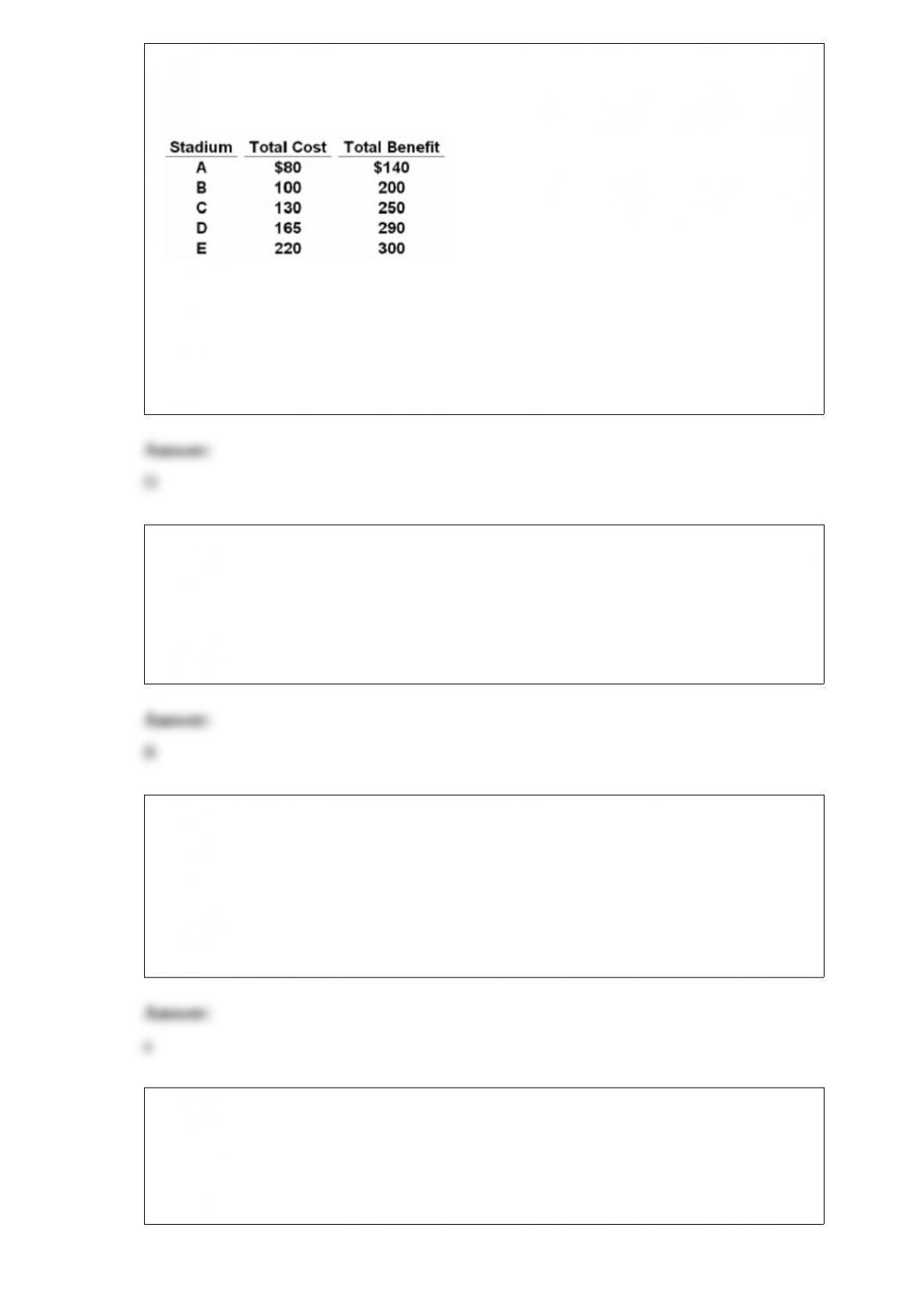
1) The following table shows the total costs and total benefits facing a city of five
different potential baseball stadiums of increasing size. All figures are in millions of
dollars.
Refer to the above table. The marginal cost and marginal benefit of stadium B (relative
to A) are:
A.$20 million and $50 million, respectively.
B.$100 million and $200 million, respectively.
C.$30 million and $50 million, respectively.
D.$20 million and $60 million, respectively.
2) Which of the following will not shift the demand curve for labor?
A.the use of a larger stock of capital with the labor force
B.a change in the wage rate
C.an increase in the price of the product which labor is helping to produce
D.the adoption of a more efficient method of combining labor and capital in the
production process
3) trade adjustment assistance:
a.helps worker dislocated by international trade without erecting barriers that impede
foreign trade.
b.subsidizes new firms trying to compete in international markets.
c.protects domestic jobs by reducing imports.
d.establishes a series of gradually loosened import quotas so that domestic firms have
time to improve their international competitiveness or transition to new markets.
4) The parity ratio:
A.compares worker productivity in the farm and nonfarm sectors.
B.is the ratio of per capita farm income to per capita nonfarm income.
C.is the ratio of prices received by farmers to prices paid by farmers.
D.is the ratio of prices paid by farmers to prices received by farmers.
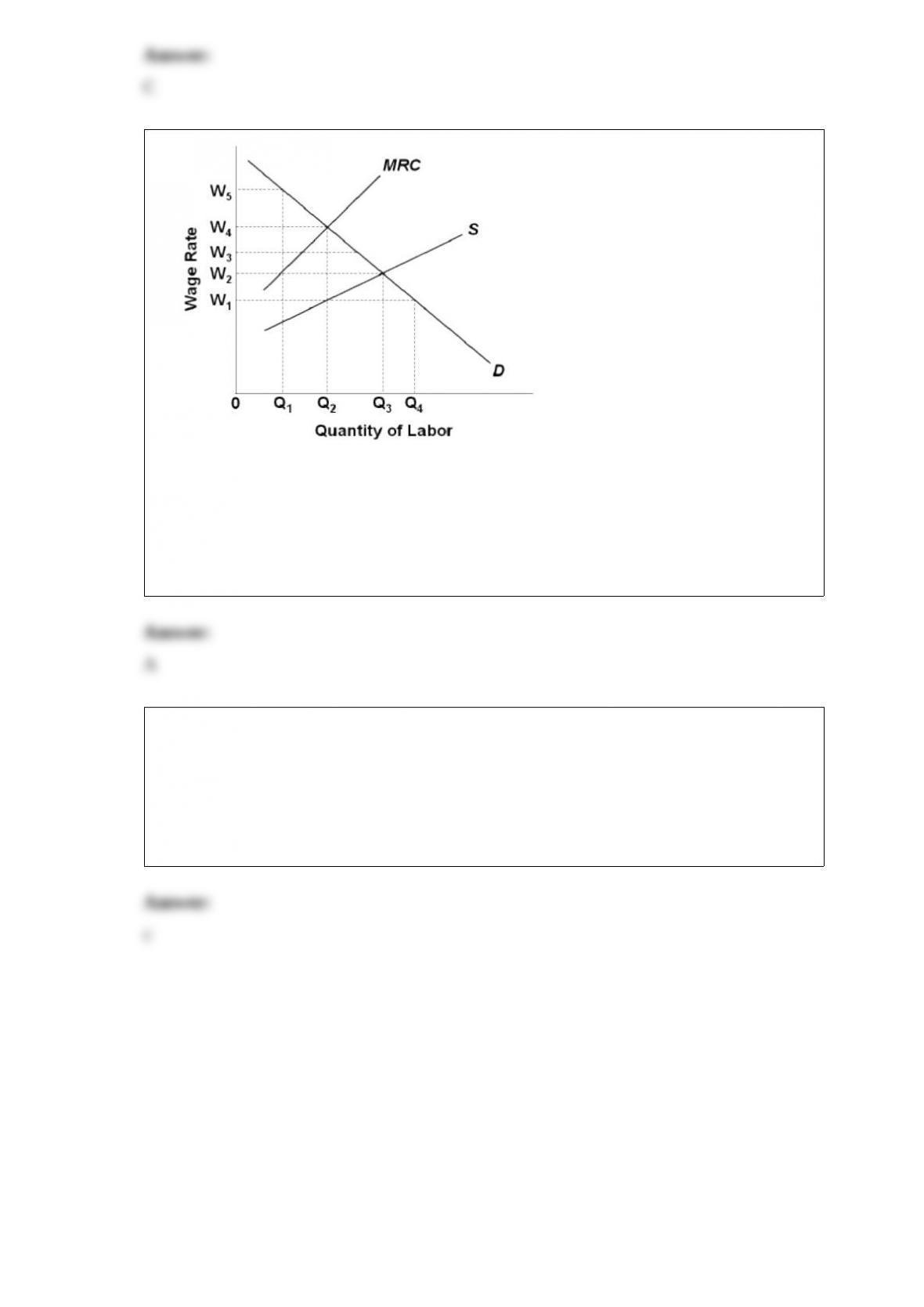
5)
Refer to the above diagram. An industrial (inclusive) union could increase employment
in this labor market:
A.by negotiating any wage rate between W1 and W4.
B.by negotiating a wage rate greater than W4.
C.only if it accepted a wage rate below W1.
D.only if it could shift the labor demand curve rightward.
6) consumer sovereignty refers to the:
a.fact that resource prices are higher than product prices in capitalistic economies.
b.idea that the pursuit of self-interest is in the public interest.
c.idea that the decisions of producers must ultimately conform to consumer demands..
d.fact that a federal agency exists to protect consumers from harmful and defective
products.
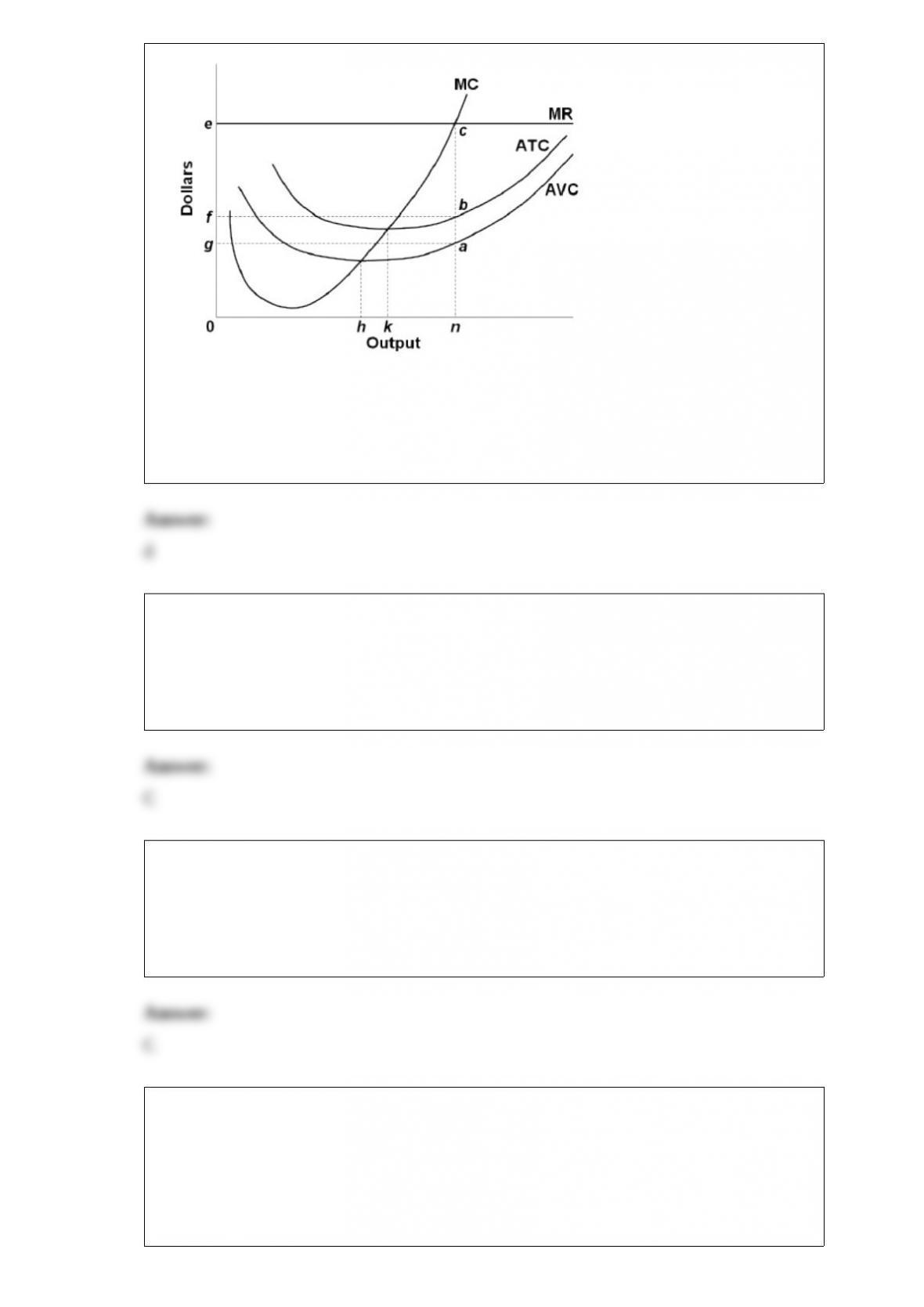
7)
refer to the above diagram. the short-run supply curve for this firm is the:
a.entire mc curve.
b.segment of the avc curve lying to the right of the mc curve.
c.segment of the mc curve lying to the right of output level k
d.segment of the mc curve lying to the right of output level h
8) The real wage will rise if the nominal wage:
A.falls more rapidly than the general price level.
B.increases at the same rate as labor productivity.
C.increases more rapidly than the general price level.
D.falls at the same rate as the general price level.
9) The transactions demand for money will shift to the:
A.right when the interest rate increases.
B.left when the interest rate decreases.
C.right when aggregate income increases.
D.right when aggregate income decreases.
10) according to economist donald boudreaux, the world’s tens of billions of individual
resources get arranged productively:
a.because government has become highly effective at central planning.
b.because private property encourages people to consider the alternative uses of their
resources and select those that provide the most rewards.
c.because people tend to be creative and orderly.

d.through random trial and error.
11) Productive inputs that are actually or virtually fixed in supply are known as:
A.renewable natural resources.
B.natural capital.
C.non-renewable natural resources.
D.alternative fuels.
12) aggregate u.s. health care spending in 2006 was about:
a.6 percent of domestic output.
b.12 percent of domestic output.
c.16 percent of domestic output.
d.20 percent of domestic output.
13) a major objection to creating a legal market for human organs is that such a market
would:
a.create a substantial surplus of unused organs.
b.increase the present shortage of organs.
c.commercialize human body parts and thus diminish the special nature of human life.
d.encourage healthier lifestyles to maintain saleable organs.
14) if you leave a football game at the end of the third quarter, you will avoid traffic and
get home more quickly. therefore, everyone should leave the game early. this assertion
illustrates the:
a.moral hazard problem.
b.adverse selection problem.
c.fallacy of limited decisions.
d.fallacy of composition.
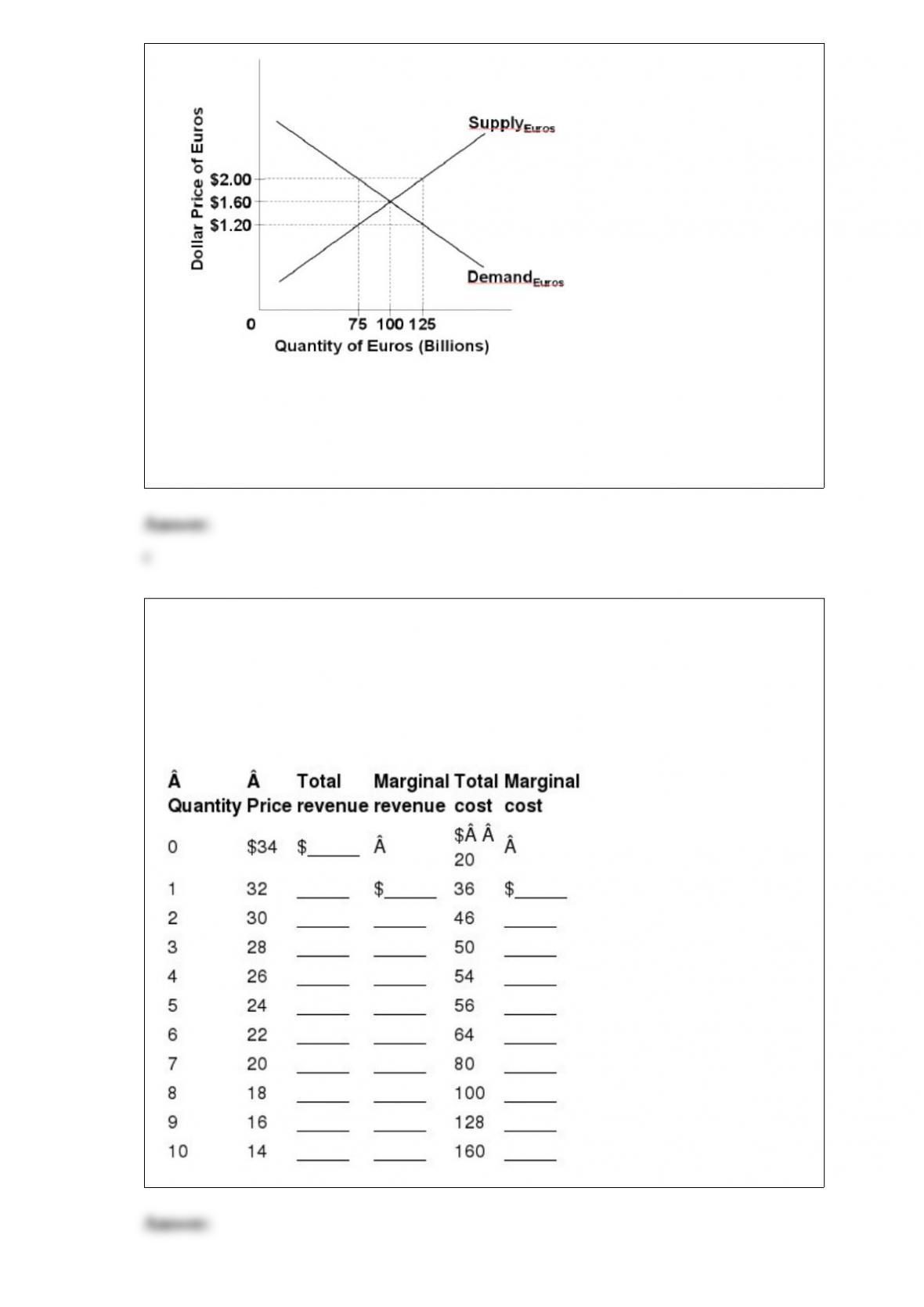
15)
refer to the above diagram. the equilibrium dollar price of euros is:
a.$0.625.
b.$1.20.
c.$1.60.
d.$2.00.
16) In the following table are demand and cost data for a pure monopolist. Complete
the table by filling in the columns for total revenue, marginal revenue, and marginal
cost. Answer these three questions: (a) What output will the monopolist produce? (b)
What price will the monopolist charge? (c) What total profit will the monopolist receive
at the profit-maximizing level of output?
17) education levels and crime rates are inversely related. this suggests that education:
a.is not subject to the exclusion principle.
b.entails external benefits.
c.creates a free-rider problem.
d.should be produced in the private sector.
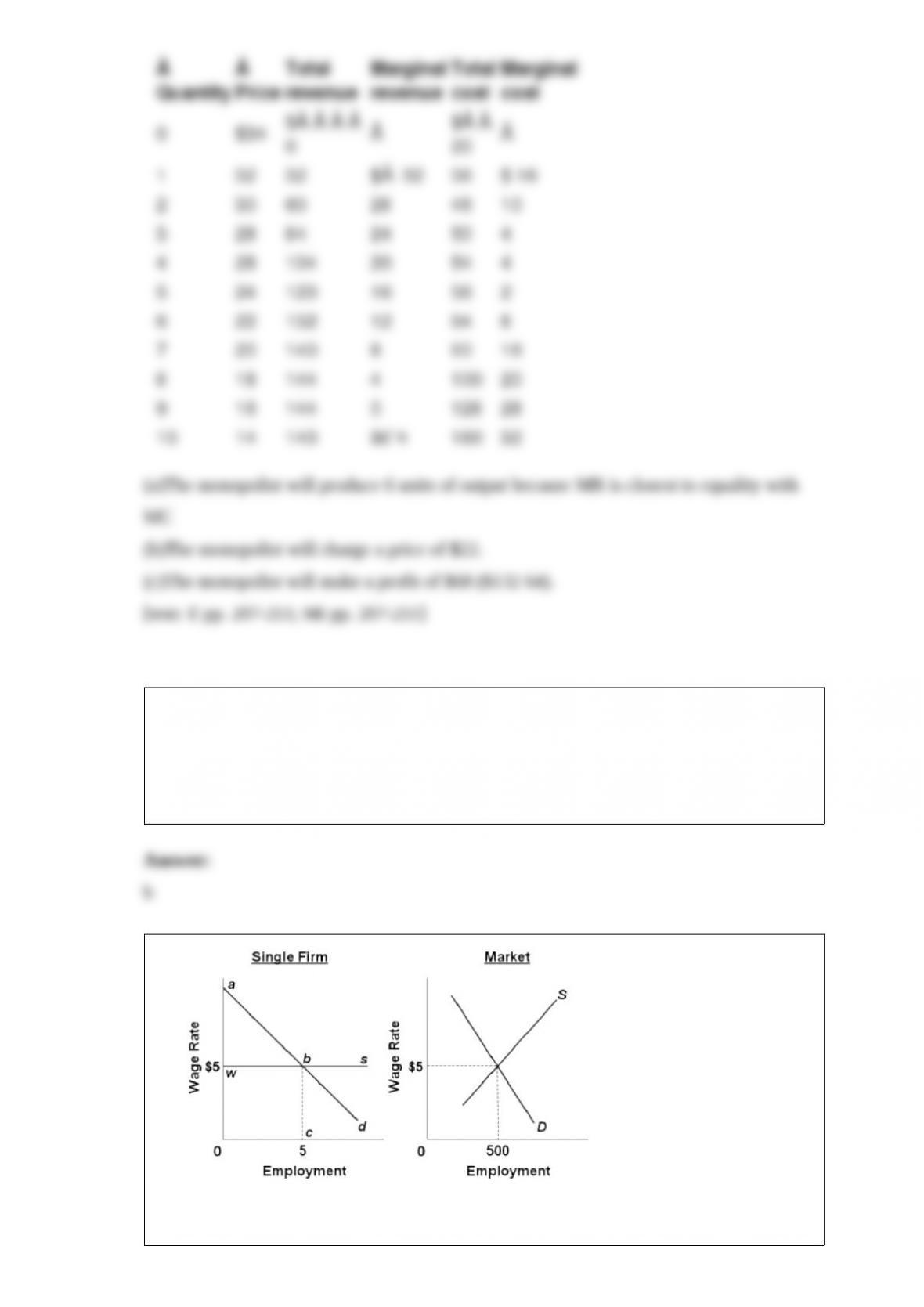
18)
Refer to the above diagrams. The firm:
A.has a principal-agent problem.

B.has a constant marginal resource cost of $5.
C.has a marginal resource cost that exceeds the wage rate for each worker.
D.will fail to maximize profits if it hires 5 workers.
19) which of the following is characteristic of a pure monopolist’s demand curve?
a.average revenue is less than price.
b.its elasticity coefficient is 1 at all levels of output.
c.price and marginal revenue are equal at all levels of output.
d.it is the same as the market demand curve.