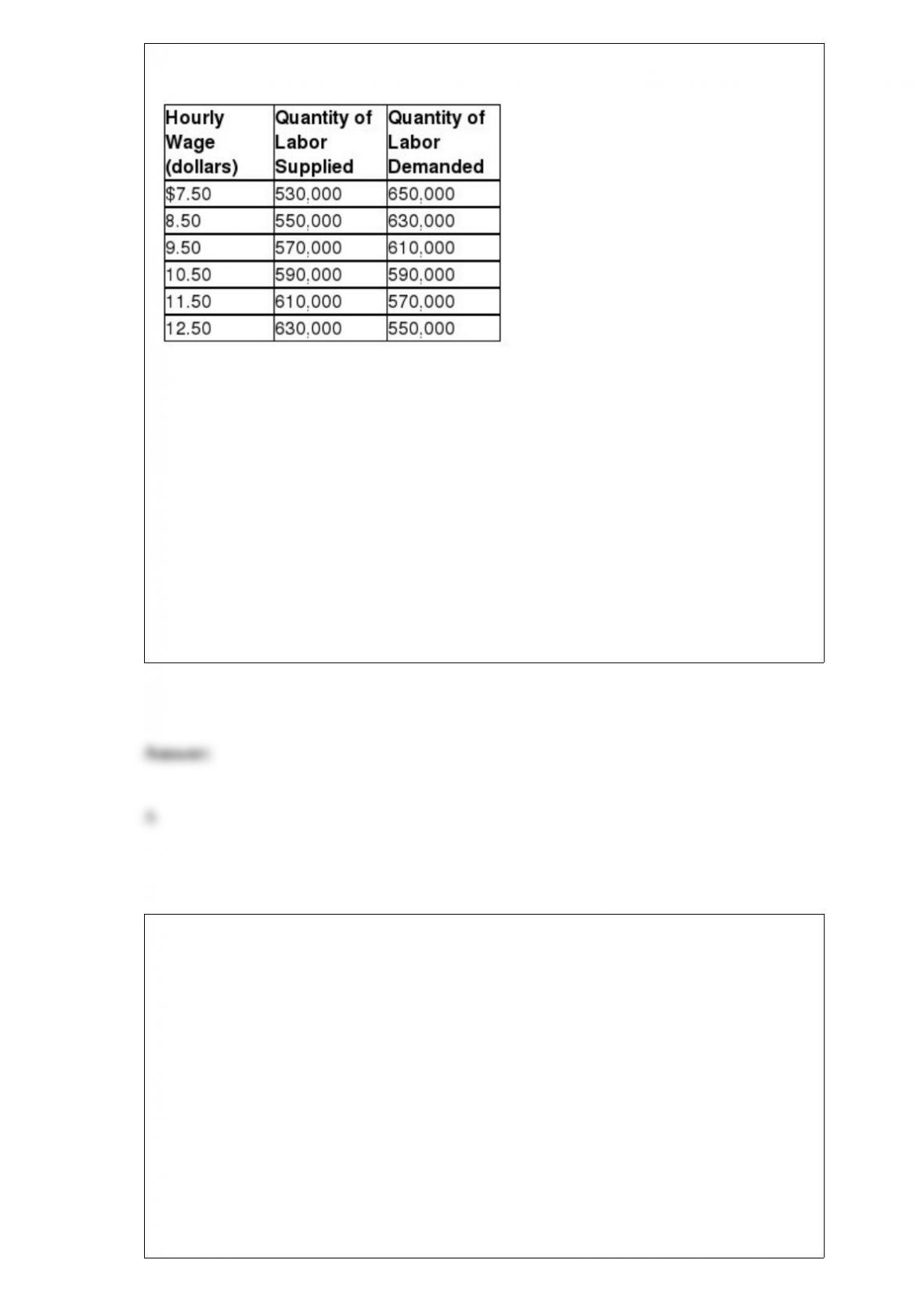
Table 4-7
Table 4-7 shows the demand and supply schedules for labor market in the city of Pixley.
Suppose that the quantity of labor demanded decreases by 80,000 at each wage level.
What are the new free market equilibrium hourly wage and the new equilibrium
quantity of labor?
A) W = $8.50; Q = 550,000
B) W = $12.50; Q = 630,000
C) W = $9.50; Q = 570,000
D) W = $9.50; Q = 590,000
The World Trade Organization (WTO) promotes foreign trade and investment, or
globalization. In recent years opposition to globalization has led to violent protests at
meetings of the WTO. All of the following are reasons for these anti-globalization
protests except
A) protestors believe the WTO favors the interests of high-income countries at the
expense of lower-income countries.
B) protesters believe that tariffs are needed to protect domestic firms from foreign
competition.
C) protesters believe that free trade destroys the distinctive cultures of many countries.
D) protesters object to the loss of intellectual property (such as software programs and
movies) that results from foreign trade and investment.
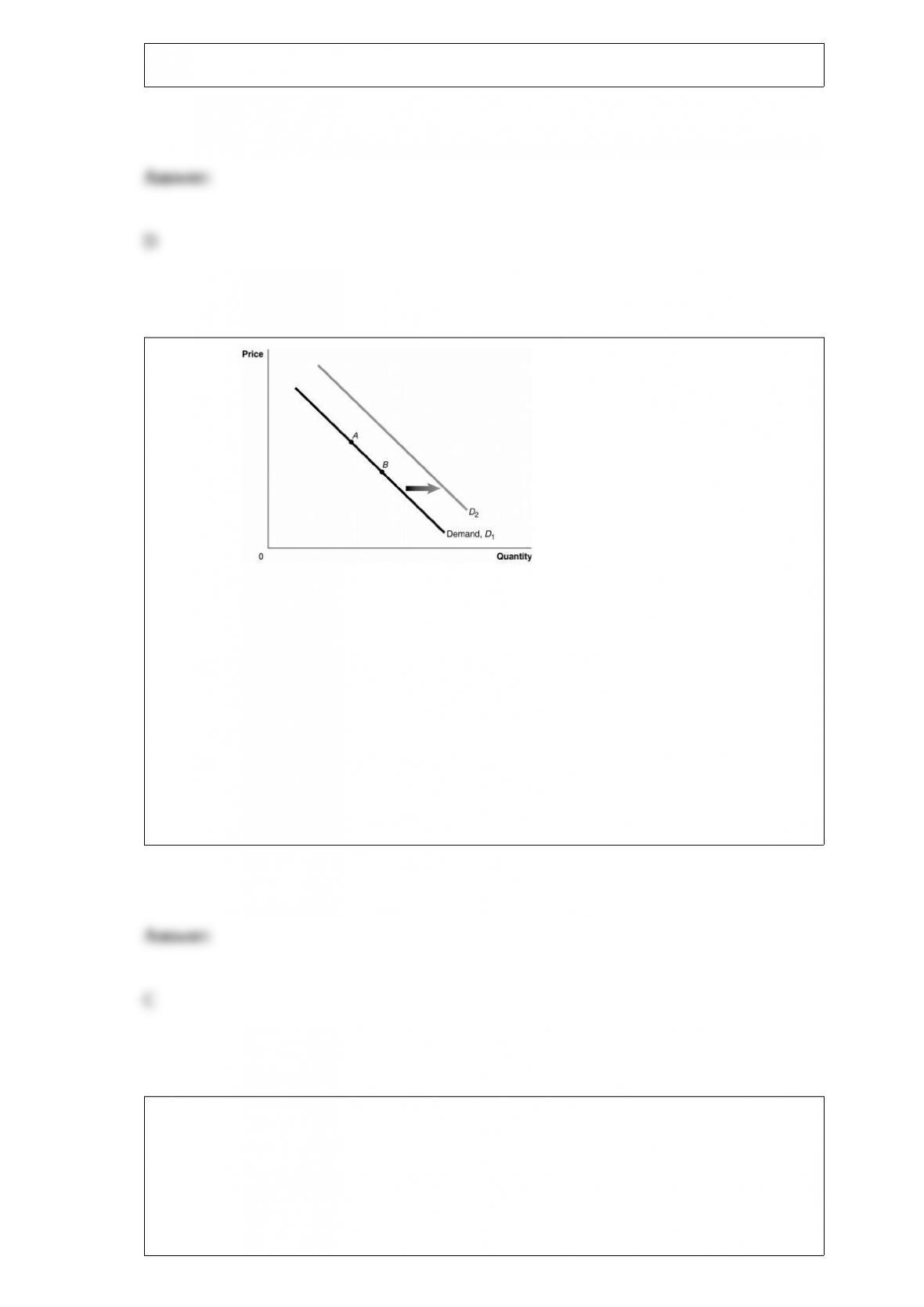
Figure 3-1
If the product represented is an inferior good, a decrease in income would be
represented by a movement from
A) A to B.
B) B to A.
C) D1 to D2.
D) D2 to D1.
What is the Difference between an “increase in supply” and an “increase in quantity
supplied”?
A) There is no Difference between the two terms; they both refer to a shift of the supply
curve.

B) There is no Difference between the two terms; they both refer to a movement along a
given supply curve.
C) An “increase in supply” means the supply curve has shifted to the right while an
“increase in quantity supplied” means at any given price supply has increased.
D) An “increase in supply” means the supply curve has shifted to the right while an
“increase in quantity supplied” refers to a movement along a given supply curve in
response to an increase in price.
All of the following are sources of comparative advantage except
A) climate and natural resources.
B) relative abundance of labor and capital.
C) a strong foreign currency exchange rate.
D) technology.
Figure 2-12
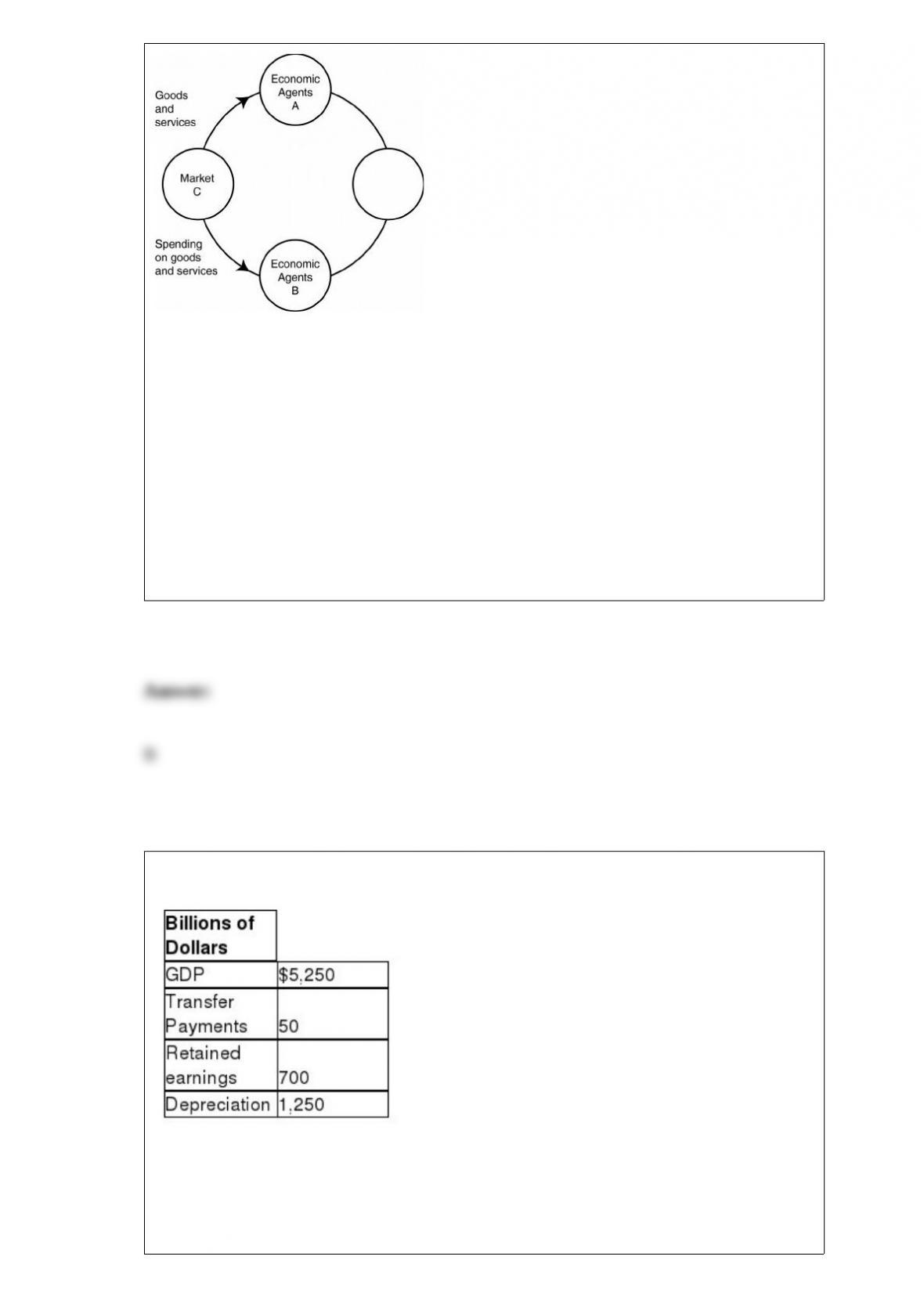
One segment of the circular flow diagram in the figure shows the flow of goods and
services from market C to economic agents A. What is market C and who are economic
agents A?
A) C = factor markets; A = households
B) C = product markets; A = households
C) C = factor markets; A = firms
D) C= product markets; A = firms
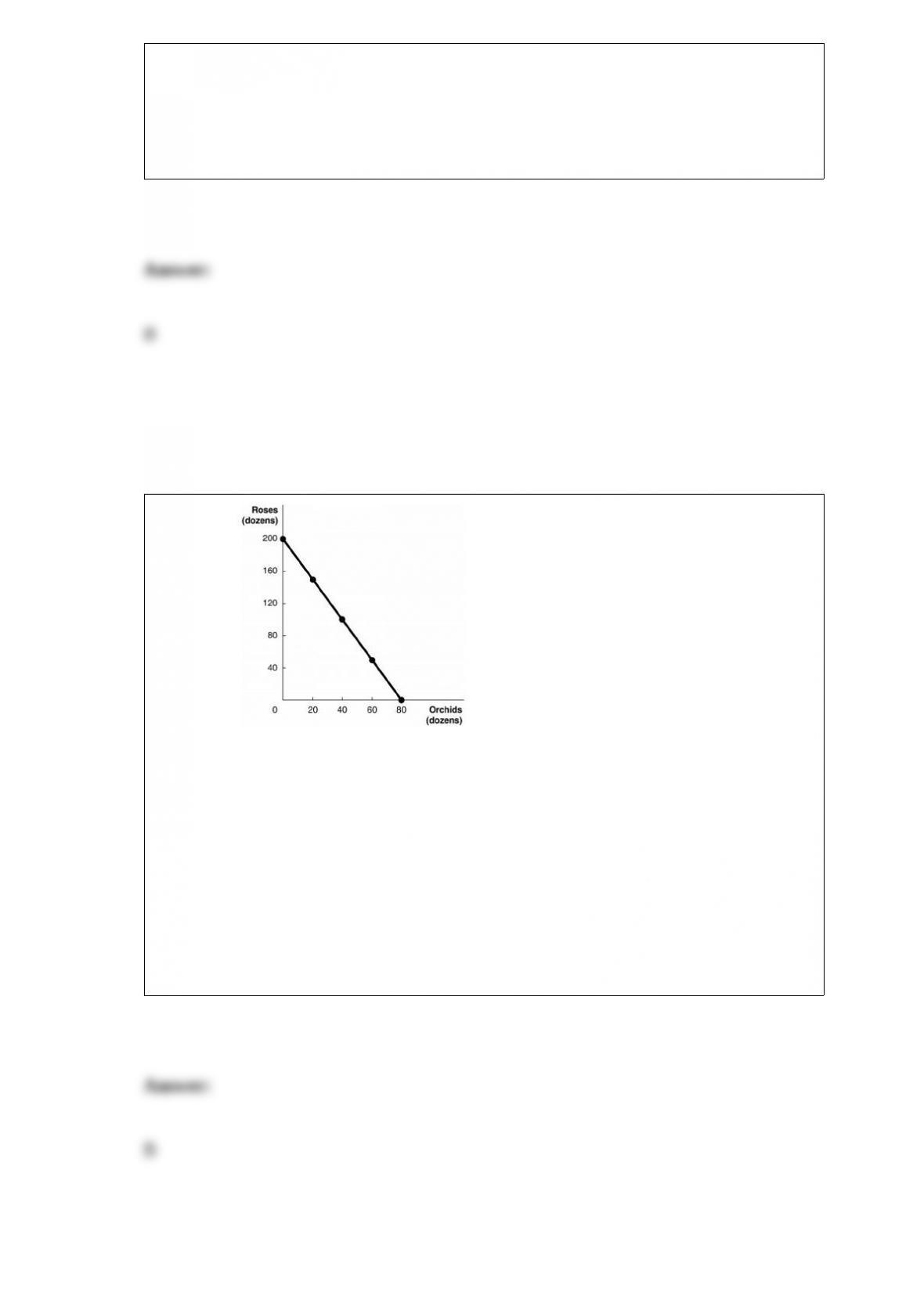
Table 19-29
Based on the table above, what is national income for this economy?
A) $4,700 billion
B) $4,000 billion
C) $3,150 billion
D) $2,450 billion
Figure 2-2 Figure 2-2 above shows the production
possibilities frontier for Vidalia, a nation that produces two goods, roses and orchids. If
Vidalia chooses to produce 80 dozen roses, how many orchids can it produce to
maximize production?
A) 24 dozen orchids
B) 48 dozen orchids
C) 60 dozen orchids
D) 74 dozen orchids

Which of the following displays these two characteristics: nonrivalry and excludability?
A) public goods
B) private goods
C) quasi-public goods
D) common resources
If tablet computers are considered substitutes for e-readers, the decline in the price of
tablet computers would, all else equal,
A) increase the demand for e-readers.
B) decrease the demand for e-readers.
C) increase the quantity demanded for e-readers.
D) decrease the quantity demanded for e-readers.
Today, ________ of Goodyear’s tire sales are in the North America.
A) only 11 percent
B) less than 40 percent
C) 65 percent
D) more than 80 percent

In the United States, corporate profits are taxed
A) only at the corporate level.
B) only when investors receive dividends.
C) at both the corporate level and when investors receive dividends.
D) neither at the corporate level nor when investors receive dividends.
Willingness to pay measures
A) the maximum price a buyer is willing to pay for a product minus the amount the
buyer actually pays for it.
B) the amount a seller actually receives for a good minus the minimum amount the
seller is willing to accept for the good.
C) the maximum price that a buyer is willing to pay for a good.
D) the maximum price a buyer is willing to pay minus the minimum price a seller is
willing to accept.

From an initial long-run macroeconomic equilibrium, if the Federal Reserve anticipated
that next year aggregate demand would grow significantly slower than long-run
aggregate supply, then the Federal Reserve would most likely
A) increase income tax rates.
B) decrease income tax rates.
C) increase interest rates.
D) decrease interest rates.
The price of a factor of production that is in fixed supply is called
A) economic rent.
B) economic profit.
C) a compensating differential.
D) opportunity cost.
Assume that emissions from electric utilities contribute to pollution in the form of acid
rain. Which of the following describes how this affects the market for electricity?
A) The equilibrium in the market is not efficient; the marginal benefit from electricity is
greater than the marginal social cost.

B) A deadweight loss occurs; at equilibrium the additional social cost of production is
greater than the additional benefit to consumers.
C) The equilibrium in the market is not efficient; because of the cost of the acid rain,
economic efficiency would be greater if more electricity were produced.
D) The equilibrium in the market is not efficient; consumer surplus is equal to producer
surplus.
Which of the following best explains why unemployment rates are higher in the
European economies than in the United States?
A) More Europeans go to school fulltime and are therefore not able to participate in the
labor market.
B) Unemployment benefits are more generous in Europe than in the United States.
C) Workers in Europe are less productive than workers in the United States.
D) European industries pay a lower wage rate than industries in the United States.
Which of the following is a characteristic of a monopoly?
A) It is easy for new firms to enter the market.
B) There is only one seller in the market.
C) The product is not unique.

D) The firm has no control over price.
The level of output at which all economies of scale have been exhausted is known as
A) constant returns to scale.
B) minimum efficient scale.
C) the economically efficient output level.
D) optimal economic size.
Assuming zero transaction cost, if your local grocer buys oranges at a low price from an
orchard and resells them to you at a higher price, then the grocer’s revenue minus costs
is known as
A) arbitrage profits.
B) transactions profits.
C) pure profits.
D) excess profits.